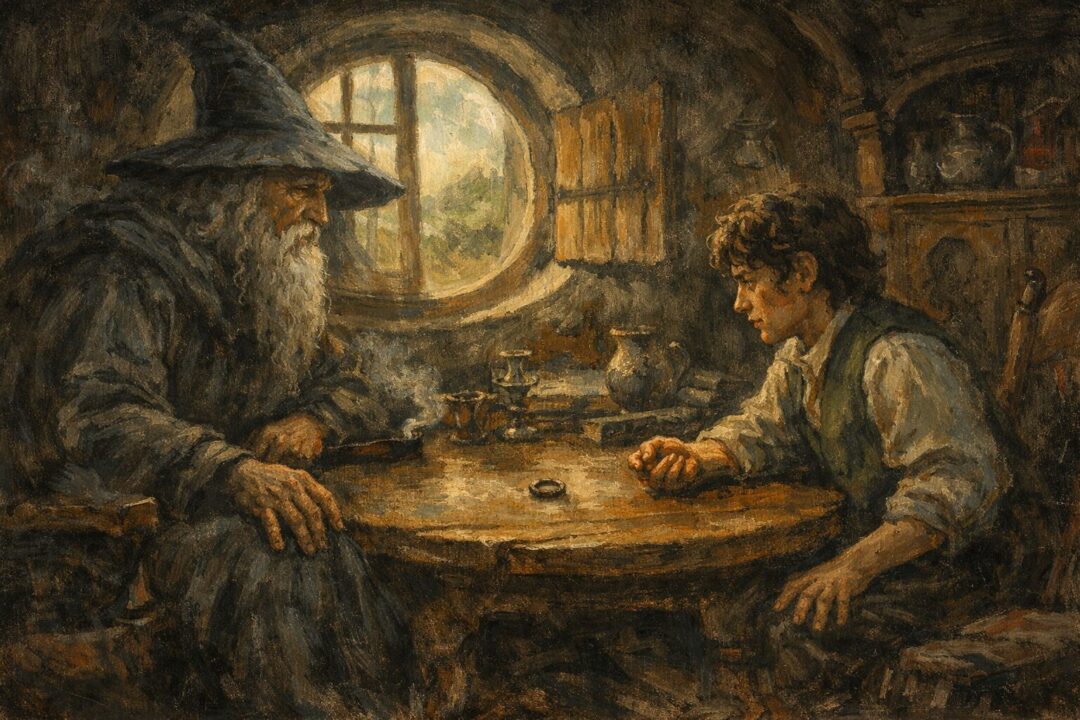
At first glance, the scene looks careless.
Gandalf comes to Bag End after years of doubt, searching, and grim confirmation. He tells Frodo the truth at last: Bilbo’s ring is the One Ring. The Enemy is moving. The Shire is no longer safe. The burden must be carried away. It is one of the most dangerous private conversations in the early chapters of The Fellowship of the Ring.
And then Sam Gamgee is found outside the window.
For many readers, that creates an immediate puzzle. Gandalf has just warned Frodo to be careful what he says, even to his closest friends, because the Enemy has many spies and many ways of hearing. If that is true, why reveal the secret in a place where Sam could so easily overhear?
The short answer is that the text does not show Gandalf knowingly delivering the secret to Sam.
What it shows is subtler than that. And once the wording is read carefully, the whole scene starts to look less like a blunder and more like a turning point.
The Text Does Not Show Gandalf Deliberately Including Sam
One detail matters immediately.
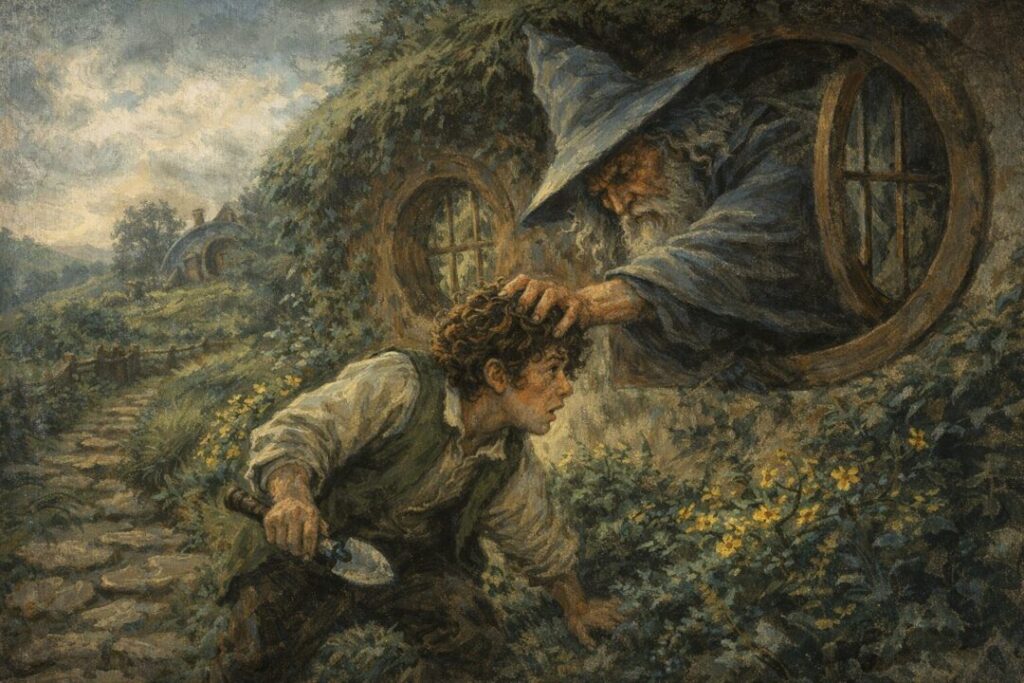
Before the final exchange, Gandalf goes to the window, draws aside the curtains and shutters, and sunlight comes back into the room. At that moment, Sam passes outside whistling. The text presents him as simply going by on the path. Gandalf then turns back to Frodo and continues speaking.
If the scene ended there, it might look as if Gandalf noticed Sam and went on talking anyway.
But that is not what the passage says next.
Instead, there is a long silence. Gandalf sits and thinks. Frodo stares into the fire. The conversation continues. Only later, after Gandalf has warned Frodo not to go alone and to choose any companion carefully, does he suddenly stop “as if listening.” Then he moves to the window, reaches out, and catches Sam.
That sequence matters.
The book does not say Gandalf knew all along that Sam had settled under the window and was listening to the most secret part of the talk. It shows him realizing it only at the end. That is an important difference. Based on the wording, the safest reading is that Gandalf did not intentionally reveal the Ring’s identity to Sam; he discovered the eavesdropping only when he heard or sensed it.
Sam Was Not Standing There by Accident
That still leaves another question.
Why Sam?
The later chapter A Conspiracy Unmasked gives the answer. Merry reveals that Frodo’s friends had already formed a quiet conspiracy around him. They had guessed that he meant to leave the Shire, suspected danger tied to Bilbo’s legacy, and had been gathering information for some time. Sam, because he was closest to Frodo, served as their “chief investigator.” Merry says Sam collected a great deal before he was “finally caught.”
That means the Bag End incident is not really a case of one gardener wandering by at exactly the wrong moment.
Sam was already watching, already listening, and already trying to protect Frodo in the only way he knew how. His eavesdropping is comic on the surface, but the book later reclassifies it. It was part of a larger pattern of loyalty.
This is crucial because it changes how Gandalf’s reaction should be read.
He does not uncover an enemy spy.
He uncovers Frodo’s most faithful servant and friend, already drawn into the danger.
Gandalf’s Response Is Not Panic, but Judgment
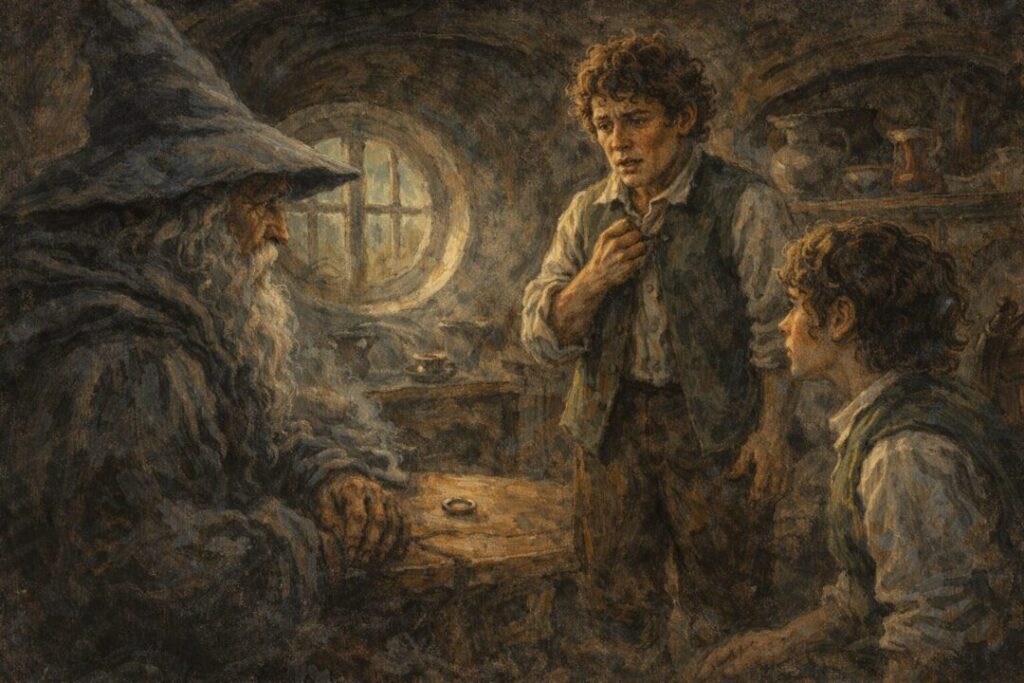
When Gandalf catches Sam, the moment begins as comedy. Sam protests that he was only trimming the grass-border under the window. He blurts out that he heard a good deal about a Ring, a Dark Lord, and the end of the world. He fears being turned into something unnatural. The tone briefly breaks the tension.
But Gandalf’s decision is serious.
He says he has thought of something better than punishing Sam. Sam shall go with Frodo. And Sam’s reaction is immediate joy, not reluctance.
The point is easy to miss because the scene is funny. Gandalf is not merely improvising a whimsical penalty. He has just told Frodo that he should not go alone if he knows anyone he can trust, but that he must be careful in choosing such a companion. Then he finds Sam under the window — frightened, nosy, indiscreet, but wholly devoted. The placement is too exact to ignore. The text strongly suggests that Gandalf’s judgment is made in that instant: this hobbit is trustworthy enough to be bound to the road.
That is still not the same as saying Gandalf planned the whole moment in advance. The book does not say that. But it does show him turning an awkward breach of secrecy into a deliberate choice.
Why Gandalf Does Not Treat Sam as a Security Failure
If secrecy mattered so much, why not send Sam away and lock the matter down?
Because by the time Sam is caught, simple ignorance is no longer possible.
Sam has heard enough to know that Frodo faces some great darkness. He has heard about the Ring and the Dark Lord. The safer course is not to pretend he knows nothing. The safer course is to place him under direction. Gandalf’s solution does exactly that. It binds Sam to Frodo openly rather than leaving him half-informed and outside the plan.
There is another layer, too.
Gandalf is one of the best judges of character in the story, but he is not omniscient in the practical sense. He often works by discernment: reading courage, pity, humility, stubbornness, and truthfulness in others. What he sees in Sam is not stealth or wisdom. It is love. Sam is terrified, but his first deep desire is still to stay near Frodo and, famously, to see Elves. Even in this clumsy moment, he reveals the qualities that define him through the rest of the journey: loyalty, simplicity, and a heart not bent toward power.
So Gandalf does not conclude that Sam is dangerous because he overheard.
He concludes that Sam is exactly the sort of hobbit who must not be left behind.
The Scene Foreshadows Sam’s True Place in the Story
Read backward from the end of the quest, the Bag End scene becomes even richer.
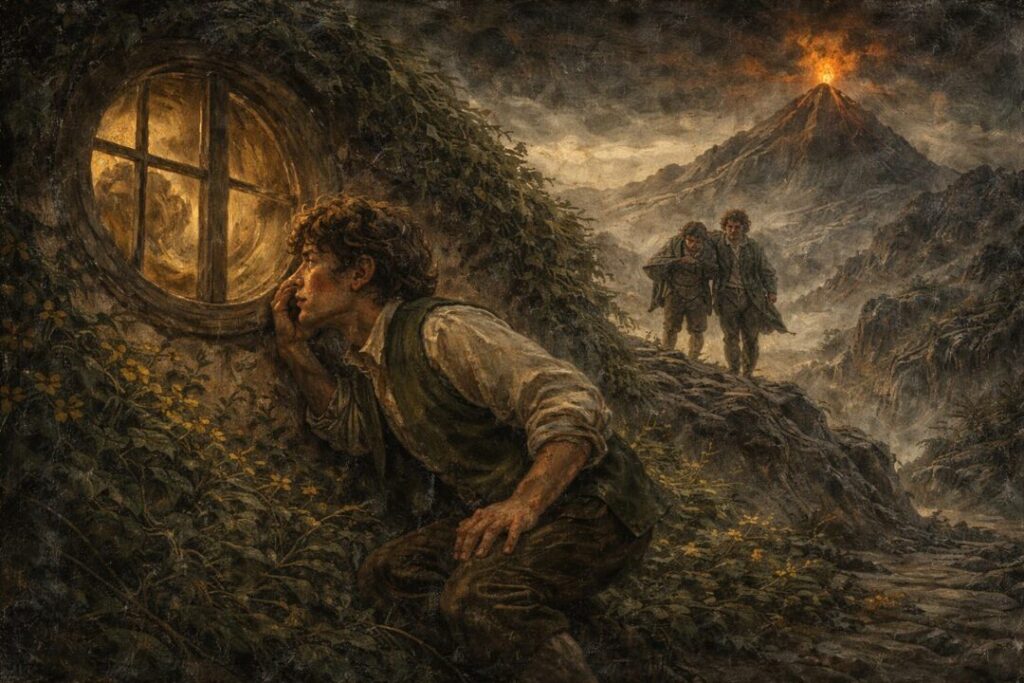
Sam is the companion who never truly leaves Frodo. He is the one who endures the long road into Mordor, carries provisions, resists despair, bears the Ring briefly without surrendering to it, and finally carries Frodo himself up the slopes of Orodruin. None of that is visible yet in Bag End. But the first movement is already there: Sam is the one who listens at the edge of the secret, is caught there, and is drawn inward rather than cast out.
That matters because the chapter is not only about the unveiling of the Ring.
It is also about the first shaping of companionship. Frodo receives the burden, but almost immediately the story begins arranging the persons who will help him bear it. Sam enters not through grandeur, wisdom, or noble birth, but through devotion. That is entirely consistent with the moral pattern of the book.
So Why Did Gandalf Reveal the Secret Where Sam Could Hear?
Strictly speaking, the books do not say that he meant to.
That is the key point.
The text supports a more careful answer: Gandalf did not knowingly sit down to reveal the One Ring to Frodo while Sam was deliberately included outside the window. Rather, Sam was already nearby and later lingered to listen; Gandalf appears to notice only near the end, stops at once, and catches him. Then, instead of treating the breach as ruinous, he judges Sam’s character and brings him into Frodo’s company.
In other words, the scene is not really about Gandalf being careless.
It is about Gandalf recognizing, almost at the moment of discovery, that Sam is not the wrong person to hear the truth.
He is the indispensable one.
And once that is seen, the whole episode stops looking like a small inconsistency in the handling of secrecy. It starts looking like one of the earliest signs that the fate of the Ring will depend not only on wisdom and power, but on the quiet fidelity of someone kneeling in the grass outside Bag End.
Sources & Notes
- J.R.R. Tolkien, The Lord of the Rings, Book I, Chapter 2, “The Shadow of the Past” — the Bag End scene: Gandalf warns Frodo about secrecy, then catches Sam listening and assigns him to go with Frodo.
- J.R.R. Tolkien, The Lord of the Rings, Book I, Chapter 5, “A Conspiracy Unmasked” — reveals that Merry, Pippin, Fatty, and Sam had already been watching Frodo, with Sam as their chief informant.
- J.R.R. Tolkien, The Lord of the Rings, Book IV, Chapter 10, “The Choices of Master Samwise” — shows the depth of Sam’s fidelity when he takes up the burden after Frodo is struck down.
- J.R.R. Tolkien, The Lord of the Rings, Book VI, Chapter 3, “Mount Doom” — completes the pattern foreshadowed at Bag End, with Sam literally carrying Frodo near the end of the quest.