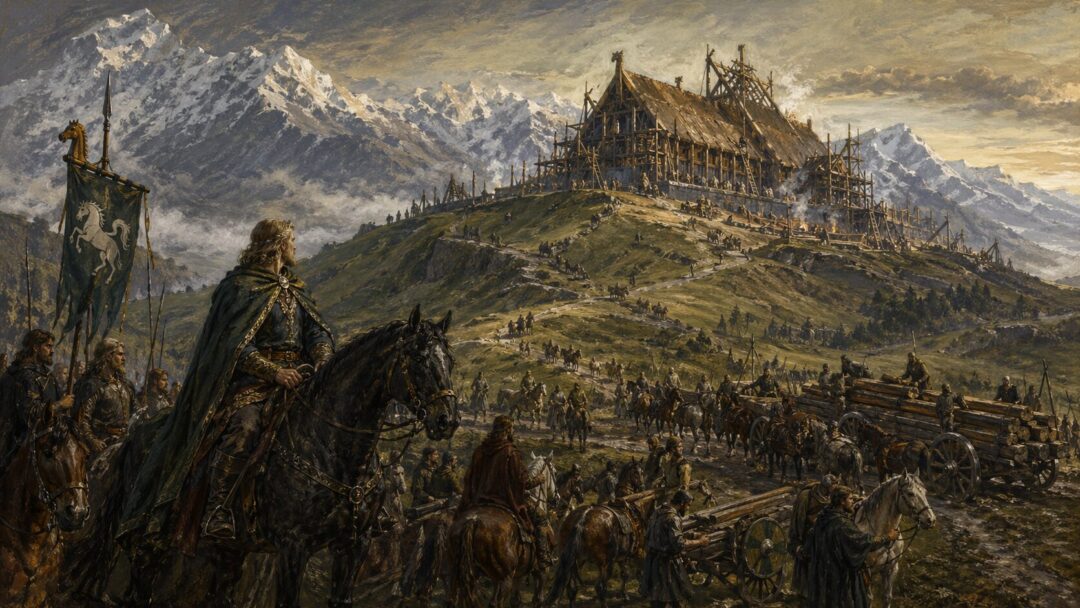
At first glance, Rohan’s choice makes little sense.
If you were founding a kingdom in a dangerous land, why would you place your royal seat on a hill at the mouth of a valley, out in view of the plains, instead of inside one of the strongest fortresses in all the Mark? Why live at Edoras when the Hornburg already stood behind stone walls, guarded by a gorge, with the mountains at its back?
It is an appealing question because Helm’s Deep feels like the obvious answer.
It looks safer.
It looks harder to take.
It looks like the sort of place a people under constant threat should have chosen first.
But the deeper one looks, the more the question begins to shift.
Because Rohan did not misunderstand its own land.
And Edoras was not chosen in ignorance of stronger walls.
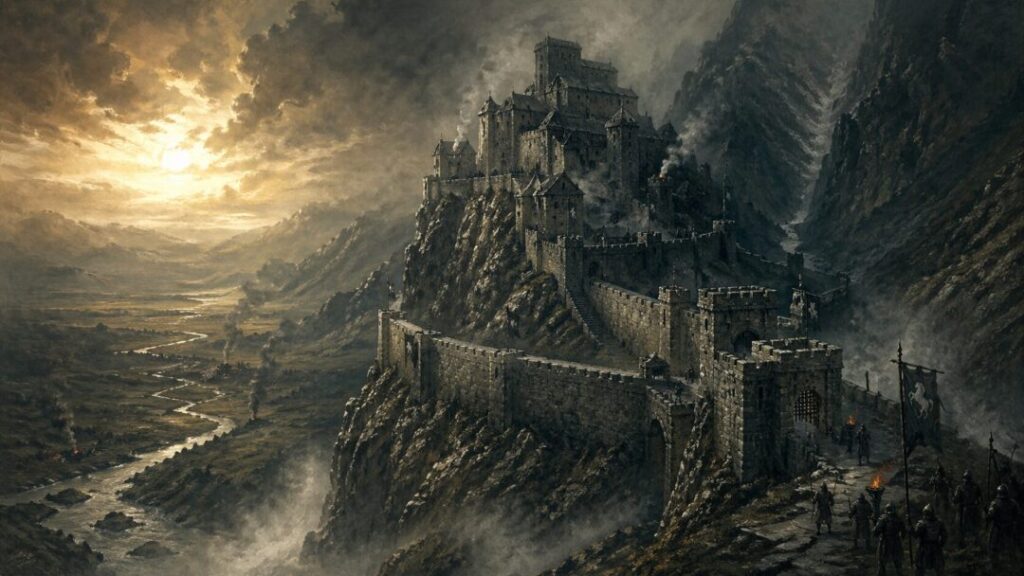
Edoras and Helm’s Deep Were Not Built for the Same Purpose
The first thing to notice is that Helm’s Deep was never originally a royal capital.
The fortress later called the Hornburg was an old Gondorian stronghold, built in the days when Gondor still held Calenardhon. It guarded the southern end of the Gap of Rohan and stood near the western borderlands. In other words, it was a defensive work on a frontier. Its purpose was military from the beginning.
That is already very different from Edoras.
When Aragorn, Legolas, and Gimli first approach it with Gandalf, Edoras is described not as a hidden refuge but as a visible hill-set city at the mouth of Harrowdale, ringed with defenses yet open to the land around it. Meduseld shines above the courts, and the whole place is presented as a seat of kingship, memory, and lordship.
This distinction matters.
A fortress is built to hold out.
A capital is built to govern.
Those are not the same thing.
Helm’s Deep could protect a people in crisis. Edoras could gather a kingdom around its king.
Rohan Did Not Begin at Edoras
There is another detail that often gets overlooked.
Edoras was not even Rohan’s first seat.
After the Rohirrim were granted Calenardhon, Eorl established himself at Aldburg, a fortified town in the Folde. Later, Brego moved the capital to Edoras and built Meduseld there, completing the Golden Hall in 2569 of the Third Age. The royal center therefore shifted within Rohan’s settled lands before it ever had anything to do with the Hornburg.
That alone helps answer the question.
The real choice in the early history of Rohan was not “Edoras or Helm’s Deep?”
It was first Aldburg, then Edoras.
The Hornburg belongs to a different category entirely.
It remained important, certainly. It was one of the strongest places in the Mark, and in later danger it became the great refuge of the West. But the line of Rohan’s kings did not move from one royal city to another. They moved from an older settlement in the Folde to a more fitting royal seat at Edoras.
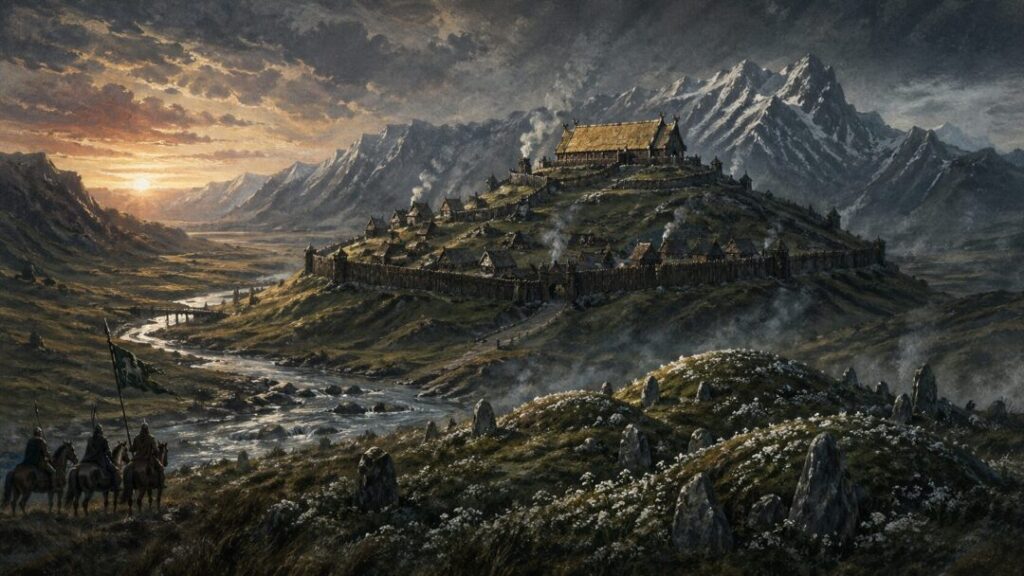
Edoras Fits the Shape of a Horse-Kingdom
The strongest answer is not a single sentence in the text saying, “This is why Brego chose Edoras.”
No such explicit explanation is given.
But the geography and structure of Rohan make the implication unusually clear.
Edoras stands where Harrowdale opens out and the Snowbourn runs from the White Mountains into the green land beyond. It sits on a hill, but not in isolation. It is connected to the plains, visible from afar, and placed where a king can look outward over inhabited country rather than hide deep inside a defensive gorge.
That suits the Rohirrim.
Rohan is not a mountain realm.
It is not a city-state.
It is not a people whose strength lies chiefly in walls.
It is a kingdom of horse-lords spread across grasslands, folds, vales, and mustering grounds. Its power depends on movement, open land, and the ability to gather riders. Even late in the Third Age, the structure of command still reflects this regional logic, with Aldburg serving as the convenient base of the East-mark and Helm’s Deep as the western military base of Théodred and Erkenbrand when Saruman’s threat rose.
So while the text does not directly say, “Edoras was chosen because it was more central and better suited to rule a mounted people,” that is the strongest inference from the evidence.
A horse-kingdom does not want its king shut away at the end of a stone throat in the far west unless war has already come.
It wants him where the kingdom can gather.
Helm’s Deep Was for the Worst Days
The story itself shows what the Hornburg is for.
When the Westfold is breaking, when Théoden cannot safely defend the open field, when Saruman’s army is already moving, then Helm’s Deep becomes necessary. The fortress is a place of resistance under pressure. It is chosen when the question is no longer how to rule Rohan, but how to prevent its destruction.
That pattern is older than the War of the Ring.
During the Long Winter and the invasion of Wulf, Helm Hammerhand withdrew to the Hornburg and was besieged there, while others took refuge in Dunharrow. Meanwhile Fréaláf later came out from Dunharrow and retook Edoras. Even in one of Rohan’s darkest crises, the kingdom’s story is divided among royal seat, mountain refuge, and war-fortress. They are not interchangeable.
That is the real pattern.
Edoras is where the kings reign.
Dunharrow is where some flee when the mountains must shelter them.
The Hornburg is where the line holds when force must be met by stone.
Once that is clear, Helm’s Deep stops looking like the place Rohan “should” have lived.
It was the place Rohan was meant to survive.
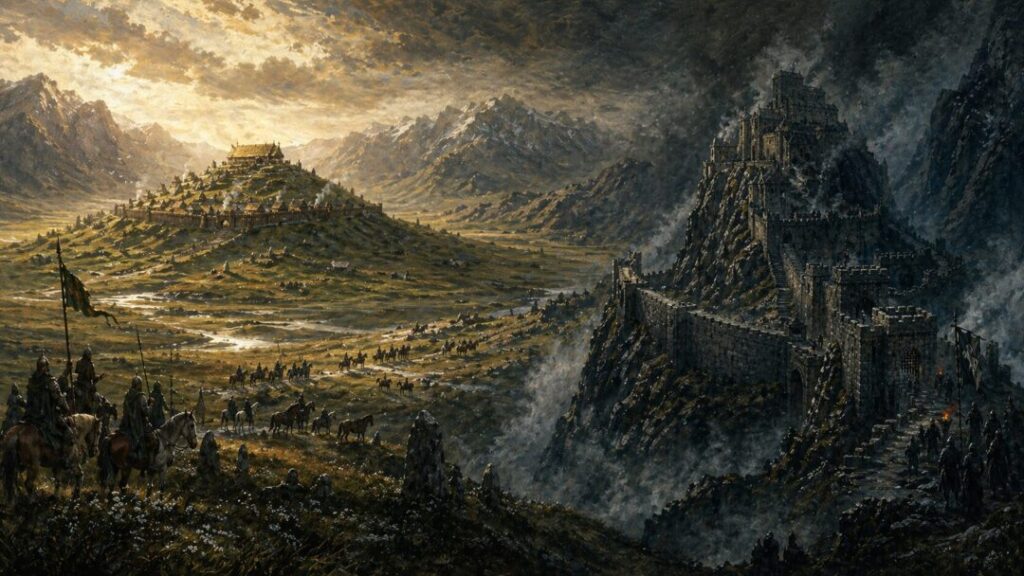
Edoras Is Exposed on Purpose
There is something symbolic here too.
Edoras is not merely practical. It is expressive.
Meduseld stands high and visible. The tombs of the kings lie before it. The hall is golden, elevated, and open to the sky and wind of the Mark. This is not the architecture of concealment. It is the architecture of lordship, ancestry, and presence.
The kings of Rohan are not portrayed as rulers who withdraw behind the best stone they can find.
Their authority is bound to hall, household, gift, memory, burial, and muster. The golden hall matters because it is seen. It crowns the settlement and gathers the identity of the people into one place. The barrows outside Edoras reinforce the same idea: this is not just where the king sleeps and eats. It is where the line of the Mark is rooted.
Helm’s Deep does not do that.
It inspires endurance, not belonging.
It is magnificent in a different register, but it is not the same kind of symbol.
The Westward Fortress Was Also in the Wrong Place to Be Everything
There is also a simpler geographic truth.
Helm’s Deep is in the Westfold, near the threatened western marches and the Gap. That makes it a superb place to guard an approach. It does not make it the natural place from which to oversee all of Rohan.
Again, the texts do not provide a formal administrative explanation.
But they do show that Rohan had more than one important center, and that military command could be based elsewhere when needed. Aldburg remained useful in the East-mark long after the capital moved; the Hornburg remained vital in the West. That strongly suggests a kingdom whose needs were regional, not concentrated in one all-purpose fortress.
In that light, asking why Rohan did not simply live at Helm’s Deep is a little like asking why a kingdom does not make its border citadel its entire identity.
Because borders are not the whole realm.
The Real Answer Is That Edoras Was a Capital and Helm’s Deep Was a Fortress
That is the heart of it.
Rohan did not choose an awkward rock instead of a better one.
It placed its kings at Edoras because Edoras functioned as a royal center: visible, ceremonial, rooted in the settled land of the Mark, and suited to a people whose life depended on horses, open country, and mustering under their lord. Helm’s Deep, by contrast, was an inherited stronghold on the western edge, built for guarding and for war.
The texts support that distinction consistently.
What they do not support is the idea that the Rohirrim somehow ignored the obvious.
They knew exactly what the Hornburg was.
That is why they fled there when they had to.
But no people can live forever in the posture of a siege.
And Rohan, more than most realms in Middle-earth, is defined by the space between refuge and freedom.
Helm’s Deep is where the Mark endures the storm.
Edoras is where it actually lives.
Sources & Notes
- J.R.R. Tolkien, The Lord of the Rings, Book III, Chapter 6, “The King of the Golden Hall” — presents Edoras and Meduseld as the visible royal seat of Théoden, with the king’s house and the barrows of his line before it.
- J.R.R. Tolkien, The Lord of the Rings, Book III, Chapter 7, “Helm’s Deep” — treats the Hornburg and the Deeping-coomb as a fortress of refuge and battle when Saruman’s army threatens the Westfold.
- J.R.R. Tolkien, The Lord of the Rings, Appendix A, “The House of Eorl” — records Eorl’s settlement at Aldburg, Brego’s building of Meduseld at Edoras, and Helm Hammerhand’s later retreat to the Hornburg.
- J.R.R. Tolkien, Unfinished Tales, “Cirion and Eorl and the Friendship of Gondor and Rohan” — explains the grant of Calenardhon to the Rohirrim and the political foundation of Rohan as a settled allied kingdom.
- J.R.R. Tolkien, The Lord of the Rings, Book III, Chapter 2, “The Riders of Rohan” — shows Rohan as a wide horse-land of plains, marches, and mounted musters rather than a people defined chiefly by one mountain fortress.