Most people think Galadriel’s power should be easy to explain.
She is one of the most luminous figures in Middle-earth. She unsettles the Fellowship the moment they enter Lórien. She seems to know what others are thinking. She can reveal terrible images in her Mirror. She preserves a land that feels almost untouched by time. And when Frodo offers her the One Ring, the story briefly opens onto a vision of overwhelming majesty and dread.
So the question seems simple:
What powers does Galadriel actually have?
But Middle-earth rarely answers that kind of question in a simple way.
Its greatest figures do not usually operate like magicians in a rule-based system. Their power is often inseparable from wisdom, lineage, inner strength, craftsmanship, memory, and the moral shape of their will. That matters especially with Galadriel, because the texts do show that she possesses extraordinary power, but they do not present it as a neat catalogue of spells.
And that is exactly why she feels so formidable.
Galadriel’s Power Is Real, But It Is Not Usually Spectacle
The first thing to clear away is a common mistake.
Galadriel is not described in the primary texts as a battlefield spell-caster throwing visible magic from her hands. Her power is real, but it is usually expressed through perception, preservation, hidden strength, spiritual authority, and the ability to sustain beauty and resistance in a fallen world. The Three Rings, especially Nenya, are associated with preservation, protection, and resistance to weariness and decay rather than domination in the crude sense. Lórien itself stands as the clearest example of that kind of power.
This is why people often feel that Galadriel is powerful long before they can explain why.
The text does not need to show her doing many overt acts. Her presence does the work. When the Company meets her, they feel exposed before her. She appears capable of seeing into them more deeply than they would like. Even Sam, the most plain-hearted of the Fellowship, feels that she looked into him and offered him a choice between remaining true and turning back to the Shire. The atmosphere around her is one of insight, testing, and inner authority.
That is power in Middle-earth, even if it does not look modern.
She Possesses Great Perception
One of Galadriel’s clearest stated abilities is perception.
In Lórien, she tells Frodo that even as she speaks to him, she perceives the Dark Lord and knows his mind, or at least all of his mind that concerns the Elves, while Sauron in turn gropes to see her thought but still finds the door closed. That is an astonishing statement. It does not mean she fully knows everything Sauron thinks. The text limits the claim. But it absolutely does show a direct contest of perception and will between Galadriel and Sauron.
This is one of the most important clues to her power.
She is not merely insightful in the ordinary sense. She has an active mental and spiritual strength great enough to perceive an enemy of immense stature and resist his attempt to penetrate her thought. That does not make her stronger than Sauron overall. The text does not say that. But it does place her among the very few beings in Middle-earth who can stand in that kind of opposition to him at all.
That is part of why her temptation by the One Ring matters so much.
The Mirror Shows Another Kind of Power
The Mirror of Galadriel is often treated as if it were a simple prophecy device.
It is not.
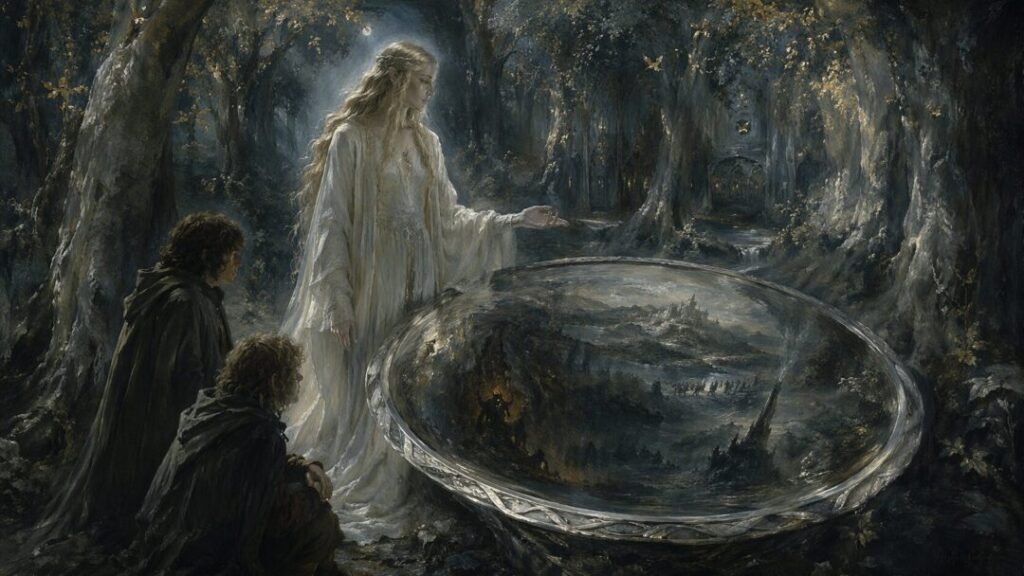
Galadriel says she can command the Mirror to reveal many things, and can show some people what they desire to see. But she also warns that it may show things unbidden, and that it reveals things that were, things that are, and things that yet may be. Even the wise, she says, cannot always tell which is which.
That warning is essential.
The Mirror does not provide clean certainty. It offers glimpses, possibilities, truths, and dangers of interpretation. Galadriel clearly has some degree of authority over it, but not absolute control over every vision that appears. So if we ask what power she has here, the safest answer is this: she possesses a real and remarkable capacity to unveil hidden things through the Mirror, but the text does not present her as omniscient or the Mirror as infallible in a simple predictive sense.
That restraint matters, because it keeps her power from becoming crude fortune-telling.
It remains mysterious, but not unlimited.
Nenya and the Preservation of Lórien
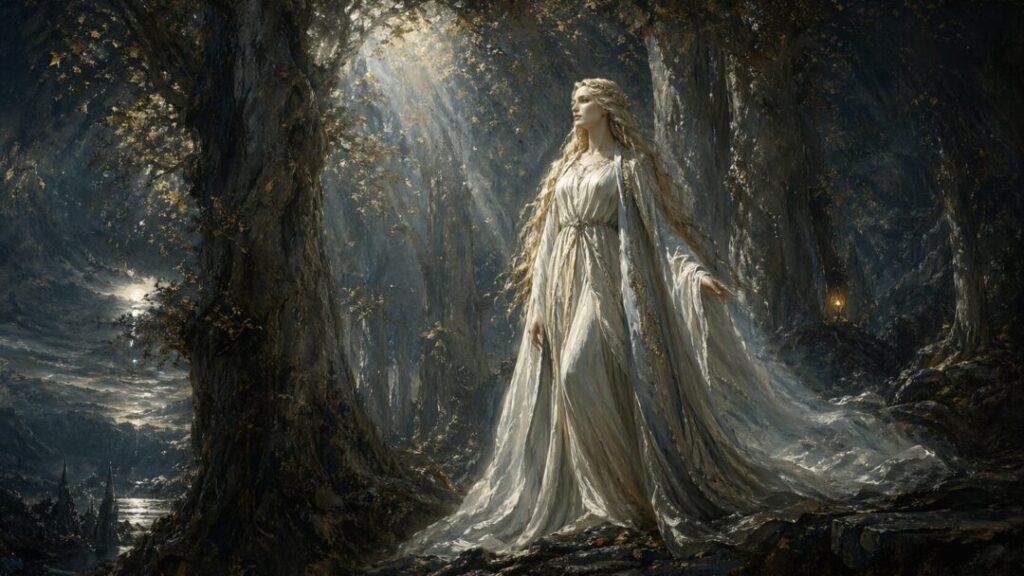
If there is one place where Galadriel’s power becomes visible in the world itself, it is Lothlórien.
Galadriel is the keeper of Nenya, one of the Three Rings. The Three were not made for domination in the same way as the One, and Galadriel’s Ring is strongly associated with preservation and protection. Reliable lore summaries based on the text describe Nenya’s effect as helping Galadriel fend off Sauron and preserve Lórien from fading and decay.
That makes sense of the feeling of Lórien.
Time seems altered there. The land feels guarded, unstained, and almost withdrawn from the wearing-down of the outer world. The text never says Galadriel created Lórien by Ring-power alone, and it would be too strong to claim that everything there comes from her personally. But it is entirely fair to say that Galadriel, through Nenya and through her own native strength, is one of the chief reasons Lórien remains what it is in the Third Age.
This is also why the end of the War of the Ring changes everything.
Once the One is destroyed, the power of the Three begins to fail as well. What Galadriel has preserved cannot be held forever.
That is one of the quiet tragedies bound up in her greatness.
Her Gifts Are Small in Form, Great in Meaning
Galadriel’s power also appears in the gifts she gives.
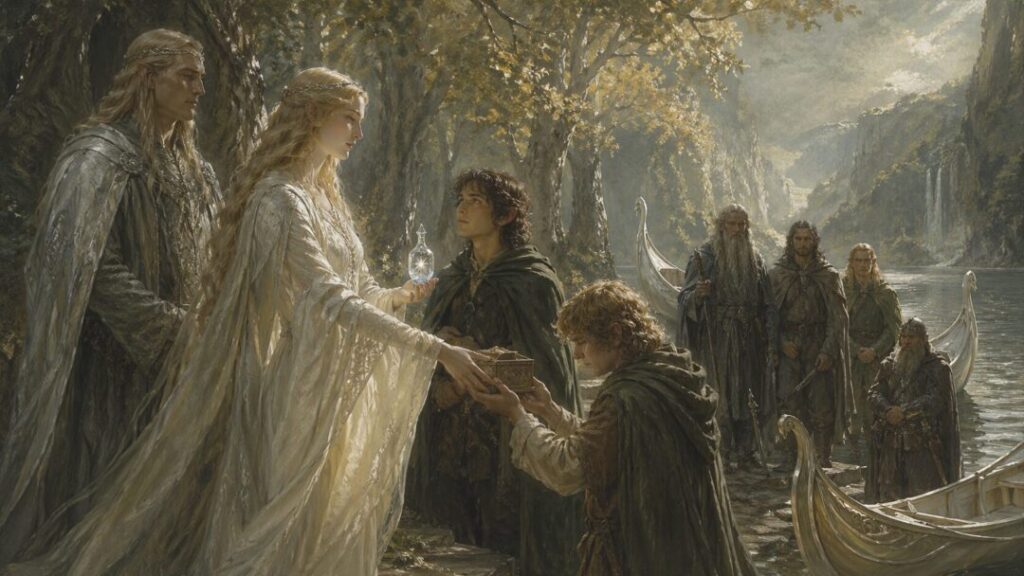
To Frodo she gives the Phial, containing the light of Eärendil’s star as caught in the waters of her fountain. The text treats this as a real aid in darkness, not just a symbol. To Sam she gives earth from her orchard together with her blessing, and that gift later helps heal the Shire after its scouring.
These gifts matter because they show the kind of power Galadriel most characteristically exercises.
She does not arm the Fellowship with engines of conquest.
She gives light. She gives memory. She gives restoration. She gives a means by which beauty can survive damage.
That is not lesser power.
In Middle-earth, it may be the more enduring kind.
The Most Revealing Power Is the One She Refuses
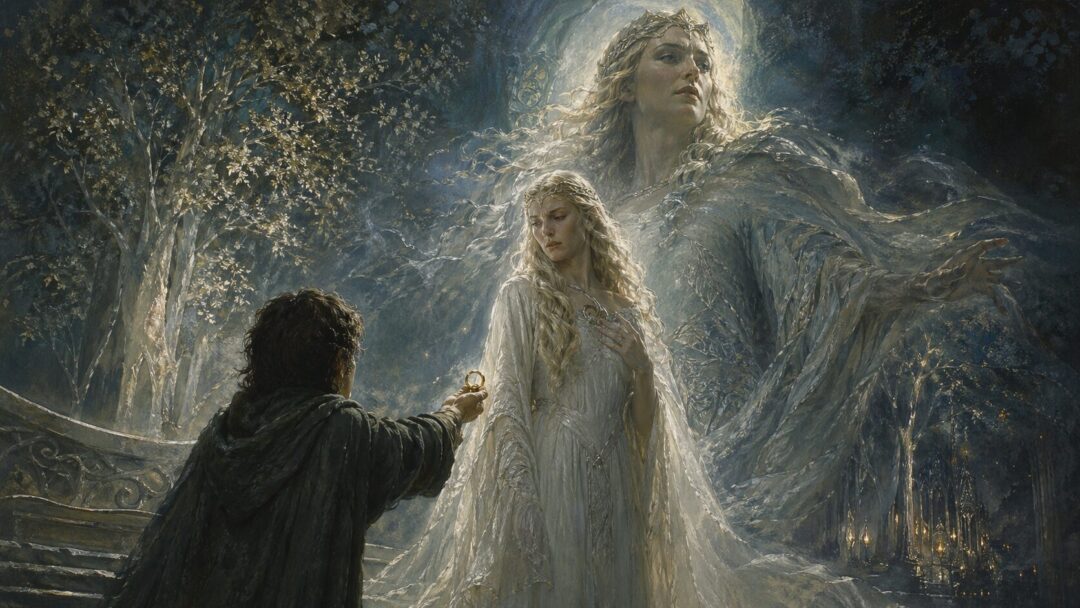
The single most important passage for understanding Galadriel is still the moment Frodo offers her the One Ring.
Her response is not that the Ring would do nothing to her.
Her response is terrifying precisely because she understands what it would make possible. She imagines herself becoming beautiful and terrible, adored and dreaded, a ruler before whom all would love and despair. Then she rejects it, passes the test, and accepts that she will diminish and go into the West.
This tells us something crucial.
Galadriel has enough native greatness that the One Ring would not turn her into a petty tyrant. It would raise her into something vast. But that imagined greatness would still be corruption. It would still be domination, however radiant it looked.
So what powers does Galadriel have?
Enough to preserve a realm.
Enough to perceive and resist the Dark Lord.
Enough to reveal hidden things.
Enough to bless light, beauty, and renewal.
And enough latent greatness that, with the One Ring, she might become terrible beyond measure.
But the final truth of Galadriel is not that she possesses power.
It is that she understands its danger.
So What Can Galadriel Actually Do?
If we answer conservatively, the texts support this much.
Galadriel has exceptional spiritual and mental perception. She can resist hostile probing of thought. She can use or command the Mirror to reveal things seen, present, and possible. Through Nenya she helps preserve and protect Lórien against weariness, fading, and assault. Her gifts carry real efficacy, as seen in the Phial and in the healing of the Shire through Sam’s box of earth and seed. And the Ring-scene makes clear that her native stature is immense enough that the One could work through her on a catastrophic scale.
What the texts do not support is just as important.
They do not present her as omniscient. They do not reduce her power to a list of combat abilities. They do not say that every strange thing in Lórien is solely her doing. And they do not suggest that her greatness is separable from wisdom, restraint, and renunciation.
That is why Galadriel remains so compelling.
In another kind of story, power answers mystery.
In Middle-earth, with Galadriel, power deepens it.
Sources & Notes
- J.R.R. Tolkien, The Lord of the Rings, Book II, Chapter 7, “The Mirror of Galadriel” — shows Galadriel testing the Company, describing her perception of Sauron, and using the Mirror to reveal things past, present, and possible.
- J.R.R. Tolkien, The Lord of the Rings, Book II, Chapter 8, “Farewell to Lórien” — gives Galadriel’s gifts, including the Phial of Eärendil’s light and Sam’s blessed earth from her garden.
- J.R.R. Tolkien, The Lord of the Rings, Book VI, Chapter 8, “The Scouring of the Shire” — shows the practical effect of Galadriel’s gift to Sam in the renewal of the Shire.
- J.R.R. Tolkien, The Lord of the Rings, Appendix B, “The Tale of Years” — records that after the Ring’s destruction Celeborn and Galadriel cast down Dol Guldur’s walls and laid bare its pits.
- J.R.R. Tolkien, The Silmarillion, “Of the Rings of Power and the Third Age” — explains the Three Rings’ purpose of preservation and Galadriel’s bearing of Nenya in Lórien.