Middle-earth is full of characters who seem larger than life.
There are kings in exile, immortal Elves, fallen wizards, captains of Gondor, and beings so ancient they seem to belong to the world before memory. Even the Hobbits who step into the great tale do so under extraordinary pressure. Frodo bears the One Ring. Bilbo finds it. Merry and Pippin are swept into war and kingship and the ruin of ancient realms.
And then there is Sam.
A gardener.
A servant from Bagshot Row.
Someone who begins the story listening at a window because he wants to hear talk of Elves.
On the surface, Samwise Gamgee should not be the figure who keeps rising in readers’ affections until he feels indispensable. He does not arrive with mystery. He does not dominate scenes by intellect, rank, or grandeur. He speaks plainly. He worries about meals, rope, and whether there will be a way home.
And yet many readers come away with the same conclusion:
Why is my favourite character Sam?
That reaction is not accidental. The story itself quietly builds toward it.
Sam is Frodo’s constant companion through the central movement of the Quest, the only original member of the Fellowship who remains with him all the way to Mount Doom. He briefly bears the Ring, resists it, rescues Frodo at Cirith Ungol, and later becomes one of the chief agents of the Shire’s healing after the war. Tolkien even referred to him in a letter as the book’s “chief hero,” a remark that has become famous for good reason.
But that line matters less as a slogan than as a clue.
The real question is not whether Sam is admirable.
It is why Middle-earth gives so much moral weight to someone like him.
Sam Is Not Great in the Usual Sense
One reason Sam feels so powerful in the story is that he does not resemble the kind of hero epic usually trains us to expect.
Aragorn carries the long burden of kingship.
Gandalf confronts powers older than kingdoms.
Galadriel bears one of the Three and stands in the fading light of the Elder Days.
Frodo shoulders the central burden of the age.
Sam has none of that stature.
He is not ignorant, but he is not scholarly.
He is not noble by birth.
He is not politically important.
He is not presented as someone meant for glory.
The text preserves that humility even when Sam does astonishing things. It does not transform him into a different kind of being. He remains recognizably himself: practical, affectionate, stubborn, wounded by fear but never ruled by it for long.
That is crucial.
Sam matters not because the story secretly reveals he was grand all along.
He matters because the story keeps showing that greatness can take a form the world is likely to overlook.
This is one of the quiet reversals at the heart of The Lord of the Rings. Strength is repeatedly severed from display. Wisdom is often hidden in the unassuming. The people most fit to carry moral weight are not always the people who look impressive under the old heroic lights.
Sam fits that pattern almost perfectly.
He Is the Character Who Stays
The simplest answer to Sam’s importance is also the deepest:
He stays.
That sounds small, but in this story it is nearly everything.
When the Fellowship breaks, Sam is the one who refuses separation from Frodo. From that point onward, the Quest narrows into something harsher and lonelier. The great councils are gone. The songs fade. The roads are ruined. Splendour gives way to exhaustion, suspicion, and hunger.
And Sam remains.
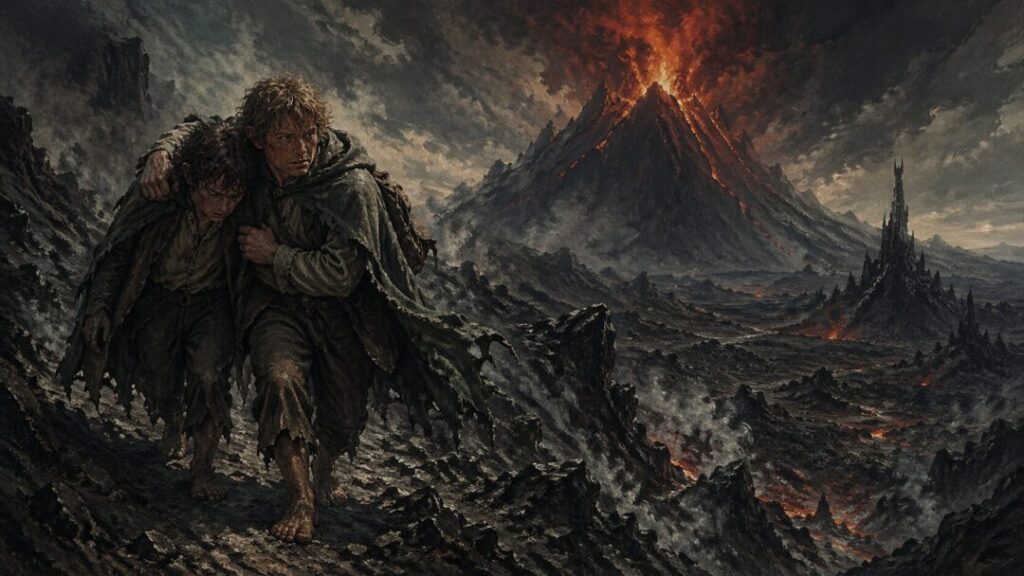
He follows Frodo into Mordor when almost no rational hope is left. He watches over him, argues with him, feeds him when he can, carries practical burdens, and holds together the last human shape of the mission when the larger strategy has all but vanished.
That is one of Sam’s defining traits in the text: he turns immense evil back into immediate duties.
Water.
Food.
Rest.
Keeping watch.
Taking the next step.
Not abandoning the person in front of him.
This does not make him less heroic than the warriors and rulers.
It makes him heroic in a more fundamental way.
Sam is not fighting for abstract triumph. He is preserving fidelity under pressure. He is the one who continues to love when the world has been reduced to ash, stone, thirst, and dread.
That is why he feels so real.
And it may also be why he feels so necessary.
Sam and the Ring
Sam’s greatness is not only emotional or practical. The texts also test him directly against the central temptation of the entire age.
After Shelob wounds Frodo, Sam believes his master is dead. In that crisis he takes the Ring. For a short time, Sam becomes a Ring-bearer himself. The Ring works on him too, offering him visions of power shaped to his own nature, yet he does not surrender to it and later gives it back.
That episode matters enormously.
It proves that Sam is not merely a comforting companion standing beside the real trial. He enters the trial.
And when he does, the text does not imply that he is immune. Rather, it shows that his desires are smaller, saner, and harder for the Ring to distort into lasting domination. Sam has imagination, but it is rooted in earth, gardens, and living things. The Ring can still magnify those desires, but the result exposes its own absurdity.
That is one of the most revealing things about Sam.
He is ambitious in the scale of care, not conquest.
His loves are too concrete to be easily turned into empire.
This does not make him pure in some impossible sense. It makes him rightly ordered. He wants what can actually be tended, not what can only be ruled. That moral shape is one of the reasons he withstands the Ring as well as he does.
And it is one of the reasons readers trust him.
The Rescue at Cirith Ungol Changes Everything
If Sam were only loyal, he would still be beloved.
But the story gives him more than loyalty.
It gives him action.
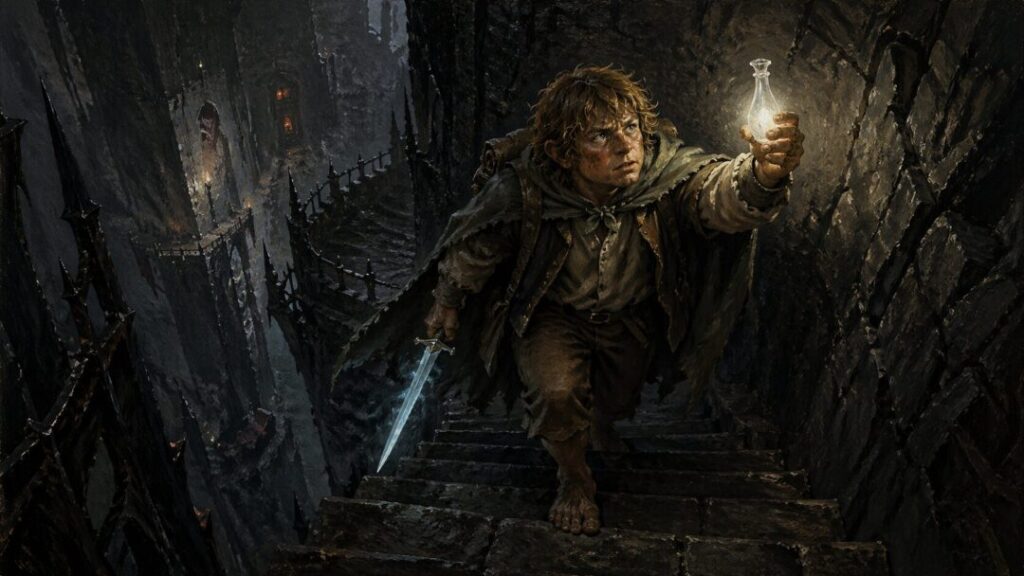
Sam does not simply accompany Frodo into darkness. He acts decisively at some of the Quest’s most critical moments. Believing Frodo dead, he takes up the Ring. Learning Frodo lives, he goes into Cirith Ungol alone and rescues him from the Orcs. This is not the behavior of a secondary figure who exists merely to encourage the protagonist. It is the behavior of someone on whom the story genuinely turns.
This is where one common misunderstanding falls away.
Sam is not important only because Frodo loves him, or because readers find him kind.
He is structurally important.
Without Sam, the Quest fails.
That is not a sentimental exaggeration. It is built into the narrative. Frodo does not get out of Cirith Ungol without him. Frodo does not reach the final approach to Orodruin without him. The Ring does not come as near to destruction as it does without Sam’s strength, vigilance, and endurance.
And still, the book refuses to turn him into a swaggering conqueror.
He does heroic things without becoming self-mythologizing.
That restraint is part of what makes him so powerful.
Sam Represents the Moral Center of the Story
There is also a larger reason Sam feels central.
He embodies, in unusually concentrated form, the moral logic of the book.
The Lord of the Rings is not finally a story about domination defeating domination. It does not teach that the best claimant to power should seize it more wisely than the wicked. Again and again, the text distrusts mastery. The desire to control, order, possess, and bend the world becomes one of its most dangerous impulses.
Sam stands against that pattern.
Not because he is incapable of force.
Not because he never gets angry.
Not because he lacks will.
But because his deepest instinct is service.
That word can sound smaller than it is. In Sam, service is not passivity. It is the refusal to make the self the center of the world. He is constantly oriented toward something outside himself: Frodo, the Shire, growing things, promises, memory, home.
This is why readers often feel that Sam is somehow “truer” than more dazzling characters.
He is not abstracted by grandeur.
His virtue remains attached to ordinary loves.
And Middle-earth repeatedly suggests that those loves are not naive. They are what make resistance possible in the first place.
He Does Not Only Help Save the World. He Helps Heal It.
One of the strongest arguments for Sam’s importance comes after the great climax is over.
Many stories would let a character like Sam fade once the mountain has done its work. The world is saved; the dark lord falls; the great powers pass into history. At that point, epic fiction often loses interest in people whose gifts are domestic, local, and restorative.
The Lord of the Rings does the opposite.
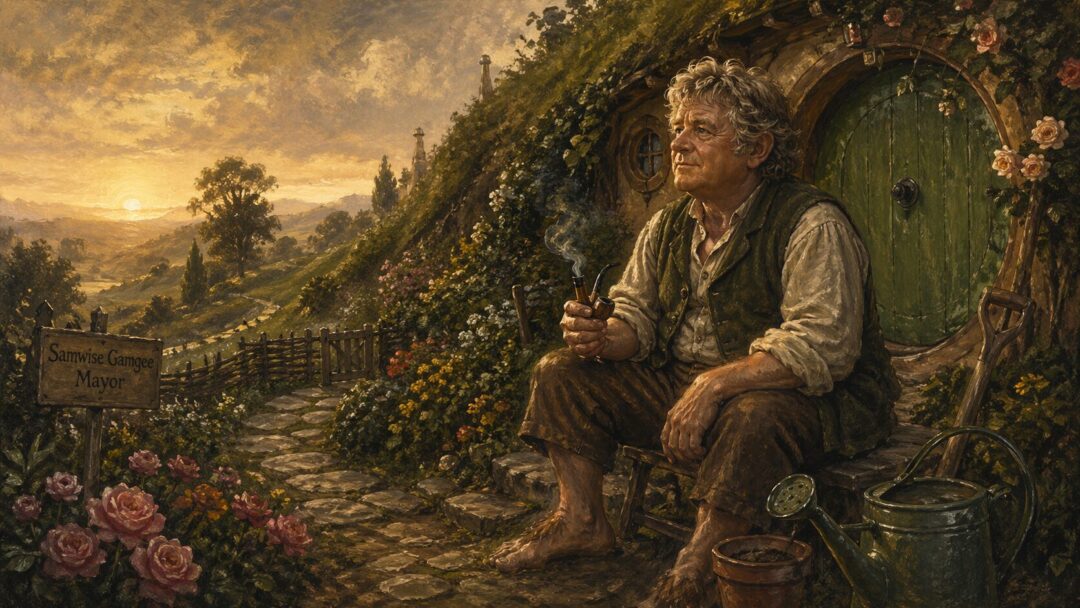
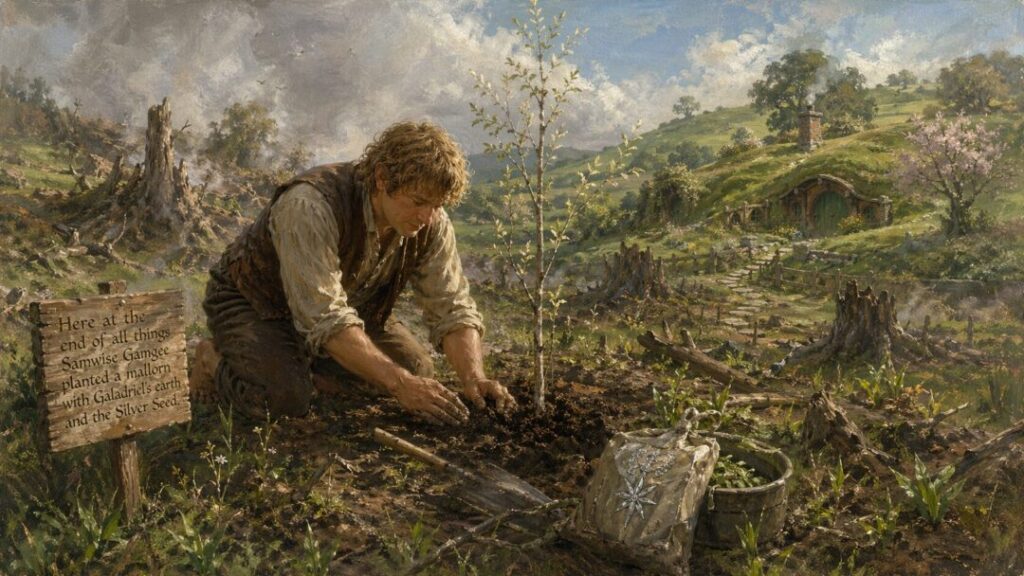
When the travellers return to the Shire, Sam becomes one of the chief forces in its renewal. Galadriel had given him a box of earth from her orchard and a silver seed. Sam uses that gift in the Shire’s restoration, and from it comes the mallorn in the Party Field. Later records also show him serving repeatedly as Mayor of the Shire.
That continuation is deeply revealing.
Sam is not only fitted for destruction’s end.
He is fitted for peace.
He can endure Mordor, but he is not made by Mordor.
He returns naturally to planting, repairing, marrying, raising children, and governing well.
This may be the clearest sign of all that the story values him at the highest level.
He is not merely useful in catastrophe.
He is fruitful afterward.
That is rarer than battlefield courage.
Many characters can strike.
Few can restore.
Sam can do both.
Frodo Needs Sam, but Sam Does Not Replace Frodo
At this point, a careful distinction matters.
Saying that Sam is many readers’ favourite character does not require diminishing Frodo.
In fact, the text becomes thinner if the two are pulled into competition too aggressively.
Frodo bears the burden Sam does not bear. He carries the Ring for far longer and under steadily intensifying pressure. The Quest is his in a sense that can never simply be transferred. Sam supports him, saves him, and even briefly shares the burden, but he does not erase Frodo’s unique suffering or role.
What the story does suggest is something more subtle.
Frodo and Sam reveal different dimensions of heroism.
Frodo shows the long, terrible endurance of direct burden.
Sam shows the steadfast, loving endurance that refuses to let the burdened one vanish alone.
That pairing is one of the reasons the final chapters feel so devastating and so complete. Frodo can save the Shire and still not be healed enough to remain fully within it. Sam, by contrast, can return more completely to ordinary life, even though he too has been marked by the journey.
The difference does not make one lesser.
It makes their bond necessary.
Still, when readers say they love Sam most, they are often responding to the fact that he makes visible something easy to miss:
the world is not saved by burden-bearers alone, but also by those who remain beside them.
Why Sam Feels Like the Closest Thing to Hope
There is one more reason Sam often becomes the favourite.
He is the character least separated from hope as a lived practice.
Not optimism.
Not certainty.
Not the belief that things will obviously turn out well.
Hope in Sam takes a more stubborn form. He remembers taste, trees, daylight, earth, stories, and the possibility that ruin is not the whole truth. Even in Mordor, he continues to think in terms of what is living rather than only what is dying.
That matters because Middle-earth is not merely interested in winning.
It is interested in what is worth winning for.
Sam never loses sight of that for long.
Even when he is exhausted, his imagination returns to things that can be cultivated and shared. He does not reduce the future to triumph over enemies. He thinks in orchards, fields, meals, sunlight, and home. That is not small-mindedness. It is moral orientation.
He remembers what peace would actually look like.
And because he remembers it, the reader does too.
So Why Is It Sam?
Because Sam makes the deepest values of Middle-earth visible without ever sounding like a lecture.
Because he proves that humility is not the opposite of strength.
Because he enters terror without loving terror.
Because he bears the Ring briefly and does not cling to it.
Because he rescues, restores, and remains himself.
Because the story keeps returning to him whenever it wants to show what power cannot build and evil cannot finally understand.
And perhaps most of all, because he shows that the true measure of a character in Middle-earth is not magnificence.
It is faithfulness.
Kings may return.
Dark towers may fall.
The Elder Days may pass.
But at the heart of the great tale stands a gardener from the Shire who keeps going when almost all grandeur has burned away.
That is not an accident.
That is one of the story’s deepest truths.
And once you see that, it becomes much easier to understand why so many people’s favourite character is Sam.
Sources & Notes
- J.R.R. Tolkien, The Lord of the Rings, Book II, Chapter 10, “The Breaking of the Fellowship” — shows Sam refusing to let Frodo go on alone and choosing the Quest over safety.
- J.R.R. Tolkien, The Lord of the Rings, Book IV, Chapter 10, “The Choices of Master Samwise” — has Sam take the Ring after Shelob and become, briefly, a Ring-bearer.
- J.R.R. Tolkien, The Lord of the Rings, Book VI, Chapter 1, “The Tower of Cirith Ungol” — gives Sam’s rescue of Frodo and his surrender of the Ring back to him.
- J.R.R. Tolkien, The Lord of the Rings, Book VI, Chapter 3, “Mount Doom” — includes Sam carrying Frodo when he cannot carry the Ring for him.
- J.R.R. Tolkien, The Lord of the Rings, Book VI, Chapter 9, “The Grey Havens,” and Appendix B — record Sam’s restoration of the Shire, family life, and later mayoralty.
- J.R.R. Tolkien, The Letters of J.R.R. Tolkien, Letter 131 — discusses Sam’s central rustic love and his essential place in the moral design of the story.