
Many readers remember a striking contrast in The Lord of the Rings.
Boromir is visibly drawn toward the Ring.
Galadriel speaks openly of the danger of taking it.
Gandalf refuses even to touch that path.
Frodo is worn down by it, and in the end cannot surrender it by will alone.
But Aragorn?
Aragorn stands closer to the center of power than almost anyone else in the story. He is Isildur’s heir. He is a captain of Men. He is moving, step by step, toward kingship. And yet the text never gives him a major scene of Ring-temptation at all.
That silence is easy to misread.
It does not mean Aragorn is beyond danger in some absolute sense.
In fact, the wider logic of the Ring argues against that. In the official letter to Eileen Elgar, Tolkien states that at the final point of maximum pressure resistance would be impossible for anyone after such a burden, and Letter 246 makes the same larger point about the limits of created beings before the Ring’s full force.
So the real question is not whether Aragorn is metaphysically immune.
The real question is why the story never lets the Ring get deep purchase on him in the first place.
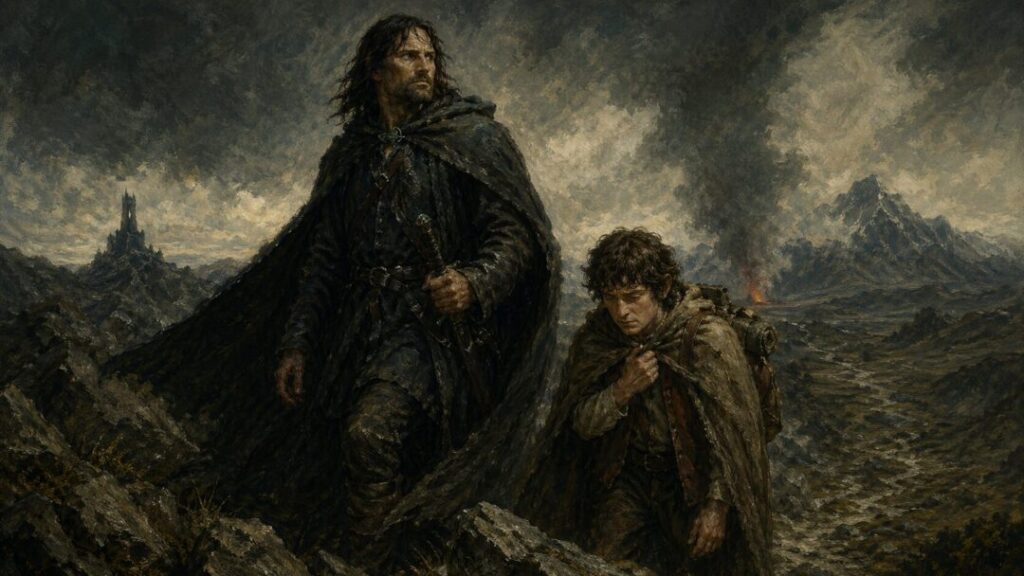
The Ring Usually Works Through a Claim of Necessity
One of the clearest patterns in the book is that the Ring does not merely tempt through greed.
It tempts through apparently justified power.
Boromir is the obvious example. He does not begin by dreaming of private luxury. He begins by thinking of Gondor under unbearable pressure and imagining the Ring as a weapon that could be turned to defense. That is precisely the sort of logic the Council rejects: the Ring cannot be safely used as a tool for good policy, good rule, or righteous war.
Faramir shows the opposite response in one of the most important Ring-passages in the story. He says he would not take the thing even if it lay by the highway, not even were Minas Tirith falling and he alone could save her by using the Dark Lord’s weapon for her good and his glory. That statement matters because it defines true resistance not as indifference, but as refusal to turn necessity into domination.
Aragorn belongs much closer to that second pattern than the first.
The text never shows him imagining the Ring as the rightful instrument of his return.
Aragorn Understands That the Ring Is Not Part of His Kingship
This is one of the most important overlooked details.
Aragorn does not need the Ring in order to be who he is.
His legitimacy does not come from sudden domination, from secret power, or from the Enemy’s own weapon. It comes from lineage, endurance, service, and the long-delayed return of the kingly line of Isildur. The story consistently frames him as heir, captain, healer, and servant of a larger cause before he ever becomes king in name.
That matters because the Ring is always trying to rewrite identity.
It whispers that true authority lies in mastery.
It suggests that the crisis is now too great for ordinary limits.
It offers a shorter and darker road to the same outward goal.
But Aragorn’s character is built around the opposite idea.
He has waited for years.
He has labored without the crown.
He has accepted obscurity.
He has learned to act without possession.
That makes him unusually hard for the Ring to approach in the way it approached Boromir.
Not impossible to corrupt in theory.
But difficult to hook.
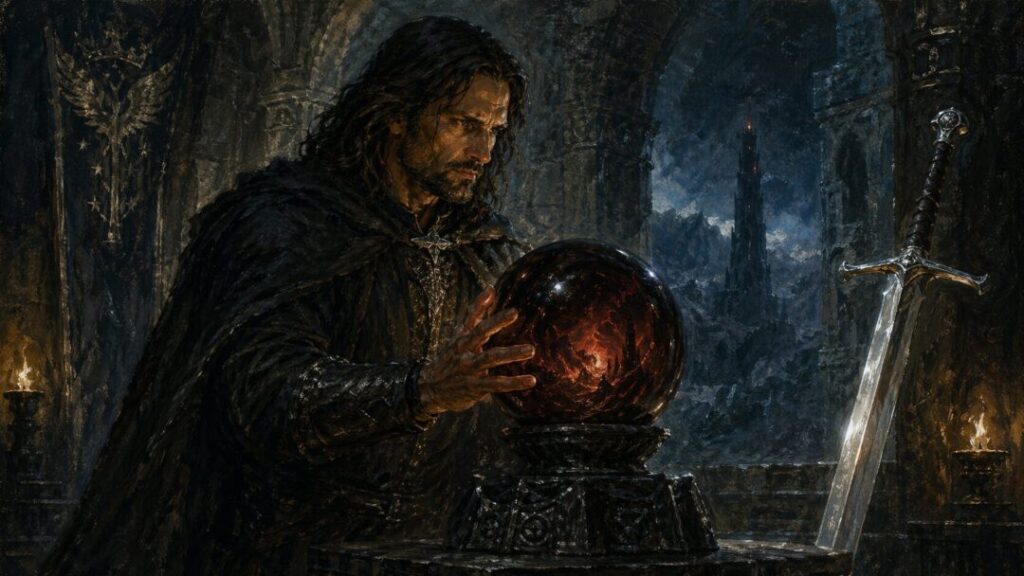
He Repeatedly Places Himself Under the Quest Rather Than Above It
The most revealing evidence is not a dramatic confrontation with the Ring.
It is Aragorn’s posture toward Frodo.
Early on, he binds himself to Frodo’s safety: “If by life or death I can save you, I will.” That line does more than mark loyalty. It defines Aragorn’s role. He is not positioning himself as the one who should take over the burden. He is positioning himself as the one who will guard the burden-bearer.
That pattern continues later in a quieter but even more important way.
At the breaking of the Fellowship, Aragorn is deeply torn. He plainly wishes to go toward Minas Tirith with Boromir. Gondor needs him. The wider war is opening. And yet the text notes that he still felt it his duty to go where the Ring-bearer chose.
That is a small sentence with enormous significance.
Aragorn does not treat Frodo’s quest as secondary to his own rise.
He does not assume that his political destiny outranks the Ring-bearer’s road.
He does not instinctively move to seize command of the Ring’s fate.
He submits himself to the mission rather than absorbing the mission into himself.
That is almost the opposite of Ring-thinking.
Aragorn Already Possesses the Kind of Strength the Ring Counterfeits
The Ring promises compressed power.
It offers the fantasy that one may skip the long road of faithfulness, endurance, and lawful authority, and reach the needed result immediately through mastery.
Aragorn is one of the few characters who already has an authentic version of many things the Ring imitates.
He has legitimate authority.
He has command in war.
He has the ability to inspire loyalty.
He has the will to confront Sauron.
And he has the inner stature to challenge the Orthanc-stone and reveal himself to the Dark Lord. Tolkien Gateway’s summaries of the palantír episodes note that Aragorn wrested the Stone to his will and deliberately used that confrontation to draw Sauron’s attention outward.
This point is easy to miss.
Because Aragorn already has true authority, he has less need to fantasize about false authority.
The Ring often feeds on inward deficiency, fear, or the belief that only one more terrible power is needed to set things right. Aragorn does experience fear and pressure, of course. But he is not inwardly organized around lack in the same way Boromir is.
He is not reaching for a missing instrument.
He is walking an appointed road.
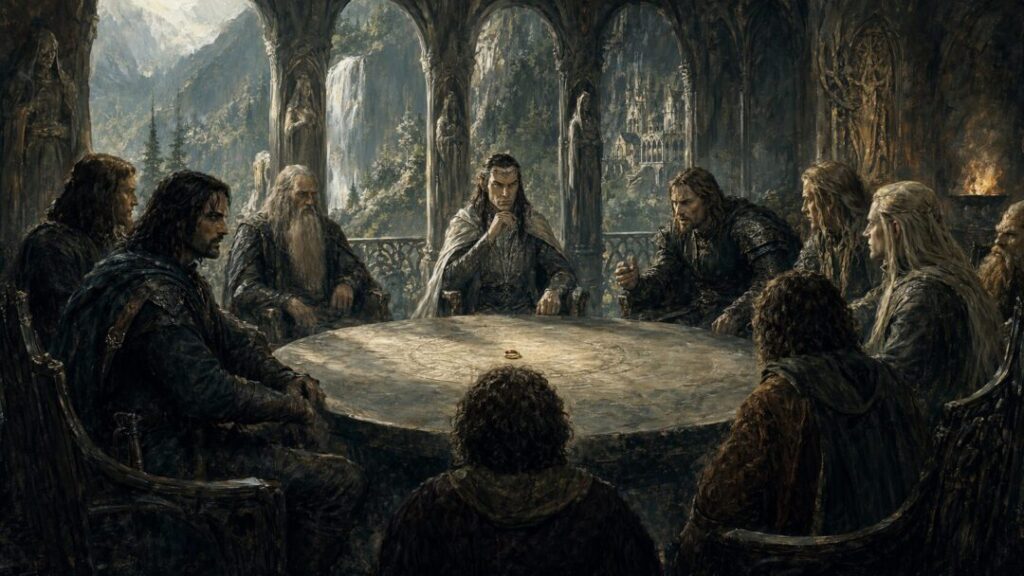
Sauron’s Misreading Proves Aragorn Was Not “Immune”
There is, however, an important correction to make.
We should not turn Aragorn into Tom Bombadil.
The story gives no basis for saying the Ring had no possible hold on him.
In fact, Sauron’s own strategic mistake depends on the opposite assumption. After Aragorn reveals himself in the palantír, Sauron concludes that one of his enemies now has the Ring and is moving rashly toward open challenge. Gandalf later builds part of the final strategy around that very misreading.
Why would Sauron think that?
Because in the moral logic of the Ring, that is what powerful rulers are expected to do.
Take it.
Claim it.
Use it.
March on the Dark Tower.
That Sauron thinks this does not prove Aragorn actually did succumb. But it does prove something important: Aragorn is not outside the Ring’s field of possible temptation in principle. He is exactly the sort of person the Enemy expects to fall into that pattern.
He simply does not.
And that refusal becomes one of the quiet moral victories of the war.
The Silence Around Aragorn Is Deliberate
Aragorn’s greatness in this matter is not that he stages a dramatic refusal like Galadriel.
His greatness is more restrained.
He never seems to enter into that fantasy deeply enough for the story to need the scene.
He knows what the Ring is.
He knows it cannot be made into a clean instrument of kingship.
He never confuses his destiny with possession of it.
And he repeatedly places himself in service to the Ring-bearer rather than above him.
That combination helps explain why Aragorn is never “significantly” tempted in the way readers expect.
The temptation is not absent because he is less ambitious than ordinary men.
It is absent because his ambition has already been disciplined into duty.
Why This Matters
This question matters because it clarifies what kind of hero Aragorn actually is.
He is not a man who becomes worthy because he rejects one dramatic offer of supreme power.
He is a man who has spent his whole life becoming the kind of person for whom that offer is already false.
That is subtler.
And, in some ways, harder.
The Ring says:
Take.
Master.
Shorten the road.
Aragorn’s whole life says:
Wait.
Serve.
Walk the long road.
That may be the deepest reason the story never lingers on his temptation.
Not because the Ring had no possible claim on him.
But because Aragorn had already chosen, long before the crisis, the sort of kingship the Ring could only parody.
Sources & Notes
- J.R.R. Tolkien, The Lord of the Rings, Book I, Chapter 10, "Strider" — Aragorn pledges himself to Frodo’s protection rather than seeking command of the Ring.
- J.R.R. Tolkien, The Lord of the Rings, Book II, Chapter 2, "The Council of Elrond" — Boromir’s argument for using the Ring is rejected; the Ring cannot be safely turned into a righteous weapon.
- J.R.R. Tolkien, The Lord of the Rings, Book II, Chapter 10, "The Breaking of the Fellowship" — Aragorn remains torn between Minas Tirith and his duty to follow the Ring-bearer’s choice.
- J.R.R. Tolkien, The Lord of the Rings, Book V, Chapter 2, "The Passing of the Grey Company"; Book V, Chapter 9, "The Last Debate" — Aragorn’s use of the palantír helps draw Sauron into assuming a rival has claimed the Ring.
- J.R.R. Tolkien, The Letters of J.R.R. Tolkien, Letter 246 — Tolkien’s comments on Frodo’s failure at the final crisis support the article’s point that resistance to the Ring has limits, not absolute immunity.