Most people treat “Mr. Frodo” as one of those familiar details that simply belong to The Lord of the Rings.
It is part of Sam’s voice.
Part of his warmth.
Part of the rhythm readers remember.
And because it is so familiar, it often passes without much thought.
But the phrase matters more than it first appears to.
Sam does not call Frodo “Mr. Frodo” just because he is humble, or because the story wants him to sound affectionate in an old-fashioned way. The title comes from something more concrete than that.
It begins in the social order of the Shire.
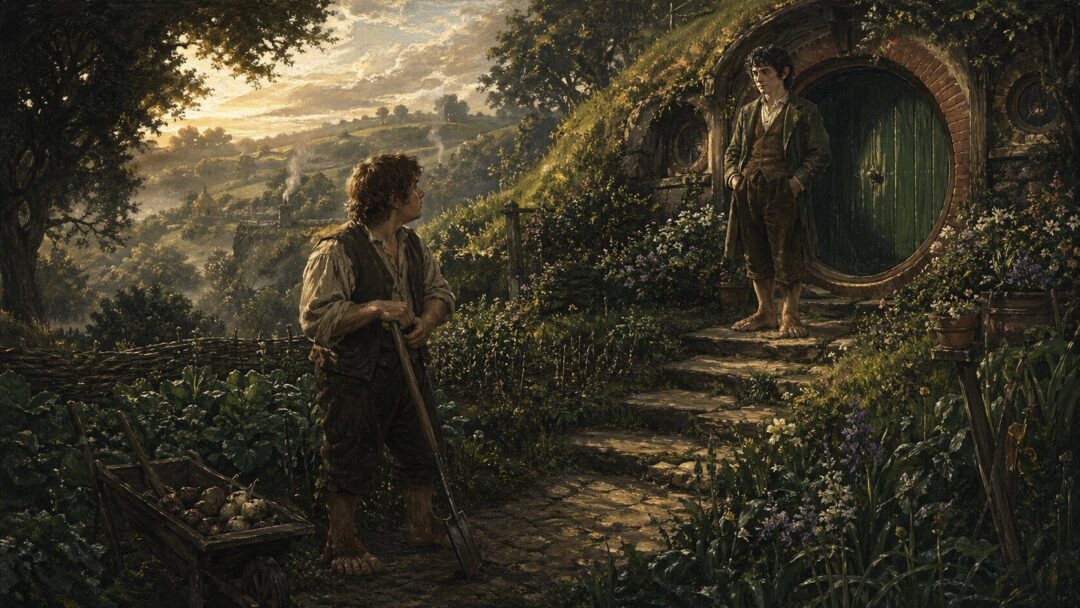
Before there is a quest, before there is a Fellowship, before there is Mordor, Sam is Frodo’s gardener. His father, Hamfast Gamgee, had also worked at Bag End. Frodo is not a king, or a warrior, or a lord in the high style of the wider world. But within Hobbit society, he is still a gentlehobbit of a higher standing than Sam.
That beginning matters.
Because the remarkable thing is not that Sam starts by calling him “Mr. Frodo.”
It is that he never stops.
The Phrase Begins in the Shire
The Shire is often remembered as warm, rustic, and cheerful.
It is all of those things.
But it is also a society with rank, property, family standing, and habits of deference. These distinctions are usually soft rather than cruel, yet they are still present. Bag End is not just another hole in Hobbiton. The Bagginses are prominent, respectable, and relatively well-off. Sam, by contrast, is the son of the Gaffer from Bagshot Row, and his work ties him to the Baggins household in a practical and social way.
The story never hides this.
When the Gaffer speaks of Frodo, he calls him a “real gentlehobbit.” That one word tells us a great deal. Frodo is not merely older, kinder, or better educated than Sam. He belongs to a social layer that Sam recognizes clearly.
So when Sam says “Mr. Frodo,” he is speaking the language of his own world.
At the beginning, the phrase is not mysterious at all.
It is how a Hobbit like Sam would naturally address a Hobbit like Frodo.
And that is important, because some readers flatten their relationship too quickly. They see the tenderness between them later and assume the old form of address must be only decorative. But the texts suggest otherwise. Sam’s loyalty grows out of a relationship that begins with service, duty, and social distance. The emotion becomes deeper than that, but it does not erase where they began.
Sam Is Not Merely a Friend at First
This is where modern readers sometimes hesitate.
To call someone “master” or to speak to him with that kind of formal deference can sound cold, unequal, or even demeaning to modern ears. But in the book, Sam’s service is neither a joke nor a disguise.
He really is Frodo’s servant in the early stages of the story.
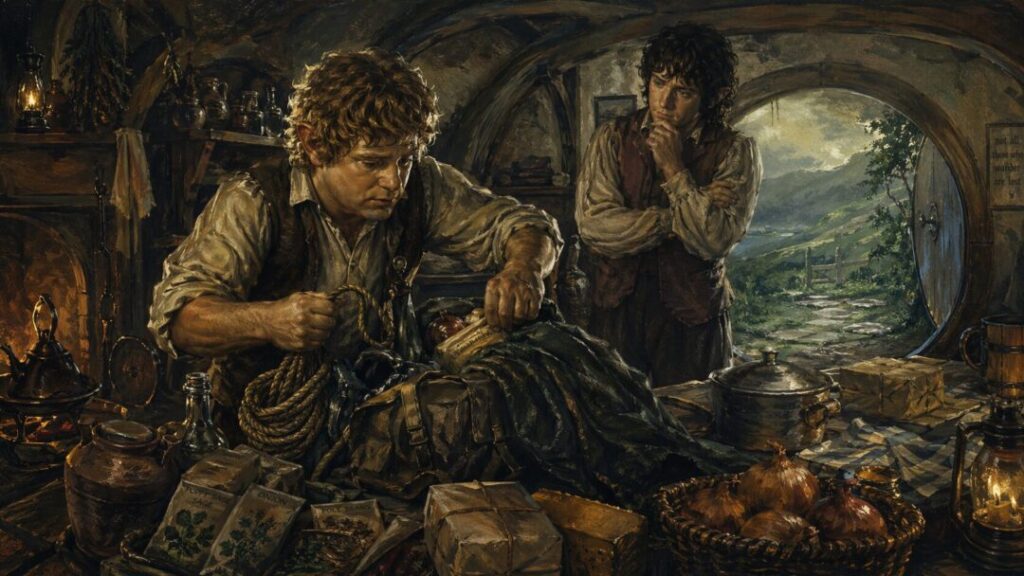
Not in the sense that Frodo is harsh or overbearing. Quite the opposite. Frodo is notably kind, and the affection between them is genuine. But the relationship still carries structure. Sam works for Frodo. He follows him. He looks after him. He often thinks of himself in relation to Frodo’s needs rather than his own.
That pattern remains visible all the way through the quest.
In fact, the story often intensifies it rather than softening it. Sam cooks, carries, watches, protects, worries, and persists. He takes pride in serving Frodo well. Even when he grows in wisdom and courage, he does not stop thinking in those terms.
This is one reason the title “Mr. Frodo” survives so long.
It is not a leftover from chapter one.
It reflects how Sam understands his role.
Why the Formality Does Not Mean Emotional Distance
And yet the phrase would not be nearly so memorable if it meant only social difference.
That is where the deeper transformation happens.
As the journey continues, Sam and Frodo pass far beyond the ordinary limits of employer and servant. They suffer together. They depend on one another absolutely. Sam sees Frodo at his weakest and remains. Frodo trusts Sam more than anyone else left beside him. By the end, their bond is intimate in the strongest and most sacrificial sense the story gives to any friendship.
But the language of the Shire remains.
That is not a contradiction. It is the point.
The phrase “Mr. Frodo” begins as formality, but it becomes something richer without losing its original shape. It carries respect, loyalty, affection, protectiveness, and long habit all at once. Sam does not need a new title because the old one has filled up with new meaning.
That is why the phrase becomes more moving as the story darkens.
If Sam had dropped the honorific halfway through and started speaking with casual familiarity, the relationship might sound more modern. It would also lose something essential. The old form of address preserves the memory of where they came from even while revealing how far beyond that beginning they have gone.
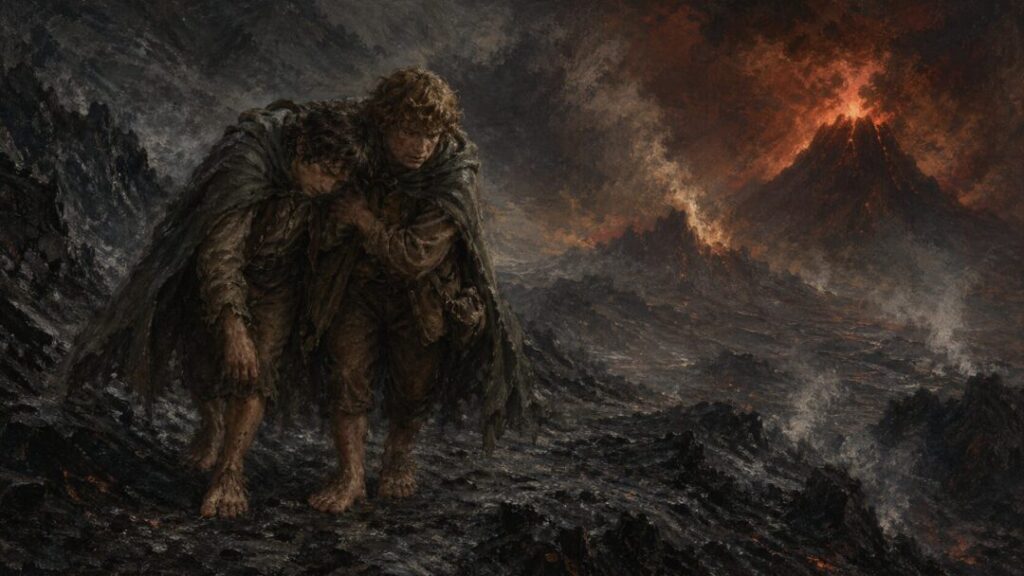
By Mordor, “Mr. Frodo” no longer marks distance in the ordinary way.
It marks devotion.
The Shire Never Fully Leaves Sam
Part of the power of Sam’s speech is that he never stops being recognizably Sam of the Shire.
He learns.
He endures.
He becomes heroic almost beyond belief.
But he is never transformed into someone who abandons his roots.
His speech remains rustic. His imagination still carries the old tales and plain sayings of home. His moral instincts are often those of a practical Hobbit: food, rope, growing things, ordinary decency, getting through one more day. Even his heroism rises out of these homely qualities rather than replacing them.
So of course he keeps saying “Mr. Frodo.”
To stop saying it would mean more than changing a phrase. It would mean Sam becoming someone other than himself.
And the story does not want that.
One of the deepest patterns in The Lord of the Rings is that greatness often arrives through fidelity rather than self-reinvention. Sam does not become worthy of the quest by ceasing to be a gardener from Bagshot Row. He becomes worthy by bringing the full truth of that humble self all the way into darkness.
The old title is part of that continuity.
He carries the Shire in his speech just as surely as he carries it in memory.
Service Is Not the Same as Smallness
There is another reason the phrase matters.
Readers sometimes assume that because Sam serves Frodo, he must stand below him in every important sense. But the book does not allow that conclusion for long.
Sam’s service is real, yet it becomes one of the highest forms of strength in the story.
He is the one who notices what must be done.
He is the one who acts when Frodo cannot.
He is the one who keeps hope alive when hope has become almost absurd.
At several crucial moments, Frodo’s survival depends on Sam completely.
And still Sam speaks as if he were the lesser figure.
That tension is deliberate.
The language remains humble even when the reality has become immense. Sam may still say “Mr. Frodo,” but by the end he is not merely the gardener following his master. He is the companion without whom the quest would fail.
This does not erase Frodo’s burden. Frodo bears the Ring in a way Sam never fully can.
But it does change how we hear the title.
It becomes the speech of a man who serves freely, not because he is incapable of greatness, but because his greatness expresses itself through service.
The Story Quietly Elevates Sam
One of the most revealing details is that the narrative does not leave Sam exactly where it found him.
It does not make him discard Frodo’s title.
Instead, it raises Sam.
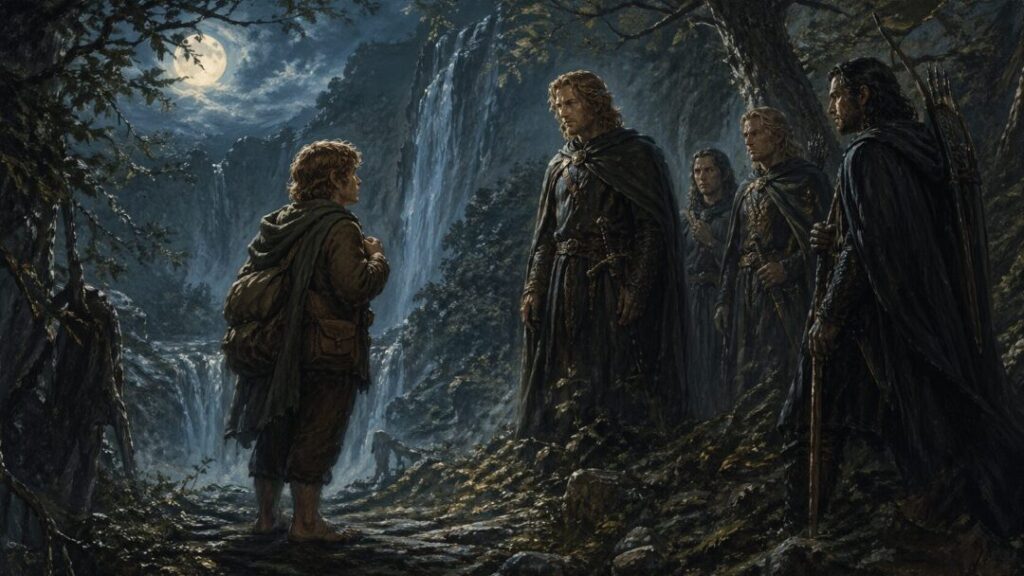
This happens in small but telling ways. Others begin to recognize his quality. Faramir calls him “Master Samwise.” One of the chapters is titled “The Choices of Master Samwise.” These moments matter because they do not mock his earlier lowliness or suggest that service was somehow shameful. Rather, they show that Sam’s inner stature has become visible.
The title “Master” comes toward him.
That is very different from Sam seizing it for himself.
And even then, he does not stop saying “Mr. Frodo.” The old language remains, not because Sam has failed to grow, but because his loyalty has become part of his identity. He can be honored by others without ceasing to honor Frodo in return.
This is one of the quiet elegances of the book.
Sam rises without becoming proud.
He becomes central without becoming self-important.
He becomes “Master Samwise” while still sounding like the Sam who began in Hobbiton.
So Why Does He Keep Saying It?
The simplest answer is also the truest.
Sam calls Frodo “Mr. Frodo” because that is how their relationship begins in the Shire: Frodo is the gentlehobbit at Bag End, and Sam is his gardener.
But that answer is only the surface.
He keeps saying it because the phrase grows with the relationship instead of falling away from it. What begins as social custom becomes personal devotion. What begins as deference becomes the vessel of love, habit, loyalty, and grief. Sam never abandons the old title because he never abandons the part of himself that first spoke it.
And by the end, the phrase contains almost the whole emotional history of their journey.
It still remembers Bag End.
It still remembers service.
But it also carries the Dead Marshes, Cirith Ungol, the ash of Mordor, and the last climb toward the Fire.
That is why “Mr. Frodo” feels so different at Mount Doom than it did in the Shire, even though the words have not changed.
The words stayed small.
The road made them enormous.
Why This Matters More Than People Think
“Mr. Frodo” is one of the clearest examples of how The Lord of the Rings handles intimacy.
The story rarely announces emotion in modern terms. It often leaves feeling embedded inside action, habit, duty, and speech. Characters do not always explain themselves. Instead, the truth of a bond is carried by what they consistently do and how they continue to address one another.
Sam’s phrase belongs to that pattern.
It lets the story preserve both hierarchy and love without reducing either one.
That is why the line endures in memory.
Not because it is quaint.
Not because it is merely sweet.
But because it holds together two things that modern stories often separate: reverence and tenderness.
Sam never speaks as though Frodo were simply his equal companion in the ordinary sense.
And yet no one in Middle-earth proves a deeper fellowship.
Once you notice that, “Mr. Frodo” stops sounding like a small verbal habit.
It starts sounding like one of the quietest and strongest emotional choices in the entire story.
Sources & Notes
- J.R.R. Tolkien, The Lord of the Rings, Prologue, “Concerning Hobbits” — gives the Shire setting and social background in which family, property, and local standing shape Hobbit manners.
- J.R.R. Tolkien, The Lord of the Rings, Book I, Chapter 1, “A Long-expected Party” — presents Bag End, the Baggins position in Hobbiton, and Hamfast Gamgee’s connection with the Baggins household.
- J.R.R. Tolkien, The Lord of the Rings, Book I, Chapter 2, “The Shadow of the Past” — establishes Sam as Frodo’s gardener and servant before the journey begins.
- J.R.R. Tolkien, The Lord of the Rings, Book IV, Chapter 8, “The Stairs of Cirith Ungol” — shows Sam’s “Mr. Frodo” loyalty deepened into intimate companionship under the pressure of Mordor.
- J.R.R. Tolkien, The Lord of the Rings, Book IV, Chapter 10, “The Choices of Master Samwise” — explicitly elevates Sam as “Master Samwise” while his service to Frodo remains central.