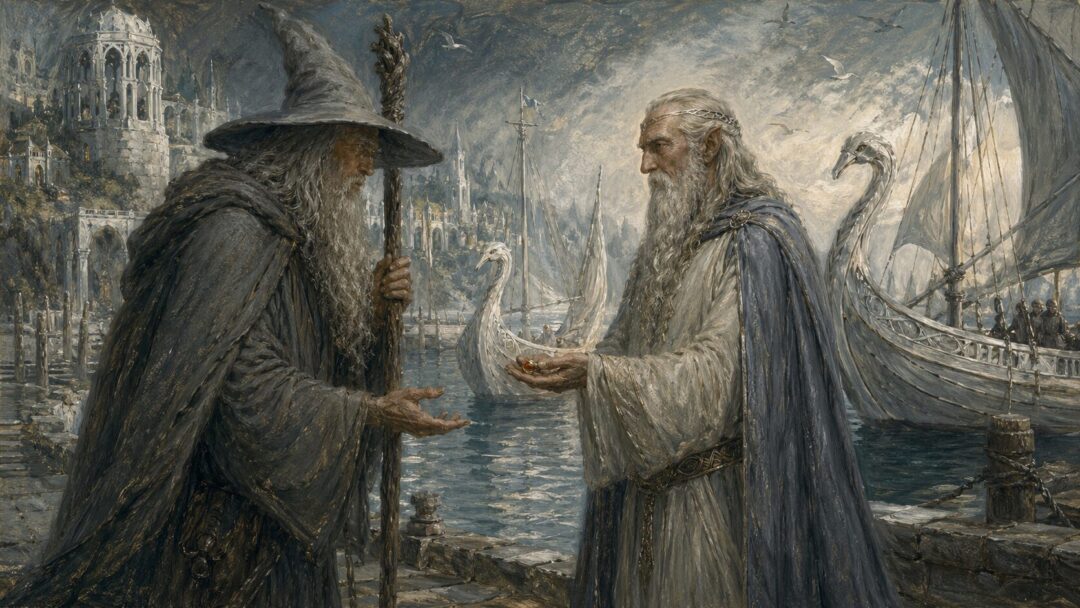
Most people think Gandalf lived because he was simply immortal.
That is true only in the vaguest possible sense.
And in Middle-earth, vague truth is often the kind that misleads most.
Because Gandalf is not presented as a being who just walks through death untouched, or as a wizard who keeps reviving because that is what wizards do. The texts are much more exact than that. They distinguish between what Gandalf is by nature, what he became in Middle-earth, and what happened to him after he fell in Moria. Once those distinctions are kept in view, the answer becomes clearer—and far more interesting.
Gandalf Was Never Just an Old Man
The first step is the most important one.
Gandalf only looks like an old man.
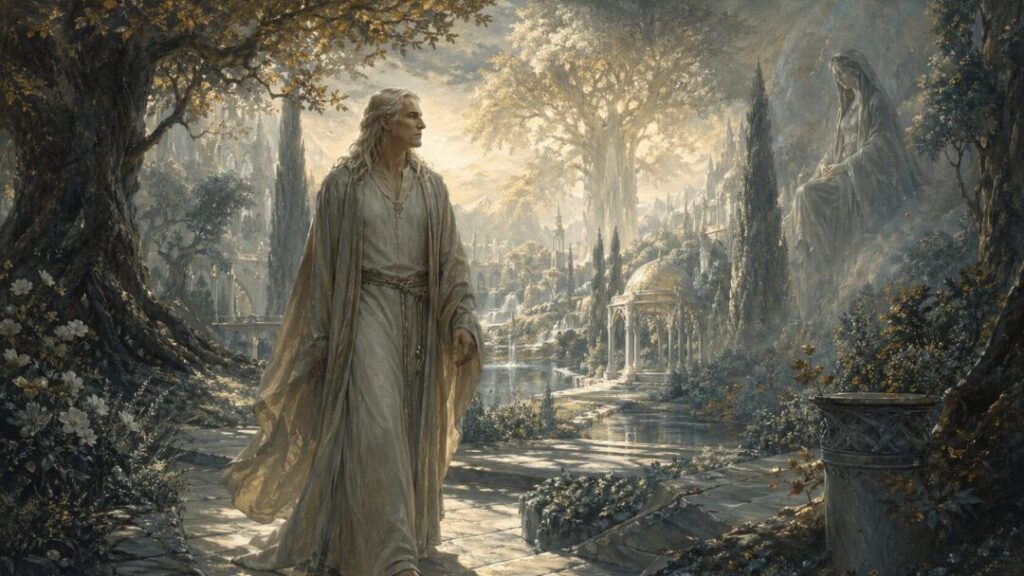
In truth, he belongs to the order of the Maiar, the lesser Ainur: spirits older than the world, existing long before the histories of Elves, Dwarves, or Men began. In the West he was known as Olórin. The later traditions gathered in Unfinished Tales describe him as a spirit associated with Manwë and Varda, and especially as one who learned pity and patience from Nienna. Even before he ever appeared in Middle-earth as Gandalf, mercy and restraint were already central to who he was.
That background matters because it explains why Gandalf’s power never looks like Sauron’s.
He is not in Middle-earth to conquer, dazzle, or dominate. He is sent to stir courage in others.
And that is where the second distinction enters.
The Istari Were Powerful, But Intentionally Limited
Gandalf did not come to Middle-earth in his native condition.
He came as one of the Istari.
The Istari were emissaries sent to resist Sauron, but the terms of that mission were deliberately restrictive. They were clothed in the bodies of old men. Their strength was veiled. They were forbidden from meeting force with force in the way Sauron did. Their purpose was persuasion, encouragement, awakening resistance in the free peoples rather than ruling them directly. Just as importantly, their embodied state made them subject to weariness, pain, grief, hunger, and the other limitations of physical life.
This means Gandalf’s “life” in Middle-earth is not a masquerade.
He is not merely wearing a costume while remaining untouched beneath it.
The texts imply something more costly than that. The wizard’s body is real enough that suffering is real. Fatigue is real. Injury is real. Temptation is real. That is one reason the story gives moral weight to Gandalf’s endurance. He does not drift untouched through the Third Age as a remote immortal visitor. He lives in exile, under limitations he has accepted for the sake of his mission.
So yes, Gandalf is immortal in origin.
But that does not mean his bodily life in Middle-earth is invulnerable.
And that is exactly why Moria matters.
Gandalf Really Died
One of the most common misunderstandings in all of The Lord of the Rings is the idea that Gandalf’s fall in Moria was never truly fatal.
The canon does not support that.
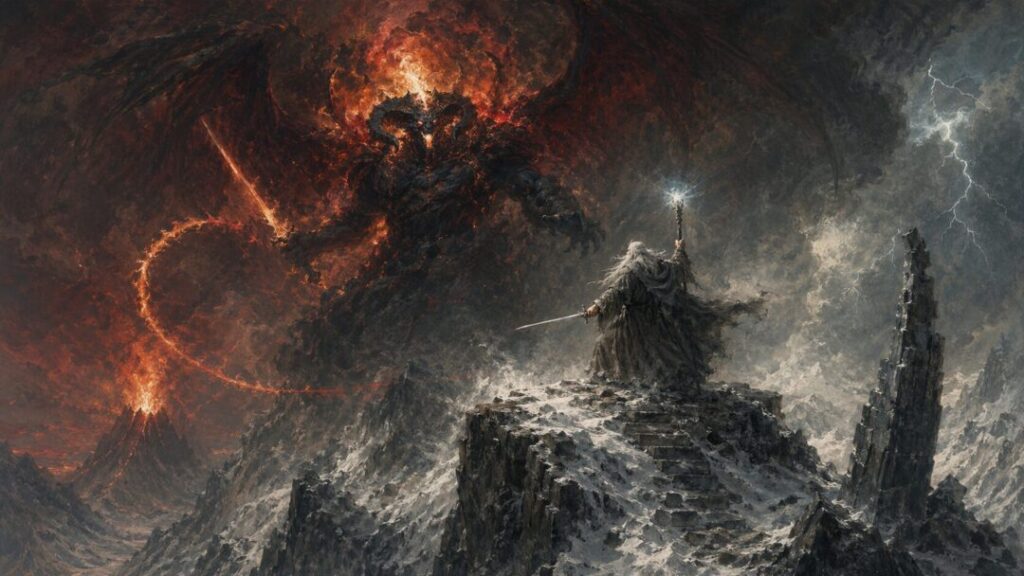
After breaking the Bridge of Khazad-dûm, Gandalf falls with the Balrog into the abyss. But the struggle does not end there. He later explains that they fought through the deep places of the world, climbed the Endless Stair to the peak of Celebdil, and there he cast the Balrog down. The battle ends in victory—but also in Gandalf’s death. Later commentary makes this explicit: Gandalf really died, and his return mattered precisely because death had made a real difference.
That point is easy to miss because the story does not linger sentimentally over it.
There is no long metaphysical lecture in the chapter itself. Instead we get Gandalf’s own strange, compressed description: darkness took him, he strayed “out of thought and time,” and then he was “sent back” for a brief time until his task was done. Even in paraphrase, the language is unmistakable. This is not a near-death recovery. It is a true death followed by return.
And that return is where the deepest part of the answer begins.
He Did Not Live Again By His Own Power
If Gandalf truly died, then why did he live again?
Not because all Maiar automatically reappear in bodily form.
Not because the Istari were guaranteed a reset if they fell.
And not because Gandalf himself simply chose to come back.
The most careful explanation comes from the later commentary traditionally identified with Letter 156. There the point is made that Gandalf’s return came from “Authority,” not merely from the ordinary governance of the Valar within the world. The implication is that his mission, at the moment of apparent failure, was taken up and confirmed from above. He had given himself fully in sacrifice, and he was sent back to complete the task.
That wording matters.
Gandalf says he was sent back.
He does not say he healed himself.
He does not say his nature made death temporary in some effortless sense.
He does not say that death had no hold on him.
The story insists on dependence, not self-exaltation.
And that fits Gandalf’s whole role in Middle-earth. He is strongest when he refuses domination. His greatest moment is not an act of conquest, but an act of surrender to the mission entrusted to him. His return therefore does not glorify his autonomy. It confirms his obedience.
Why Gandalf Returned, But Saruman Did Not
This is where the contrast with Saruman becomes essential.
Both were Maiar.
Both were Istari.
Both were sent under the same general purpose.
But only one returned from death in the story.
Why?
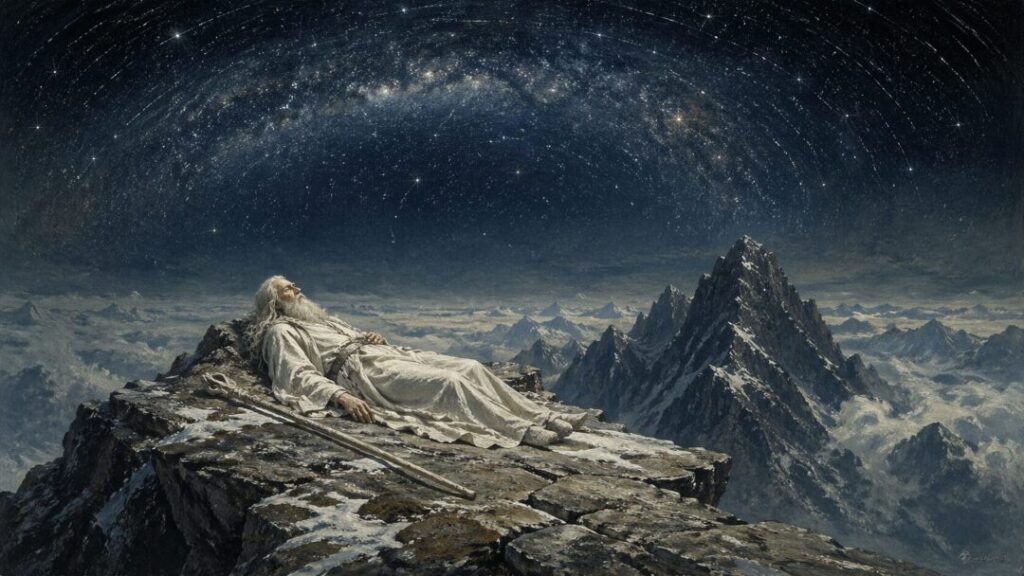
The traditional explanation is not that Gandalf was simply more powerful. In fact, Saruman had originally been the chief of the order. The deeper issue is fidelity to the mission. Gandalf remained committed to aiding others without seizing lordship for himself. Saruman sought mastery. By the time Gandalf died on Zirakzigil, he had become the one Istar who had truly held to the charge laid upon him. That is why, when he returned, he did not come back merely as Gandalf restored. He came back as Gandalf the White, taking up the place Saruman should have filled.
This is one of the most important shifts in the whole narrative.
Gandalf the White is not just Gandalf with brighter robes.
He is the same person, but changed in authority, office, and degree of unveiled power. The old restraint remains. He still guides rather than dominates. But after Moria there is less concealment. He can speak with greater command. He can openly cast down Saruman. The hidden weight in him is no longer hidden to the same extent.
So when people ask how Gandalf “actually lived,” the answer is not merely that he was immortal.
It is that he was returned with purpose.
His Long Life Was Real, But It Was Also Exile
There is another side to the question that is often overlooked.
How did Gandalf live for so long in Middle-earth before Moria?
Again, the answer is not that he was simply an undying old man wandering forever.
As an Istar, he aged only slowly and endured across centuries. But the same traditions that explain the Istari also suggest that embodiment carried a kind of exile with it. They remembered, however distantly, the Blessed Realm they had left. They had to learn much again through experience. They bore the pains of limitation willingly so that they might oppose Sauron in the right way, without becoming another tyrant.
This casts Gandalf in a very different light.
His wandering is not just charming eccentricity.
His weariness is not just theatrical old-man behavior.
His patience is not just temperament.
All of these belong to the form of life he accepted.
He lives among Elves, Men, Dwarves, and Hobbits as one who is older than all of them, yet voluntarily narrowed for their sake. That is why he so often works indirectly. He arranges, counsels, provokes, warns, and heartens. He is not there to solve Middle-earth by raw display. He is there to help its peoples remain themselves long enough to resist the Shadow.
Gandalf’s Return Is Not a Loophole
Modern fantasy has trained many readers to expect resurrection as a device.
A plot reset.
A power upgrade.
A dramatic fake-out followed by applause.
Gandalf’s return is not built that way.
It costs him his life.
It changes him.
It comes from beyond his own agency.
And it happens only because his task is not yet finished.
That restraint is why the moment holds its weight.
The story does not say death was unreal.
It says death was not final in this one particular case.
And even then, only for “a brief time.”
That phrase matters just as much as “sent back.” Gandalf is not restored to begin a new age of open rule. He is returned for completion, not continuation. He is given just enough time to see the war through, to set others in their proper places, and then to depart over Sea when the work is done.
So How Did Gandalf Actually Live?
He lived in Middle-earth first because he was a Maia sent in embodied form as one of the Istari: an immortal spirit, yes, but one truly burdened with age, pain, and limitation. He lived again after Moria not because death could not touch him, but because he was genuinely slain and then sent back by higher authority until his task was complete.
That is the crucial answer.
Gandalf does not survive because the rules do not apply to him.
He survives because the rules are larger than they first appear.
And once that is understood, his story becomes more moving, not less. The old wanderer in grey was never just a mysterious magician. He was a being of immense antiquity choosing weakness for the sake of others. The white rider who returns is not undoing death as though it meant nothing. He is bearing witness that sacrifice, in Middle-earth, can be taken up into something greater without ceasing to be sacrifice.
That is how Gandalf actually lived.
Not by escaping cost.
But by accepting it all the way through.
Sources & Notes
- J.R.R. Tolkien, Unfinished Tales, “The Istari” — identifies Gandalf/Olórin as one of the Maiar sent in aged human form, with power veiled and a mission to counsel rather than dominate.
- J.R.R. Tolkien, The Lord of the Rings, Book II, Chapter 5, “The Bridge of Khazad-dûm” — gives the fall with the Balrog that begins the real crisis behind Gandalf’s return.
- J.R.R. Tolkien, The Lord of the Rings, Book III, Chapter 5, “The White Rider” — has Gandalf describe the battle to the peak, his death beyond “thought and time,” and being “sent back” until his task was done.
- J.R.R. Tolkien, The Letters of J.R.R. Tolkien, Letter 156 — explains that Gandalf truly died and was returned by higher “Authority,” not by his own wizardly power or ordinary Valarin action.
- J.R.R. Tolkien, The Lord of the Rings, Book VI, Chapter 9, “The Grey Havens” — completes the pattern by showing Gandalf’s departure after the task for which he was returned is finished.