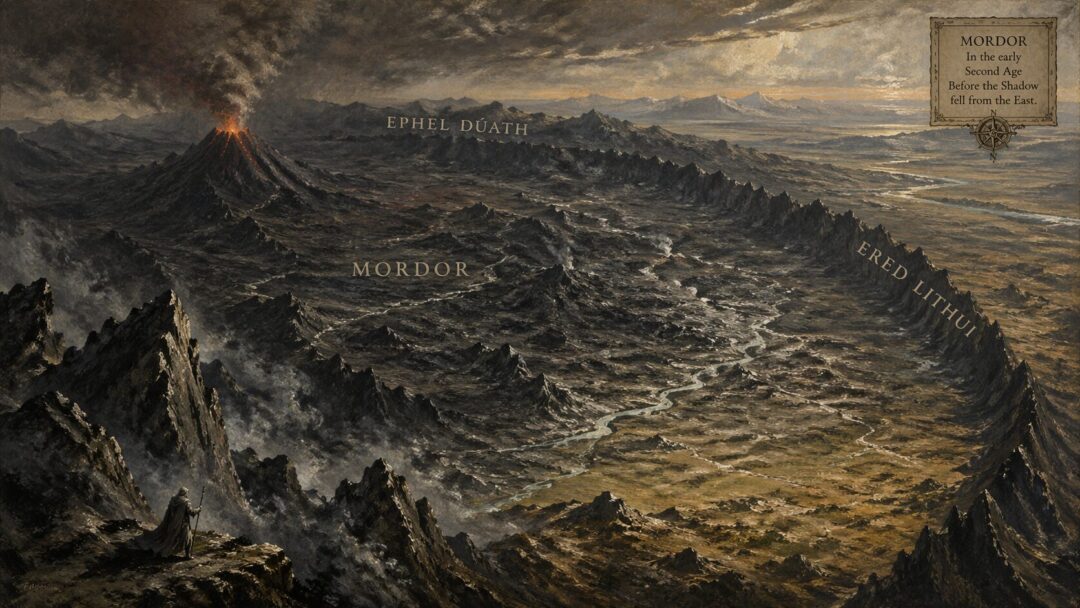
Most people imagine Mordor as if it had always already become itself.
Black rock.
Ash-choked air.
A land built for armies, fear, and fire.
In that picture, Mordor does not really have a history. It has an essence. It exists as the Dark Land because darkness is what it is.
But the canon points to something more precise—and in some ways more disturbing.
Mordor was not merely a symbol. It was a place with geography, resources, strategic value, and a history of occupation. Sauron did not create the land itself from nothing. He chose it, settled in it, and made it into the center of his power around the end of the first millennium of the Second Age. The timeline in The Lord of the Rings places that decision around S.A. 1000, and the tradition preserved in Unfinished Tales places his move into Mordor in the era of Aldarion’s voyages.
That distinction matters.
Because once the land is something chosen rather than conjured, a new question opens:
What exactly did Sauron find there?
Mordor Was Dark Before Sauron, But Not Fully Defined by Him
The first thing to say carefully is that Mordor was probably never a gentle, untouched paradise.
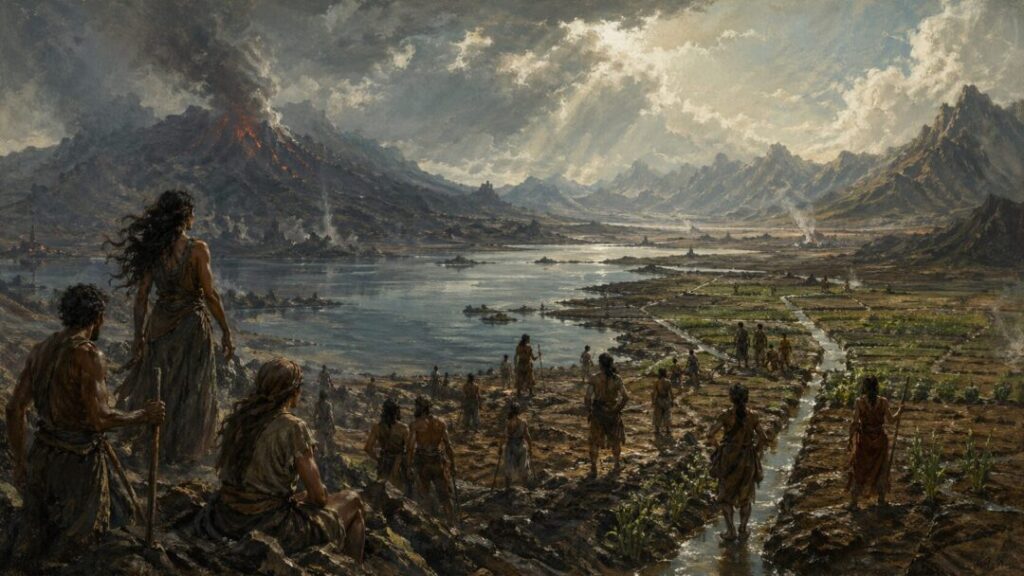
Mount Doom did not begin with Sauron. Sources tied to the legendarium tradition state that Orodruin already existed in the First Age and that its eruptions may even explain why the region later bore the name Mordor, though that point is not stated with full certainty and should be treated cautiously. What is clear is that Sauron chose Mordor partly because of Orodruin and the fire that welled there from the earth, which he used in his sorceries and forging.
So the land was not pristine in the simple pastoral sense.
It already had a volcanic center.
It was already hemmed in by mountain walls.
It was already a place with an ominous natural character.
But that is not the same thing as saying it already looked like the blasted northern Mordor Frodo and Sam endure.
That harsher image comes mainly from Gorgoroth and the regions closest to Barad-dûr and Orodruin. Canon descriptions of Mordor make an important distinction between its northern wastes and its southern lands. Núrn, in the south, was fertile enough to sustain agriculture, with Lake Núrnen fed by rivers descending from the surrounding highlands. Even in Sauron’s final age, those lands were productive enough to feed his military machine.
That means the famous “hellscape” image is real, but partial.
It is not false.
It is incomplete.
The Mordor Frodo Saw Was Only Part of Mordor
This is one of the most overlooked details in the entire geography of the War of the Ring.
Frodo and Sam cross Mordor through its most desolate and militarized regions. They move through the ash, fumes, slag, dust, and hard road systems near the seat of Sauron’s power. Naturally, that is the Mordor readers remember. But the text quietly tells us that away to the south there were “great slave-worked fields” by Lake Núrnen, and roads stretching toward tributary lands from which goods and slaves were brought in.
That line changes the atmosphere of the entire land.
Because a realm that contains agriculture is not simply a dead waste.
It is a functioning state.
A cruel one, obviously.
An industrialized and militarized one.
But not one made only of lava and ruin.
In other words, Mordor under Sauron was not barren in every direction. It was divided. The north was the furnace. The south was the storehouse. One part was twisted into terror; another was subjugated into service.
And that helps answer the central question.
Yes, there was almost certainly a time when Mordor did not look like the fully realized nightmare most people imagine.
Not because it was ever wholly bright and lovely, but because its later appearance reflects centuries of fortification, war-making, and domination concentrated around the northwestern heart of Sauron’s realm.
Did Mordor “Fall” Quickly?
Here the canon becomes more restrained than many retellings.
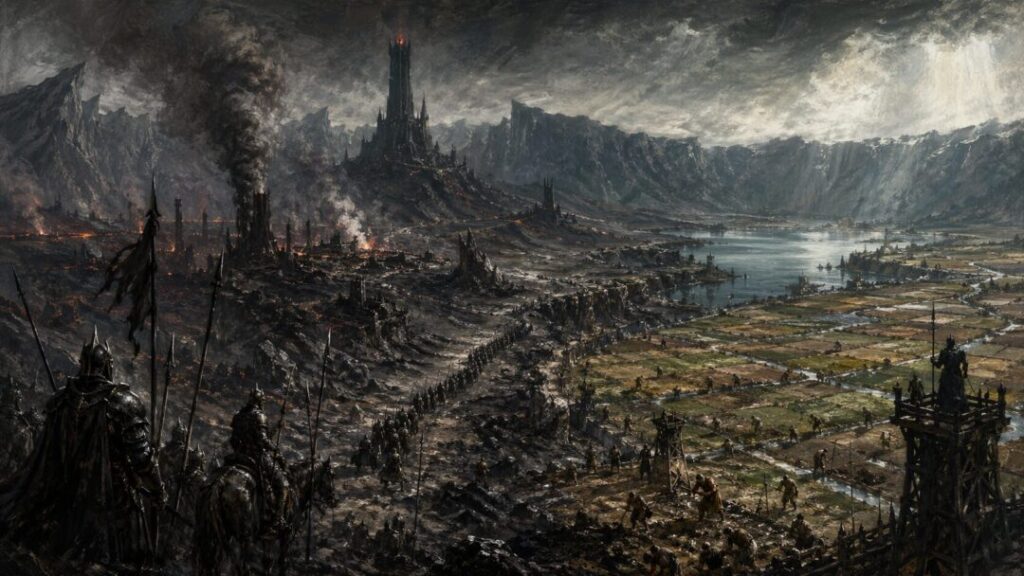
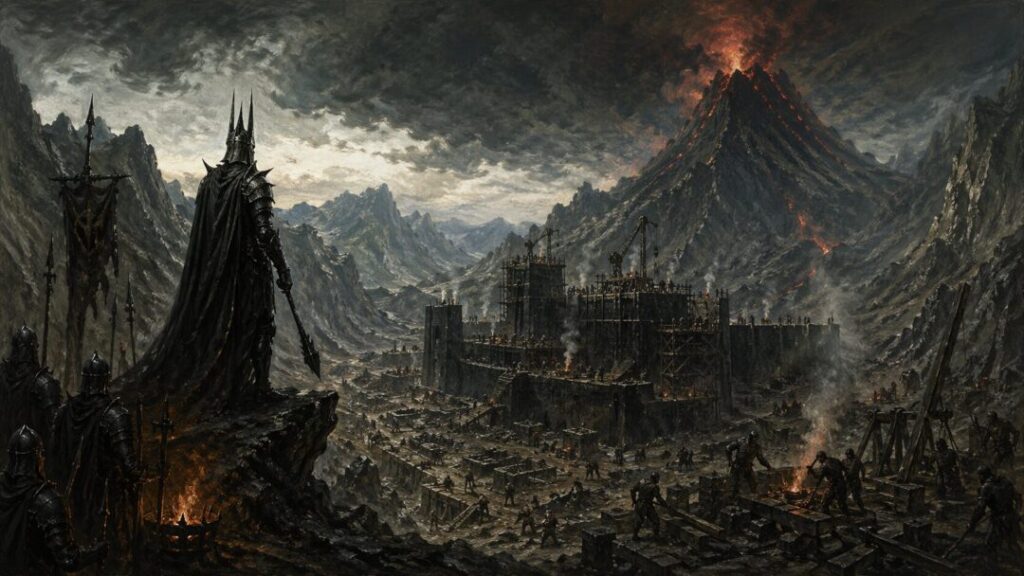
There is no detailed narrative of Mordor being conquered in a great campaign like the fall of a famous kingdom. The texts do not describe a populated independent realm collapsing before Sauron’s armies. Instead, they describe Sauron choosing Mordor as a stronghold and beginning the construction of Barad-dûr around S.A. 1000. By around S.A. 1600, he had forged the One Ring in Orodruin and completed Barad-dûr.
That timeline suggests something important.
Mordor did not necessarily “fall” in the dramatic sense.
It may have been occupied, fortified, organized, and darkened under sustained rule.
That is a different kind of corruption.
The sources also preserve no earlier well-defined political identity for the region. One reference tradition even notes that no earlier name for the land is recorded after later lore remembers it as Mordor. That does not prove the land was empty, but it does warn against inventing a lost kingdom there without evidence.
So the safest lore-accurate answer is this:
Mordor seems to have become Sauron’s realm less through a narrated sudden conquest of a known nation and more through strategic occupation of a naturally defensible land, followed by centuries of transformation into a dark fortress-state.
Why Sauron Chose Mordor
Once this is understood, Sauron’s choice begins to look almost inevitable.
Mordor was protected on three sides by mountain ranges.
It possessed the fire of Orodruin.
It contained regions fit for sustaining war.
And it lay far enough east and south to serve as a secure seat of power against western resistance.
This is why Mordor should not be imagined only as a cursed wasteland.
It was useful.
That usefulness is part of what makes it so dark. Evil in Middle-earth does not merely destroy. It also arranges, disciplines, extracts, and enslaves. The land around Núrnen was not left dead; it was made to serve. The north was not merely volcanic; it was turned into a theater of domination.
And so the final shape of Mordor reflects Sauron’s mind.
Not chaos.
System.
Not just ruin.
Ruled ruin.
Even After Sauron, the Land Was Not One Thing
Another revealing detail comes after the War of the Ring.
When Sauron falls, Aragorn does not treat all of Mordor as permanently unusable. The freed slaves are released and given the lands about Lake Núrnen as their own. That decision only makes sense because those lands could still sustain life and settlement.
So even at the end, Mordor is not a single visual reality.
Some of it is bound to the volcanic desolation around Gorgoroth.
Some of it is agricultural land that had been bent into slavery.
The realm is black, but not uniform.
This matters because it brings the answer into focus.
What Mordor Was Like Before the Hellscape
The most conservative, text-faithful conclusion is this:
Before Sauron, Mordor was likely already a harsh and ominous land, especially in the north near Orodruin. It was enclosed, strategically strong, and marked by volcanic power. But it was not necessarily the fully industrialized, fortress-choked, slave-driven realm of the late Second and Third Ages. Southern Mordor, especially Núrn around Lake Núrnen, was capable of supporting life and agriculture, and there is no canonical basis for treating the whole region as one uninterrupted field of ash from the beginning.
As for how quickly it fell, the canon does not give us a cinematic collapse. It gives us a darker answer.
Sauron chose the land around S.A. 1000.
He began building Barad-dûr.
By around S.A. 1600, the stronghold and the Ring-forging center were in place.
So within roughly six centuries, Mordor had become the fixed heart of his power.
That may sound slow.
But in the scale of Middle-earth, it is terribly fast.
And perhaps that is the real unease in the question.
Mordor did not need to begin as a complete nightmare.
It only needed to be the right kind of land in the hands of the right kind of will.
The hellscape came later.
The choice came first.
Sources & Notes
- J.R.R. Tolkien, The Lord of the Rings, Appendix B, “The Tale of Years” — dates Sauron’s choice of Mordor around S.A. 1000, and the forging of the One Ring and completion of Barad-dûr around S.A. 1600.
- J.R.R. Tolkien, The Silmarillion, “Of the Rings of Power and the Third Age” — describes Sauron establishing himself in Mordor, building Barad-dûr, and using the fire of Orodruin in the making of the One Ring.
- J.R.R. Tolkien, Unfinished Tales, “Aldarion and Erendis,” Appendix D — places Sauron’s move into Mordor within the wider Second Age setting of Númenórean voyages and growing shadow in Middle-earth.
- J.R.R. Tolkien, The Lord of the Rings, Book VI, Chapter 2, “The Land of Shadow” — distinguishes the ash-choked northern roads from the slave-worked fields around Lake Núrnen that supplied Sauron’s armies.
- J.R.R. Tolkien, The Lord of the Rings, Book VI, Chapter 5, “The Steward and the King” — shows Aragorn granting the freed slaves the lands about Lake Núrnen, confirming that southern Mordor was not simply dead wasteland.