At first glance, the question seems simple.
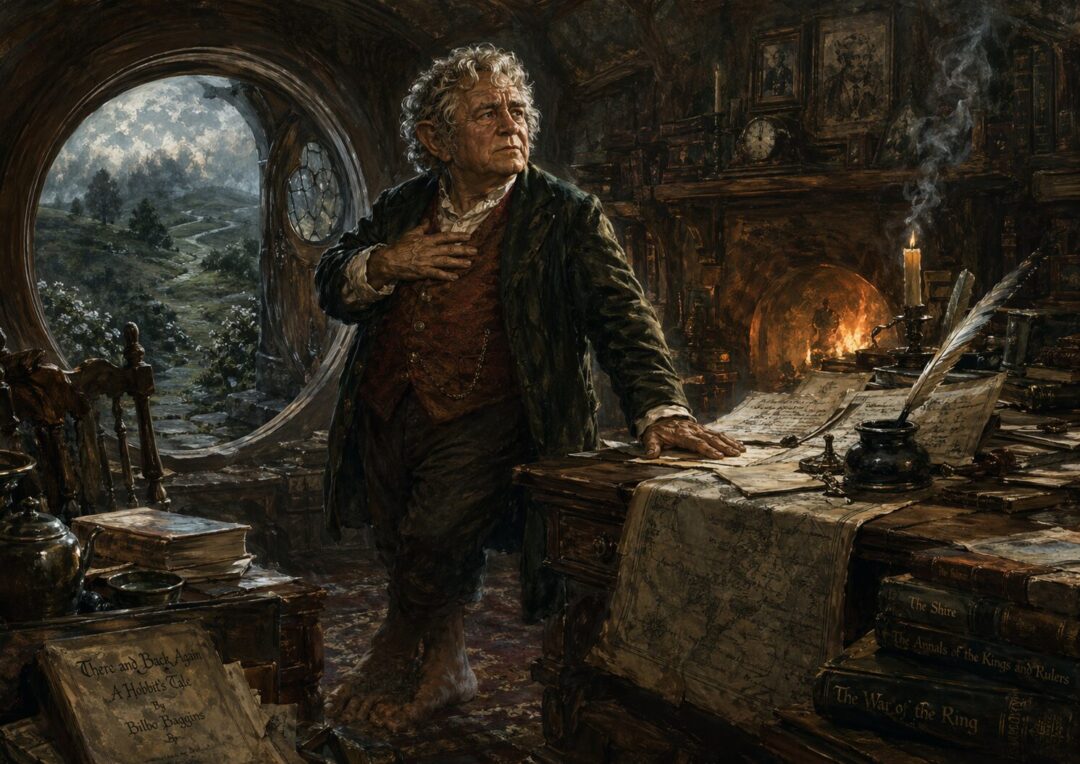
Bilbo gives up the Ring, and eventually he begins to look old.
Gollum keeps the Ring for centuries, yet the story never shows the same kind of sudden catching-up. So many readers reach the same conclusion: Bilbo must somehow have aged faster than Gollum.
But that is not quite what the texts show.
In fact, the deeper answer is more unsettling than that.
Bilbo and Gollum are not two identical cases with different outcomes. They are two very different examples of what the One Ring does to a creature over time. And once the details are set side by side, the real pattern begins to emerge.
The question is not simply why Bilbo aged faster.
It is why Bilbo seems preserved, while Gollum seems consumed.
Bilbo Was Not Aging Normally While He Had the Ring
Long before the Ring is destroyed, the story quietly tells us that Bilbo is not living under ordinary conditions.
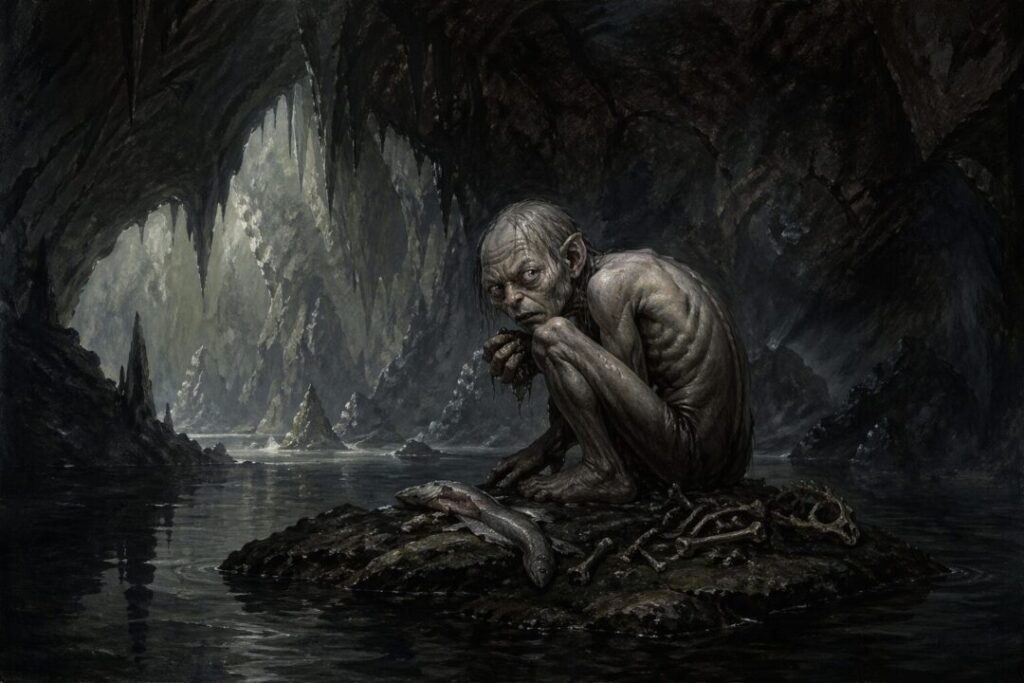
By the time of his farewell party, he is eleventy-one, already older than almost any Hobbit has ever been. Yet Gandalf notices his unusual youthfulness, and Bilbo’s condition is strange enough to deepen Gandalf’s suspicions about the Ring. Bilbo himself does not describe this as health. He describes it as strain. He feels “thin,” “sort of stretched,” as though his life has been unnaturally drawn out.
That distinction matters.
Bilbo is not simply aging slowly because he is robust or lucky. The implication is that the Ring is preserving him beyond his natural span. It does not make him young again. It holds him in a state that is not quite natural, and Bilbo can already feel the cost of that.
This is why his condition should not be imagined as harmless longevity.
The Ring is not giving him extra life in a wholesome sense.
It is suspending something.
Gollum Was Being Sustained, But Not Preserved
Gollum’s case is far darker, and also far less tidy than people sometimes assume.
The Ring prolongs his life far beyond its natural limit. Tolkien Gateway’s summary of the canon material notes that it twists both his body and mind, and that centuries of isolation deepen the ruin. Gandalf’s own description is especially important here: Gollum had possessed the Ring for so long that it went back almost as far as he could remember, yet he had long since worn it little, because in the darkness it was seldom needed. Gandalf adds that Gollum had “never faded” and was still “thin and tough,” even while the torment of the Ring had become almost unbearable.
That gives us one of the clearest clues in the whole discussion.
Gollum is not being kept in the same condition as Bilbo.
Bilbo is “well-preserved,” outwardly more youthful than he should be.
Gollum is not youthful at all. He is withered, hardened, narrowed into something miserable and unnatural. The Ring prolongs him, yes. But it does not preserve his body in any gentle or pleasant sense. What it preserves in Gollum is bare continuance, while corruption has already done its work.
So when readers compare Bilbo’s later aging to Gollum’s appearance, they are often comparing unlike things.
Gollum does not look younger because he has already been physically altered by centuries of corruption, deprivation, and life in darkness. The Ring kept him alive, but it did not keep him fair, healthy, or recognizably whole.
The Most Important Difference Is That Bilbo Survives the Ring’s End
This is the point many discussions miss.
Bilbo lives on after the Ring is destroyed.
Gollum does not.
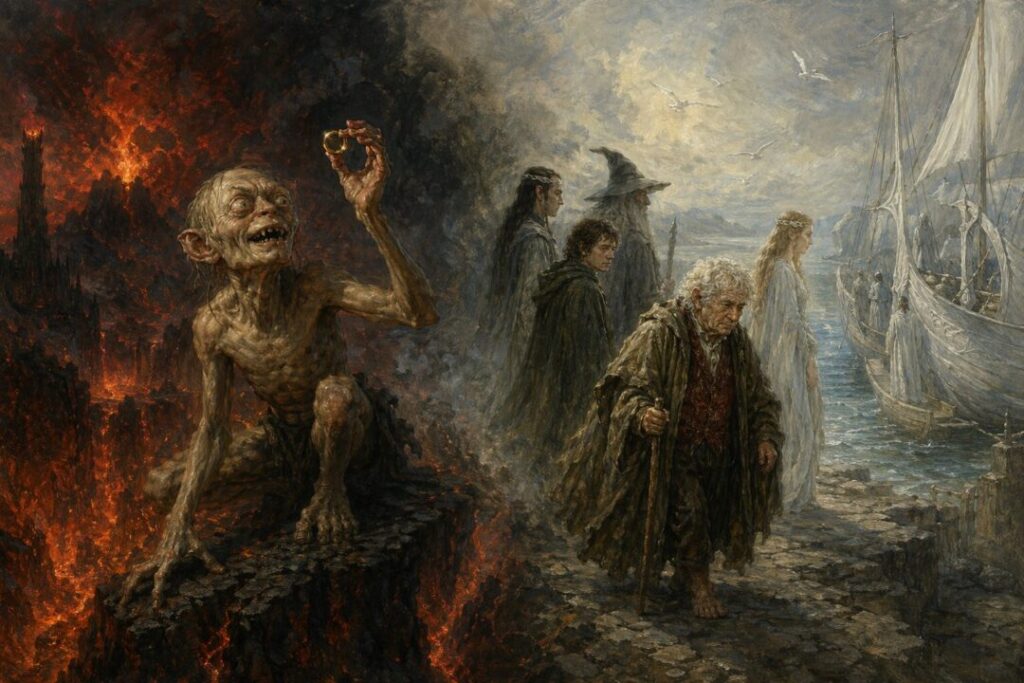
Gollum dies on 25 March 3019, in the very moment he seizes the Ring and falls into the Cracks of Doom. Bilbo, by contrast, is still alive more than two years later, and sails from the Grey Havens in September 3021 at the age of 131.
That means Bilbo is the one character through whom we actually witness the aftermath.
If the Ring had been unnaturally holding back his age, then once the Ring is destroyed, that preservation can no longer continue. The result is not that Bilbo suddenly becomes old out of nowhere. It is that the unnatural suspension ends, and his true burden of years begins to show.
With Gollum, we never get that stage.
He is gone instantly.
So the apparent contrast is partly an illusion created by the story’s timing. Bilbo seems to “age faster” because we are allowed to see him after the Ring’s power is broken. Gollum never reaches that point in life.
Bilbo’s Change Is Gradual, Not a Single Instant Collapse
It is also worth being careful here.
The texts do not really present Bilbo as remaining perfectly unchanged until the Ring is destroyed and then collapsing in one dramatic moment. Even before that, the Ring’s cost is already visible in subtler ways.
He feels stretched.
He wants a “very long holiday.”
He withdraws from the Shire.
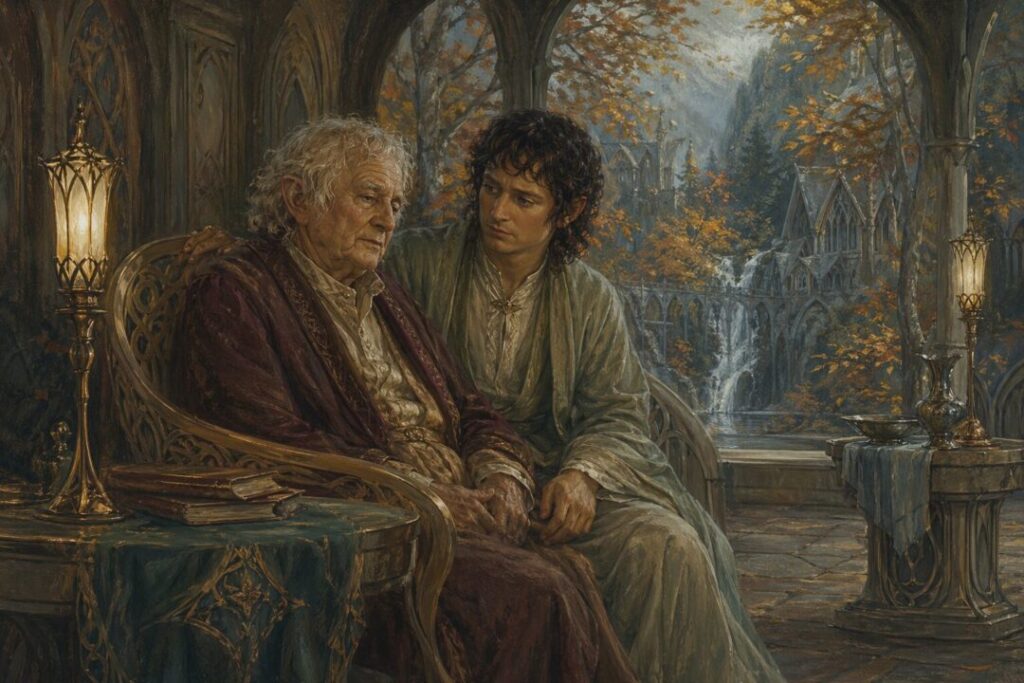
And by the time Frodo sees him again in Rivendell, age is beginning to show more than before. Tolkien Gateway’s summary of “Many Meetings” notes that Bilbo is affected by age more visibly than when he had the Ring and feels it more keenly.
So the better reading is not that Bilbo suddenly becomes old in a single magical snap.
It is that the Ring’s preservation had already become strained, and once the Ring is finally destroyed, there is no longer any power left to hold him in that unnatural condition. From there, his remaining years move swiftly toward their proper end.
This makes Bilbo’s later frailty feel less like a punishment and more like a release into reality.
Why Gollum Does Not Offer a Clean Comparison
Another reason the comparison misleads is that Gollum is not merely an old Ring-bearer.
He is a being who has been shaped by centuries of obsession.
He murdered for the Ring the moment he saw it. He used it for secrecy, malice, and spying. He withdrew into darkness, ate raw fish, and lived cut off from ordinary life for hundreds of years. By the time Bilbo meets him, Gollum is already the long result of corruption, isolation, and unnatural survival.
So when readers ask why Bilbo “aged faster,” there is a hidden assumption beneath the question: that Gollum was somehow aging more successfully.
The texts do not support that.
Gollum is not a preserved Hobbit who stayed young.
He is a ruined creature who remained alive.
That is a very different thing.
Did Bilbo’s Willing Surrender Matter?
There is one more point worth handling carefully.
Bilbo is singled out as the first Ring-bearer to give up the One Ring voluntarily. That is clearly morally significant within the story.
But did that voluntary surrender directly affect how his body aged afterward?
The texts do not say so outright.
It is reasonable to suggest that Bilbo’s case differs from Gollum’s partly because Bilbo relinquished the Ring before it wholly mastered him, whereas Gollum remained enslaved to it until death. That is a fair interpretation. But it should still be labeled as interpretation, not firm statement.
What the canon does show directly is simpler:
Bilbo carried the Ring for decades and remained unnaturally youthful.
Gollum carried it for centuries and became hideously corrupted.
Bilbo survived the Ring’s destruction.
Gollum did not.
Those four facts explain most of the difference without needing anything more speculative.
The Real Answer Is Darker Than It Looks
So why did Bilbo physically age faster than Gollum?
Strictly speaking, the safest answer is that he did not necessarily age faster at all.
Bilbo is simply the one whose post-Ring life we are allowed to witness.
The Ring appears to have held back his natural aging for many years, though not without cost. Once it is destroyed, that preservation can no longer continue, and Bilbo’s true age begins to assert itself. Gollum, meanwhile, never reaches a comparable aftermath. He dies the instant the Ring perishes.
And there is something bleak in that.
Bilbo’s later frailty is painful to see, but it also reveals something merciful: there was still a Bilbo left to return to ordinary time.
Gollum’s condition suggests something worse.
By the end, the Ring had not merely prolonged his life. It had already consumed so much of it that there may have been very little left to “return” to at all.
That is why Bilbo’s aging feels visible and Gollum’s does not.
One of them outlived the Ring.
The other had been living inside its ruin for centuries already.
Sources & Notes
- J.R.R. Tolkien, The Lord of the Rings, Book I, Chapter 1, ‘A Long-expected Party’ — Bilbo at eleventy-one is unusually well-preserved, while he describes himself as thin and stretched by the Ring’s unnatural prolonging of life.
- J.R.R. Tolkien, The Lord of the Rings, Book I, Chapter 2, ‘The Shadow of the Past’ — Gandalf explains that a mortal Ring-bearer does not gain more life but merely continues, and contrasts fading with Gollum’s thin, tough survival in the dark.
- J.R.R. Tolkien, The Hobbit, Chapter 5, ‘Riddles in the Dark’ — Bilbo finds Gollum already altered by long possession of the Ring and hidden life under the Misty Mountains.
- J.R.R. Tolkien, The Lord of the Rings, Book VI, Chapter 3, ‘Mount Doom’ — Gollum dies at the Cracks of Doom at the moment the Ring is destroyed, so the story gives him no post-Ring period comparable to Bilbo’s.
- J.R.R. Tolkien, The Lord of the Rings, Book VI, Chapter 9, ‘The Grey Havens’ — Bilbo, aged 131, survives into the aftermath and departs over Sea with the other Ring-bearers.