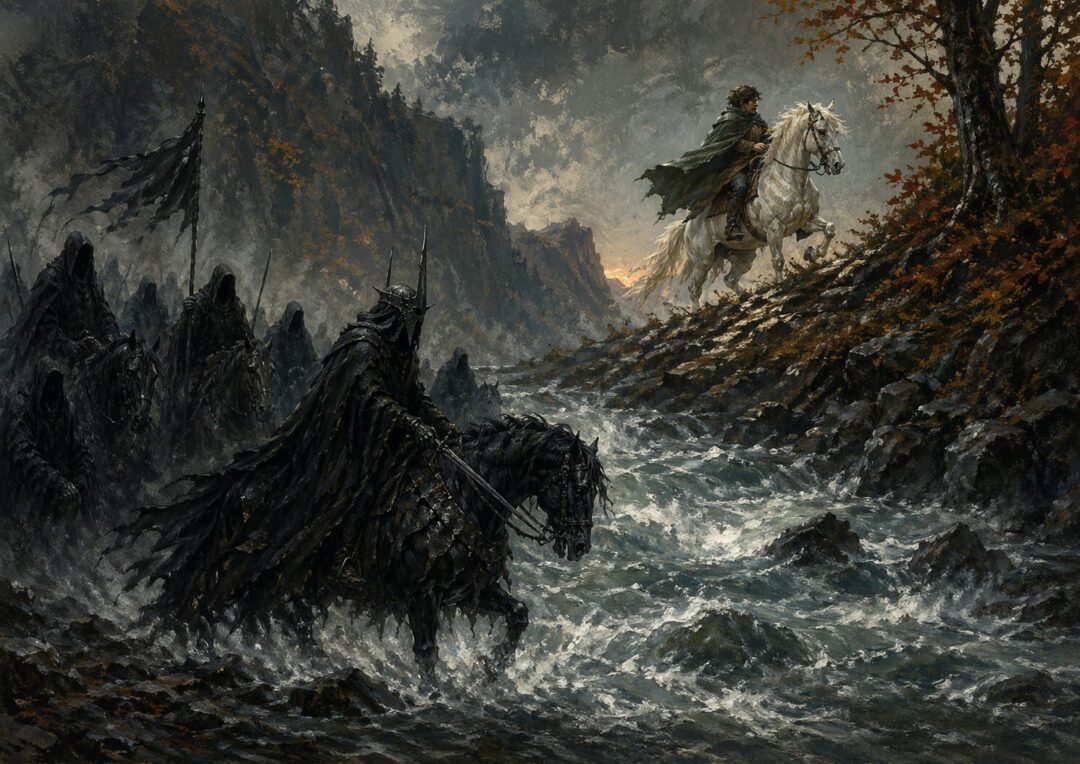
When the Ringwraiths reach the Ford of Bruinen, the scene is usually remembered for the flood.
Frodo escapes across.
The Nine gather at the water’s edge.
Then the river rises in wrath and sweeps them away.
It is one of the most vivid moments in The Fellowship of the Ring.
But the detail that matters most comes just before that.
They hesitate.
That hesitation is easy to miss because the flood is so dramatic. Yet once it is noticed, it opens a much deeper question. Why would the Nazgûl—Sauron’s most feared servants, beings before whom animals panic and ordinary hearts fail—show reluctance at a river?
The answer is more careful than many summaries make it sound.
The texts do say that the Ringwraiths feared water.
But they do not explain that fear in a simple, mechanical way. They do not say that running water destroys them, or that they are under some universal magical ban. In fact, the evidence suggests something subtler, and more interesting, than that.
The clearest statement comes outside the main narrative
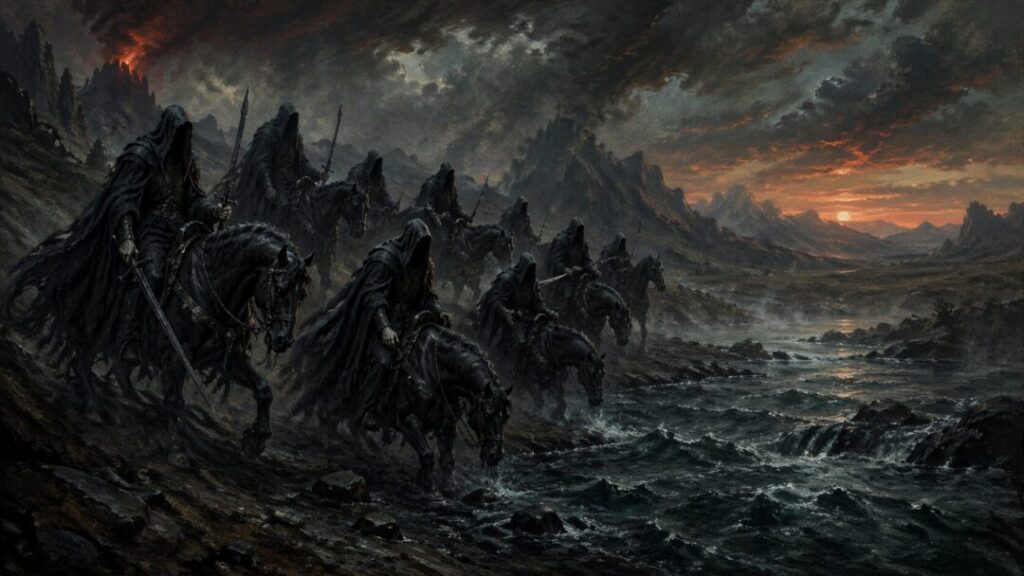
The strongest direct statement appears in Unfinished Tales, in the material known as “The Hunt for the Ring.”
There, the Nazgûl’s pursuit of the Ring is described with an important limitation attached to it: all except the Witch-king feared water and were reluctant to cross rivers without a bridge. Christopher Tolkien also notes that this fear is nowhere else explained, and that the idea was difficult to sustain consistently.
That matters immediately.
It means the fear is real within the text tradition.
It also means the texts do not turn it into a fully systematized rule.
So the safest reading is not that the Nazgûl are incapable of entering water.
The safest reading is that water is a genuine obstacle and danger to them, one serious enough to shape how they move, especially when they do not have a secure crossing.
The Ford of Bruinen shows that the fear is not absolute
If water were a hard prohibition, the scene at the Ford would look very different.
But it does not.
Frodo sees the Nine at the river. Then the foremost Rider—clearly acting as their leader—spurs his horse forward. The horse checks at the water and rears, but the Rider forces onward, and two others follow him into the Ford before the flood strikes.
That scene is crucial because it prevents the simplest explanation.
The Nazgûl are not like creatures in later fantasy who cannot physically cross running water at all. At least in extreme need, they can attempt it. The Witch-king can clearly drive the matter to a decision, and the others can follow.
So the problem is not bare contact.
The problem is risk.
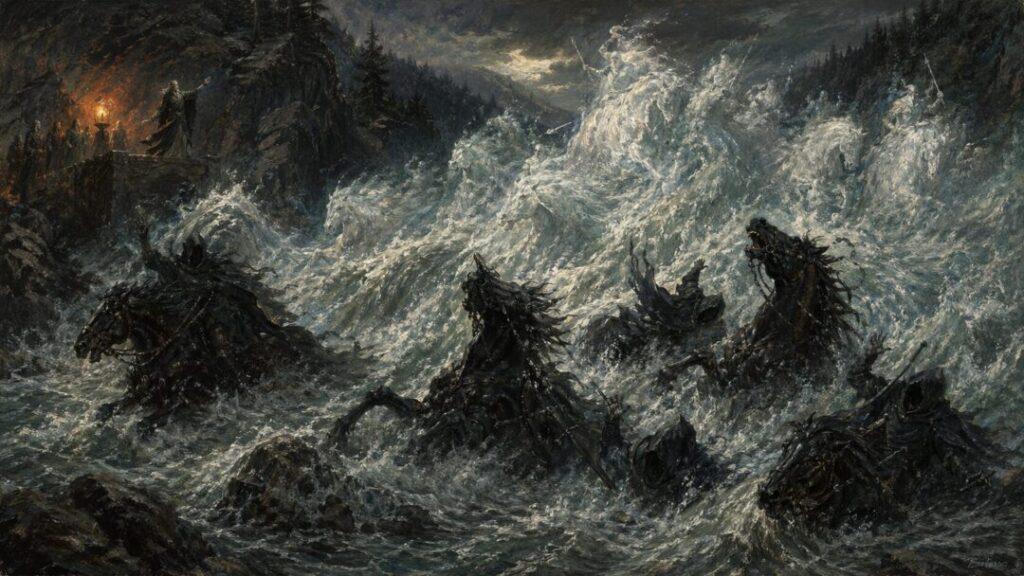
At the Ford, that risk becomes catastrophic almost instantly. Elrond commands the river, Gandalf adds terrifying force and imagery to the flood, and the Riders are caught between water, fire, and the revealed presence of an Elf-lord. Their horses are driven mad and carry them into the torrent. Gandalf later says the horses perished, while the Ringwraiths themselves were not destroyed but left crippled without their mounts.
That already gives us part of the answer.
Water is fearful to them not because it is a symbolic inconvenience, but because it can break their movement, separate them from their horses, and ruin the form in which they can most effectively hunt.
Their dependence on horses makes rivers far more dangerous
One of the most important details about the Nazgûl is that, despite their terrifying nature, they are not just drifting shadows.
When they deal with the living world, they use real clothing, real weapons, and in this case real horses. Gandalf says this directly, explaining that the black horses are actual animals bred to the Dark Lord’s service.
That has a practical consequence.
The Ringwraiths are far more dangerous as mounted hunters than as disembodied terrors moving without shape through the wilderness. Mounted, they can pursue, surround, menace, and overtake prey. Unhorsed, they are diminished. Gandalf explicitly says that without their horses they are crippled for the time.
So when Unfinished Tales says they feared water, that fear likely includes the very real danger of losing the animals that make them mobile and formidable in the physical world.
The Ford of Bruinen confirms this exactly.
The flood does not annihilate the Nine themselves. It destroys their immediate effectiveness by destroying the horses and scattering the Riders. Water, then, is not merely unpleasant to them. It threatens the way they operate.
The fear becomes sharper where hostile power is present
There is another layer here, and the text at Rivendell makes it hard to ignore.
Gandalf tells Frodo that Elrond commanded the flood. The river of that valley is under Elrond’s power, and it rises in anger when needed to bar the Ford. Gandalf then says he added some touches of his own.
This means the Bruinen is not just water.
At that moment it is water acting as an instrument of powers opposed to Sauron.
That distinction matters because the Nazgûl are especially vulnerable in places where the Seen and Unseen worlds overlap under the protection of great Elvish power. Gandalf explains that the high Elves dwelling in Rivendell do not fear the Ringwraiths, and that Glorfindel exists with power in both worlds. Frodo, half in the wraith-world because of the Morgul wound, briefly sees Glorfindel in a more terrible light than ordinary sight would show.
So the danger at the Ford is not reducible to hydraulics.
The Nazgûl are entering a defended threshold near Rivendell, a place where their enemies possess authority in both the visible and invisible dimensions in which the wraiths themselves operate. Water there is not neutral terrain. It is part of the valley’s resistance.
That does not mean every stream in Middle-earth is equally dreadful to them.
But it does mean the Bruinen is the worst possible place to test their nerve.
The texts do not fully explain why water in particular matters
This is where careful phrasing matters most.
The texts tell us that the Nazgûl feared water.
The texts show that rivers could hinder them.
The texts show that the Ford of Bruinen was disastrous for them.
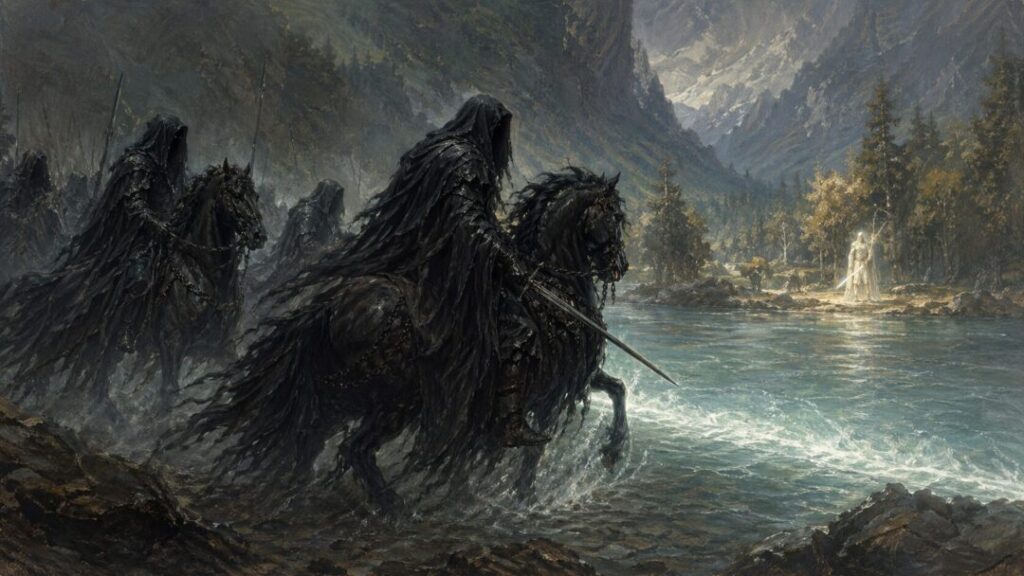
The texts do not tell us, in a single definitive statement, why water became this particular weakness.
That leaves room for interpretation, but only if it is labeled as interpretation.
One possible reading is practical: rivers are obstacles to mounted pursuit, especially for servants whose chief weapon is terror and speed. That reading is strongly supported by the actual events.
A second possible reading is spiritual: the Nazgûl, beings unnaturally suspended between life and death, are ill at ease with elemental forces that remain unmastered by them—especially where those forces are under the governance of powers hostile to Sauron. The Ford scene supports this in part, but the text never states it outright, so it should remain an interpretation, not a certainty.
A third possibility is that the idea reflects an older imaginative pattern in which evil beings are checked by boundaries, thresholds, and cleansing natural forces. That may help explain the feel of the scene, but again, it is broader literary interpretation rather than explicit in-world explanation.
The strongest answer is still the most restrained one.
Water is a named weakness.
Rivers are obstacles.
And where water is joined to Elvish power, the Nazgûl can be thrown into real disorder.
Even the Witch-king’s exception tells us something
The exception in Unfinished Tales is revealing.
All feared water except the Witch-king. Or, more precisely, all except him are described as fearing it in that passage.
That does not mean the Witch-king is invulnerable to rivers. He too is swept away at the Ford. But it does suggest greater will, greater mastery, or at least greater ability to force action where the others would shrink back.
That matches what the story repeatedly shows elsewhere.
The Witch-king is not simply one more Nazgûl among nine. He is their captain, their chief, and the one most capable of pressing forward in moments where others hesitate. At the Ford, it is the foremost Rider who first enters the water, breaking the deadlock.
So even here the pattern holds.
Water troubles the Nazgûl.
The Witch-king can push past that trouble.
But once the river answers in force, even he cannot master what has been unleashed.
Why this detail changes the whole scene
The Ford of Bruinen is often told as a moment when the Ringwraiths simply fail.
It is more precise to say that they overreach.
They pursue Frodo to the edge of Rivendell.
They force the crossing despite a known weakness.
And they do so in the one place where water is not only an obstacle, but a weapon in the hands of their enemies.
That makes their defeat more revealing than it first appears.
The Nazgûl are terrifying, but not limitless.
They dominate fear, but are not beyond fear themselves.
They are strongest where the living world can be bent into dread.
They are weaker where that world rises against them.
And that may be the deepest answer the texts allow.
The Ringwraiths fear water because water is one of the places where their power stops feeling absolute.
Not everywhere.
Not always.
Not as a neat rule.
But enough that when they come to the Bruinen, even before the flood, they already know they are nearing a boundary where the world does not fully belong to them.
That is why they hesitate.
And that is why the river matters before it ever rises.
Sources & Notes
- J.R.R. Tolkien, Unfinished Tales, “The Hunt for the Ring” — says the Nazgûl feared water, with the Witch-king as the exception, and were reluctant to cross rivers without a bridge.
- J.R.R. Tolkien, The Lord of the Rings, Book I, Chapter 12, “Flight to the Ford” — shows Frodo at the Bruinen, the Riders halted at the water, and the foremost Rider forcing his horse into the Ford before the flood breaks.
- J.R.R. Tolkien, The Lord of the Rings, Book II, Chapter 1, “Many Meetings” — Gandalf explains that Elrond commanded the flood, that he added the horse-shaped waves, and that the Riders were unhorsed and crippled for a time.
- J.R.R. Tolkien, The Lord of the Rings, Book II, Chapter 1, “Many Meetings” — identifies the black horses as living animals bred to Sauron’s service, supporting the article’s stress on mounted pursuit and vulnerability when unhorsed.
- J.R.R. Tolkien, The Lord of the Rings, Book I, Chapter 12, “Flight to the Ford”; Book II, Chapter 1, “Many Meetings” — Glorfindel’s revealed power and Gandalf’s comments on Rivendell’s High Elves support the reading of the Ford as especially hostile ground for the wraiths.