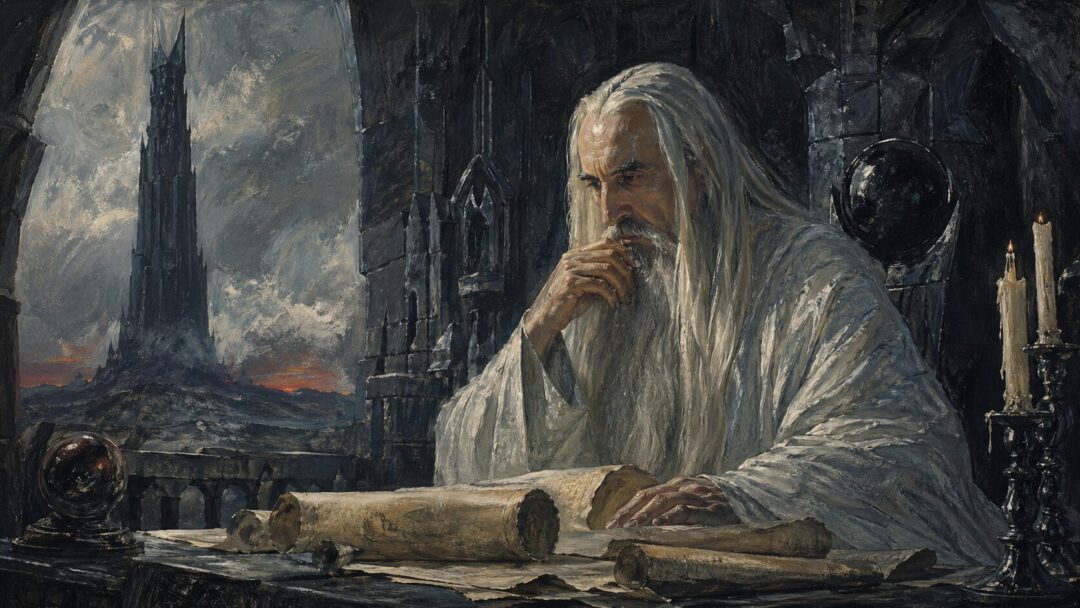
Saruman’s betrayal is often imagined as a sudden fall.
A wise wizard looks too long into dark knowledge.
A proud mind meets Sauron through the palantír.
A servant of the West becomes a rival of the Dark Lord.
There is truth in that outline.
But it is not the whole story.
Saruman did not become dangerous only when Gandalf arrived at Orthanc in the year 3018 of the Third Age. By then, the mask had slipped. Saruman was no longer merely studying power. He was trying to possess it.
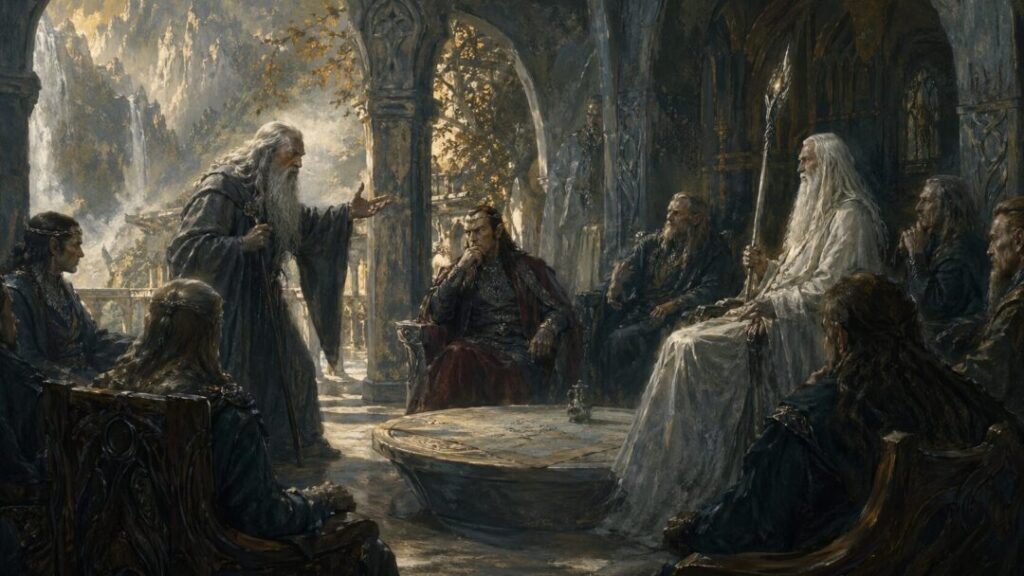
The more difficult question is whether that secret purpose had already begun much earlier—around the time of Gandalf’s dealings with Rivendell and the White Council, before the events of the War of the Ring had fully opened.
Was Saruman’s plan already settled then?
The answer is not simple.
The texts do not show us one private moment where Saruman decides, “I will betray the Council.” They do not give us a confession from his own heart. But they do give us a chain of actions, delays, lies, and concealed searches.
And when those pieces are placed together, Saruman’s fall looks less like a sudden collapse and more like a long inward turning.
Saruman Was Not Always a Servant of Sauron
The first thing to say carefully is this:
Saruman was not simply “on Sauron’s side” from the beginning.
That would make the story too easy.
He came to Middle-earth as one of the Istari, sent to oppose Sauron, not to join him. He was counted among the Wise and became the head of the White Council. His knowledge of Ring-lore was real. His authority was real. His early purpose, at least in origin, was not false.
This matters because Saruman’s evil is not presented as ordinary loyalty to darkness.
It is corruption through pride.
He does not begin as a servant kneeling before Mordor. He becomes a mind that believes it can study the Enemy’s weapons, master the Enemy’s logic, and use power without being consumed by it.
That is exactly what makes him dangerous.
Saruman’s path is not the path of someone who loved Sauron.
It is the path of someone who began to resemble him.
The Ring-Lore That Should Have Protected Him
Saruman’s special field was the Rings of Power.
This gave him status among the Wise. When questions arose about the One Ring, his voice carried weight because he had studied these matters deeply.
But knowledge in Middle-earth is never neutral when it concerns instruments of domination.
The One Ring was not merely a lost artifact. It was made by Sauron to rule the bearers of the other Rings and to strengthen his own power. To study it was to study the central weapon of the Enemy.
Saruman may have begun with legitimate purpose. The texts allow that. He had reason to investigate the Ring. The Wise needed knowledge, and Saruman had much of it.
But at some point, the line shifted.
He no longer wished only to understand the Ring.
He began to desire it.
This is one of the most important points in the chronology. In the year 2851 of the Third Age, the White Council met, and Gandalf urged an attack on Dol Guldur after discovering that the dark power there was truly Sauron. Saruman overruled him. The later record makes clear that Saruman had already begun to desire the One Ring for himself and hoped that if Sauron were left alone for a time, the Ring might reveal itself.
That does not mean Saruman’s entire later strategy was already complete.
But it does mean the decisive inward corruption had begun.
He was no longer thinking only as a guardian.
He was thinking as a seeker.

The Delay at Dol Guldur
The delay over Dol Guldur is one of the first major signs that something is wrong.
Gandalf wanted action. Saruman resisted.
On the surface, this could be presented as caution. A wise leader might argue against striking too soon. Saruman could make his delay sound strategic, careful, even responsible.
But the later explanation darkens that decision.
Saruman hoped that Sauron’s growing strength might draw the Ring out of hiding. In other words, he was willing to let the Shadow remain in Dol Guldur because he believed the situation might help reveal the Ring.
That is a terrible calculation.
He was not yet openly declaring himself against the Council. He was not yet raising armies in Isengard. But already he was treating the danger of Sauron as something that might serve his private desire.
That is the beginning of betrayal.
Not because Saruman had already become Sauron’s servant, but because he had begun to use the war against Sauron as a cover for his own hunt.
The Search Near the Gladden Fields
The location matters.
The Gladden Fields were the place associated with Isildur’s death and the loss of the One Ring. After Sauron’s defeat at the end of the Second Age, Isildur took the Ring. Later, he was ambushed near the Gladden Fields, and the Ring was lost in the River.
Saruman’s later search in that region is therefore deeply revealing.
He was not merely studying old stories from a distance. He was looking near the place where the Ring had vanished from history.
The texts do not tell us every detail of his search, and we should not invent what is not stated. But the direction of his interest is clear enough. Saruman believed the Ring might still be found. More than that, he wanted it for himself.
This is where the question of Rivendell becomes so interesting.
If we are imagining Gandalf and Saruman in the same broad period of White Council affairs, then Gandalf was dealing with someone who still appeared to be a leader of the Wise, while already carrying a hidden desire that would one day ruin him.
Gandalf did not yet know the full danger.
And that ignorance was exactly what allowed Saruman to remain so effective.
Was the Plan Already Settled?
The answer depends on what “plan” means.
If we mean: had Saruman already decided to openly betray Gandalf, imprison him, build an army, claim lordship over Isengard, and set himself up as a rival power?
The safest answer is no, or at least not in any form the texts clearly state.
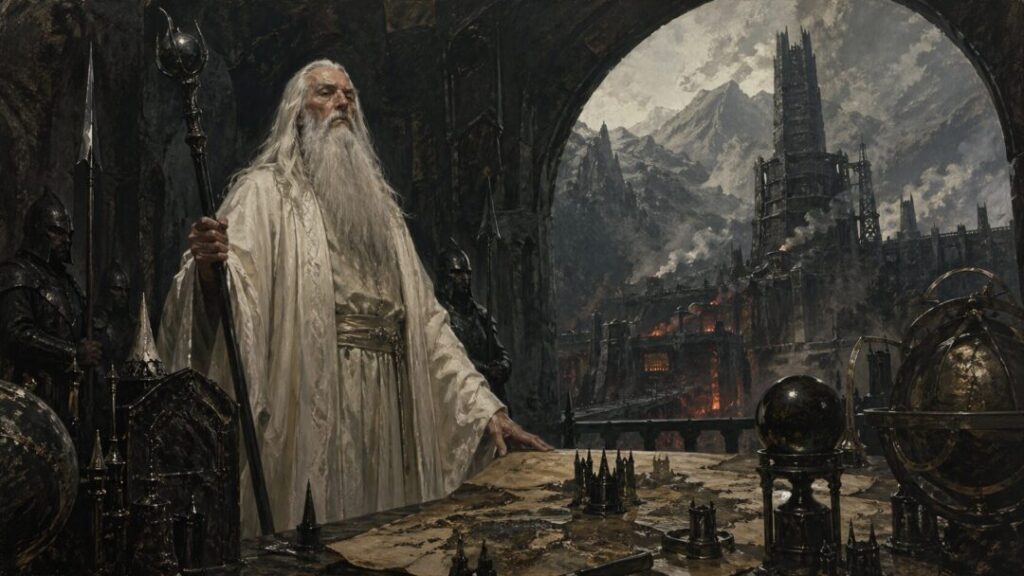
That later shape of treachery develops over time. Saruman’s fortification of Isengard, his use of the palantír, his dealings with Sauron, his breeding and mustering of servants, and his eventual assault on Rohan belong to the later hardening of his fall.
But if we mean: had Saruman already begun secretly seeking the One Ring for himself?
Yes.
That part is strongly supported.
The texts indicate that his desire for the Ring had already begun long before the War of the Ring. He had already delayed action in a way that served his private hope. He had already begun searching in the region where the Ring had been lost.
So the plan was not fully formed.
But the root of the plan was alive.
And in Saruman’s case, the root mattered more than the details.
The Lie That Revealed Him
One of Saruman’s most revealing claims comes later, at the final meeting of the White Council in 2953.
There he quieted fears by saying, in effect, that the Ring had long ago gone down Anduin to the Sea. This made the Ring sound unreachable. Lost beyond recovery. No longer a practical danger.
But that claim sits uneasily beside Saruman’s own behavior.
If Saruman truly believed the Ring was gone forever, why had he searched near the Gladden Fields? Why did he care so deeply about the movements of Sauron’s servants near the River? Why did the subject continue to matter to him?
The most conservative reading is that Saruman said more than he knew, or said what was useful rather than what was certain.
A darker interpretation is that he deliberately misled the Council to keep others from seeking what he still hoped to find.
The texts strongly support the idea that Saruman concealed his true desire. They do not require us to imagine every detail of his deception. His own words and actions are enough.
He told others the Ring was beyond reach.
But he behaved like a person who still wanted to reach it.
Why Gandalf Did Not See It Fully
This is not because Gandalf was foolish.
Saruman had status, knowledge, and authority. He was the head of the White Council. His reputation gave him cover. And his arguments could be framed as wisdom rather than corruption.
That is how Saruman’s fall works.
He does not begin by looking obviously evil.
He begins by sounding reasonable.
Delay the attack.
Trust my knowledge.
Do not fear the Ring.
Leave these matters to those who understand them.
To others, this could sound like prudence.
But beneath it was a private hunger.
Gandalf’s later suspicion grows because events force the truth into the open. When he finally comes to Orthanc in 3018, Saruman no longer merely hides his desire. He reveals himself as one who wants the Ring and believes power must be answered with power.
By then, Gandalf is not seeing the birth of Saruman’s betrayal.
He is seeing its unveiling.
Saruman Did Not Want to Serve Sauron
This point is crucial.
Saruman’s secret ambition was not simply to help Sauron win.
He wanted the Ring for himself.
That made his position more complicated and more dangerous. He could oppose Sauron and still be evil. He could desire Sauron’s defeat and still betray the Free Peoples. He could tell himself that he would use power wisely, perhaps even for order, knowledge, or victory.
But that is the Ring’s trap.
It offers domination in the language of necessity.
Saruman’s mistake was not only that he wanted power. It was that he believed his wisdom made him safe from the moral cost of seeking it.
This is why his title later becomes so chilling.
“Saruman Ring-maker” is not merely a boast.
It is the sound of a mind that has stopped resisting the logic of the Enemy and begun imitating it.
The Rivendell Question
So was Saruman’s secret plan settled when he met Gandalf in Rivendell?
Not in every outward detail.
The texts do not show a completed blueprint at that point. We should not claim that Saruman had already planned every later act, from the imprisonment of Gandalf to the ruin of Isengard.
But the deeper betrayal had already begun.
By the time the White Council debates Dol Guldur and the fate of the Ring, Saruman is no longer a purely trustworthy guardian of Ring-lore. He has already turned inward. He has already begun to seek the Ring. He has already allowed the struggle against Sauron to become entangled with his own desire.
That is the real answer.
Saruman’s fall was not settled all at once.
It settled slowly.
First as curiosity.
Then as expertise.
Then as private desire.
Then as concealment.
Then as policy.
Then as open treachery.
By the time Gandalf stood before him in Orthanc, the road had reached its end.
But the first steps had been taken long before.
Why This Makes Saruman More Tragic
Saruman is frightening because he is not ignorant.
He knows too much.
He understands the Rings. He understands Sauron. He understands power. He has wisdom, rank, and long experience.
And still he falls.
That is the tragedy.
Saruman’s ruin does not come from lack of knowledge. It comes from knowledge without humility. He studies the Enemy so deeply that he begins to think like the Enemy. He seeks a weapon of domination and persuades himself that he can remain its master.
In the end, Saruman’s secret plan was not merely to find the Ring.
It was to prove that he was wise enough to use it.
And that was the lie at the heart of everything.
Middle-earth gives many warnings about power, but Saruman’s may be one of the quietest and most severe:
The fall does not always begin when someone chooses evil openly.
Sometimes it begins when they decide that they alone can be trusted with it.
Sources & Notes
- J.R.R. Tolkien, The Lord of the Rings, Appendix B, “The Tale of Years” — records the 2851 White Council meeting: Gandalf urged an attack on Dol Guldur, Saruman overruled him, and Saruman began seeking the Ring near the Gladden Fields.
- J.R.R. Tolkien, The Lord of the Rings, Book II, Chapter 2, “The Council of Elrond” — Gandalf recounts Saruman’s assurance that the Ring had gone down Anduin to the Sea, later undercut by Saruman’s own desire for it.
- J.R.R. Tolkien, The Silmarillion, “Of the Rings of Power and the Third Age” — frames Saruman as head of the White Council and shows the Wise delaying action against Dol Guldur until Sauron’s designs became clearer.
- J.R.R. Tolkien, Unfinished Tales, “The Hunt for the Ring” — gives fuller background on Saruman’s Ring-search, his watch on the Gladden Fields, and his concealed motives around the One Ring.
- J.R.R. Tolkien, Unfinished Tales, “The Istari” — establishes the Wizards’ original mission to oppose Sauron by counsel and encouragement, sharpening the contrast with Saruman’s later pursuit of power.