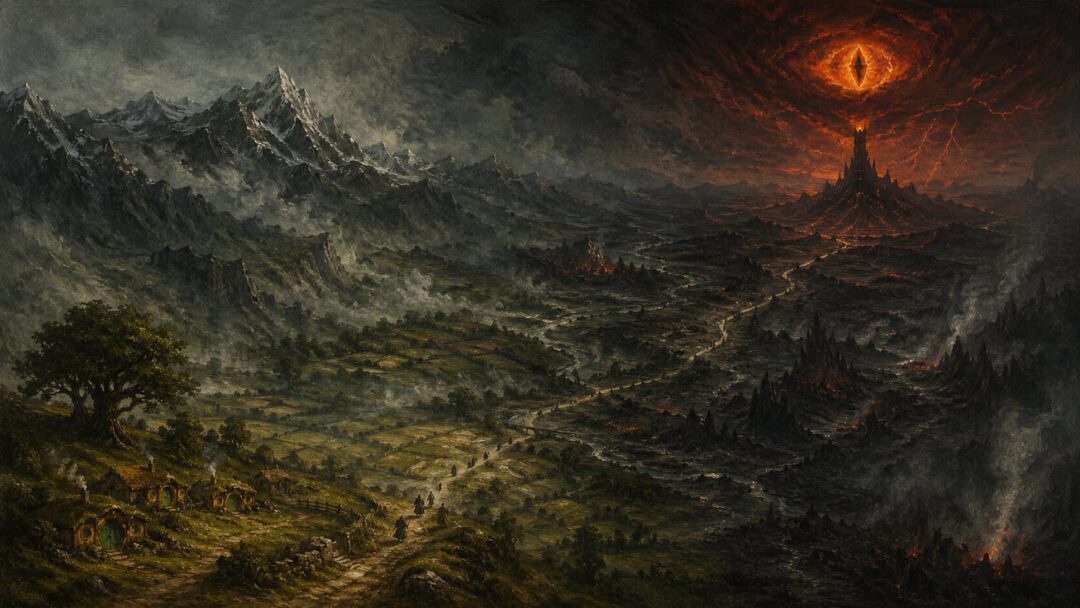
Most readers know the title by heart.
The Lord of the Rings.
It is so familiar now that it can almost disappear. We hear it as the name of the whole story: Frodo, Sam, Gandalf, Aragorn, the Shire, Mordor, the Quest, the Ring, the fall of Sauron, and the return of the King.
But the title itself is much sharper than that.
It does not say The Ring.
It does not say The Fellowship.
It does not say The War of the Ring.
It says The Lord of the Rings.
And within the story, that Lord is Sauron.
That matters more than it first appears.
Because Sauron is not the hero. He is not the character whose thoughts we follow. He does not dominate the page through speeches or personal appearances. For most of the story, he is a presence felt at a distance: a will, a pressure, a search, a shadow.
Yet the book bears his title.
That is not an accident of drama. It is one of the quietest and most important truths in the whole work.
The story is named after the power that everyone is trying to resist.
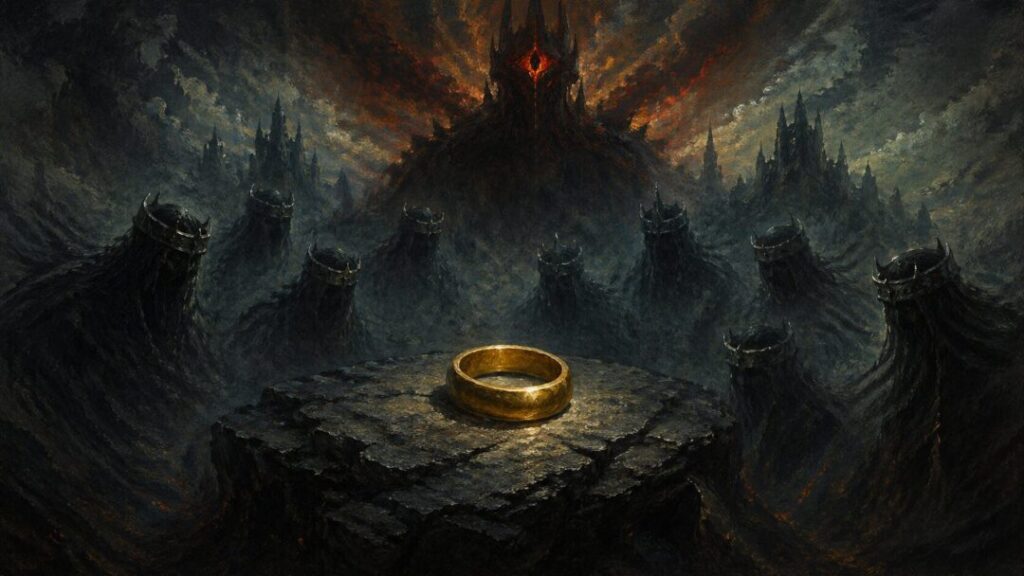
The Title Does Not Belong to Frodo
At first glance, it is tempting to connect the title to Frodo.
He carries the One Ring. He bears the burden into Mordor. He suffers most directly under its weight. If the story has a central Ring-bearer, it is him.
But Frodo is never the Lord of the Ring.
That distinction is essential.
Frodo possesses the Ring for a time, but possession is not lordship. He inherits it, carries it, hides it, resists it, and finally fails to surrender it at the very edge of its destruction. His relationship to the Ring is one of burden, not mastery.
The Ring does not belong to him in any deep sense.
It belongs to the one who made it.
This is why the title cannot really be about Frodo. The story does not call him Lord because he never becomes Lord. In fact, the entire moral force of his journey depends on the opposite: he must carry a thing made for domination without becoming its master.
That is the paradox at the center of the Quest.
Frodo must take the Ring farther than anyone else can, but he must never claim what it offers.
The Lord Is Sauron
Sauron is the Lord of the Rings because the Rings of Power are bound to his design.
The lesser Rings were made in the Second Age, and the One Ring was made by Sauron in secret to rule the others. Its famous verse is not merely a threatening poem. It describes the purpose of the One Ring: to rule, find, bring, and bind.
That is why the plural matters.
The title is not The Lord of the Ring, as though only one object were in view. It is The Lord of the Rings. The story remembers the whole system of power behind the One.
The Three Rings of the Elves were not made by Sauron’s hand, but they were still made within the wider knowledge and danger of that age, and they became subject to the One when he forged it. The Seven went to the Dwarves. The Nine went to Men, who became the Ringwraiths. The One was the ruling Ring.
So Sauron’s lordship is not just ownership.
It is domination.
He does not merely want the Ring back because it is precious to him. He wants it because through it his power can again be made complete. The Ring is not a weapon he happens to desire. It is the instrument through which his will was poured into the world.
To name the story after him is to name the real shape of the danger.
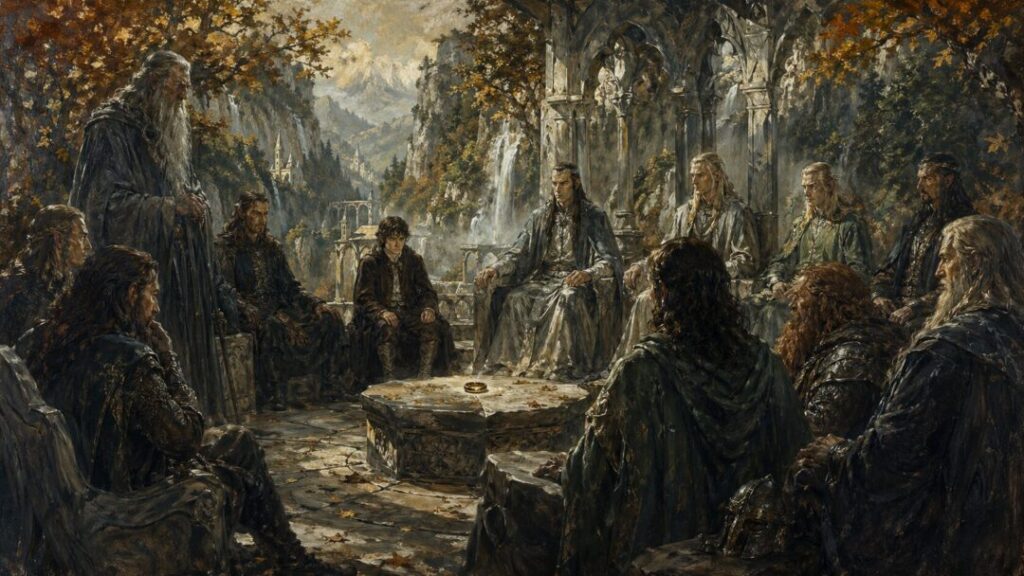
Why Name a Story After the Enemy?
This is where the title becomes strange.
The heroes of the story are not Sauron’s servants. The emotional heart of the tale belongs to the Hobbits, to friendship, endurance, pity, courage, and mercy. The return of Aragorn is central. The fall of the Ring is central. The preservation of the Shire matters deeply.
So why should the title point to Sauron?
Because the story is not only about defeating an enemy.
It is about refusing the kind of power the enemy represents.
Sauron’s great desire is not destruction for its own sake. In the texts, his evil is tied to control, ordering, command, and domination. He wants wills bent to his own. He wants the world arranged beneath him.
That is why the Ring is so dangerous even in the hands of the good.
The central temptation is not simply to do evil. It is to use evil as a tool for good ends.
Boromir imagines using the Ring for Gondor. Galadriel is tested by the vision of what she might become if she took it. Gandalf refuses it because he understands that he would be tempted to use it from pity and a desire to do good. Even Sam, briefly bearing the Ring, experiences a vision of himself made great.
These moments matter because they show that Sauron’s shadow is not limited to Mordor.
The danger of Sauron is the desire to master.
Sauron Is Absent, Yet Everywhere
One of the most striking things about the story is how rarely Sauron appears directly.
He is not given long scenes as a speaking villain. He is not humanized through private reflection. He is not treated like a tragic king on a throne explaining himself to the reader.
Instead, he is known by effect.
His servants move.
His armies gather.
His will searches.
His Ring pulls.
His shadow stretches across lands and minds.
This makes his presence more terrifying, not less.
Sauron becomes almost atmospheric. He is felt in the fear of Gondor, in the corruption of Saruman, in the despair of Denethor, in the terror of the Ringwraiths, and in the increasing pressure laid upon Frodo as he approaches Mordor.
The title captures that.
The Lord of the Rings does not need Sauron to appear constantly, because the story is already moving inside the consequences of his will.
The Ring is Sauron’s absence made present.
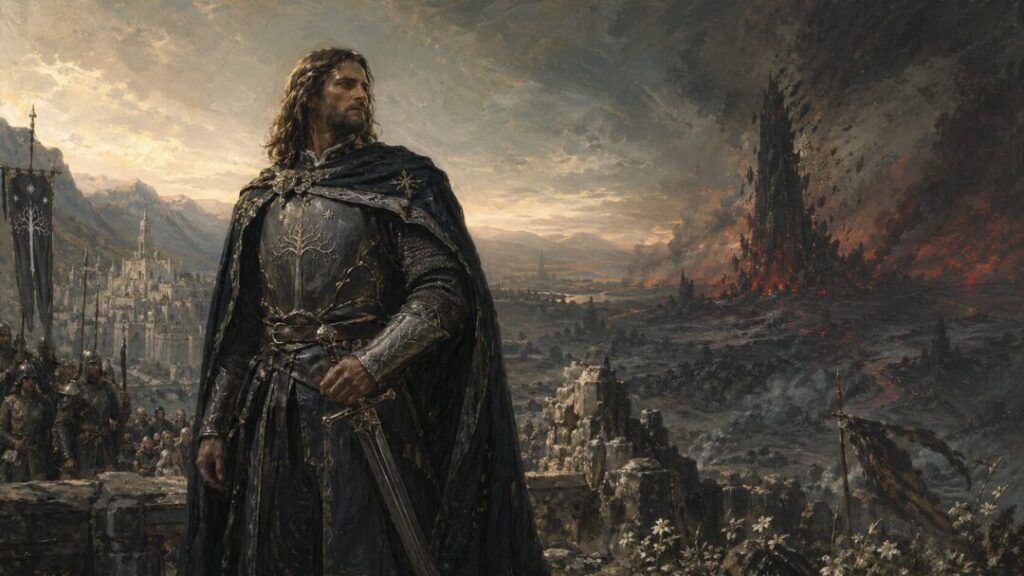
The Ring Is Not Neutral
A common mistake is to imagine the Ring as a tool that could be turned to better purposes.
The Wise do not treat it that way.
They understand that the Ring cannot simply be used against Sauron without carrying Sauron’s own logic into the heart of the user. It was made for domination. Its power is not morally blank.
This is why the great and powerful are especially dangerous around it.
The more strength, wisdom, ambition, or authority someone has, the more terrible they might become if they claimed the Ring. The Ring does not offer everyone the same fantasy, but it works upon desire. It magnifies the longing to control.
That is why humility becomes so important in the story.
Hobbits are not immune to the Ring. Frodo proves that at the end. Gollum proves it across centuries. Bilbo is marked by it. Sam is tempted too.
But Hobbits are small in the eyes of the great. They do not begin with armies, thrones, or grand designs. Their smallness gives the Quest a chance—not because they are invincible, but because they are less naturally aligned with the kind of mastery the Ring promises.
The title names Sauron, but the story answers him with people who do not look like lords at all.
Aragorn’s Return Is Part of the Same Answer
The longer title written within the story includes both the downfall of the Lord of the Rings and the return of the King.
That pairing is important.
Sauron is a false lord. Aragorn is the returning king.
But the contrast is not merely political. It is moral.
Sauron rules by fear, domination, and the extension of his own will. Aragorn’s kingship is shown through service, healing, restraint, and rightful authority. He does not seize power through the Ring. He refuses that path entirely.
This is one reason the title’s connection to Sauron is so powerful.
The story is not saying that all lordship or kingship is evil. It is separating rightful authority from possessive domination.
Sauron wants to own.
Aragorn is called to restore.
The Ring offers control.
The King brings healing.
The fall of one makes room for the return of the other.
The Title Is Also a Warning
If the book were called The Quest of Frodo, the emphasis would fall mainly on the bearer.
If it were called The War of the Ring, the emphasis would fall on the conflict.
If it were called The Return of the King, the emphasis would fall on Aragorn’s restoration.
All of those are true parts of the story.
But The Lord of the Rings points to the deepest danger beneath them all.
It reminds us that the Ring is not merely a lost object. It belongs to a will. It has a maker. It has a purpose. It is part of a design.
And that design is lordship through domination.
This is why the title feels almost like a shadow cast over the entire book. Before the reader even begins, the name of the enemy stands over the story. Yet by the end, that title has been broken.
The Lord of the Rings falls.
Not because someone stronger takes his place with the Ring.
But because the Ring is destroyed.
That distinction is everything.
Why the Title Still Works After Sauron Falls
By the end, Sauron is overthrown. The Ring is unmade. Barad-dûr falls. The Shadow passes.
So why does the title still feel right?
Because the story has never been about Sauron’s greatness.
It has been about the long resistance to his claim.
The title names what must be overcome. It names the power that tempts nearly everyone who comes near it. It names the central lie of the Ring: that the world can be saved by mastering it.
Frodo’s tragedy is that even he cannot finally overcome that temptation by strength alone. At the Crack of Doom, he claims the Ring. The Quest succeeds not because Frodo remains untouched, but because mercy, pity, and providence have already shaped the path in ways no one fully controlled.
That is the final defeat of Sauron’s logic.
Sauron believes in domination. He does not understand mercy. He does not plan for pity. He cannot imagine that the weak, the broken, and the spared might become the means of his ruin.
The title points to him.
But the story quietly proves that he has misunderstood the world.
The Enemy Gets the Title, But Not the Last Word
The Lord of the Rings is named after Sauron because Sauron is the maker and true master of the ruling Ring.
But the meaning goes deeper than identification.
The title names the temptation at the heart of the story: the desire to rule, possess, bind, and command. Every major act of goodness in the book stands against that desire.
Frodo carries but must not claim.
Gandalf guides but does not dominate.
Galadriel refuses the fantasy of becoming a queen of terrible beauty.
Aragorn waits, serves, heals, and returns without taking the Ring.
Sam loves without wanting lordship.
Bilbo gives up what he once called his own.
Sauron may be the Lord of the Rings.
But the story is about the end of that lordship.
That is why the title is so powerful.
It does not honor Sauron.
It exposes him.
It places his claim over the whole story so that, page by page, that claim can be resisted, diminished, and finally destroyed.
The book is named after the Dark Lord.
But it belongs to those who refused to become him.
Sources & Notes
- J.R.R. Tolkien, The Lord of the Rings, Prologue, “Note on the Shire Records” — gives the Red Book’s long title as “The Downfall of the Lord of the Rings and the Return of the King,” tying Sauron’s fall to Aragorn’s return.
- J.R.R. Tolkien, The Lord of the Rings, Book I, Chapter 2, “The Shadow of the Past” — Gandalf explains the Ring-verse and the One Ring’s purpose: “One Ring to rule them all.”
- J.R.R. Tolkien, The Silmarillion, “Of the Rings of Power and the Third Age” — recounts Sauron forging the One Ring in secret to govern the other Rings of Power and dominate their bearers.
- J.R.R. Tolkien, The Lord of the Rings, Book II, Chapter 2, “The Council of Elrond” — frames the Ring as Sauron’s own instrument and rejects the idea that the Wise can safely wield it against him.
- J.R.R. Tolkien, The Letters of J.R.R. Tolkien, Letter 131 — describes Sauron’s characteristic evil as domination and the ordering of all things according to his own will.