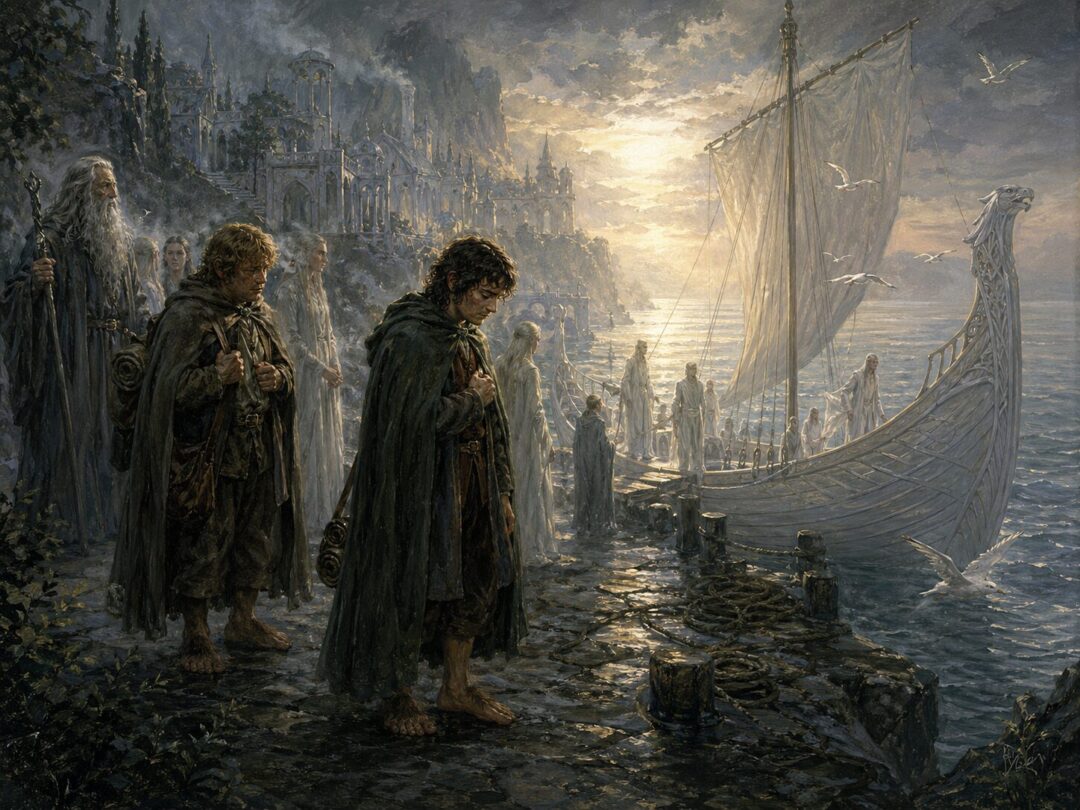
When Frodo leaves Middle-earth, the story becomes strangely quiet.
There is no great description of Valinor. No scene of Frodo stepping onto white shores and being welcomed by the Valar. No account of his final years. No explanation of exactly how long he lived after the ship passed beyond sight.
The book gives us something much more restrained.
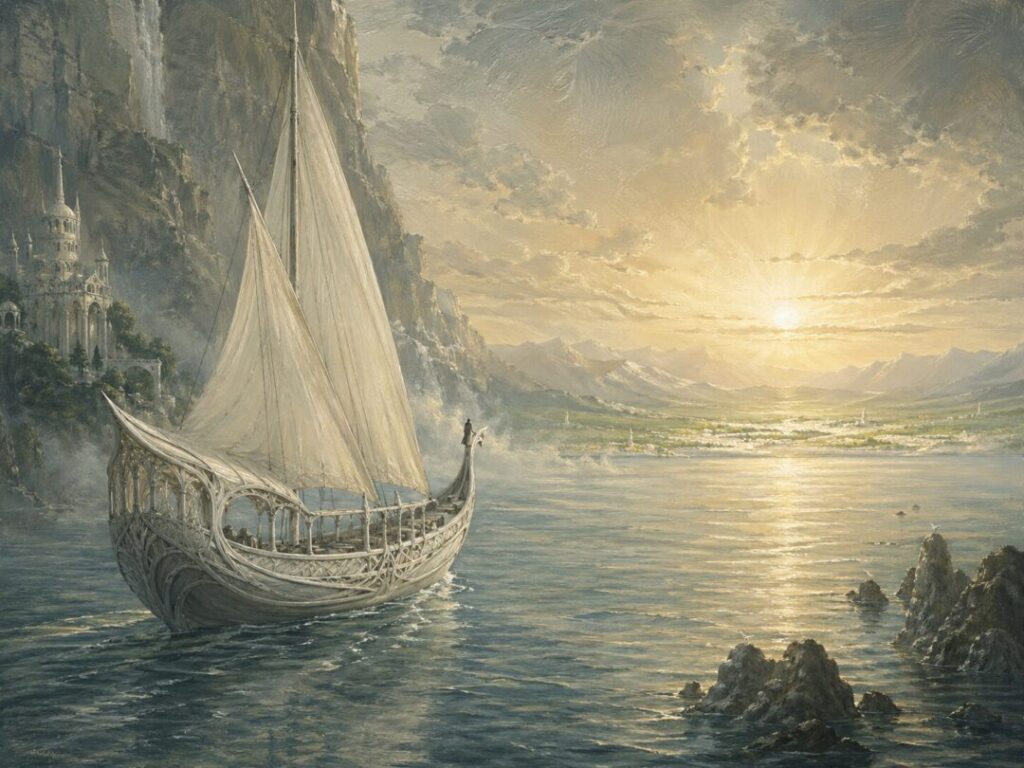
Sam sees the ship sail away. The sea rises around it. Then the vision of the West appears only for a moment: white shores, and beyond them a far green country under a swift sunrise.
Then it is gone.
For many readers, this feels like Frodo has passed into a kind of heaven. The phrase “Undying Lands” almost invites that misunderstanding. Frodo suffered, endured, saved the world, and then sailed away to live forever in peace.
But that is not what the lore says.
Frodo’s ending is not immortality.
It is healing.
And that difference changes the entire meaning of the Grey Havens.
The Undying Lands Did Not Make Frodo Immortal
The first thing to understand is that the Undying Lands are not called “undying” because they make mortals live forever.
They are undying because they are the dwelling place of undying beings: the Valar, the Maiar, and the Elves who dwell in Aman. A mortal who enters that land does not become an Elf. His nature is not changed. His fate is not erased.
Frodo remains mortal.
That point matters, because without it the ending becomes too simple. If Frodo merely sails into eternal life, then the Grey Havens become a reward scene. Sad, yes, but still a kind of escape from every consequence.
The actual ending is more delicate than that.
Frodo is not granted freedom from death. He is granted time, peace, and the possibility of healing before death.
A later explanation of his fate says that Frodo was allowed to pass over the Sea to be healed “if that could be done” before he died. That cautious phrase is important. It does not present the West as a magical cure that instantly removes every wound. It presents it as mercy.
Frodo goes West not because he has become something other than a Hobbit.
He goes because he is still a Hobbit, and because he has been hurt beyond what Middle-earth can mend.
Frodo Did Not Simply “Retire”
It is tempting to imagine Frodo’s voyage as a beautiful retirement after the Quest.
But the story before the Grey Havens does not support that reading.
After the Ring is destroyed, the Shire is restored. The trees grow again. The mills are repaired. Sam marries Rosie Cotton. New life returns in abundance. The Shire does not remain scarred forever by Sharkey’s men or by the shadow of the War.
Frodo, however, does.
His suffering continues long after victory.
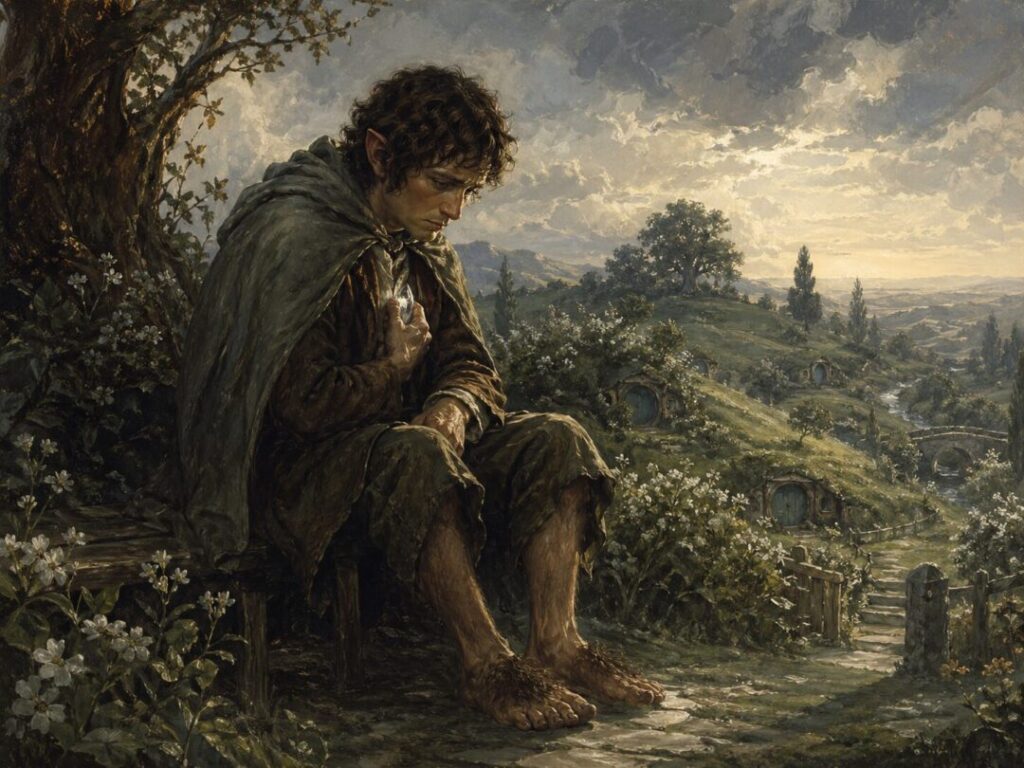
In the years after his return, Frodo becomes ill on the anniversaries of his deepest wounds. On October 6, the date of the attack at Weathertop, he suffers again. On March 13, the date associated with Shelob’s sting and his capture in Cirith Ungol, he is ill again.
These are not random moments of sadness.
They show that the Quest has left marks in him that do not obey ordinary healing. The Ring is gone, but Frodo’s body and spirit still remember what happened.
The Shire has moved into spring.
Frodo remains tied to the darkest days of the road.
The Wound at Weathertop Never Fully Leaves Him
The first great wound comes before Mordor, before Shelob, before Frodo fully understands what he is carrying.
At Weathertop, he is struck by a Morgul-knife. The intention is not merely to kill him. The weapon is meant to draw him toward the wraith-world, to make him fade under the power of the Nazgûl.
He survives only because help reaches him in time.
But survival is not the same as restoration.
Even after the shard is removed and the physical wound is treated, Frodo is never quite untouched again. The injury becomes part of his later suffering. It returns in memory and pain. It marks the beginning of a pattern that continues until he leaves Middle-earth.
This is one reason his ending cannot be understood as simple sadness.
Frodo is not just melancholy because the adventure is over. He is not merely struggling to settle down after seeing great things. He carries wounds connected to powers that were never meant to touch a Hobbit at all.
His body was pierced by the servants of the Enemy.
His mind was pressed by the Ring.
His will was stretched to the breaking point.
And even though he survived, something in him never fully came back.
The Ring Was Destroyed, But Frodo Was Not Unmade from It
The greatest wound is not visible.
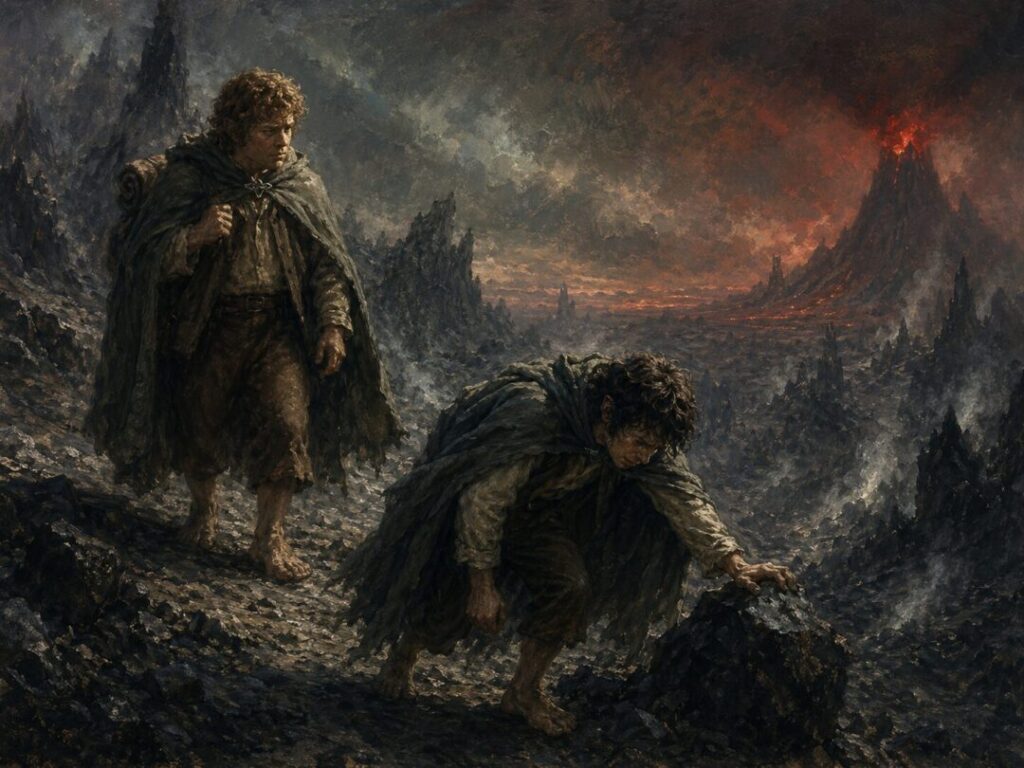
For months, Frodo carried the One Ring closer and closer to the place of its making. The nearer he came to Mordor, the heavier the burden became. By the end, the Ring was not merely an object in his possession. It had become a pressure on his will, his memory, and his very sense of self.
At Mount Doom, Frodo does not freely cast the Ring into the Fire.
He claims it.
That moment is sometimes treated too harshly, as if Frodo simply failed morally at the last second. But the story is more compassionate than that. No one in Middle-earth could be expected to bear the Ring to the very heart of its power and remain untouched. Frodo carried it farther than anyone else could have hoped.
Still, the fact remains: at the end, the Ring overcame him.
That knowledge must have stayed with him.
The world celebrates the destruction of the Ring, and rightly so. But Frodo himself knows that the final act did not happen because he was strong enough to surrender it. It happened through pity, providence, and Gollum’s last desperate fall.
That does not make Frodo less heroic.
It makes his wound deeper.
He saved the world, but he could not save himself from the full cost of carrying the thing that threatened it.
Why the Shire Could Not Heal Him
The Shire is Frodo’s home, but after the Quest it becomes a place of painful contrast.
Everything he fought to preserve is there. The fields, the lanes, the gardens, the ordinary comforts of Hobbit life—all of them still matter. Frodo does not despise them. He does not leave because the Shire is too small or because he has become too grand for it.
That would misunderstand him completely.
Frodo leaves because the Shire is healed in a way he cannot be.
This is one of the most moving parts of his story. The very success of the Quest creates the conditions for his loneliness. Sam can return to life. Merry and Pippin can grow into their roles. The Shire can rebuild. Children can be born. Trees can bloom.
Frodo can witness all of that.
But he cannot fully enter it.
He has become, in a sense, the cost hidden beneath everyone else’s peace. The Shire survives because he carried its danger away from it. But when he comes back, the danger has left traces in him that the Shire has no language for.
There are some wounds, Gandalf says, that cannot be wholly cured in Middle-earth.
Frodo is living proof.
Did Frodo Actually Reach Valinor?
The final chapter does not show Frodo’s arrival in detail. It gives us the ship, the Sea, the white shores, and the green country beyond. It does not pause to map his destination.
For that reason, careful wording matters.
Readers often say Frodo went to Valinor, and broadly this is understandable because the ship is sailing into the West, toward the Undying Lands. But the texts do not give us a detailed scene of Frodo living in Valinor itself. Later discussion of mortals in the West speaks of Aman and of dwelling there only for a limited time. Some interpretations place the Ring-bearers especially on Tol Eressëa, the lonely isle associated with the Elves.
The safest answer is this:
Frodo was allowed to pass over the Sea into the Undying Lands, under special grace given to the Ring-bearers, but the story does not describe his daily life there in detail.
That silence is not a gap to fill with invented scenes.
It is part of the beauty of the ending.
We are not meant to follow Frodo into every room of his final peace. We are allowed only to know why he went, and what kind of mercy was offered to him.
What Frodo Found in the West
So what happened when Frodo reached the West?
The most lore-accurate answer is also the most restrained: he found healing, peace, reflection, and rest for as long as he was permitted to remain in the world.
Not endless life.
Not a throne.
Not a transformation into something greater than a Hobbit.
The West offered Frodo a place where the Shadow was not pressing upon him in the same way. A place where beauty was not mingled with the same weariness that had overtaken Middle-earth. A place where he could begin to understand the strange mixture of littleness and greatness that had defined his life.
That last idea matters.
Frodo’s greatness was never the greatness of kings or warriors. He did not command armies. He did not overthrow Sauron by strength. He was small, frightened, wounded, and often dependent on the mercy and loyalty of others.
Yet his smallness was not a flaw.
It was part of the reason he could carry the Ring as far as he did.
In the West, Frodo was not rewarded by being made mighty. He was allowed to see more truly what his burden had meant.
The West Was Both Reward and Mercy
Frodo’s passage West is exceptional.
Mortals do not normally sail to Aman. The Straight Road is not open to ordinary Men, Hobbits, or Dwarves. Frodo and Bilbo are permitted because of their unique place as Ring-bearers. Later, Sam is also said to have crossed the Sea, and his brief bearing of the Ring connects him to that same mercy.
But this permission should not be understood as a prize in the usual sense.
A prize is given because someone has won.
Frodo’s passage is given because someone has been wounded.
That does not remove honor from it. Frodo is honored. His suffering matters. His endurance matters. His pity toward Gollum matters. His long obedience to the Quest matters.
But the emotional center of the ending is not glory.
It is compassion.
Middle-earth cannot give Frodo what he needs. So the West receives him.
Did Frodo Die There?
Yes, eventually.
The texts do not give us a death scene. They do not provide a date. They do not describe his grave or his final words. But the lore is clear that Frodo remained mortal. No mortal can abide forever within the circles of the world.
That means Frodo’s time in the West had an end.
This can feel disappointing at first. Many readers want Frodo to live forever because he suffered so much. But an immortal Frodo would actually weaken the meaning of his ending.
His gift is not escape from mortality.
His gift is a gentler road toward it.
He is allowed to spend his final time somewhere unmarred by the Shadow that had tormented him. He is allowed rest before the end. He is allowed healing that may not have been possible in the land he saved.
That is quieter than immortality.
It is also more human, and in many ways more moving.
Why Sam Had to Stay Behind
Sam’s presence at the Grey Havens makes Frodo’s departure even more painful.
Sam wants Frodo to stay. The reader wants Frodo to stay. Everything in the Shire seems to ask him to stay. But Sam also has a life still waiting for him.
Rosie is waiting. Elanor has been born. The garden, the home, the future of the Shire—all of it belongs to Sam in a way it no longer belongs to Frodo.
This is not because Sam suffered less in any simple sense. Sam endured terror, hunger, despair, and the burden of the Ring for a short time. But Sam is still able to return. He can root himself again in ordinary love.
Frodo cannot.
That difference is heartbreaking because it is not a judgment. Sam is not shallow for staying. Frodo is not faithless for leaving. They simply have different endings.
Sam’s healing is in the Shire.
Frodo’s must be beyond it.
The Real Meaning of Frodo’s Ending
Frodo’s voyage West is one of the most beautiful endings in fantasy because it refuses easy comfort.
The world is saved, but not everyone is made whole.
Evil is defeated, but its wounds remain.
The hero returns home, but home cannot cure him.
That is why the Grey Havens hurt so much. Frodo has done exactly what he set out to do. He preserved the Shire. He made room for Sam’s children, for gardens, for laughter, for ordinary mornings untouched by Sauron’s shadow.
But he cannot fully share in the peace he made possible.
So he leaves.
Not because he has stopped loving Middle-earth.
Because he loved it enough to spend himself for it.
And when there is no more healing for him there, he is given the grace of the West: not immortality, not escape, not triumph, but rest.
Frodo’s story does not end with him becoming deathless.
It ends with him being allowed to lay down a burden he had carried far beyond hope.
And that is why the white ship is not a victory parade.
It is a mercy.
Sources & Notes
- J.R.R. Tolkien, The Lord of the Rings, Book VI, Ch. 9 “The Grey Havens” — Frodo’s lingering anniversary illnesses, Gandalf’s “some wounds cannot be wholly cured,” and the final vision of white shores and a far green country.
- J.R.R. Tolkien, The Lord of the Rings, Book I, Chs. 11–12 “A Knife in the Dark” and “Flight to the Ford” — the Morgul-knife wound and the danger of Frodo fading under the power of the Nazgûl.
- J.R.R. Tolkien, The Letters of J.R.R. Tolkien, Letter 325 — Frodo’s passage West is explained as healing “if that could be done,” before his death; he remained mortal.
- J.R.R. Tolkien, The Silmarillion, “Akallabêth” — Aman is the realm of the Deathless, but it does not make mortals deathless.
- J.R.R. Tolkien, The Lord of the Rings, Appendix B, “The Tale of Years” — records the Ring-bearers’ departures over Sea, including Frodo and later Sam.
- J.R.R. Tolkien, The Letters of J.R.R. Tolkien, Letter 246 — discusses Frodo at Mount Doom and the Ring’s final overpowering pressure on his will.