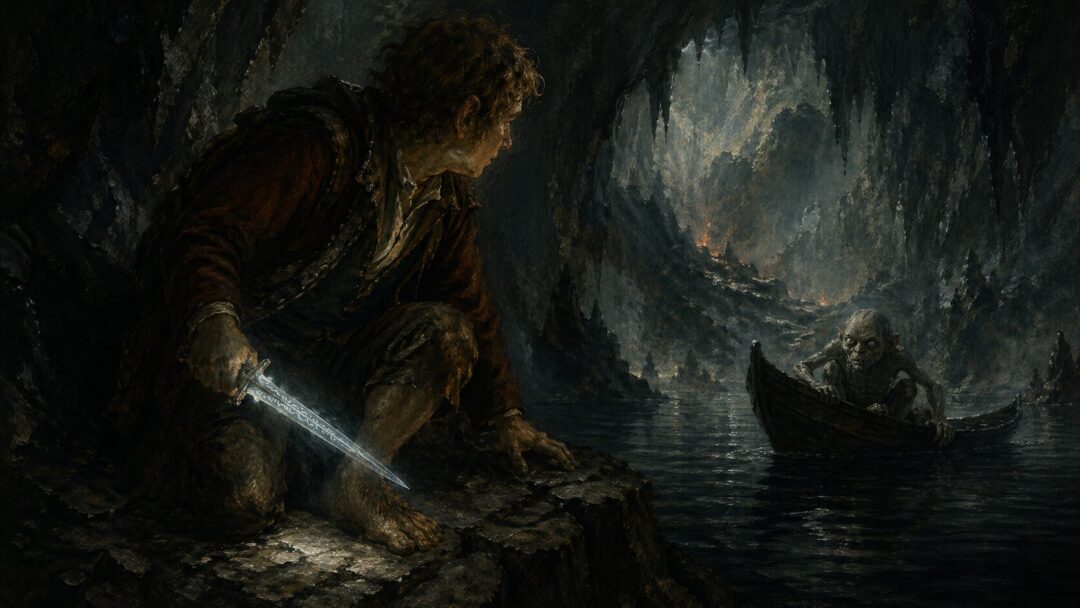
When Bilbo Baggins first meets Gollum, he is lost in a darkness deeper than anything he has ever known.
He has fallen beneath the Misty Mountains. He has been separated from the dwarves. He has no map, no guide, and no real understanding of how far below the world he has come.
Then he finds a ring.
Only after that does he reach the black underground lake.
There, in the dark, something sees him.
A small, slimy creature comes paddling toward him in a boat, watching with pale eyes. He speaks in whispers and hisses. He talks to himself. He calls someone—or something—“my precious.” And he begins the famous riddle-game that will change the history of Middle-earth.
But there is a small question hidden inside this scene that many readers eventually notice.
How did Bilbo know Gollum’s name?
After all, Gollum does not simply introduce himself.
He does not bow and say, “I am Gollum.”
He does not tell Bilbo his old name, Sméagol.
And yet the story calls him Gollum almost immediately.
The answer is simple on the surface, but far more interesting underneath.
Because “Gollum” is not just a name.
It is a sound.
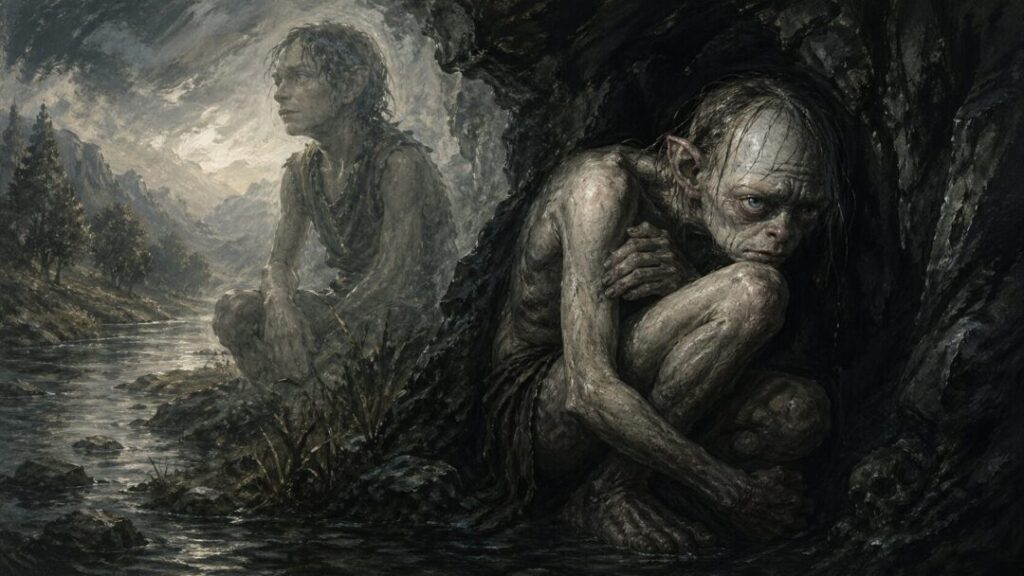
Gollum Does Not Introduce Himself Properly
In “Riddles in the Dark,” the creature Bilbo meets is already named for the reader.
The narration tells us about Gollum before Bilbo fully understands what he is facing. We are told that he lives deep down by the dark water, alone, catching blind fish and sometimes goblins.
But inside the scene itself, Gollum’s own speech is much stranger.
He does not speak like a person giving his name to a stranger. He speaks in fragments, in whispers, in self-address. He calls himself “my precious.” He uses “we” and “us.” He mutters to himself as much as he speaks to Bilbo.
That matters.
Bilbo is not meeting someone socially.
He is encountering a creature who has been alone so long that ordinary identity has almost broken apart. Gollum’s language already shows that fracture. He is not simply “I.” He is “we.” He is “us.” He is “my precious.”
So when we ask how Bilbo knew his name, we have to be careful.
The text does not show Gollum calmly giving Bilbo a formal name.
Instead, it shows Bilbo hearing the thing from which the name comes.
The Name Comes From the Noise
The key is the swallowing sound.
In The Hobbit, the creature says “gollum” with a horrible noise in his throat. The narrator explains that this is how he got his name, though he usually calls himself “my precious.”
That is the clearest answer in the text.
Bilbo hears the sound.
The reader is told that the sound is the source of the name.
So “Gollum” is not presented as a normal personal name in the way “Bilbo” or “Gandalf” is. It is tied to a bodily habit, a repeated throat-noise, something unpleasant and involuntary.
This makes the name feel less like identity and more like a mark.
It is what others call him because of what he has become.
Bilbo does not need Gollum to announce the name in a formal way. The sound is present in the encounter itself. The name is almost being spoken every time the creature makes that choking noise.
This is why the question is so interesting.
Bilbo may not have “learned” the name as one learns a polite introduction. He may have carried away the sound, and the story gives us the name attached to it.
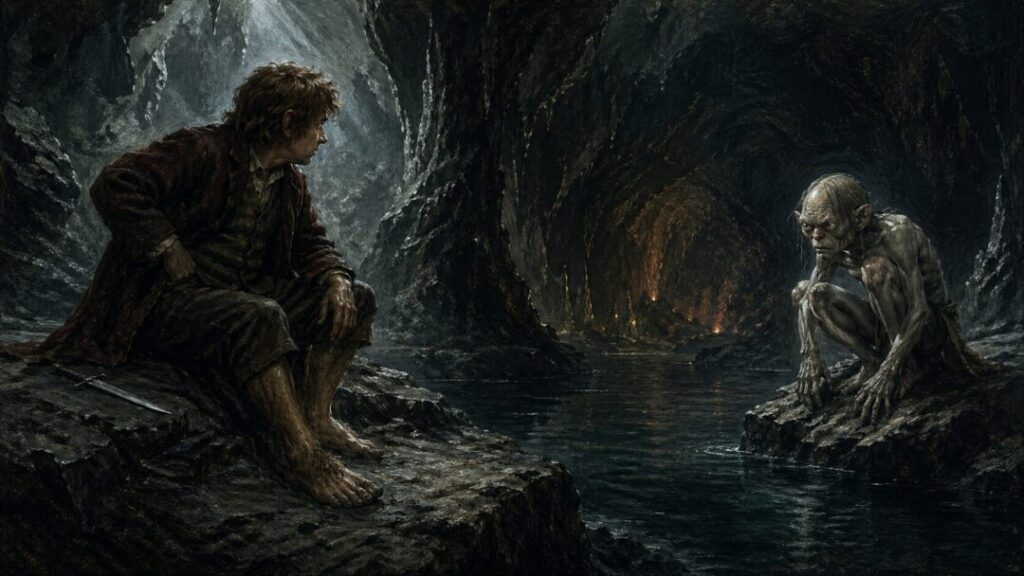
Gandalf Later Gives the Older Explanation
The deeper background comes later, in The Lord of the Rings.
In “The Shadow of the Past,” Gandalf tells Frodo the story of Sméagol. He explains that Sméagol was not always the cave-creature Bilbo met. He had once belonged to a people related to the fathers of the fathers of the Stoors.
After he found the Ring and murdered Déagol, he changed. He became secretive. He muttered. He used the Ring for spying and petty theft. Eventually his people drove him away.
And because of the horrible swallowing noise he made in his throat, they called him Gollum.
That is important because it confirms that “Gollum” was not a name he invented for himself beside the underground lake.
It was a name given to him by others.
His own people used it before he disappeared under the mountains.
By the time Bilbo meets him, the old identity of Sméagol is almost completely buried. Bilbo does not know that old story. He does not know about Déagol. He does not know about the murder by the river. He does not know that the ring in his pocket is the One Ring.
But he hears the remnant.
He hears “gollum.”
Bilbo Did Not Know the Whole Truth
This is where the answer must be kept precise.
Bilbo did not know everything.
He did not know Gollum’s real origin. He did not know his old name. He did not know that Gollum had once been Sméagol. He did not know the full history of the Ring. He did not even understand what he had found.
In The Hobbit, Bilbo’s understanding is limited to the immediate danger.
He knows he is trapped underground.
He knows this creature is dangerous.
He knows the riddle-game may decide whether he lives or dies.
He knows the creature is obsessed with something called “precious.”
And he hears the sound that gives the creature his name.
Anything beyond that belongs to later explanation.
This distinction matters because Middle-earth often reveals truth in layers. The first version of a story may be true as far as it goes, but incomplete. Later, another character or another text opens the older history behind it.
Bilbo meets Gollum as a frightening cave-creature.
Frodo later learns that Gollum was once Sméagol.
The name that seemed almost comic in The Hobbit becomes tragic in The Lord of the Rings.
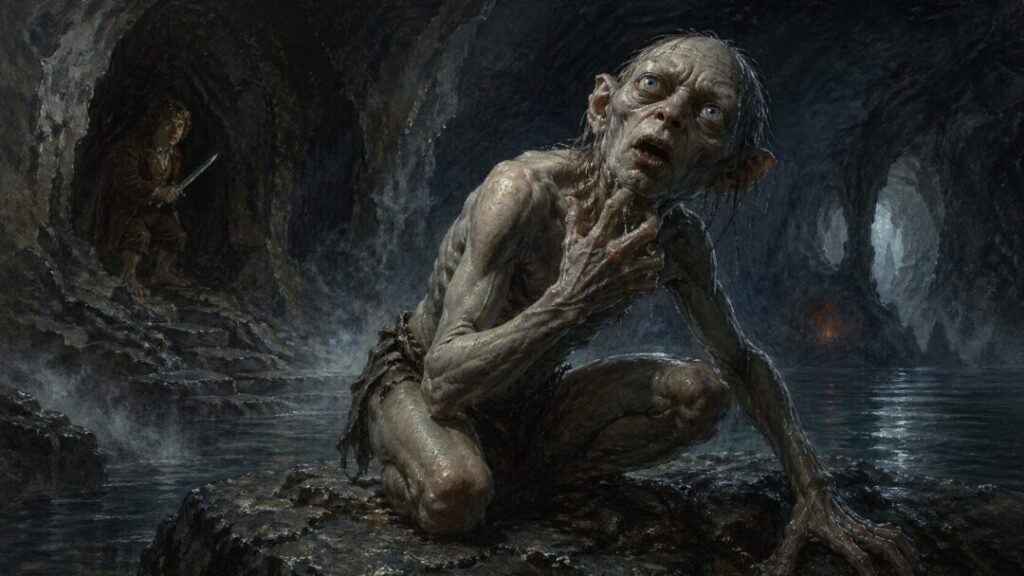
The Narrator May Know More Than Bilbo
There is another careful point to make.
The narrator of The Hobbit knows things Bilbo may not fully know at that moment.
That is normal in storytelling. The narration can call the creature “Gollum” even if Bilbo himself has not yet consciously sorted out the name in the way a historian would.
So when the text says “Gollum,” it does not necessarily mean Bilbo has been formally told the name.
It means the story is identifying him for us.
This is especially important because The Hobbit is framed as Bilbo’s adventure, but it is still told by a narrator who can step slightly outside Bilbo’s immediate awareness. The narrator can explain that the swallowing sound is how Gollum got his name.
Bilbo hears enough to associate the creature with that sound.
The narrator gives the reader the full label.
That may be the cleanest way to understand the scene without forcing something the text never says.
Bilbo does not need to receive a formal introduction.
The story names the creature from the sound Bilbo hears.
Why the Name Feels Almost Like a Riddle
This fits the entire atmosphere of the chapter.
“Riddles in the Dark” is a chapter about names, hidden things, and half-knowledge.
Bilbo does not tell Gollum his name at first. Gollum does not properly give his. The Ring is present, but its full identity is hidden. Bilbo asks, “What have I got in my pocket?”—a question that is not really a proper riddle, but becomes the turning point of the game.
Everything in the chapter is uncertain.
Bilbo does not know what he has found.
Gollum does not know where his Ring has gone.
Neither fully understands the other.
Even the name “Gollum” belongs to that same pattern. It is not introduced cleanly. It emerges from noise, habit, fear, and repetition.
A creature in the dark makes a sound.
The sound becomes a name.
The name survives after the old self has nearly disappeared.
That is very different from a normal introduction.
And it is much more disturbing.
“Gollum” Is What Is Left of Sméagol
By the time of The Lord of the Rings, the name Gollum carries enormous weight.
Frodo and Sam later meet him not merely as a monster, but as a divided being. At moments, the older Sméagol seems to return. At other moments, Gollum dominates.
The two names become a way of understanding the struggle inside him.
Sméagol is not innocent by the time we meet his story. He murdered Déagol to take the Ring. He lied. He was corrupted by desire very early. But he was still once a person with a name, a place, and a people.
Gollum is what remains after long possession, exile, secrecy, and obsession.
That does not mean the Ring alone explains everything he did. The texts do not excuse his choices. But they do show that the Ring deepened and prolonged his ruin.
His name reflects that ruin.
“Gollum” is not noble.
It is not ancestral.
It is not chosen in honor.
It is a nickname born from a horrible sound, and eventually it becomes the name by which nearly everyone knows him.
That is tragic in a very quiet way.
Bilbo’s Mercy Begins Before He Understands
The question of Gollum’s name also leads into Bilbo’s most important choice.
After the riddle-game, Bilbo has a chance to kill Gollum.
He is invisible. Gollum is between him and the way out. Bilbo has his sword. He knows Gollum would gladly harm him if he could.
But Bilbo does not strike.
The reason given in The Hobbit is pity. Bilbo suddenly understands, at least in part, the misery of Gollum’s existence: alone, blind to the wider world, miserable in the dark.
Bilbo does not know the whole history.
He does not know that this act of mercy will one day help bring about the destruction of the Ring.
He does not know Sméagol’s story.
But he knows enough to pity him.
That is one of the deepest patterns in Middle-earth. Mercy does not always require complete knowledge. Sometimes it begins with recognizing that even a dangerous creature is more than the worst thing he has become.
Bilbo hears “Gollum.”
He does not yet know “Sméagol.”
But his pity leaves room for the possibility that there is more to the creature than the sound.
The Real Answer
So how did Bilbo know Gollum’s name?
The safest answer is this:
Bilbo heard the repeated swallowing sound “gollum,” and the narrator tells us that this sound is how the creature got his name.
Later, Gandalf confirms the deeper history: Sméagol’s people called him Gollum because of that same horrible noise.
Bilbo did not know the full backstory.
He did not know the name Sméagol.
He did not know what the Ring truly was.
He did not know how important Gollum would become.
But he heard the name in its most broken form.
Not as a greeting.
Not as a title.
As a sound in the dark.
And that is what makes the answer so fitting.
Gollum’s name is not a clean piece of information Bilbo receives. It is part of the atmosphere of the cave itself: the black lake, the pale eyes, the muttering voice, the obsession with “precious,” and that horrible noise rising again and again from his throat.
Bilbo escapes with the Ring.
He escapes with his life.
And he escapes with a name that is barely a name at all.
Only much later does the larger tragedy become clear.
The creature under the mountains was not born Gollum.
He became Gollum.
And Bilbo, without understanding it, heard the sound of that becoming.
Sources & Notes
- J.R.R. Tolkien, The Hobbit, ch. 5, “Riddles in the Dark” — introduces Gollum by the horrible swallowing sound in his throat and notes that he usually calls himself “my precious.”
- J.R.R. Tolkien, The Lord of the Rings, Book I, ch. 2, “The Shadow of the Past” — Gandalf gives the older Sméagol/Déagol history and explains why Sméagol’s people called him Gollum.
- J.R.R. Tolkien, The Hobbit, ch. 5, “Riddles in the Dark” — frames Bilbo’s limited knowledge in the cave: the riddle-game, the Ring, Gollum’s “precious,” and Bilbo’s pity before escape.
- J.R.R. Tolkien, The Lord of the Rings, Book IV, ch. 1, “The Taming of Sméagol” — shows the later Sméagol/Gollum division that gives the name its tragic weight.