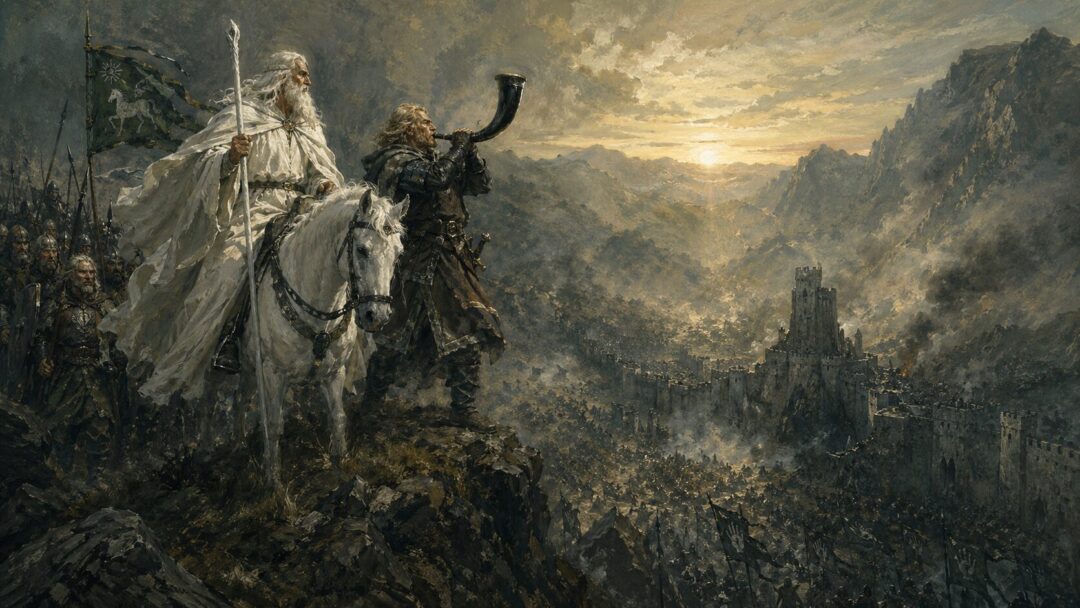
At first glance, Gandalf’s role at Helm’s Deep seems to create a problem.
The Wizards were not sent into Middle-earth as conquerors. They were not meant to overthrow Sauron by raw force, seize command of armies, or dominate the wills of Elves and Men. Their mission was more restrained, more hidden, and more difficult.
They were sent to counsel.
To encourage.
To unite those who still had the will to resist.
And yet, when the battle of the Hornburg reaches its darkest hour, Gandalf appears at dawn in white, bringing aid that turns the tide.
So the question almost asks itself:
If the Istari were forbidden from meeting power with power, why does Gandalf take part in the battle of Helm’s Deep?
The answer is not that Gandalf ignores the rule.
The answer is that most people misunderstand what the rule actually forbids.
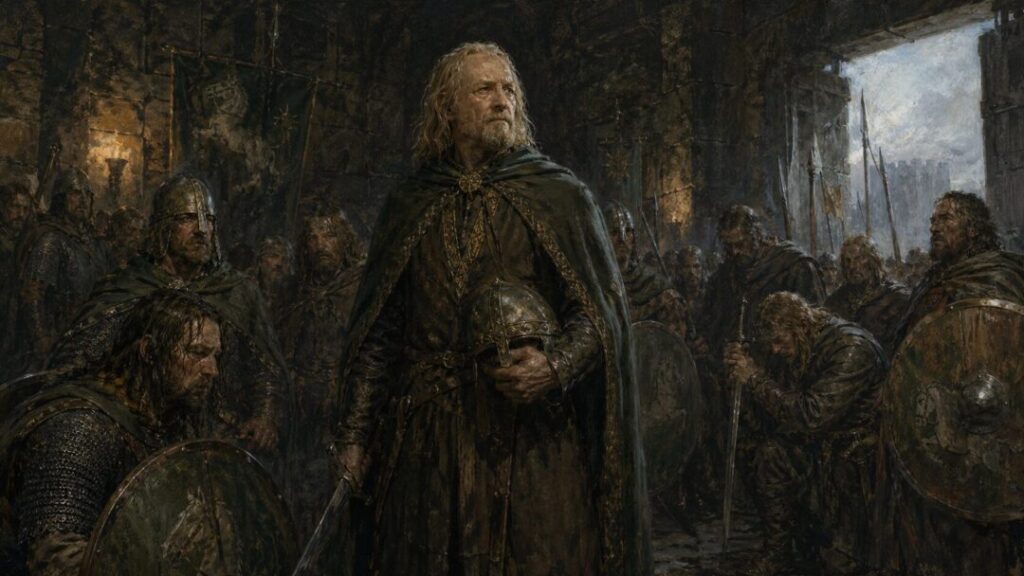
The Istari Were Not Sent as Pacifists
The Wizards were not forbidden from all conflict.
That is important.
Their mission was never to stand aside while the free peoples were slaughtered. They were sent specifically because Sauron’s shadow was rising again, and Middle-earth needed resistance. The Istari were part of that resistance, but not as open rulers or overwhelming powers.
Their restriction was more precise than simple pacifism.
They were forbidden to match Sauron’s power with power, and they were not to dominate Elves or Men by force and fear.
That distinction matters enormously.
It means Gandalf may oppose evil.
He may counsel kings.
He may expose deception.
He may defend others.
He may rally scattered strength.
He may even physically resist servants of darkness when necessary.
What he must not do is become another Sauron in white robes.
He must not win the war by replacing the freedom of others with his own superior will.
Helm’s Deep Is Not Gandalf Taking Over the War
The battle of Helm’s Deep is often remembered as Gandalf riding in and saving everyone.
That is not entirely wrong—but it can easily become misleading.
In the book, Gandalf does not remain in the Hornburg casting down enemies by his own hidden angelic might. He does not seize Théoden’s throne, command Rohan as his private army, or obliterate Saruman’s host through unveiled supernatural force.
Instead, he leaves.
That is one of the most important details.
At the very moment when Théoden and his people are moving toward danger, Gandalf rides away. On the surface, this may look like abandonment. But Gandalf is not fleeing the war. He is searching for the strength that Rohan itself still possesses.
He seeks out Erkenbrand and the scattered men of the Westfold.
Then, at dawn, he returns with them.
The victory at Helm’s Deep is therefore not Gandalf replacing human courage.
It is Gandalf gathering it.
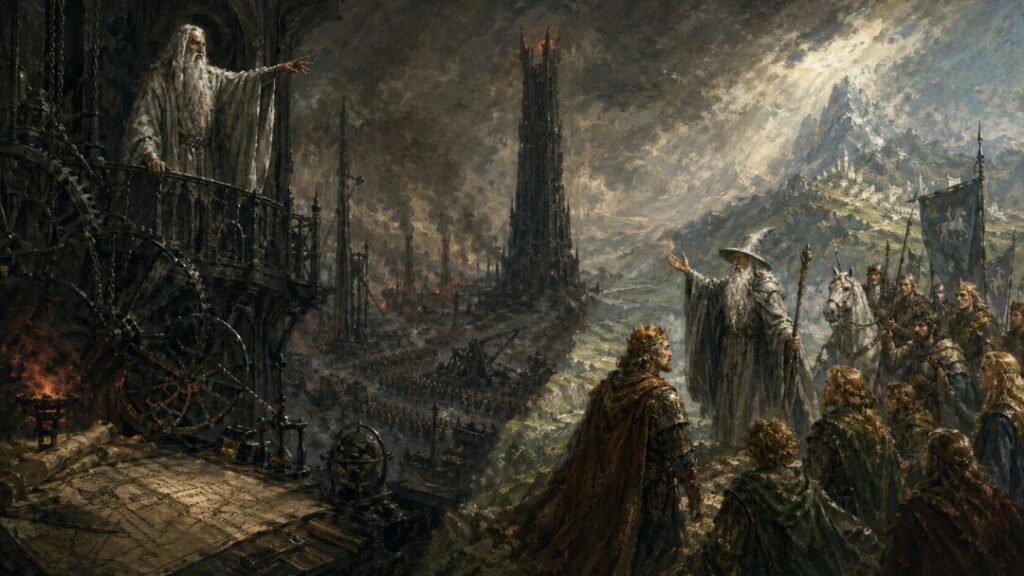
The Difference Between Gandalf and Saruman
To understand why Gandalf’s actions are permitted, it helps to compare him with Saruman.
Saruman is also one of the Istari. He is also wise, powerful, persuasive, and sent originally for the same broad purpose: to oppose Sauron.
But Saruman falls because he begins to desire mastery.
He studies the devices of the Enemy too deeply. He grows fascinated with power, order, control, and domination. By the time Rohan faces his armies, Saruman is no longer merely opposing Sauron. He is imitating him.
He breeds armies.
He deceives rulers.
He imprisons Gandalf.
He bends others to his designs.
He uses fear and machinery to impose his will.
That is precisely the path the Istari were not meant to take.
Gandalf’s conduct at Helm’s Deep is the opposite.
He does not break Théoden’s will. He frees it.
He does not rule Rohan. He restores its king.
He does not create an army of servants. He gathers scattered men who already belong to the land they are defending.
Saruman turns people into tools.
Gandalf helps people become themselves again.
That is why the two Wizards can both appear in a war, and yet stand on opposite sides of the rule that governs them.
Gandalf’s Power Works Through Others
Gandalf’s greatest victories are often indirect.
That can make them easy to misunderstand.
He is powerful, certainly. He is far more than an old man with a staff. But the pattern of his work in Middle-earth is not domination. Again and again, his power appears as counsel, awakening, timing, courage, and hope.
He pushes Bilbo out of comfort and into an adventure that will change the fate of the world.
He guides the Fellowship but does not carry the Ring himself.
He confronts Théoden’s despair and helps draw the king out from under the shadow that has fallen over him.
At Helm’s Deep, he does not win by making Rohan irrelevant.
He wins by ensuring Rohan is not alone.
That is very different from matching Sauron’s power with power.
Sauron seeks to gather all wills into himself. Gandalf seeks to strengthen the wills of others so they may freely resist him.
The result may look like military intervention.
But spiritually and morally, it is something else.
Did Gandalf Personally Fight at Helm’s Deep?
This is where careful wording matters.
The book does not present Gandalf as personally cutting through Saruman’s army in the way many modern viewers might remember from adaptations.
At the dawn turn of the battle, he appears on a ridge, clothed in white and shining in the rising sun. With him come Erkenbrand and a force of men on foot. This arrival breaks the moment of despair and changes the battle’s direction.
But Gandalf’s decisive action is not described as a display of destructive wizardry.
He brings aid.
He brings timing.
He brings hope.
He brings together forces that Saruman’s assault had scattered.
That is not a minor distinction. It is the key to the whole question.
If Gandalf had unveiled himself as a Maia and annihilated the army by overwhelming spiritual power, the concern would be much stronger. But that is not what the text shows.
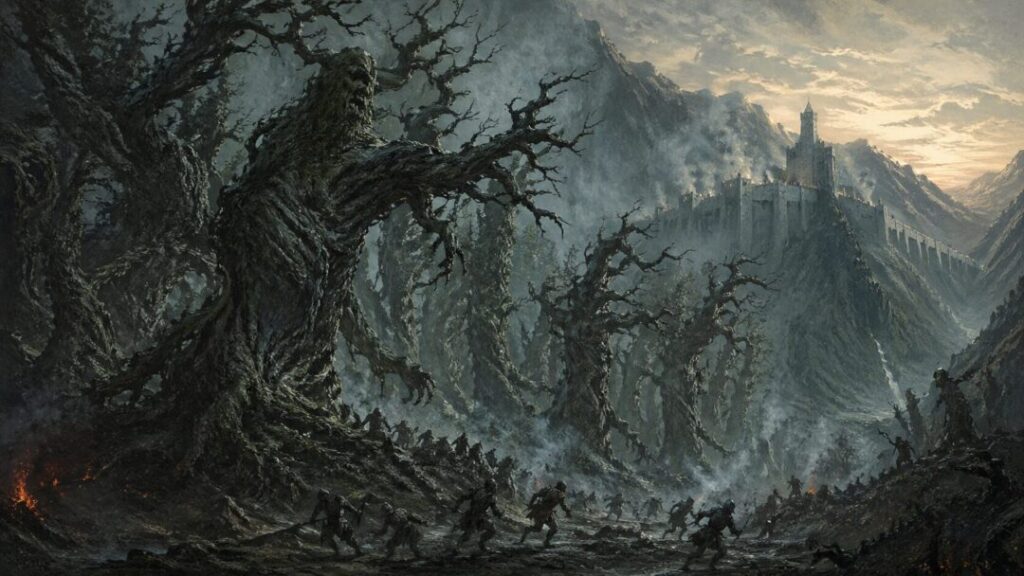
The battle is won through the courage of Théoden, Aragorn, Éomer, the defenders of the Hornburg, Erkenbrand’s arrival, and the strange, terrifying presence of the Huorns that hem in Saruman’s fleeing forces.
Gandalf is essential.
But he is not the sole instrument of victory.
The Huorns and the Limits of Certainty
The sudden appearance of the forest near Helm’s Deep is one of the eeriest parts of the battle.
The text identifies this moving wood as connected with Fangorn, and later the fate of many of Saruman’s Orcs is bound up with the Huorns. They are not simply ordinary trees. They are ancient, dangerous, and deeply tied to the wrath of the forest against Saruman’s destruction.
Gandalf clearly understands more about these events than most of the characters do.
But the exact degree to which he directs, arranges, or merely anticipates the Huorns’ role should be phrased carefully.
The text does not require us to say Gandalf “commands” the Huorns like troops under his personal authority. That would risk overstating the matter.
What can be said safely is this: Gandalf’s return at dawn coincides with the arrival of Erkenbrand’s force and the presence of the strange forest, and together these bring about the ruin of Saruman’s army.
The broader pattern remains consistent.
Gandalf does not dominate nature, Men, or events as a tyrant would.
He works within the free and living forces already opposed to Saruman.
Why This Does Not Break the Rules
The Istari’s restriction was never meant to prevent them from helping.
It was meant to prevent them from conquering.
That is why Gandalf’s behavior at Helm’s Deep fits his mission.
He does not use fear to rule Rohan.
He does not establish himself as king.
He does not force Théoden’s people to serve him.
He does not attempt to defeat Sauron or Saruman by becoming a rival Dark Lord.
He acts as a messenger, counselor, and awakener of resistance.
Even when he appears in glory at dawn, that glory does not erase the agency of others. It strengthens it.
This is one of the deepest moral patterns in Middle-earth.
The right use of power does not make others smaller.
It calls them back to courage.
Theoden’s Choice Still Matters
One of the reasons Helm’s Deep works so powerfully is that Théoden is not treated as a puppet.
Gandalf frees him from the poisonous influence that has weakened his house, but Théoden must still choose what kind of king he will be.
He chooses to ride.
He chooses to defend his people.
He chooses, at the edge of defeat, to go out from the Hornburg rather than wait passively for death.
Gandalf’s aid does not cancel these choices. It meets them.
That is crucial.
If Gandalf simply solved everything alone, Théoden’s courage would become decorative. Rohan would be saved, but not restored. The king would survive, but he would not be renewed.
Instead, Gandalf’s intervention allows Théoden’s own nobility to reappear.
The old king becomes himself again.
That is exactly the sort of victory Gandalf was sent to make possible.
Gandalf’s Warfare Is Not Saruman’s Warfare
So did Gandalf “fight” at Helm’s Deep?
In one sense, yes.
He takes part in the struggle against Saruman’s assault. He rides, gathers aid, returns at the critical hour, and helps bring about the defeat of an army serving evil.
But if “fight” means using his full hidden nature to crush enemies by divine force, then Helm’s Deep does not show that.
Gandalf’s warfare is not conquest.
It is resistance.
It is not domination.
It is deliverance.
It is not the replacement of Men by angelic power.
It is the restoration of Men to hope, courage, and action.
That is why Gandalf can stand in the middle of a war without betraying the purpose for which he was sent.
The Real Meaning of Gandalf’s Arrival
Gandalf’s dawn arrival at Helm’s Deep is not simply a dramatic rescue.
It is a revelation of what his kind of power is.
He comes when despair is strongest.
He comes after Théoden has chosen courage.
He comes with the strength of Rohan itself, gathered from the wreckage.
He comes not to rule, but to return hope to those who were nearly overcome.
This is why the scene does not violate the law of the Istari. It fulfills it.
Gandalf is not forbidden from standing against evil.
He is forbidden from becoming the kind of power he was sent to resist.
And at Helm’s Deep, he does the opposite.
Saruman tries to win by control.
Gandalf wins by awakening.
Saruman makes slaves and engines.
Gandalf restores kings and gathers free men.
Saruman’s power narrows the world around his own will.
Gandalf’s power opens the world again.
That is the hidden answer inside the battle.
Gandalf does fight at Helm’s Deep.
But he fights in the only way a faithful Wizard can.
Not by taking the war out of mortal hands.
But by making sure those hands do not fail before the morning comes.
Sources & Notes
- J.R.R. Tolkien, Unfinished Tales, “The Istari” — says the Wizards were forbidden to match Sauron’s power with power or to dominate Elves and Men, but were sent to advise and encourage resistance.
- J.R.R. Tolkien, The Lord of the Rings, Book III, Chapter 6, “The King of the Golden Hall” — Gandalf breaks Wormtongue’s hold and restores Théoden’s will rather than taking rule of Rohan himself.
- J.R.R. Tolkien, The Lord of the Rings, Book III, Chapter 7, “Helm’s Deep” — Gandalf leaves the Hornburg, returns at dawn with Erkenbrand and the Westfold men, and turns the battle through gathered aid.
- J.R.R. Tolkien, The Lord of the Rings, Book III, Chapter 8, “The Road to Isengard” — explains the Huorns’ role after the battle, supporting caution about treating them as ordinary troops under Gandalf’s command.
- J.R.R. Tolkien, The Lord of the Rings, Book III, Chapter 10, “The Voice of Saruman” — contrasts Gandalf’s freeing counsel with Saruman’s coercive voice, deception, and desire for mastery.