Saruman’s ring is one of the strangest small details in The Lord of the Rings.
It appears briefly. It is mentioned almost in passing. No one stops to examine it. No one tells us its name. No one explains its powers. It is never treated like one of the great Rings of Power.
And yet it appears at one of the most important turning points in the story.
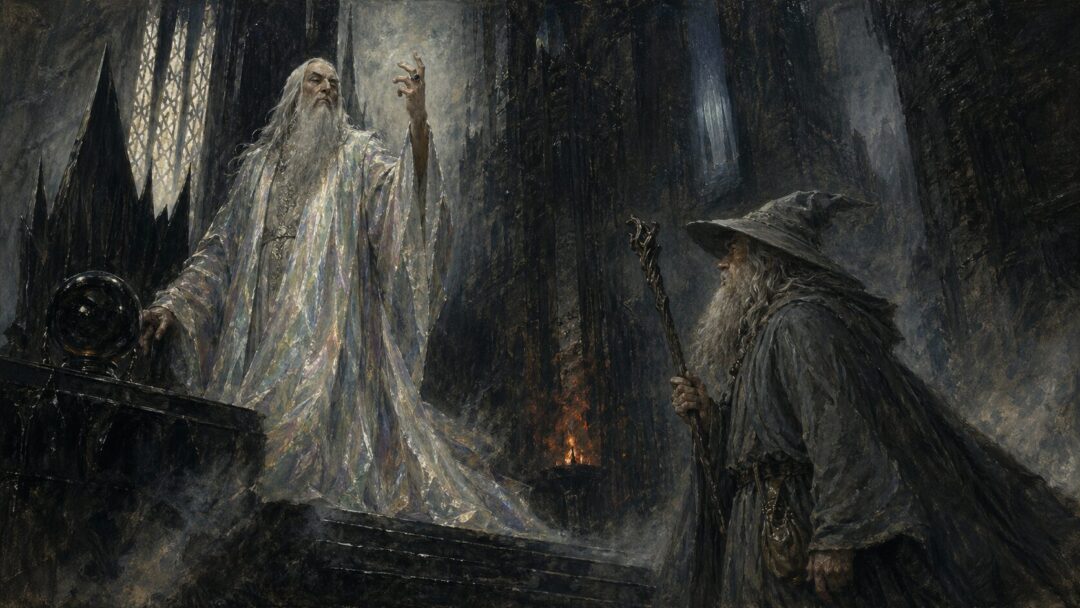
When Gandalf tells the Council of Elrond what happened at Orthanc, he remembers a detail that might seem minor at first:
Saruman was wearing a ring.
Then Saruman gives himself a new title.
Not only Saruman the Wise.
Not only Saruman of Many Colours.
But Saruman Ring-maker.
That phrase changes everything.
Because in Middle-earth, rings are not ordinary symbols. They are bound to the great temptation of the age: the desire to order the world by power, to preserve what should pass away, and to bend other wills to one’s own design.
So what was Saruman’s ring?
The most important answer is also the most careful one:
The text does not fully tell us.
But it tells us enough to understand why the detail matters.
Saruman’s Ring Is Not Explained Like the Great Rings
The first thing to notice is what the story does not say.
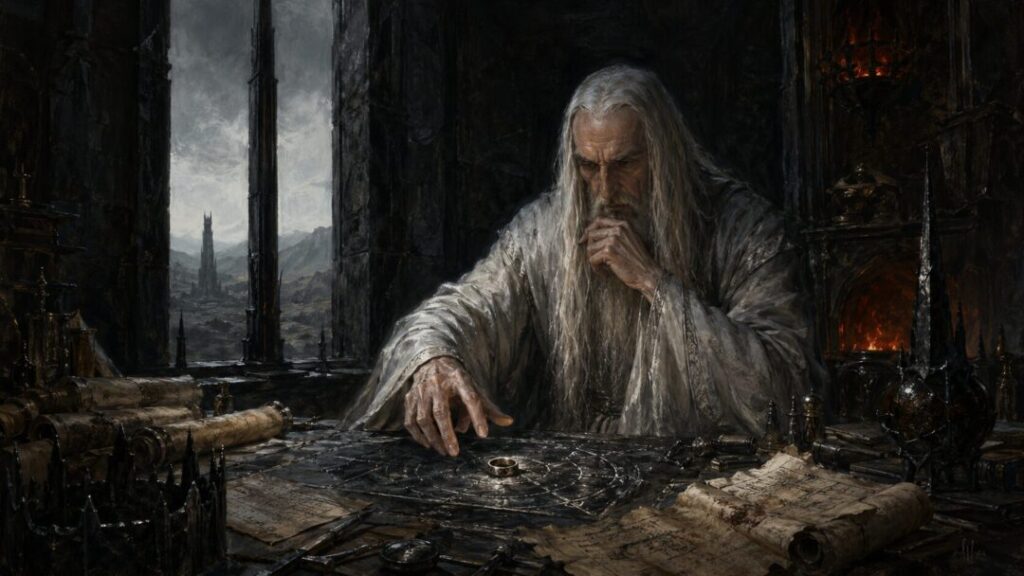
Saruman’s ring is not named among the Three, the Seven, the Nine, or the One. It is not given a history. It is not described as one of the lost Rings of Power. No character explains that it can preserve, dominate, enslave, or extend life.
Gandalf simply sees that Saruman is wearing a ring.
Then Saruman calls himself “Ring-maker.”
That is all the direct evidence the narrative gives.
This means we should be cautious. It is tempting to imagine Saruman forging some powerful secret Ring of his own, perhaps a lesser version of the One. But the text never confirms that. It never tells us what the ring could do, or whether it had any real power at all.
What we can say is more limited, but also more interesting.
Saruman wanted Gandalf to see it.
The ring was part of how he presented himself. It belonged to the new identity he was claiming: not merely a servant of wisdom, not merely the head of the White Council, but a maker in his own right.
That makes the ring less important as a weapon and more important as a confession.
Saruman Had Gone Deep Into Ring-lore
Saruman’s connection to Ring-lore did not appear suddenly at Orthanc.
He had long studied the Rings of Power. Among the Wise, he was known for his knowledge in that area. His authority on the subject helped shape the counsel others received about the One Ring.
This is part of what makes his fall so dangerous.
Saruman did not begin as an ignorant servant of evil. He was wise. He understood much. He had real knowledge of the devices of the Enemy.
But knowledge alone did not protect him.
In fact, his study of the Rings seems to have become one of the paths by which temptation reached him. The more he understood the history and power of the Rings, the more he appears to have desired mastery for himself.
That is one of the quiet tragedies of Saruman.
He studies the Enemy’s art in order to oppose it.
Then, little by little, he begins to admire it.
“Ring-maker” Is a Terrible Title to Claim
Saruman’s title matters because it echoes the central evil of the age.
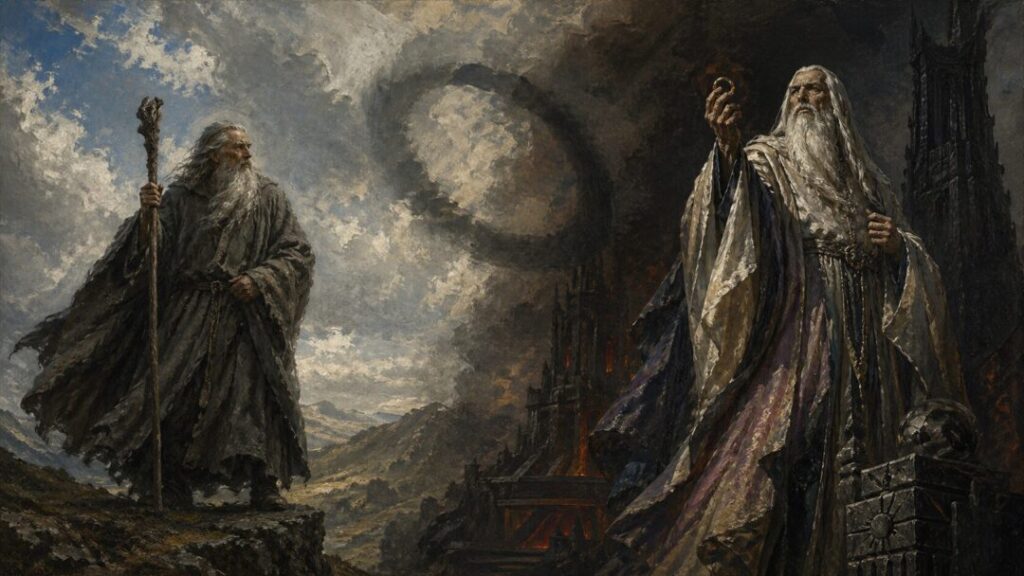
Sauron is the great Ring-maker. He forged the One Ring to rule the others. The One was not simply a tool of strength; it was the instrument of domination. It was made to control, to bind, and to impose one will over many.
So when Saruman calls himself Ring-maker, he is not using a harmless title.
He is placing himself in the same pattern.
He may not possess Sauron’s full craft. He may not have made anything close to the One Ring. The text gives us no reason to think he succeeded on that scale.
But spiritually and morally, the direction is clear.
Saruman no longer wants only to resist Sauron.
He wants to rival him.
That is the true danger of the ring.
Not that it proves Saruman has become another Dark Lord in power, but that it shows he has begun to think like one.
The Ring Shows Saruman’s Desire to Imitate Sauron
Saruman’s fall is not simply a case of fear.
It is not only that he believes Sauron is too strong to defeat. It is not only that he thinks compromise is necessary.
His words to Gandalf reveal something deeper.
He speaks of power. He speaks of knowledge. He speaks of ruling events rather than being ruled by them. He imagines a new order in which the Wise might guide the world through strength and calculation.
But beneath that language is the same old temptation:
Use power to defeat power.
Use domination to prevent domination.
Become dangerous enough that danger can be controlled.
This is where Saruman’s ring becomes so revealing.
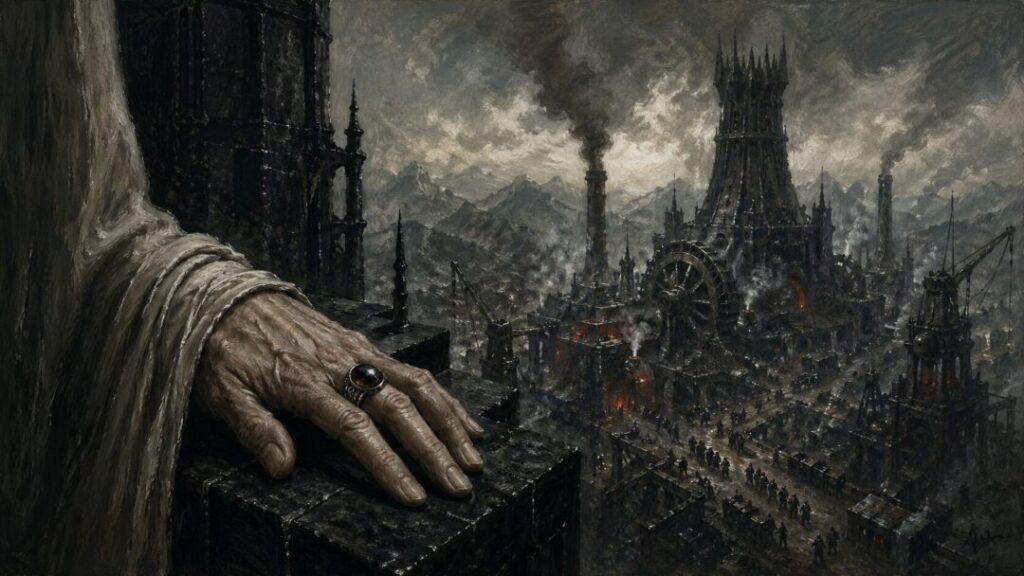
It is a small, visible sign that he has crossed a line internally. He is no longer merely researching the Rings. He is making himself into a Ring-maker.
The imitation is the point.
Saruman’s ring may be weak. It may be symbolic. It may be an incomplete experiment. The story does not say.
But even if it had no great power, it still tells us what Saruman wanted to become.
The Ring May Be Less Important Than the Boast
There is a reason the story gives us Saruman’s title but not the ring’s powers.
The title is what matters.
Saruman wants to be known as Ring-maker.
That means the ring is tied to pride. It is part of his self-reinvention. He has changed his robes. He has changed his allegiance. He has changed the way he speaks about wisdom and power.
And now he has changed his name.
Saruman the White has become Saruman of Many Colours.
Saruman the Wise has become Saruman Ring-maker.
The ring is not presented as a mystery for the reader to solve in a mechanical sense. The question is not mainly, “What spell did it contain?” or “What exact ability did it give him?”
The deeper question is:
Why would Saruman want that title at all?
The answer is unsettling.
Because he no longer sees the making of rings as a warning.
He sees it as an achievement.
A Counterfeit of True Authority
Saruman’s ring also reveals something about his authority.
At the beginning, Saruman holds real status. He is the chief of the Istari. He is respected by the Wise. His counsel carries weight. His voice has power.
But by the time Gandalf reaches Orthanc, Saruman’s authority is becoming counterfeit.
He still looks like a figure of wisdom. He still speaks with command. He still presents himself as one who sees farther than others.
Yet the heart of his wisdom has turned.
The ring on his finger is part of that counterfeit kingship. It suggests mastery, craft, hidden power, and superiority. It is a sign Saruman gives himself, as if he can crown himself through knowledge and making.
But Middle-earth repeatedly shows that true authority is not seized in that way.
Aragorn does not become king by grasping at the Ring.
Gandalf does not defeat Sauron by imitating him.
Frodo does not save the world through domination.
Saruman chooses the opposite path.
He tries to make himself great by becoming like the enemy.
Why the Ring Is Never Mentioned Again
One of the strangest things about Saruman’s ring is that the story does not return to it.
After Orthanc, the focus moves elsewhere. Saruman’s armies are defeated. His voice loses its force. His staff is broken. He is cast down from his position. Eventually, he ends in the Shire, diminished and bitter.
The ring never becomes a major plot object.
That absence is important.
If Saruman’s ring had been a true rival to the Rings of Power, the narrative would almost certainly treat it differently. Instead, it vanishes into the larger story of Saruman’s collapse.
This suggests that its significance is not primarily practical.
It is thematic.
Saruman’s ring matters because it shows the shape of his corruption before the full collapse becomes visible. It is a signpost placed early in the road. By the time Gandalf sees it, Saruman has already begun remaking himself in Sauron’s image.
The ring does not need to dominate the plot.
It has already revealed the man.
Saruman’s Ring and the Failure of “Useful Evil”
Saruman’s great mistake is believing that evil can be managed if one is clever enough.
He thinks in terms of necessity, strategy, and control. He believes he understands the movements of power better than others. He sees himself as realistic, while Gandalf remains, in his view, naïve or sentimental.
But the ring on his finger betrays him.
It shows that Saruman has not mastered evil.
He has been drawn into its logic.
This is one of the great moral patterns of The Lord of the Rings. The desire to use the Enemy’s methods against the Enemy is itself a trap. The One Ring is the clearest example, but Saruman embodies the same temptation in another form.
He does not need to wear the One Ring to fall into its philosophy.
He only needs to believe that domination is wisdom.
The Real Meaning of Saruman’s Ring
So what is the significance of Saruman’s ring?
It is not that Saruman secretly forged another One Ring.
The text does not support that.
It is not that his ring was one of the great lost Rings.
The text does not say that either.
Its significance is more subtle and more tragic.
Saruman’s ring is the visible sign of his inward imitation of Sauron. It shows that his study of Ring-lore has turned into ambition. It reveals that he no longer wants merely to understand power, but to create it, claim it, and define himself by it.
The ring is a symbol of counterfeit mastery.
It is Saruman’s attempt to become a maker of power in a world already nearly ruined by such making.
And that is why the detail is so chilling.
Gandalf does not need to know exactly what the ring does.
He only needs to see that Saruman is wearing it.
Because by then, the warning is already clear:
Saruman has not merely betrayed the Wise.
He has begun to become the thing he was sent to oppose.
Why This Small Detail Matters
Saruman’s ring is easy to miss because it is small.
But that is exactly how corruption often appears in Middle-earth.
Not always first as open war.
Not always first as monstrous cruelty.
Not always first as a banner raised for the Enemy.
Sometimes it appears as a private title.
A new robe.
A changed philosophy.
A ring on a finger.
Saruman’s fall was not only a political betrayal. It was a spiritual surrender to the idea that power is the highest form of wisdom.
That is why his ring matters.
Not because we know its secrets.
But because it shows that Saruman had already chosen what kind of story he wanted to belong to.
And tragically, it was not the story of the Wise.
It was the story of the Ring-makers.
Sources & Notes
- J.R.R. Tolkien, The Fellowship of the Ring, Book II, Chapter 2, “The Council of Elrond” — Gandalf reports Saruman’s ring, his title “Ring-maker,” and his argument for using power and knowledge to order events.
- J.R.R. Tolkien, The Fellowship of the Ring, Book II, Chapter 2, “The Council of Elrond” — the same account presents Saruman as long concerned with Ring-lore and already withholding counsel about the One Ring.
- J.R.R. Tolkien, The Silmarillion, “Of the Rings of Power and the Third Age” — sets the larger pattern of Sauron as maker of the ruling Ring, binding lesser rings to domination rather than ordinary ornament.
- J.R.R. Tolkien, Unfinished Tales, “The Istari” — gives Saruman’s place among the Wizards and his special affinity for craft, knowledge, and devices, the background against which his Ring-making boast becomes ominous.
- J.R.R. Tolkien, Letter 131 — Tolkien describes Sauron’s essential desire for order, rule, and domination, matching the article’s reading of Saruman’s imitation of the Enemy’s methods.