When Sauron falls, Middle-earth changes almost overnight.
The Ring is destroyed. Barad-dûr collapses. The Nazgûl are gone. Gondor receives its king, and the long fear that had lain over the West is lifted.
But far away from Mordor, another ending is taking place more quietly.
In the North, the Rangers no longer have to remain what they had been.
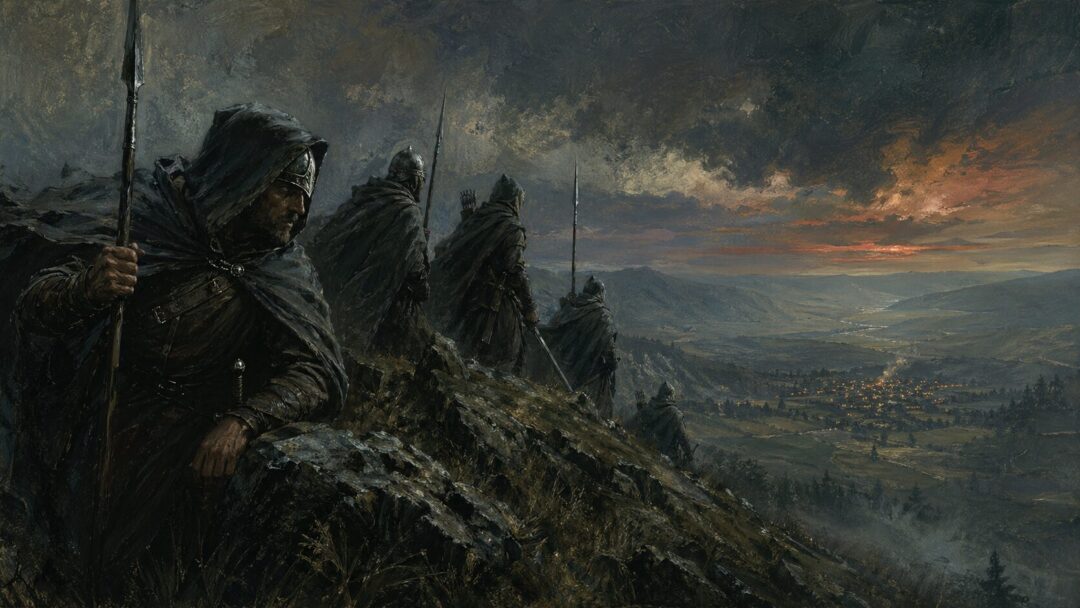
For centuries, the Rangers of the North had lived in secrecy. They watched the roads, guarded the borders of the Shire, fought Orcs and wolves, and moved through Eriador as grim, half-feared wanderers. Most ordinary people did not know who they were. The Bree-folk called them Rangers, but they did not understand that these men were the last remnant of the Dúnedain of Arnor.
They were not merely wandering warriors.
They were the surviving people of a fallen kingdom.
So when Aragorn became King Elessar, the question becomes more interesting than it first appears:
What did the Rangers do after the fall of Sauron?
The simple answer is that the texts do not give us a full account.
The deeper answer is that their old life ended because their hidden purpose had finally been fulfilled.
The Rangers Were Not Just Soldiers
To understand what happened to the Rangers after the War of the Ring, we first have to understand what they were before it.
They were not a formal army in the way Gondor had armies. They were not a band of adventurers. They were not mercenaries or outlaws.
They were the Northern Dúnedain.
Their ancestors had belonged to Arnor, the North-kingdom founded by Elendil. But Arnor had long since fallen. It had divided, weakened, and been destroyed through war, plague, and the malice of Angmar. By the late Third Age, no northern kingdom remained in any visible form.
But its people did.
Reduced in number, hidden in the wild, and led by the Chieftains of the Dúnedain, they continued to endure. Their royal line survived in secrecy, guarded in part through Rivendell, until it came at last to Aragorn.
This matters because the Rangers were never simply protecting empty land.
They were preserving memory.
Every lonely watch near Bree, every guard kept around the Shire, every unseen struggle against Orcs in Eriador was part of a much older story. They were keeping alive the last shape of Arnor until the day when the king might return.
Most people in the North did not know this.
That is part of the tragedy.
The people they protected often distrusted them.
The Watch Over the Shire
The Hobbits of the Shire lived in remarkable peace through much of the Third Age.
They were not powerful. They had no great armies. They were not known for war. And yet the Shire remained mostly untouched by the larger dangers of the world until the final years before Sauron’s defeat.
This was not because danger never came near.
It was because others stood between the Shire and the darkness.
The Rangers were part of that hidden protection. The Hobbits remembered “the Guardians” only dimly, if at all. They did not fully understand that stern men in the wild were helping preserve the very peace in which Hobbit life could flourish.
This gives the Rangers a strange kind of heroism.
They were not celebrated. They were not thanked. Their names were not sung in Hobbit inns. Even in Bree, where they were seen more often, they were treated with suspicion.
And still they kept watch.
That watch becomes especially important when the Ring begins to matter again. In the years before the War, the Shire is guarded more closely. The Enemy is searching. Gollum has spoken. The Nazgûl are abroad.
The Rangers’ role, then, is not decorative.
Without them, the quiet lands of the North would have been far more exposed.
The Grey Company and the Last Ride South
During the War of the Ring, the Rangers are revealed most clearly through the Grey Company.
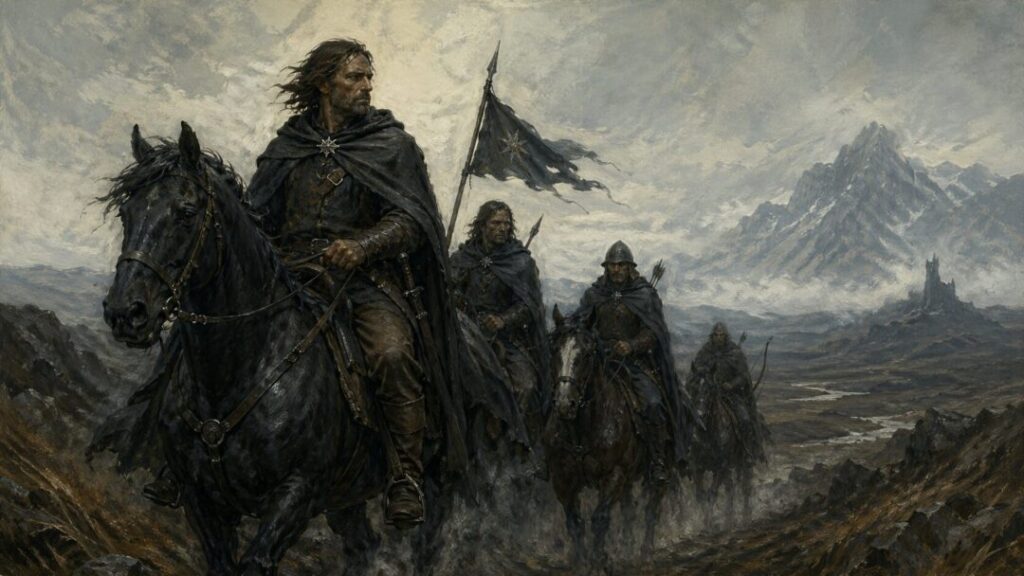
Halbarad gathers what men he can and rides south to Aragorn. But the number is strikingly small. In haste, he can bring only thirty Rangers.
That detail says a great deal.
The Northern Dúnedain were not numerous. They were a dwindled people. Their strength lay not in great armies, but in endurance, secrecy, skill, and loyalty.
The Grey Company joins Aragorn, passes through the Paths of the Dead, and fights in the great events that lead to the lifting of the siege of Minas Tirith. Halbarad himself dies in the Battle of the Pelennor Fields.
This is one of the few named losses among the Rangers, and it carries symbolic weight.
The old hidden life of the Dúnedain is giving its last strength to bring about the return of the king.
After that, the story no longer follows the Rangers closely as a separate group. And that silence is important.
Because once Aragorn is crowned, the Rangers’ purpose changes completely.
Aragorn Was Their Chieftain Before He Was King
Aragorn does not come from nowhere.
Before he is crowned in Gondor, he is already the Chieftain of the Dúnedain of the North. To the people of Bree, he may be Strider. To the Hobbits, at first, he may seem like a dangerous wanderer. But among his own people, he is the heir of Isildur.
The Rangers followed him before Gondor accepted him.
That means when Aragorn becomes King Elessar, the Rangers are not merely gaining a distant monarch. Their own lord has been revealed as king of both Gondor and Arnor.
This is the turning point.
The Chieftain of a hidden people becomes the ruler of a restored realm.
The line that had survived in secrecy is now public. The kingship that had existed only as memory and inheritance becomes political reality again.
So the Rangers do not need to keep living as the last shadow of Arnor.
Arnor is being restored.
The Reunited Kingdom Changes Everything
After the War of the Ring, Aragorn rules the Reunited Kingdom of Gondor and Arnor.
That phrase is easy to pass over, but for the Rangers it means everything.
For more than a thousand years, the North-kingdom had been gone. Its cities were ruined. Its people were scattered. Its kings were reduced to chieftains in the wild.
Now that story is reversed.
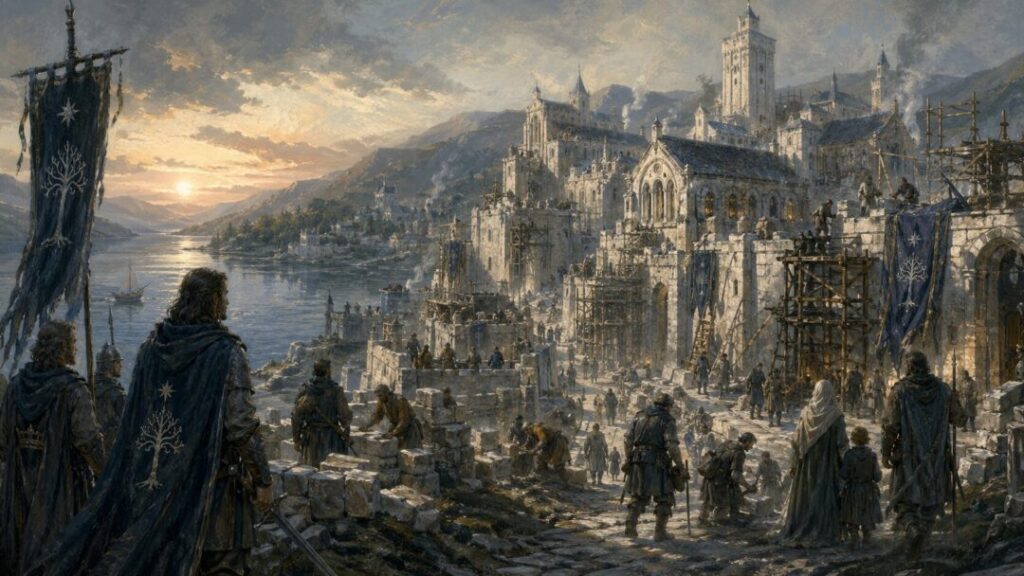
The texts tell us that Aragorn rebuilt Annúminas and would dwell there when he came north. Fornost, too, is associated with restoration. The North is no longer merely a land of ruins, roads, and memory. It becomes a realm again.
This is probably the closest thing we get to an answer.
The Rangers became part of the restored people of Arnor.
The texts do not describe exactly which Ranger took which role. We are not told that one became a captain, another a lord, another a warden of Annúminas. Those details would be invention.
But the larger movement is clear.
The hidden guardians of the North are gathered back into a kingdom.
They are no longer only Rangers.
They are Dúnedain of Arnor under the restored line of Elendil.
Did They Stop Being Rangers?
This is where we have to be careful.
The texts never say, in a formal way, “the Rangers ceased to exist.”
So we should not imagine a sudden ceremony in which every Ranger hangs up his cloak and abandons the wild forever. Middle-earth does not give us that scene.
It is entirely possible that some form of ranging continued for a time.
The North would still need scouts. Roads would still need protection. Wild lands do not become safe in a single season. Orcs, trolls, and other dangers may have lingered even after Sauron’s defeat. Aragorn’s reign is remembered as a time of peace and renewal, but peace still has to be maintained.
So in a practical sense, some Rangers may have continued to serve as wardens, scouts, messengers, or guardians of the northern roads.
But their meaning would have changed.
Before the fall of Sauron, they were guardians without a visible kingdom.
After the return of the king, any such work would belong to a restored realm.
That is the difference.
They would no longer be protecting a memory.
They would be serving a kingdom.
The Shire Remained Protected — But Differently
One of Aragorn’s most revealing acts as king concerns the Shire.
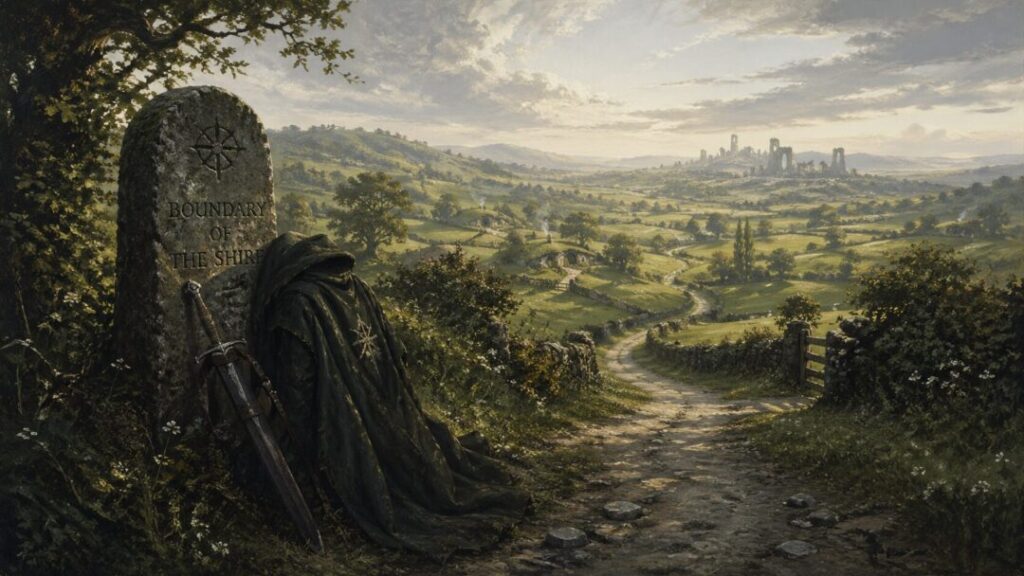
He makes a law that Men are not to enter it, and he himself respects that law. This is a remarkable gesture. The Shire lies within the restored order of the North, yet it is given a special kind of protection.
Before the War, the Rangers protected the Shire from outside threats without the Hobbits fully understanding what was happening.
After the War, the King protects the Shire by law.
That is a quiet but beautiful transformation.
The same care remains, but it is no longer only hidden in the movements of grim men beyond the borders. It is now written into the peace of the realm.
The Hobbits are not absorbed into the world of Men. They are allowed to remain themselves.
This also shows that Aragorn did not forget the lands his people had guarded for so long. The old watch of the Rangers becomes part of the king’s justice.
What About the Common People of the Dúnedain?
Another important point is that the Rangers were not necessarily the entire population of the Northern Dúnedain.
The texts show us armed Rangers most often because they are the ones who enter the story. But the Dúnedain had families, hidden dwellings, and a continuing people. Aragorn himself comes from this world of concealed lineage and survival.
After the restoration of Arnor, those people would no longer need to exist only in secrecy.
Again, the texts do not give us a census. They do not describe the rebuilding of every settlement or the fate of every household. But if Arnor is restored and Annúminas is rebuilt, then the Northern Dúnedain must have some renewed place in the world.
This may be the most meaningful part of their fate.
The Rangers are often imagined as lonely wanderers, and many of them were. But their story is not only about wandering.
It is about return.
Return of the king.
Return of the realm.
Return of a people from the edge of disappearance.
Their Greatest Victory Was Becoming Unnecessary
There is something deeply moving about the Rangers’ ending because it is not dramatic.
They do not receive a grand farewell.
They do not stand before all the peoples of Middle-earth to be praised for centuries of hidden service.
Most of what they did remains unseen.
But that is exactly the kind of heroism they represent.
The Rangers spent generations preserving a peace that others took for granted. They guarded people who mistrusted them. They remembered a kingdom that had become ruins. They kept faith with a line of kings when no crown remained.
And then, at last, the king returned.
That return did not make their work meaningless.
It proved that their work had mattered all along.
The Rangers of the North did not simply vanish after the fall of Sauron. They were transformed by the very victory they helped make possible. The secret watch became open peace. The hidden Chieftain became King. The broken North became Arnor again.
In the Third Age, the Rangers were the last remnant of a lost kingdom.
In the Fourth Age, they became the first people of a restored one.
And perhaps that is why the texts say so little about their ending.
Because the best ending for the Rangers was not one more desperate battle in the wild.
It was a road safe enough that no one needed to wonder who was guarding it.
Sources & Notes
- J.R.R. Tolkien, The Lord of the Rings, Prologue, “Concerning Hobbits” — notes that the Shire’s peace was guarded by watchful Rangers and that hobbits scarcely understood this protection.
- J.R.R. Tolkien, The Lord of the Rings, Appendix A, “The North-kingdom and the Dúnedain” — gives the fall of Arnor, the hidden Chieftains of the Dúnedain, and Aragorn’s northern inheritance.
- J.R.R. Tolkien, The Lord of the Rings, Book V, Chapter 2, “The Passing of the Grey Company” — Halbarad brings only thirty Rangers south, showing the small but loyal remnant that followed Aragorn.
- J.R.R. Tolkien, The Lord of the Rings, Appendix B, “The Tale of Years” — records Aragorn as King Elessar of the Reunited Kingdom and places Arnor again under the restored royal line.
- J.R.R. Tolkien, The Lord of the Rings, Appendix B, Fourth Age entries — Aragorn’s northern visits, the rebuilding of Annúminas, and the law forbidding Men to enter the Shire show how hidden guardianship becomes royal protection.