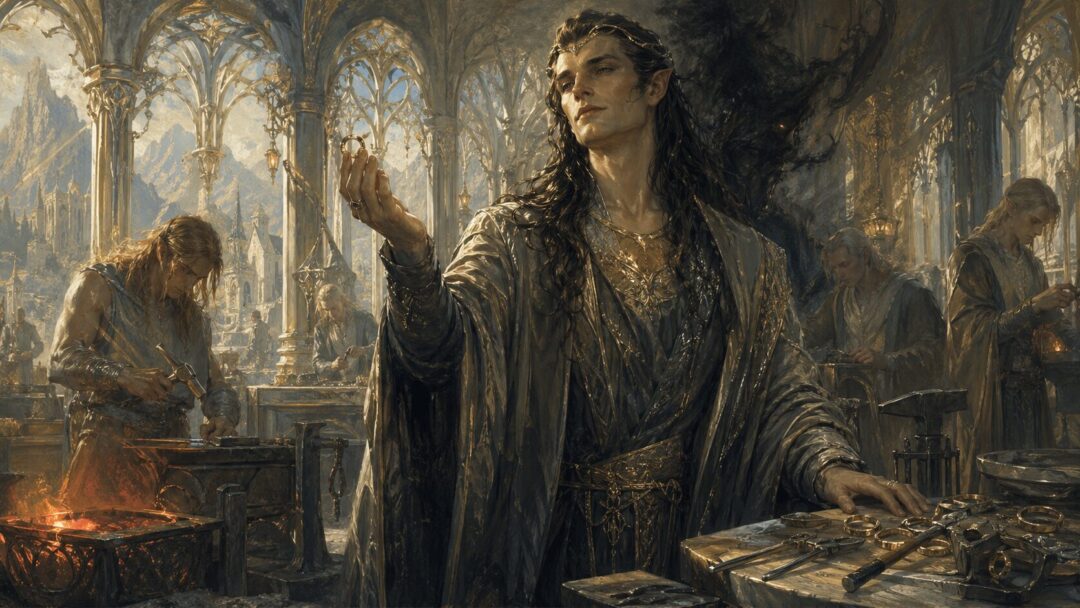
Most people can picture Sauron instantly.
A towering figure in black armor.
A spiked crown-like helmet.
A terrible mace.
A body that seems less like flesh than forged darkness.
For many viewers, that image has become Sauron.
It is so powerful, so simple, and so memorable that it feels as if it must have come directly from the books. As if somewhere in the text there must be a full description of the Dark Lord standing on the slopes of Mount Doom, armored from head to foot, crowned in iron, and burning with hatred.
But that is not quite true.
The movie version of Sauron is not a direct transcription of a detailed book description.
It is an adaptation.
And that makes it more interesting.
Because the books give us enough to understand the terror of Sauron, but not enough to draw him exactly as the films present him. The filmmakers had to solve a difficult problem: how do you show a being who is most often felt as a will, a shadow, an Eye, and a power of domination?
Their answer was not random.
But it was not purely textual either.
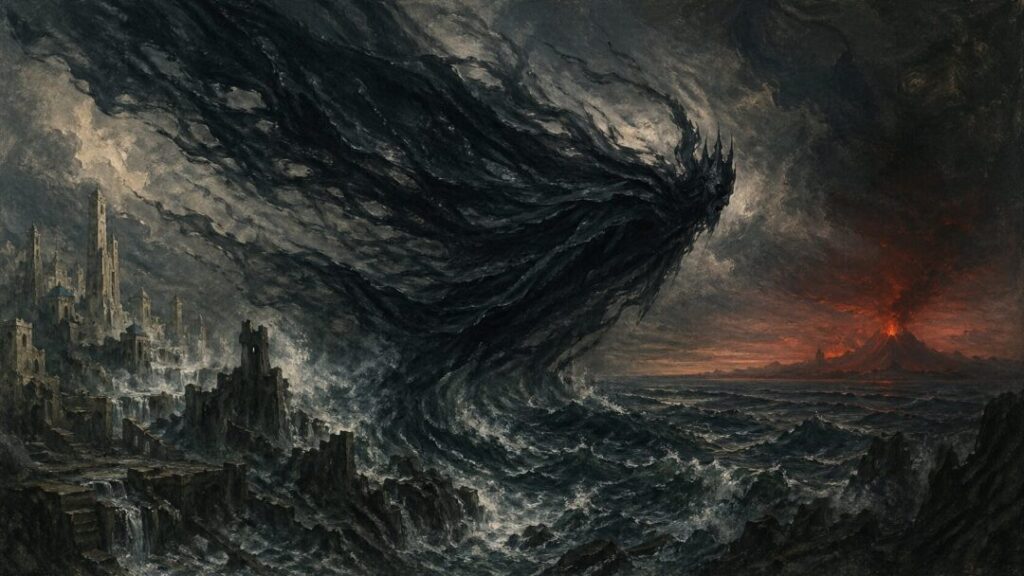
The Books Do Not Give Us the Movie Sauron
The first thing to understand is how little physical detail the texts actually provide.
Sauron is not introduced as a fully described armored villain. In The Lord of the Rings, he is usually experienced indirectly. Characters fear his attention. They speak of his will. They feel the pressure of his searching mind. His symbol is the Eye, and that Eye becomes one of the dominant images of his power.
But the Eye should not be confused too quickly with his whole being.
The story strongly indicates that Sauron has a real form during the War of the Ring. Gollum, who had been taken to Mordor, speaks of the Black Hand and says that one finger is missing. That matters, because it connects the Sauron of Frodo’s time to the Sauron overthrown by Isildur at the end of the Second Age.
Still, that is not the same thing as a detailed portrait.
We are not told the exact shape of his face.
We are not told the design of his armor.
We are not told that he wore a spiked helmet.
We are not given the movie silhouette.
What we are given is more symbolic and more disturbing.
Sauron has become a being whose body is remembered through terror.
The Black Hand and the Burning Touch
One of the most important physical details comes from the account of the Last Alliance.
When Sauron finally came forth, Gil-galad and Elendil fought him and overthrew him, but both were killed. The memory attached to that battle is not of ordinary combat. It is something more terrible.
Sauron’s hand was black, and it burned like fire.
This is one of the few concrete physical images the text gives us, and the films clearly preserve the feeling of it. The movie Sauron is not just dark. He looks heated from within. His armor catches firelight. His presence feels volcanic, as if Mount Doom itself has given him shape.
That is not a literal line-by-line description from the books.
But it is a visual expansion of something the books do say.
Sauron is associated with burning force, blackness, and bodily danger. He is not merely a distant spirit. He can kill by direct contact. His physical presence is destructive.
The film design takes that small textual seed and grows it into a whole image: a black armored body that seems forged in heat and hatred.
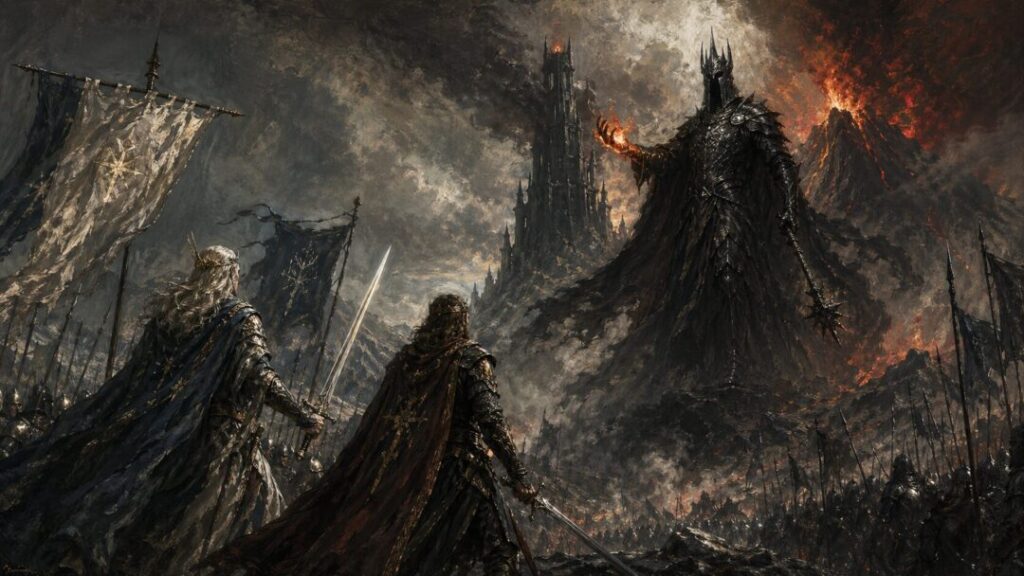
Sauron Was Once Fair
There is another important detail that the films do not show directly in the prologue, but which stands behind the whole question.
Sauron was not always unable to appear beautiful.
In the Second Age, he could take a fair form and deceive the Elves as Annatar, the Lord of Gifts. He presented himself not as a monster, but as a giver of knowledge. That is essential to understanding him. Sauron’s evil is not only battlefield violence. It is persuasion, craft, order, and domination disguised as wisdom.
But after the Downfall of Númenor, that fair form was lost to him. The texts say he could no longer appear beautiful to the eyes of Men.
That means the terrible Sauron of the Last Alliance is already a diminished and hardened being.
Not weak.
But changed.
He is no longer the deceiver in fair shape. He is the tyrant revealed.
The films had to show that version of him: not Annatar, not the subtle tempter, but the Dark Lord after the mask of beauty has been stripped away.
So the armor makes a kind of visual sense.
It is not the face of persuasion.
It is the shell left after persuasion has failed.
The Shadow of Morgoth
The strongest visual clue may not come from Sauron alone.
It may come from Morgoth.
In the deeper history of Middle-earth, Sauron was not the first Dark Lord. He was the chief servant of Morgoth, the original rebel power who corrupted much of the world long before the War of the Ring.
This matters because Sauron is, in many ways, Morgoth’s heir.
Not identical to him.
Not as vast in origin.
Not the same kind of being in the full scale of the mythology.
But he continues Morgoth’s work: domination, fear, corruption, and the bending of other wills.
Morgoth is associated with iron, darkness, and a terrible crown. In The Silmarillion, he wears an iron crown in which the Silmarils are set. He is not imagined as a clean or elegant evil, but as a ruined majesty: a power that has poured itself into tyranny and become bound to its own darkness.
This is where the movie Sauron’s design begins to feel especially meaningful.
The spiked, crown-like helmet does not come from a precise description of Sauron in The Lord of the Rings. But it does visually connect him to the older image of a Dark Lord: crowned, iron, terrible, and enthroned in fear.
That does not make the movie design “canon” in the strict sense.
But it explains why it feels so fitting.
The film Sauron looks like the successor of Morgoth.
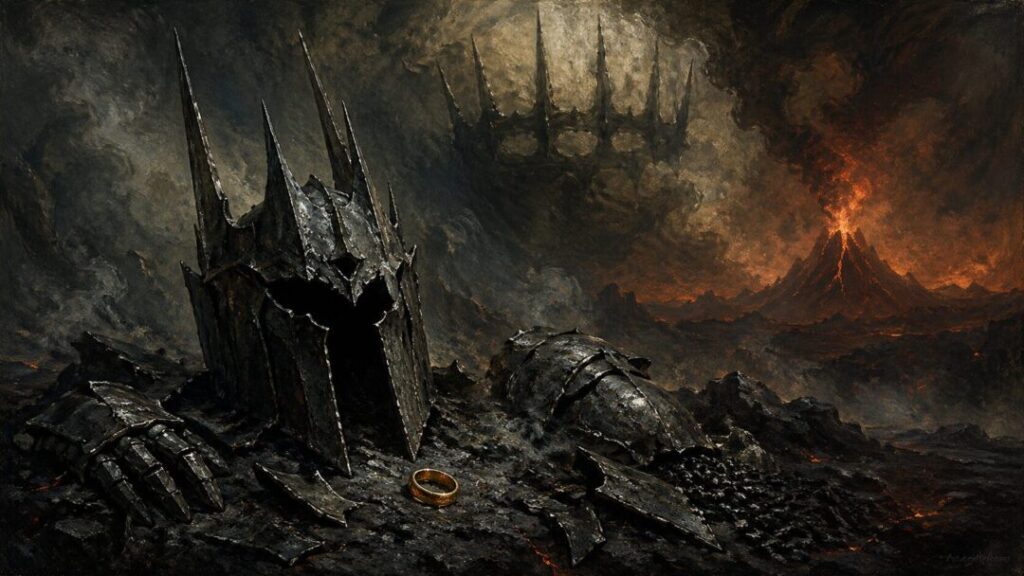
A Master of Craft, Not Just a Monster
There is another reason the armor works.
Sauron was not simply a brute force of evil. Before his fall, he belonged to the people of Aulë, the Vala associated with making, craft, and the substances of the earth. Sauron’s evil is deeply connected to skill, order, and construction.
He is a maker.
A forger.
A planner.
The One Ring itself is the clearest expression of this. Sauron does not merely conquer with armies. He creates an object designed to control the bearers of the other Rings. His greatest weapon is not a sword. It is a work of craft.
That background makes the idea of elaborate armor feel appropriate, even if the books do not describe the armor itself.
The movie design turns Sauron into something forged.
He does not look like a wild beast.
He does not look like a simple warrior.
He looks manufactured, deliberate, and terrible.
Every edge feels intentional. Every spike feels like domination made physical. His body becomes almost an extension of Mordor’s industry: black metal, heat, weight, and cruelty.
That is a very filmic solution, but it is not disconnected from the books’ deeper idea of who Sauron is.
Why the Face Is Hidden
One of the most effective choices in the film design is that Sauron’s face is not really shown.
This is important.
A visible face would make him more knowable. It would turn him into a character in the ordinary sense: someone with expressions, reactions, and perhaps even vulnerability.
But Sauron in The Lord of the Rings is rarely encountered that way.
He is a will before he is a face.
The hidden face preserves that quality. The helmet gives the audience a body, but not intimacy. We can see him move, strike, and fall, but we are not invited to read him like a man.
That choice fits the text surprisingly well.
Sauron’s terror is not that he is physically large. Many beings in Middle-earth are physically formidable. His terror is that his personhood has become almost entirely consumed by the desire to dominate.
The hidden face turns him into a presence.
A shape of command.
A crowned absence.
The Eye and the Armor
The films also made another major visual decision: they turned the Eye into a literal flaming presence above Barad-dûr.
In the books, the Eye is a symbol, a perception, and a terrifying image of Sauron’s searching will. It is not simply a giant eyeball in the sky in the ordinary physical sense. But for film, invisible pressure has to become visible.
So the movies divide Sauron into two images.
In the past, he is the armored Dark Lord.
In the present, he is the flaming Eye.
Both are simplifications.
But both come from real textual ideas.
The armored Sauron shows the bodily terror of the Last Alliance. The Eye shows the searching, sleepless will that dominates the War of the Ring. Together, they give cinema what prose can leave mysterious.
The danger is that viewers may combine them too literally and assume the books describe Sauron as only a disembodied Eye.
They do not.
The books are subtler. Sauron has a form, but his power is most often experienced as attention, pressure, fear, and command.
So Where Did the Movie Design Come From?
The honest answer is this:
Not from one direct book description.
The movie design seems to have grown from a combination of sources and needs.
It draws from the few physical hints the books give: blackness, burning heat, the terrible hand, the loss of fair form, and Sauron’s presence at the Last Alliance.
It draws from the larger mythology: the image of Morgoth as the first Dark Lord, crowned in iron and associated with ancient, tyrannical darkness.
It draws from Sauron’s identity as a maker and forger, a being whose evil is disciplined, crafted, and imposed.
And it draws from the practical demands of cinema.
The audience needed to understand, instantly, that this was not merely a king, a sorcerer, or a battlefield commander.
This was the Dark Lord.
The design had to communicate history before anyone explained it.
That is why the silhouette matters so much. The spiked crown, the black armor, the immense scale, and the faceless helmet all say the same thing:
This is power without mercy.
Why It Still Feels Right
Strictly speaking, the movie Sauron is not exactly “book Sauron.”
The books leave too much unsaid for that.
But adaptation is often most powerful when it gives shape to what the text implies rather than only what it describes.
The film design works because it does not contradict the central truth of Sauron. It does not make him chaotic, comic, or merely monstrous. It makes him ordered, ancient, and oppressive.
He looks like someone who would forge a Ring to rule all others.
He looks like someone who would build Barad-dûr.
He looks like someone who once served a greater darkness and then tried to become its heir.
That is the real secret of the design.
It is not lore-accurate because every spike is described in the books.
It is lore-sensitive because it understands what Sauron represents.
The Gap the Films Filled
The texts leave Sauron partly unseen for a reason.
Mystery gives him scale. The less we see of him directly, the more his will seems to spread across the world. He is in Mordor, but his fear reaches the Shire. He is one being, but his attention feels like a shadow cast over nations.
Film cannot rely on that kind of absence in the same way.
Especially not in a prologue.
So the filmmakers filled the gap with an image.
And because that image drew from the right parts of the legend—the black hand, the burning malice, the loss of beauty, the inheritance of Morgoth, the craft of domination—it became one of the most recognizable villain designs in modern fantasy.
Not because the books described it exactly.
But because the books made room for it.
That is why the movie Sauron feels both invented and inevitable.
He is not the full answer to what Sauron looked like in the text.
He is what the text’s terror looks like when hammered into armor.
Sources & Notes
- J.R.R. Tolkien, The Fellowship of the Ring, Book I, Chapter 2, “The Shadow of the Past” — Gollum’s memory of Sauron’s Black Hand and missing finger supports the article’s point that Sauron was not merely a disembodied Eye.
- J.R.R. Tolkien, The Fellowship of the Ring, Book II, Chapter 2, “The Council of Elrond” — gives the Last Alliance frame in which Sauron is overthrown and Isildur cuts the Ring from his hand.
- J.R.R. Tolkien, The Silmarillion, “Akallabêth” — after Númenor’s Downfall, Sauron can no longer appear fair to Men, fitting the article’s contrast between Annatar and the later Dark Lord.
- J.R.R. Tolkien, The Silmarillion, “Of the Rings of Power and the Third Age” — summarizes Sauron’s fair disguise, Ring-making, Barad-dûr, and the Second Age war behind the film prologue image.
- J.R.R. Tolkien, The Silmarillion, “Of the Flight of the Noldor” — Morgoth’s iron crown and dark lord imagery provide the deeper mythic background for a crowned, tyrannical successor.
- J.R.R. Tolkien, Letter 131 — Tolkien’s account of Sauron’s drive toward order, control, and domination supports the article’s reading of the armor as disciplined, crafted evil rather than random monstrosity.