Most people think the answer is simple.
The Lord of the Rings is Sauron.
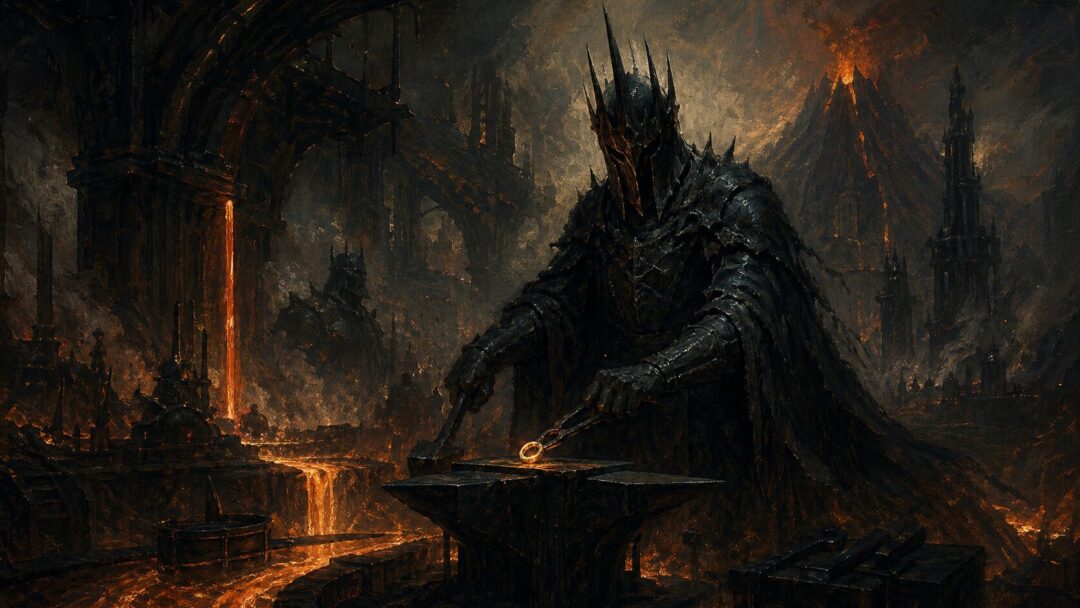
He is the Dark Lord. He made the One Ring. He forged it in the fire of Orodruin, poured much of his own power into it, and designed it to rule the other Rings of Power.
The Ring-verse appears to settle the question before it even begins:
“One for the Dark Lord on his dark throne.”
That line seems plain enough. Sauron is the lord. The Rings are his intended instruments. The title points to him.
And yet the story itself makes the answer feel more complicated.
Not because Sauron is not the Lord of the Ring.
He is.
But because the title The Lord of the Rings is not only a name for a villain. It is also a warning about what the Ring does to nearly everyone who comes near it.
The deeper meaning is not just about who made the Ring.
It is about what kind of lordship the Ring creates.
Sauron Is the Literal Answer
At the most direct level, the title refers to Sauron.
This is not really in doubt.
The One Ring was made by him in the Second Age. It was created secretly, after the Rings of Power had already come into being. Its purpose was not decoration, preservation, or wisdom. It was domination.
Through the One, Sauron sought to govern the bearers of the other Rings.
That is the meaning of the inscription.
“One Ring to rule them all.”
The language is not vague. The Ring was not merely a weapon. It was a device of command. It was made to gather other powers into one will.
That will was Sauron’s.
So when we ask who the Lord of the Rings is, the first and most literal answer must be Sauron. He is the maker of the ruling Ring. He is the Dark Lord named in the Ring-verse. He is the one whose power is bound to it.
Gandalf’s warning makes this even clearer. There is only one true Lord of the Ring, and he does not share power.
That matters.
The Ring may pass from hand to hand. Isildur takes it. Gollum hides it. Bilbo finds it. Frodo bears it. Sam briefly carries it. But possession is not the same as mastery.
Others may hold the Ring.
Sauron is the one it was made for.
The Ring Is Not Neutral
The mistake is to imagine the Ring as a tool that can simply be turned against its maker.
This is the temptation that returns again and again.
Why not use it against Sauron?
Why not claim his weapon and bend it toward good?
Why not answer dark power with righteous power?
The story rejects that idea almost completely.
The One Ring is not neutral. It is not a sword that can be lifted by any hand and used according to the bearer’s moral intention. Its very nature is bound to domination, control, and possession.
This is why the Wise fear it.
It is not only dangerous because Sauron wants it back. It is dangerous because anyone powerful enough to wield it would be changed by the act of wielding it.
The Ring offers mastery.
But mastery is the trap.
A person might begin by saying they would use it to defend the weak, overthrow evil, or preserve beauty. But the Ring does not preserve innocence. It magnifies the desire to command.
That is why the title is so powerful.
The danger is not simply that Sauron is the Lord of the Rings.
The danger is that the Ring invites others to become lords in the same pattern.
Boromir and the Dream of Righteous Power
Boromir is one of the clearest examples.
He does not begin as a servant of evil. He is brave, loyal to Gondor, and deeply burdened by the war against Mordor. His people have stood for generations in the shadow of Sauron’s return.
So when he thinks about the Ring, he does not first imagine cruelty.
He imagines rescue.
To him, it seems almost unbearable that such a weapon should be thrown away. Gondor is bleeding. Mordor is rising. The Ring has come within reach. Why should the West refuse the one thing that might give it victory?
This is what makes Boromir’s fall so tragic.
His temptation is not petty greed. It is the temptation to use power for a cause he believes is noble.
But the Ring twists even that.
It turns defense into possession. It turns courage into entitlement. It turns love of country into the desire to command.
Boromir does not become Sauron.
But for a moment, he moves toward the same logic: power must be seized, because the need is great.
That is how the Ring works.
It rarely begins by asking someone to become evil.
It begins by convincing them that they alone know what must be done.
Galadriel and the Refusal of a Terrible Crown
Galadriel’s temptation is different.
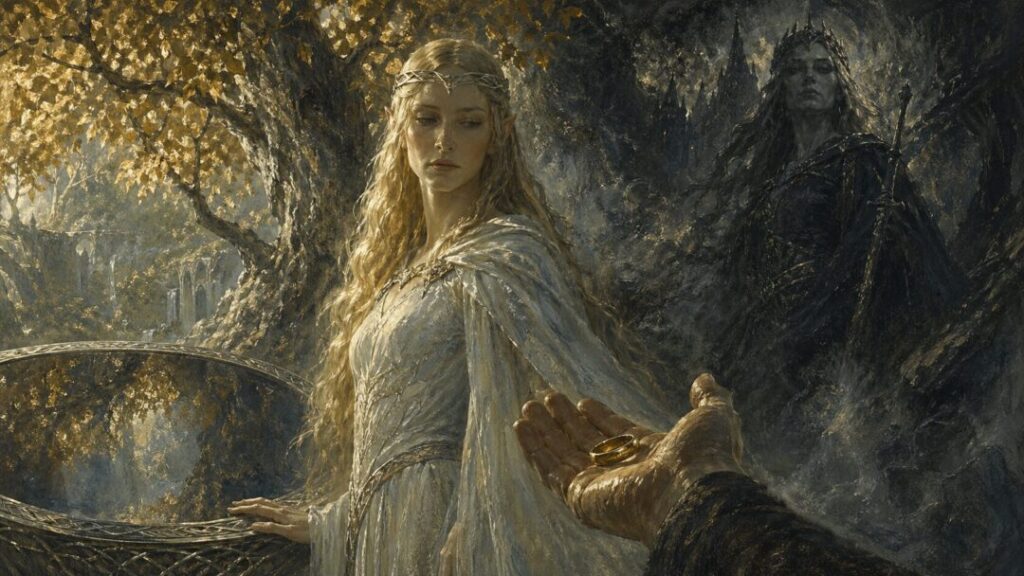
She is not Boromir. She is ancient, wise, and far more aware of what the Ring truly is. When Frodo offers it to her, she understands the danger with terrifying clarity.
Her vision is not small.
If she took the Ring, she would not merely become a stronger ruler of Lothlórien. She imagines herself as a queen, beautiful and terrible, loved and feared. The language of that moment is crucial because it shows the Ring’s deepest promise.
Not ugliness.
Splendor.
Not obvious corruption.
Adoration.
The Ring can offer a form of lordship that looks radiant. It can dress domination in beauty, wisdom, and order. That is why Galadriel’s refusal matters so much.
She does not reject the Ring because she is too weak to use it.
She rejects it because she understands what using it would mean.
She would become a ruler after Sauron’s pattern, even if her beginning looked fairer.
Her victory is not conquest.
It is refusal.
She passes the test by choosing to diminish, to go into the West, and to remain herself.
In that moment, the title The Lord of the Rings becomes more than a reference to Sauron. It becomes a question placed before every great figure:
Will you rule, if ruling means becoming what you oppose?
Gandalf Knows the Trap Too Well
Gandalf’s refusal is just as important.
When Frodo offers him the Ring, Gandalf reacts with fear. Not because he lacks strength, but because he has too much of it.
He knows that if he took the Ring, he would try to use it from pity. That detail matters. His danger would not begin in hatred. It would begin in the desire to do good.
But through him, the Ring would gain a power too great and terrible to imagine.
This is one of the most important moral ideas in the story.
Good intentions do not make domination safe.
Gandalf understands that the Ring would not become pure in his hands. Instead, his own desire to help, guide, and correct others could become corrupted into rule by force.
He would become a lord.
Perhaps a lord who spoke of wisdom.
Perhaps a lord who claimed to bring peace.
Perhaps even a lord who defeated Sauron.
But still a lord of the same Ring.
That is why he refuses before the temptation can take root.
He knows that some powers cannot be used without becoming their servant.
Frodo Bears the Ring, But Does Not Master It
Frodo is the Ring-bearer, but he is not the Lord of the Ring.
That distinction is essential.
He carries it farther than anyone else could have. He resists it for an astonishing length of time. He shows mercy, endurance, and humility. Without Frodo, the Ring would not have reached the Fire.
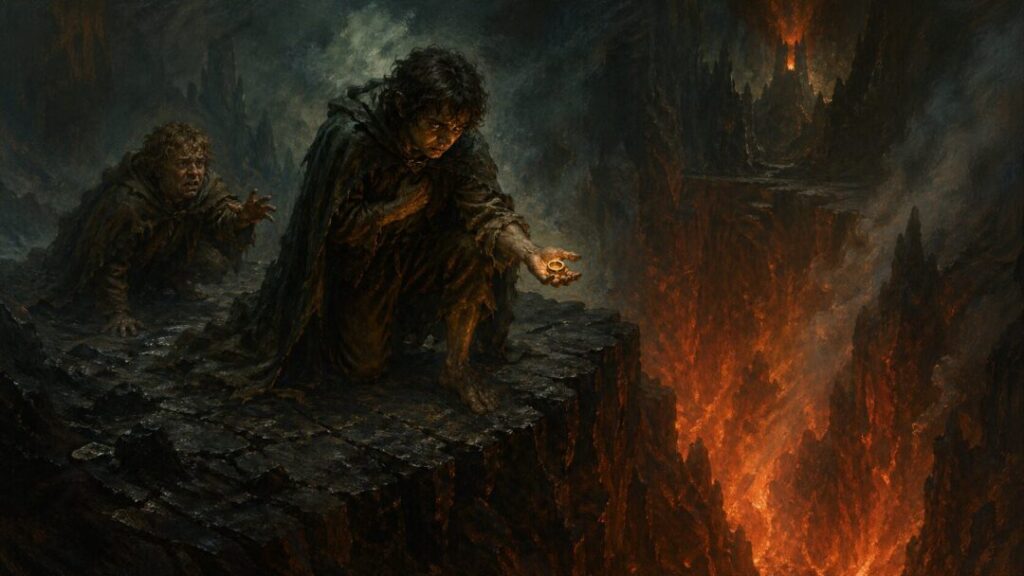
But at the very end, at the Cracks of Doom, he cannot destroy it.
This is not a failure in the simple sense.
It is the final proof of what the Ring is.
No one simply overcomes it by strength of will. No one stands at the heart of its power and calmly chooses its destruction as though it were an ordinary object.
At the last moment, Frodo claims it.
He says the Ring is his.
That moment is devastating because it shows that even the most merciful bearer cannot finally master the thing made for mastery. Frodo’s greatness lies not in being immune to the Ring, but in carrying it as far as he did.
The Ring is destroyed through a convergence of mercy, pity, providence, and Gollum’s own long enslavement to it.
Frodo does not become the Lord of the Rings.
But the Ring brings him to the edge of that claim.
That is how powerful its pull is.
Why Sauron Cannot Imagine the Real Threat
Sauron’s greatest blindness is not that he forgets the Ring exists.
He knows it exists.
His blindness is that he cannot imagine anyone truly seeking to destroy it.
This is one of the most revealing things about him.
Because Sauron thinks in terms of power, he assumes his enemies will do the same. He expects a rival. He expects a claimant. He expects someone great to take the Ring and try to use it.
In other words, he expects another lord.
That expectation shapes the entire war.
The strategy of the Wise depends on doing the one thing Sauron cannot properly understand: sending the Ring into Mordor not to be wielded, but to be unmade.
This is why humility becomes more dangerous to Sauron than military strength.
A Hobbit carrying a burden is less visible to him than a king raising a banner.
Not because Hobbits are magically invisible to evil, but because the choice to renounce power lies outside Sauron’s deepest assumptions.
He is the Lord of the Ring.
And that is exactly why he cannot imagine someone refusing lordship altogether.
The Title Is a Warning
So who is the Lord of the Rings?
The literal answer is Sauron.
But the full meaning of the title reaches further.
It points to the power Sauron made, the system of domination he tried to impose, and the temptation that follows the Ring wherever it goes.
The title is not only about one dark ruler in Mordor.
It is about the desire to rule through force.
The desire to make others obey.
The desire to take power because the cause seems urgent enough.
The desire to become the one will that orders all others.
That is the true shadow behind the Rings.
Sauron is its clearest embodiment, but he is not the only one tested by it. Boromir is tested. Galadriel is tested. Gandalf is tested. Frodo is tested.
Each encounter reveals something different about the same danger.
The Ring does not merely ask, “Will you serve Sauron?”
It asks, “Would you replace him?”
The Real Victory Is Renunciation
This is why the destruction of the Ring is not simply a military victory.
It is a moral victory.
Sauron falls because the Ring is unmade, but the road to that moment is paved by refusals. Gandalf refuses it. Galadriel refuses it. Aragorn does not claim it. Faramir, in one of the most important acts of restraint in the story, rejects the idea of taking it by force.
Again and again, the free peoples survive because someone refuses to become a lord through the Ring.
That is the hidden pattern.
The Ring is defeated not by a greater domination, but by the rejection of domination itself.
This is why the title remains so haunting.
The Lord of the Rings is Sauron.
But the story is about everyone who is tempted, even briefly, to answer the Ring’s call and become something like him.
In the end, Middle-earth is saved not because someone better becomes Lord of the Rings.
It is saved because no one does.
Sources & Notes
- J.R.R. Tolkien, The Silmarillion, “Of the Rings of Power and the Third Age” — Sauron secretly makes the One Ring in Orodruin to rule the other Rings and their bearers.
- J.R.R. Tolkien, The Lord of the Rings, Book I, Chapter 2, “The Shadow of the Past” — Gandalf identifies Sauron as the Ring’s maker and warns Frodo that there is only one true Lord of the Ring.
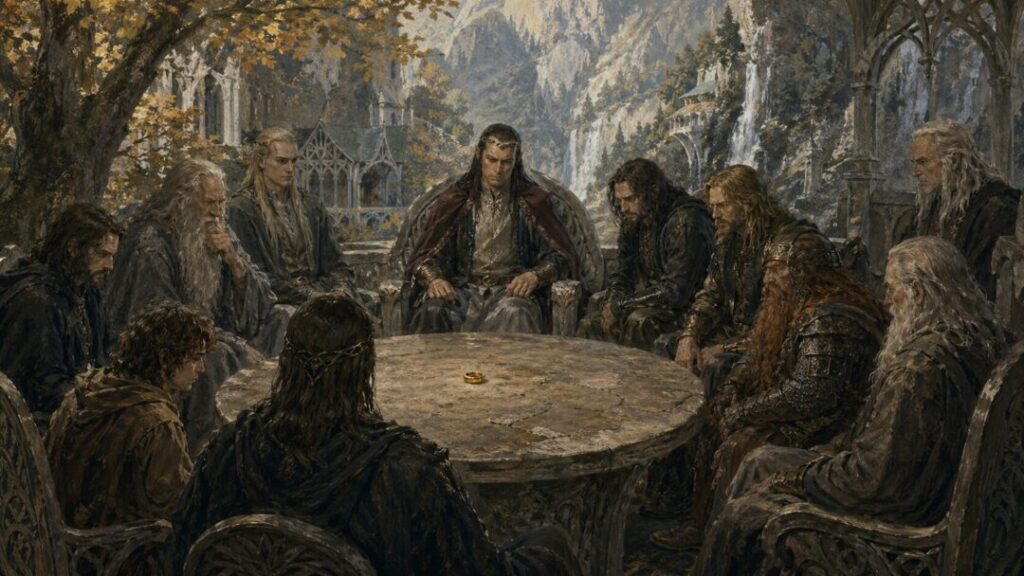
- J.R.R. Tolkien, The Lord of the Rings, Book II, Chapter 2, “The Council of Elrond” — Boromir argues that the Ring should be used against Mordor, showing the temptation to answer evil power with commanding power.
- J.R.R. Tolkien, The Lord of the Rings, Book II, Chapter 7, “The Mirror of Galadriel” — Galadriel imagines herself as a beautiful and terrible queen if she takes the Ring, then refuses that form of lordship.
- J.R.R. Tolkien, The Lord of the Rings, Book I, Chapter 2, “The Shadow of the Past” — Gandalf refuses the Ring because he would try to use it from pity, and through him it would wield a power too great and terrible.
- J.R.R. Tolkien, The Letters of J.R.R. Tolkien, Letter 131 — Tolkien describes Sauron’s will toward order, control, and domination, supporting the article’s reading of the Ring as a system of lordship rather than a neutral tool.