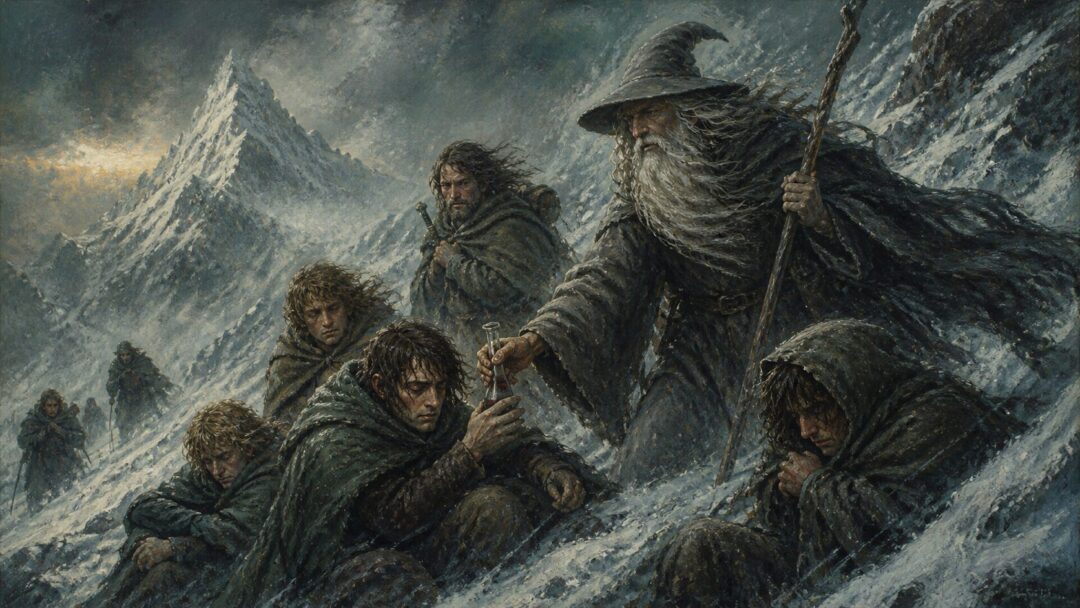
When the Fellowship leaves Rivendell, the scene feels strangely quiet.
There is no army.
No shining host of Elves.
No wagon train of provisions.
No company of guards riding beside Frodo to carry the Ring safely across Middle-earth.
Instead, nine walkers pass into the wild in winter. Four of them are Hobbits. One is a Dwarf. One is an Elf. Two are Men. One is Gandalf, whose wisdom is immense, but whose power is not used like the power of a battlefield commander.
For a quest that will decide the fate of the world, the whole thing can seem dangerously underprepared.
Why would Elrond, one of the wisest remaining lords in Middle-earth, allow the Ring-bearer to leave with so little?
Why would Gandalf, who understood the danger better than almost anyone, not insist on more protection?
The answer is not that they were careless.
It is that the quest was never meant to be won by looking strong.
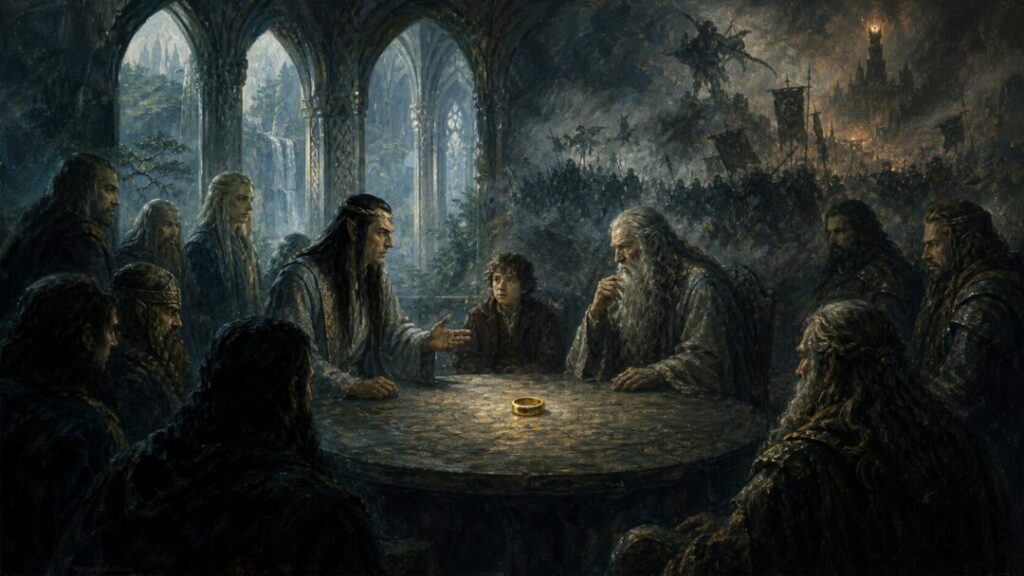
The Fellowship Was Not an Army
The most important answer is given before the Company ever leaves Rivendell.
At the Council of Elrond, the plan is not to march against Mordor. It is not to fight Sauron openly. It is not even to carry the Ring to Gondor and defend it behind walls.
The Ring must be destroyed.
That means it must be taken into the one place Sauron guards most fiercely: his own land.
This changes the nature of the mission completely.
A military expedition would fail because Sauron understands military power. He watches for armies. He prepares for kings, captains, weapons, banners, and claims of dominion. His whole mind is bent toward mastery, and he expects others to desire power as he does.
The Fellowship’s only real hope is that Sauron will not imagine someone trying to destroy the Ring.
That is why Elrond says the Company must be few. Their hope lies in speed and secrecy. He even states that if he had a host of Elves in armor from the Elder Days, it would not truly help. It would only arouse the power of Mordor.
That is the heart of the matter.
More strength would not necessarily mean more safety.
It might mean being noticed sooner.
They Were Better Equipped Than They Looked
Still, it is not accurate to say the Fellowship was sent out helpless.
They were not dressed like soldiers of a great army, but they did carry significant equipment.
Aragorn bore Andúril, the reforged sword of Elendil. Gandalf carried Glamdring, an ancient Elven blade, as well as his staff. Legolas had his bow and knife. Gimli had his axe. Boromir came as a warrior of Gondor, with his sword, shield, and horn.
The Hobbits were not unarmed either.
Merry and Pippin still had the blades taken from the Barrow-downs, weapons that later proved far more important than they first appeared. Sam also had a barrow-blade. Frodo carried Sting, the Elven blade Bilbo had used before him.
And Frodo had something even more remarkable: Bilbo’s mithril coat.
That gift was not from Elrond or Gandalf, but it mattered enormously. Frodo’s mail was hidden beneath his clothing, and in Moria it saved his life when an orc-thrust struck him. Without it, the Ring-bearer might have died long before reaching Mordor.
The Company was also furnished with warm clothes and travelling gear from Rivendell. Elrond gave Gandalf miruvor, the cordial of Imladris, which helped the Company on Caradhras when cold and exhaustion threatened them.
So the real issue is not that they had nothing.
It is that they did not look like a force prepared to conquer Mordor.
And that was intentional.
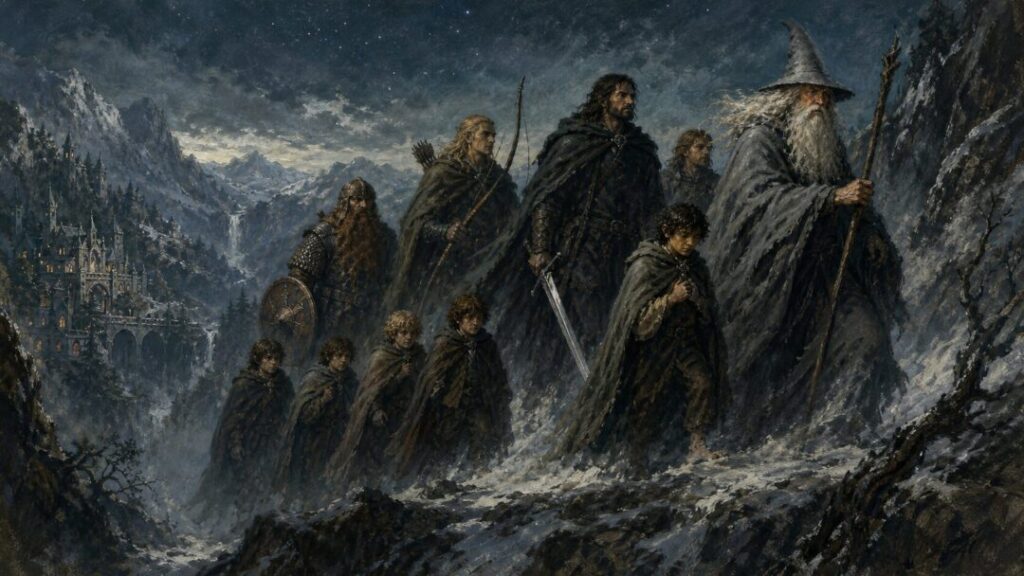
Armor Would Not Solve the Real Problem
It is tempting to imagine the Hobbits in mail, helmets, shields, and better weapons.
But this assumes that the main danger was ordinary combat.
It was not.
The Fellowship faced hunger, snow, wolves, spies, watchers, betrayal, exhaustion, difficult terrain, and choices no armor could answer. Their greatest dangers were not always things a sword could cut.
Heavy equipment would also have come at a cost.
This is partly practical interpretation rather than something the text states directly: more armor and bulk would likely have slowed them down, especially in winter and rough country. The Company had to cross wild lands, climb dangerous passes, travel through darkness, and remain mobile when plans changed.
They were not marching along safe roads.
They were trying to pass unseen through a world already being watched.
There is also a deeper reason. The Ring itself made the quest unlike any normal errand. The more the Company resembled a band of conquerors, the more they would have moved within the very logic Sauron understood.
Weapons had their place. Courage had its place. But the Ring could not be destroyed by force of arms.
That is why the Fellowship’s apparent weakness is not a flaw in the plan.
It is part of the plan’s only chance.
Why Not Send More Elves?
This is one of the most natural questions.
If Elrond had warriors in Rivendell, why not send them?
The Council itself answers this. A great armed company would draw attention. Sauron’s servants were already searching. The Nazgûl had ridden as far as the Shire and Rivendell. Spies, birds, and hostile powers were abroad. Saruman had also betrayed the Wise and was no longer trustworthy.
In such a world, a large escort would not be protection.
It would be a signal.
And even if Elves had gone in greater number, they could not simply fight their way into Mordor. The strength of the Eldar in Middle-earth was fading. Their great realms were not what they had been in the Elder Days. Rivendell was a hidden refuge and a house of wisdom, not a kingdom prepared to launch a final war.
There is also the danger of the Ring itself.
The more powerful the companion, the more terrible the temptation could become. This does not mean Elves were uniquely weak to the Ring. Rather, it means that anyone with power, wisdom, ambition, or desire to do good through strength could be drawn into peril.
The Ring offered power according to the stature and imagination of the one tempted.
A larger company would not only create more visibility.
It might create more chances for the Ring to work.
Why Not Send Glorfindel?
Glorfindel is another common suggestion.
He had already helped Frodo reach Rivendell. He was mighty, ancient, and terrifying to the servants of Sauron. On the surface, he seems like the perfect companion.
But that is also the problem.
Glorfindel was not subtle.
In the unseen world, he was a figure of great power. Sending him with the Ring-bearer might have made the Company more formidable, but it also might have made them far more noticeable to the Enemy’s servants.
This is why the choice of the Fellowship is so strange and so wise.
It is not simply a collection of the strongest people available.
It is a small company representing the Free Peoples, bound together not by certainty of victory, but by willingness to go as far as they can.
Elrond does not even bind them with an oath to go all the way. He knows none of them can foresee what they will meet.
That restraint matters.
The quest is not built on pride.
It is built on humility before danger.
Why Not Use Horses?
Horses might seem like another obvious solution.
But again, the road matters.
The Company did not know exactly how their journey would unfold. They considered the Redhorn Pass. They later entered Moria. They travelled through lands where secrecy mattered and terrain could become impossible for mounted travel.
A group on horseback is faster in open country, but not always safer in mountains, snow, tunnels, forests, and enemy-watched lands.
They did have Bill the pony for a time, and even that became impossible at the Gates of Moria. Bill had to be released before the Company entered the dark.
That moment quietly proves the limitation.
The quest could not depend on comfort, speed, or ordinary travel plans. The road would change beneath them.
The Ring-bearer had to keep going even when every support fell away.
Lórien Shows What True Aid Looked Like
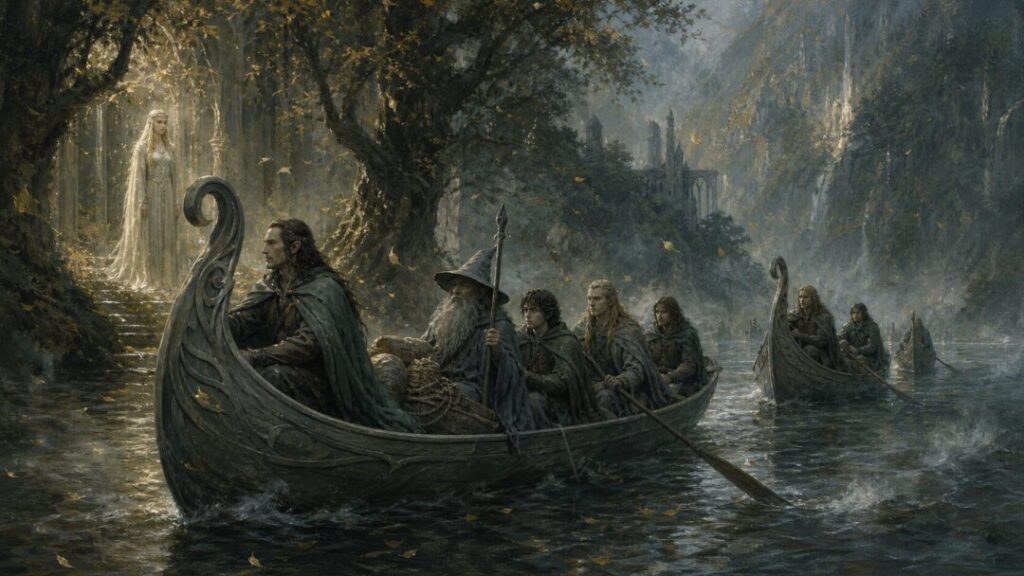
The Fellowship is equipped again after reaching Lothlórien.
But notice the kind of help they receive.
They are given boats, not war-horses.
Lembas, not banquet stores.
Elven-cloaks, not shining armor.
Rope, not siege gear.
Galadriel also gives individual gifts, each suited in a different way to the bearer. Frodo receives the Phial, which later becomes crucial in Shelob’s lair. Sam receives earth from Galadriel’s garden, which becomes a gift for healing the Shire after the War.
These gifts are not random treasures.
They are aids for endurance, concealment, guidance, memory, and hope.
That is very different from equipping the Fellowship like an army.
The help they receive is not designed to make them look powerful.
It is designed to help them continue when power fails.
The Mission Had to Remain Small Enough to Be Overlooked
Sauron’s great blindness was not lack of intelligence.
It was the shape of his imagination.
He could understand conquest. He could understand fear. He could understand someone taking the Ring and trying to use it. That is why Aragorn’s later challenge through the palantír and the march to the Black Gate matter so much: they encourage Sauron to look in the wrong direction.
But the original seed of that strategy is already present at Rivendell.
The Ring will not be taken to Mordor by someone who looks like a lord claiming power.
It will be carried by Frodo.
A Hobbit.
Small, ordinary, easily dismissed by the great powers of the world.
That is not an accident. It is one of the central patterns of the story.
The fate of Middle-earth turns not on the strongest hand, but on the humblest bearer.
The Risk Was Still Terrible
None of this means Elrond and Gandalf had a perfect plan.
They did not.
They knew the quest was desperate. They knew much was hidden from them. They did not know every road the Company would take. They did not know Gandalf would fall in Moria. They did not know Boromir would try to take the Ring. They did not know Frodo and Sam would go on alone.
The wisdom of Rivendell was not omniscience.
It was the ability to choose the least impossible path.
That path required companions, but not an army. Weapons, but not reliance on weapons. Supplies, but not dependence on comfort. Hope, but not certainty.
The Fellowship was equipped for a secret road, not a campaign.
That distinction explains almost everything.
The Apparent Weakness Was the Strategy
So why didn’t Gandalf and Elrond equip the Fellowship better?
Because “better” depends on the mission.
If the goal had been to win battles, they were under-equipped.
If the goal had been to impress allies, they were under-equipped.
If the goal had been to look like the last great hope of the West, they were under-equipped.
But if the goal was to move quietly through a watched world, avoid the full attention of Mordor, resist the logic of power, and carry the Ring toward destruction rather than victory, then the Company’s smallness was not a mistake.
It was the only kind of hope left.
The Fellowship did not leave Rivendell as a poor substitute for an army.
It left as the opposite of an army.
And that is why Sauron failed to understand it until it was too late.
Sources & Notes
- J.R.R. Tolkien, The Lord of the Rings, Book II, Chapter 2, “The Council of Elrond” — Elrond chooses nine walkers, warns that a larger force would only increase danger, and says even an Elf-host of old would not help this road.
- J.R.R. Tolkien, The Lord of the Rings, Book II, Chapter 3, “The Ring Goes South” — the Company leaves Rivendell in secrecy, with travelling gear and Elrond’s miruvor, not as a visible army.
- J.R.R. Tolkien, The Lord of the Rings, Book II, Chapter 4, “A Journey in the Dark” — Bill the pony must be released at Moria, and Frodo’s hidden mithril-coat saves him when ordinary plans and protections fail.
- J.R.R. Tolkien, The Lord of the Rings, Book II, Chapter 8, “Farewell to Lórien” — Galadriel and Celeborn equip the Fellowship with boats, lembas, cloaks, rope, and personal gifts suited to endurance and secrecy.
- J.R.R. Tolkien, The Lord of the Rings, Book V, Chapter 9, “The Last Debate” — the Captains of the West rely on Sauron misreading their purpose, since he expects others to use the Ring as a weapon of power.