At first, the answer seems obvious.
The Elves helped destroy the One Ring because Sauron had to be defeated.
He was the great enemy of the Free Peoples. His armies threatened Gondor, Rohan, Lórien, Dale, Erebor, and every land that still resisted him. If the Ring returned to his hand, his victory would become almost certain.
So of course the Elves opposed him.
But that answer is too simple.
Because for the Elves, the destruction of the One Ring was not only a victory.
It was also a loss.
A terrible one.
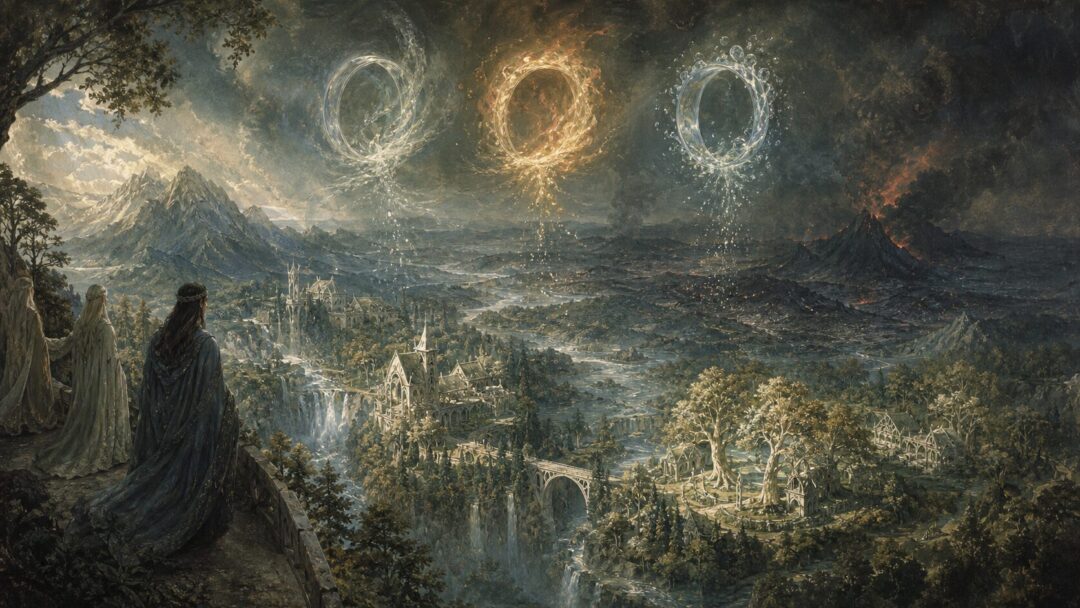
When Frodo’s quest succeeded, Sauron’s power was broken. But the power of the Three Elven-rings also came to an end. The hidden beauty of Rivendell and Lothlórien could no longer be preserved in the same way. The long delay of fading was over. The Elves who remained in Middle-earth would have to depart across the Sea or diminish.
That means the Elves were not simply helping to destroy Sauron’s weapon.
They were helping to end their own age.
And that makes their choice far more moving than it first appears.

The Elves Were Not Fighting for a Simple Victory
In many stories, the good side fights the evil side because the outcome is clear.
If the enemy is defeated, the heroes win. Their homes are saved. Their power is restored. Their future becomes brighter.
But The Lord of the Rings does not work that way.
Victory comes with grief.
The Shire is saved, but Frodo cannot truly remain healed within it. Gondor is restored, but many of the old powers of the world pass away. Sauron is defeated, but the Elves do not return to some earlier golden age.
Their victory is also their farewell.
This is why the Elves’ support for the destruction of the Ring is so important. They are not acting because the outcome benefits them in a simple political sense. They are acting because the moral choice is clear, even when the personal cost is immense.
They know that Sauron must not be allowed to recover the Ring.
But they also know that destroying it will change Middle-earth forever.
The Three Rings Were Different
To understand the Elves’ dilemma, we have to understand the Three Rings.
The Three were not like the Nine given to Men. They did not turn their bearers into wraiths. They were not made as tools of open domination. They were associated with preservation, healing, and the resistance of decay.
Elrond explains at the Council that those who made the Three did not desire strength, domination, or hoarded wealth. Their purposes were understanding, making, and healing, and the preservation of things unstained.
That matters.
The Three Rings were not used to build armies or conquer kingdoms. Their power was quieter and more Elvish. They helped preserve beauty against the weariness of time.
This is why Rivendell feels like a refuge outside the ordinary world.
This is why Lothlórien seems to Frodo like a land where ancient days still live.
These places are not merely beautiful because Elves live there. They are places where Elven memory, craft, and power have held back the fading that marks Middle-earth.
But that preservation was not free from danger.
Because the Three, though untouched by Sauron’s hand, were still Rings of Power.
And all the Rings of Power were tied to the One.
The One Ring Was the Trap
The One Ring was not simply Sauron’s strongest weapon.
It was the ruling Ring.
Its purpose was mastery.
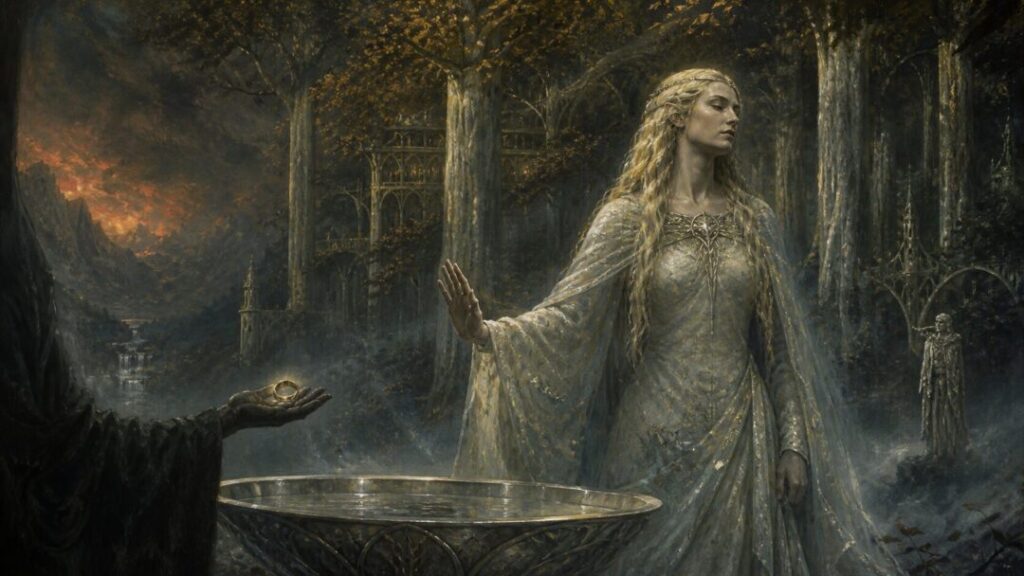
Sauron made it to dominate the other Rings and to bring their bearers under his control. When he first put on the One in the Second Age, the Elves became aware of him and removed their Rings. This was why Sauron’s original design failed among them.
But the danger never disappeared.
As long as the One endured, the fate of the Three remained bound to it. The Elves could use them only while Sauron did not possess the Ruling Ring. If he recovered it, the bearers of the Three would be exposed to him.
This is the nightmare behind the Council of Elrond.
The Elves cannot simply keep the One hidden forever. They cannot use it safely. They cannot send it away and pretend the danger is gone. And they cannot allow Sauron to reclaim it.
Every path is dangerous.
But only one path ends Sauron’s power permanently.
The Ring must be destroyed.
Destroying the Ring Meant Losing the Three
Here is the painful part.
The Elves understood that destroying the One might cause the Three to fail.
Elrond says this openly at the Council. He does not claim perfect certainty, but he believes that when the One is gone, the Three will lose their power, and many fair things will fade and be forgotten.
This is not a small sacrifice.
For mortal kingdoms, the defeat of Sauron means the possibility of renewal. Gondor can have its king again. Rohan can survive. The Shire can be restored.
But for the Elves, the defeat of Sauron means the final fading of what they had preserved in Middle-earth.
The places they loved would not instantly vanish. But their special power would pass away. The ancient beauty held in suspension would be released back into time.
Lothlórien would no longer remain what it had been.
Rivendell would no longer be the same refuge.
The last great Elven realms of the Third Age would become memories.
That is the cost hidden inside the victory.
Galadriel’s Choice Reveals the Truth
No one expresses this tragedy more clearly than Galadriel.
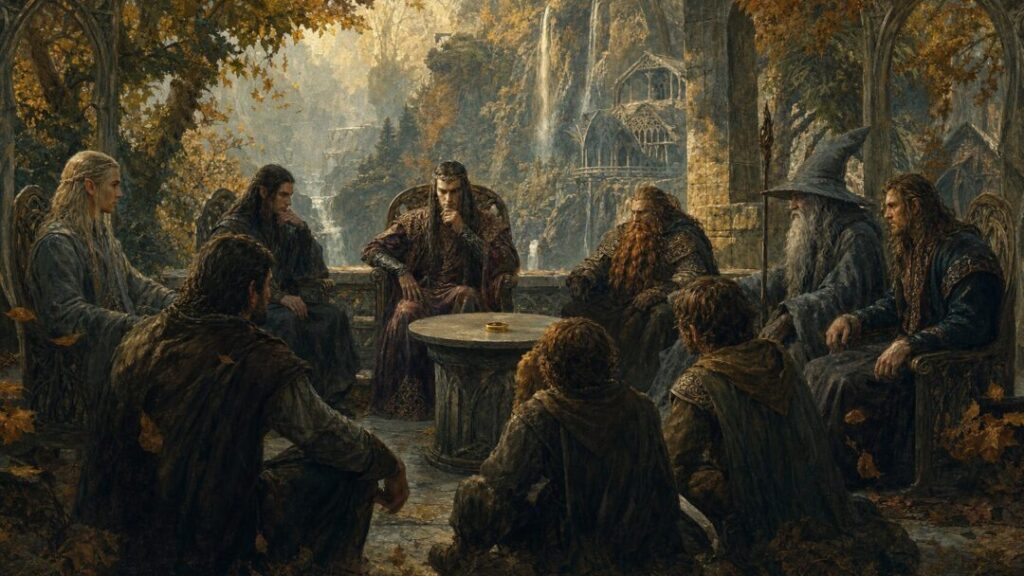
When Frodo offers her the One Ring, she faces the temptation directly. With the Ring, she imagines herself becoming a great queen: beautiful and terrible, adored and feared. She would not be a servant of Sauron. She would overthrow him and take his place.
But that is exactly the danger.
The Ring does not only tempt the cruel. It tempts the wise through their desire to do good. Galadriel’s temptation is not simple greed. It is the possibility of saving, ruling, ordering, and preserving by force.
And she refuses.
Her words after refusing the Ring are some of the most important in the story. She accepts that she will diminish and go into the West.
That is the heart of the Elven choice.
Galadriel does not reject the Ring because she does not understand what it could do.
She rejects it because she understands too well.
To use the Ring, even against Sauron, would be to accept the logic of domination. It would preserve beauty by corrupting it. It would save Lothlórien only by turning its lady into something terrible.
So she lets the possibility pass.
And in doing so, she accepts the end of her own realm.
Why Not Just Hide the Ring?
This is one of the most natural questions.
If destroying the Ring would cause the Elves to fade, why not hide it somewhere?
The Council considers versions of this idea. But the problem is that hiding the Ring does not solve anything. It only delays the danger.
Sauron is actively searching for it. His power is growing. His servants are moving. The Ring itself has a will toward returning to its master. Keeping it in Rivendell or sending it across the Sea are not treated as true solutions.
The Wise understand that the Ring cannot be made harmless by storage.
It cannot become a museum object.
It cannot be safely guarded forever.
Its very existence is a continuing threat.
And for the Elves, that threat is especially sharp. The Three can continue their work only while the One remains out of Sauron’s hand. If he regains it, the hidden Elven powers in Middle-earth are no longer safe.
So the Elves face a bitter choice.
Destroy the Ring and lose the power of the Three.
Or preserve the Three for a time and risk everything falling under Sauron’s mastery.
There is no painless option.
The Elves Choose Freedom Over Preservation
This is what makes their decision so profound.
The Elves love preservation. That is not a flaw in itself. Their grief is tied to memory, beauty, and the sorrow of watching the world change. Much of their art and power is bound up with the desire to keep things unstained.
But the War of the Ring forces them to confront a hard truth.
Not everything can be preserved.
And some attempts at preservation become dangerous when they require compromise with evil.
The Elves could not save their age by keeping the One Ring in the world. They could not protect Lothlórien forever by allowing the ruling Ring to endure. They could not defeat Sauron by using his own instrument without becoming corrupted by the same hunger for mastery.
So they choose freedom over preservation.
They choose the healing of Middle-earth over the continuation of their own power within it.
They choose to let go.
Elrond’s Role Is Not Passive
Elrond’s part in this story is sometimes overlooked because he does not travel with the Fellowship.
But the Council happens in his house. The decision to send the Ring to Mordor is made under his roof. He understands the stakes better than almost anyone present.
Elrond is one of the great figures of the Third Age, and Rivendell is one of the last great havens of Elven wisdom in Middle-earth. The success of the quest means that the kind of world Rivendell represents cannot continue unchanged.
Yet Elrond does not try to preserve his house at the expense of the world.
He sends forth the Fellowship.
He allows the Ring to leave Rivendell, not to be hidden, studied, or used, but destroyed.
That choice contains quiet sacrifice.
Elrond is not merely helping someone else’s war. He is helping bring about the end of the protected Elven world that Rivendell embodies.
The Elves Were Already Leaving
It is important to say this carefully.
The Elves were already fading from Middle-earth before the Ring was destroyed. Their time in Middle-earth was not going to last forever. Many had already departed across the Sea, and the Third Age is filled with the sense that the Elder Days are receding.
The destruction of the Ring does not create that fading from nothing.
But it does hasten and finalize the passing of the great Elven powers that remained.
The Three Rings had delayed loss. They had preserved certain places against decay. They had allowed something of the Elder Days to linger.
When the One is destroyed, that delay ends.
This is why the victory over Sauron feels both joyful and mournful. The Shadow is gone, but so is much of the old wonder. The world is healed, but it is also diminished in mystery.
The Fourth Age belongs primarily to Men.
The Elves have helped make that future possible.
But it is not truly their future.
Why Would They Help?
So why would the Elves help destroy the One Ring?
Because keeping it meant eventual ruin.
Because using it meant corruption.
Because hiding it meant only postponing disaster.
Because if Sauron recovered it, the Three would become a terrible vulnerability.
Because the beauty they preserved was not worth saving if the price was submission to evil.
And because the Elves, at their wisest, understand that some things must be surrendered rather than possessed.
That is the deeper answer.
The Elves help destroy the Ring not because they are untouched by the cost, but because they understand the cost better than almost anyone.
They know that the end of Sauron also means the end of their own dominion in Middle-earth.
They know that Lothlórien will fade.
They know that Rivendell will not remain as it was.
They know that their long resistance to time is nearly over.
And still, they help.
The Tragedy Behind the Victory
The destruction of the One Ring is one of the greatest victories in the history of Middle-earth.
But it is not a simple triumph.
For the Elves, it is a surrender of power. A relinquishing of preservation. A final admission that the world must pass into other hands.
This is why the departure from the Grey Havens matters so much.
The Elves are not leaving because they failed.
They are leaving because their part in the story has been fulfilled.
They resisted Sauron. They preserved beauty. They gave counsel, shelter, wisdom, and aid. And when the final choice came, they did not cling to their own fading glory.
They let the Ring be destroyed.
They let their age end.
And in doing so, they helped save a world they could no longer remain at the center of.
That is why their choice is so powerful.
The Elves did not help destroy the One Ring because the loss meant nothing to them.
They helped because it meant everything.
Sources & Notes
- J.R.R. Tolkien, The Lord of the Rings, Book II, Chapter 2, “The Council of Elrond” — Elrond explains the Three as works of understanding, making, healing, and preservation, yet bound to the fate of the One.
- J.R.R. Tolkien, The Lord of the Rings, Book II, Chapter 2, “The Council of Elrond” — the Council rejects hiding, using, or sending away the Ring and chooses the only final answer: its destruction in Orodruin.
- J.R.R. Tolkien, The Silmarillion, “Of the Rings of Power and the Third Age” — Sauron forges the One to rule the other Rings, the Elves perceive him and hide the Three, and their safety depends on his not regaining it.
- J.R.R. Tolkien, The Lord of the Rings, Book II, Chapter 7, “The Mirror of Galadriel” — Galadriel says that if Frodo succeeds the power of Lórien will diminish, and she chooses to pass the test and go into the West.
- J.R.R. Tolkien, The Lord of the Rings, Book VI, Chapter 9, “The Grey Havens” — after the Ring is destroyed, the bearers of the Three depart, making the victory inseparable from the passing of the Elven age.