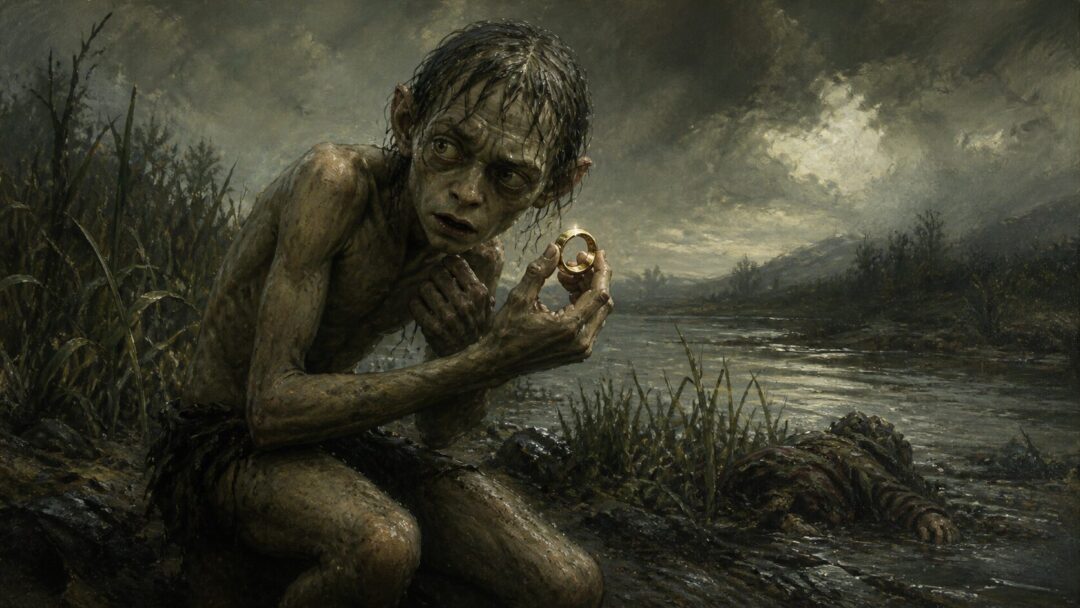
Gollum is one of the most familiar names in Middle-earth.
It is sharp, unpleasant, and almost impossible to separate from the creature himself. The name feels like part of his body: the pale eyes, the long fingers, the crawling movement, the muttering voice, the hunger for the Ring.
But that familiarity hides a stranger question.
Does Gollum know that other people call him Gollum?
At first, the answer seems obvious. Of course he does. Everyone knows him by that name. Bilbo encounters him as Gollum. Gandalf speaks of him as Gollum. Frodo and Sam use the name during the journey to Mordor.
But the deeper question is not whether the sound reaches his ears.
The deeper question is whether Gollum understands the name as his own.
Because “Gollum” was not his first name. It was not the name of a Hobbit-child by the Anduin. It was not the name remembered by his family, his grandmother, or his people.
Before the Ring, he was Sméagol.
And that changes everything.
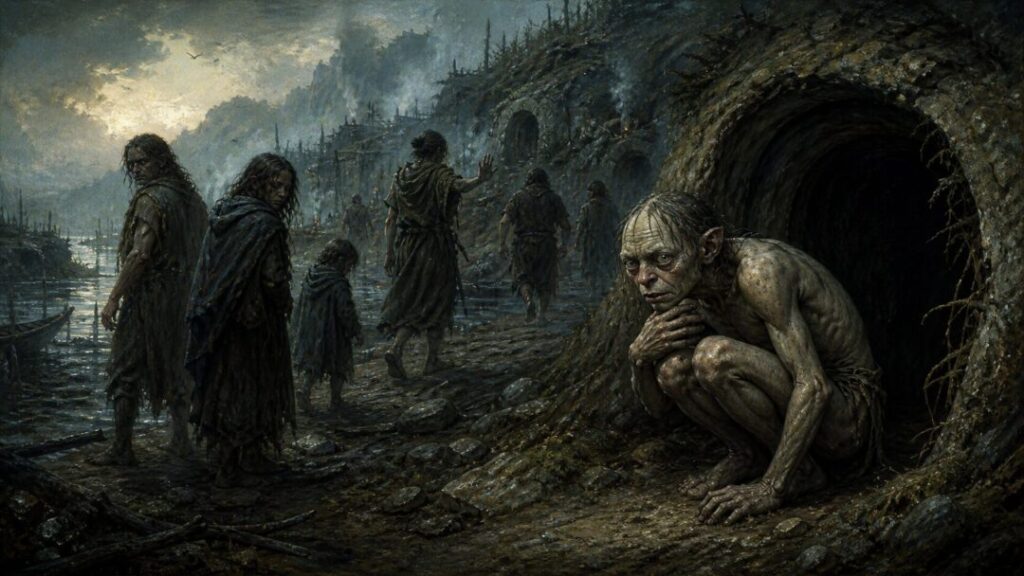
Gollum Was Not Born Gollum
The texts are clear that Gollum was originally called Sméagol.
He belonged to a small branch of Hobbit-kind, connected with the Stoors, living near the Gladden Fields. He was not born as a monster in a cave. He had kin. He had a household. He had a grandmother who held authority in the family.
Then came the Ring.
Sméagol’s relative Déagol found it in the river. Sméagol wanted it immediately. When Déagol would not give it to him, Sméagol killed him and took it.
This is the true beginning of Gollum.
Not the cave.
Not the riddles with Bilbo.
Not the long hunt through Middle-earth.
The beginning is the moment Sméagol chooses possession over kinship.
After that, the Ring begins to reshape his life. He discovers its power of invisibility and uses it for secretive, malicious things. He spies. He steals. He listens to things not meant for him. He becomes hated among his own people.
And then comes the name.
A Name Given in Disgust
The name “Gollum” comes from the sound he made in his throat.
In The Hobbit, this is explained almost casually. When he says “gollum,” he makes a horrible swallowing noise. That is how he got his name, though the narration adds that he called himself “my precious.”
That little distinction matters.
He did not begin by naming himself Gollum.
Others gave him that name because of what he had become.
In The Lord of the Rings, Gandalf’s account makes the social cruelty of the name much clearer. Sméagol’s people disliked him, cursed him, kicked him, and told him to go away. He muttered to himself and gurgled in his throat, and so they called him Gollum.
That means the name began as rejection.
It was not a title.
It was not a chosen identity.
It was not a secret name of power.
It was what people called him when they no longer wanted to see Sméagol.
A sound became a label.
A label became a name.
A name became a prison.
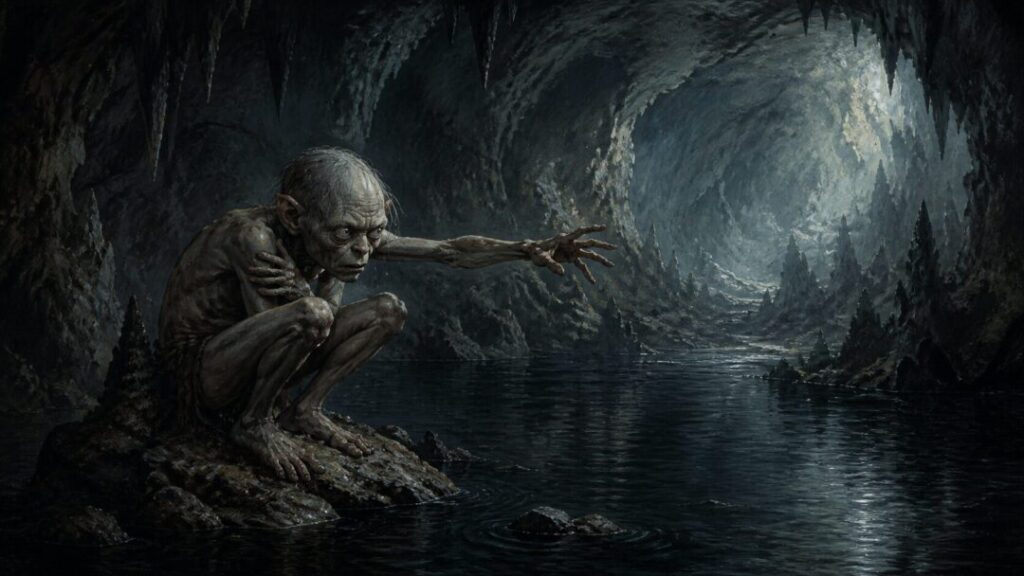
Did He Know They Called Him That?
Yes — by the time of the main story, Gollum clearly knows the name.
This is not only because others use it around him. Frodo and Sam both address him as Gollum at different points, and he responds. He is not confused by it. He does not ask who they mean. He does not reject the name as unfamiliar.
But the strongest evidence comes from Gollum himself.
In The Two Towers, while imagining what he might become if he regained the Ring, he pictures himself in grand, distorted terms. Among those imagined titles are forms like “Gollum the Great” and “Most Precious Gollum.”
That is decisive.
He does not merely hear the name from others. He can apply it to himself.
But this does not mean the matter is simple.
Knowing a name is not the same as accepting it in the deepest sense. Gollum’s identity is fractured. He speaks to himself. He calls himself “we.” He argues with himself. He shifts between the more pitiful, remembering Sméagol and the darker, possessive Gollum.
So yes, he knows.
But the real tragedy is that he knows too well.
“My Precious” and the Loss of Self
In The Hobbit, Gollum’s own preferred way of speaking is deeply strange.
He often calls himself “my precious.” Later, that phrase becomes inseparable from the Ring, but the older pattern of speech shows something more unstable: Gollum’s sense of self has already become distorted.
He does not speak like a person standing firmly in his own name.
He speaks as someone curled inward.
“My precious” can refer to himself, to the Ring, or to the strange bond between the two. That confusion is not accidental. The Ring has become the center of his being. His identity has been bent around it for centuries.
This is why the name “Gollum” is so disturbing.
Sméagol is his old name.
Gollum is what others call the thing he has become.
“My precious” is the language of obsession that replaces ordinary selfhood.
Between those three names, his whole tragedy is visible.
He was a person.
He became a creature.
He clung to an object until even his own self was hard to separate from it.
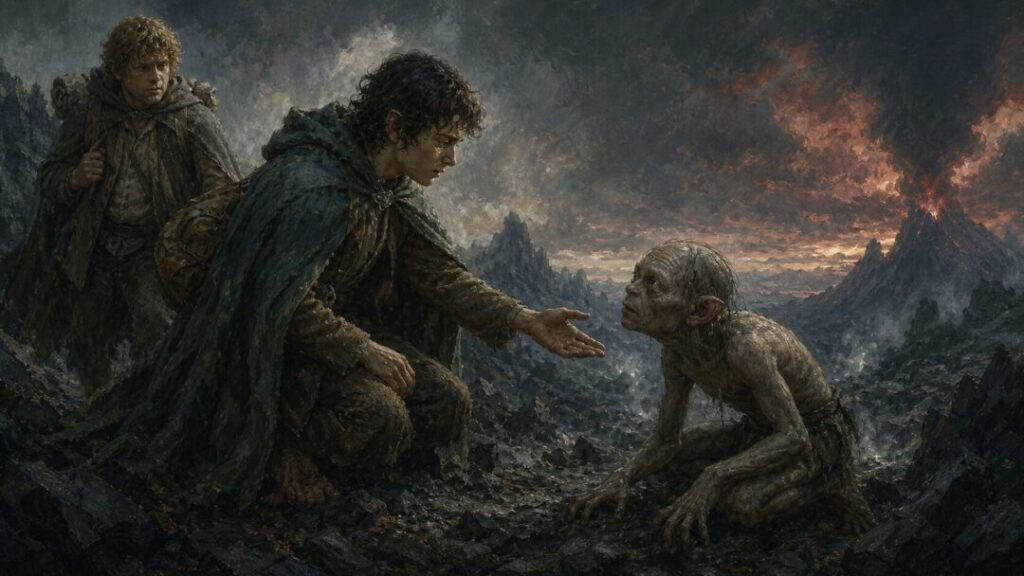
Why Frodo Calls Him Sméagol
One of the most important choices Frodo makes is calling him Sméagol.
This is not just politeness. It is not simply a softer nickname. Frodo knows the story. He knows that Gollum was once something else. He knows that before the darkness, there was a Hobbit-like being with a real name and a real past.
By calling him Sméagol, Frodo reaches toward that buried identity.
And the effect is real.
Gollum does not become healed. He does not become innocent. He does not escape the Ring’s hold. But something in him responds. The name Sméagol awakens memory, shame, hope, and need.
It reminds him that he was not always Gollum.
That is why Frodo’s mercy matters so much. Frodo does not deny the danger. He does not pretend Gollum is harmless. But he refuses to reduce him entirely to the name given by disgust.
Sam, by contrast, often sees him through suspicion — and Sam is not wrong to be suspicious. Gollum is dangerous. Gollum is treacherous. Gollum does lead them toward Shelob.
But Frodo sees something Sam struggles to see.
Not innocence.
Possibility.
The Name Gollum Became Part of Him
The most unsettling thing is that Gollum does not simply reject the name.
If he hated being called Gollum in a straightforward way, the story would be simpler. He would be Sméagol inside, wounded by a cruel nickname from the outside.
But that is not what the text gives us.
By the time we meet him, “Gollum” has become part of his own imagination. He can dream of being “Gollum the Great.” He can place the hated name inside fantasies of power, plenty, and revenge.
That is what the Ring does so well.
It does not merely tempt people with things they do not want. It twists what they already fear, desire, remember, and resent. It takes shame and turns it into grandeur. It takes hunger and turns it into entitlement. It takes a name born from mockery and makes it into a possible title.
Gollum knows what others call him.
But after centuries, the name has become more than an insult.
It has become one of the masks through which he understands himself.
Sméagol Is Not Fully Gone
Even so, the story never treats Sméagol as completely erased.
This is crucial.
The creature who follows Frodo and Sam is not simply a monster wearing an old name. There are moments when Sméagol seems genuinely moved by Frodo’s trust. There are moments when he appears almost childlike, almost relieved to be treated as something other than a crawling enemy.
The most painful example comes on the stairs of Cirith Ungol.
Gollum finds Frodo and Sam asleep. For a moment, he looks at them, and something changes. The text presents him in a way that recalls an old, weary creature touched by a memory of tenderness. It is one of the saddest moments in the entire journey, because it suggests that the last remnant of Sméagol is still there.
Not strong enough to save him by itself.
But present.
And then the moment passes.
Sam wakes, speaks harshly, and the fragile opening closes. This does not make Sam responsible for Gollum’s later betrayal. Gollum had already planned evil, and his will was deeply corrupted. But the scene shows how narrow the path of mercy had become.
There was still something to reach.
Barely.
Why the Question Matters
So, does Gollum know that others call him Gollum?
Yes.
But the answer matters because it reveals the deeper tragedy of names in his story.
“Sméagol” is the name of origin.
“Gollum” is the name of corruption and rejection.
“My precious” is the language of obsession.
And by the end, all three are tangled together.
Frodo’s use of “Sméagol” is therefore not a small detail. It is one of the clearest signs of Frodo’s pity. He speaks to the part of Gollum that the world has almost stopped addressing.
That does not save Gollum in the ordinary sense.
Gollum still betrays Frodo.
He still attacks him at the very end.
He still dies with the Ring.
And yet, through that final act, the Ring is destroyed.
This is the terrible mystery of Gollum’s place in the story. He is not redeemed in a clean or comforting way. He is not restored to Sméagol. He does not overcome the name Gollum and walk free.
But neither is he meaningless.
His misery, his obsession, Frodo’s pity, Bilbo’s earlier mercy, and the long ruin of his divided self all become part of the final unmaking of Sauron’s power.
The Saddest Answer
Gollum knows that others call him Gollum.
He hears it.
He answers to it.
He even uses it in his own fantasies.
But somewhere beneath that name, Sméagol still remembers being Sméagol.
That is what makes the question so sad.
The tragedy is not that he forgot his real name.
The tragedy is that he remembered it — and still could not fully return to it.
Gollum is not simply a monster’s name.
It is the sound of a person becoming unrecognizable, first to his people, then to the world, and finally to himself.
And when Frodo calls him Sméagol, the story briefly opens a door.
Not wide enough for escape.
But wide enough for us to see what was lost.
Sources & Notes
- J.R.R. Tolkien, The Hobbit, Chapter 5, “Riddles in the Dark” — introduces Gollum’s throat-noise name and his strange “my precious” speech.
- J.R.R. Tolkien, The Lord of the Rings, Book I, Chapter 2, “The Shadow of the Past” — Gandalf recounts Sméagol, Déagol, the murder for the Ring, and how his people came to call him Gollum.
- J.R.R. Tolkien, The Lord of the Rings, Book IV, Chapter 1, “The Taming of Sméagol” — Frodo and Sam deal with him under both names, showing that he answers to Gollum but can still be reached as Sméagol.
- J.R.R. Tolkien, The Lord of the Rings, Book IV, Chapter 3, “The Black Gate Is Closed” — gives Gollum’s own fantasy of becoming “Gollum the Great,” evidence that the name has entered his self-image.
- J.R.R. Tolkien, The Lord of the Rings, Book IV, Chapter 8, “The Stairs of Cirith Ungol” — the sleeping-hobbits scene briefly reveals the old Sméagol beneath the corrupted Gollum persona.