Most readers notice the difference almost immediately.
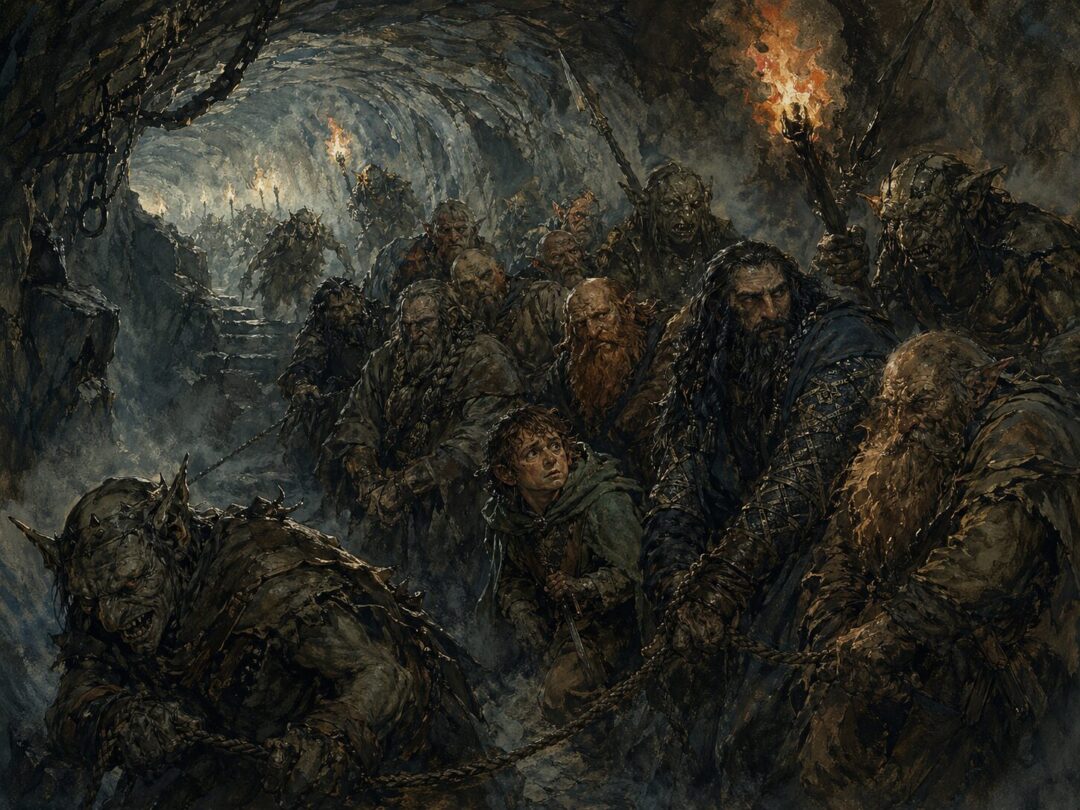
In The Hobbit, Bilbo Baggins meets goblins.
They live under the Misty Mountains. They sing cruel songs. They drag Thorin and Company into the halls of the Great Goblin. They are noisy, malicious, clever with tunnels and weapons, and deeply tied to the dark places beneath the mountains.
Then The Lord of the Rings arrives, and suddenly the word changes.
Now the enemies are orcs.
Orcs of Mordor.
Orcs of Moria.
Orcs of Isengard.
Orcs marching under the Eye, the White Hand, or their own brutal captains.
At first glance, it feels obvious: goblins and orcs must be different creatures.
But the texts do not support that simple division.
The real answer is more subtle, and much more interesting. In the books, “orc” and “goblin” are not presented as two separate species. They are different names, or translations, for the same broad kind of creature.
The confusion comes from tone, language, and the changing scale of the story.
The Short Answer
In the books, goblins and orcs are essentially the same thing.
That does not mean every orc is identical. The texts show many kinds of orcs: smaller mountain-orcs, stronger fighting-orcs, servants of Mordor, troops of Isengard, and the great Uruks. They vary in size, strength, allegiance, and habits.
But “goblin” is not treated as a separate race with its own distinct origin.
It is another word used for orcs.
This matters because many modern readers come to Middle-earth through adaptations, games, and fantasy settings where goblins and orcs are often separate species. In those worlds, goblins may be smaller, weaker, sneakier, or more cave-dwelling, while orcs are larger soldiers.
That division is familiar.
But it is not the clean division the books give us.
Middle-earth is less interested in a monster manual and more interested in names: what different peoples call things, how stories are translated, and how an old fear appears under different words.
Why The Hobbit Uses “Goblins”
The main reason this question exists is The Hobbit.
Bilbo’s adventure is told in a lighter, more fairy-tale style than The Lord of the Rings. Its early chapters have trolls with comic voices, riddling in the dark, talking purses, and goblins who sing as they threaten their prisoners.
The word “goblin” fits that mode.
It is familiar, old-fashioned, and storybook-like. It belongs naturally in a tale told around danger, caves, treasure, and riddles.
But even inside The Hobbit, the connection to “orc” is already present.
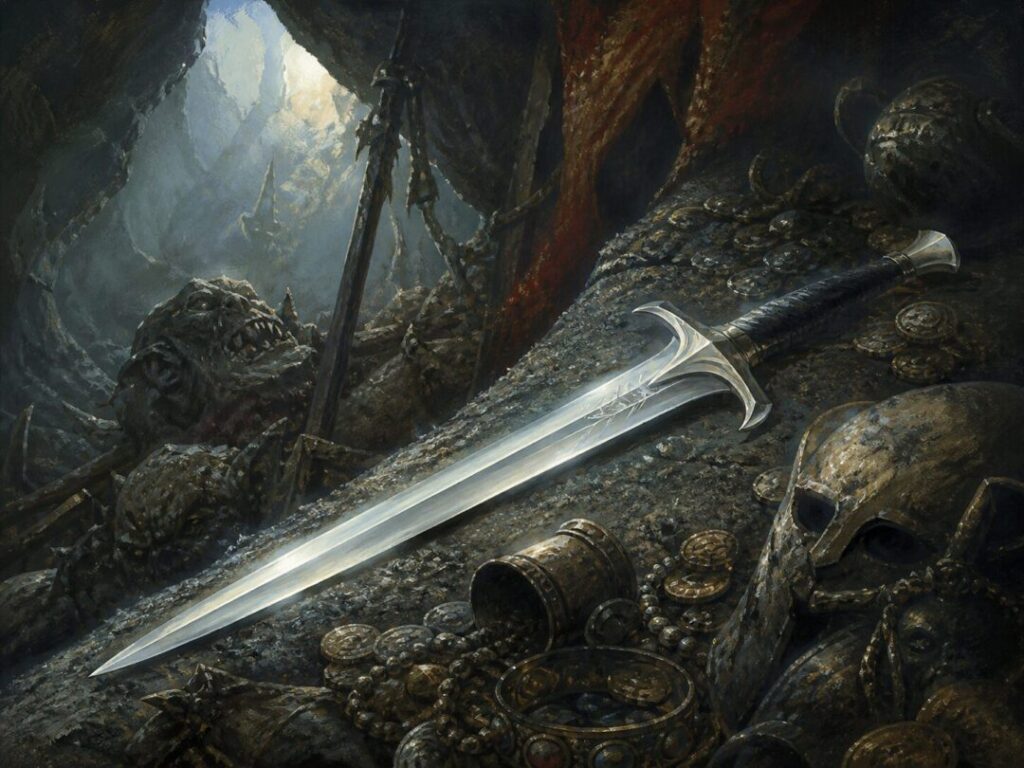
The clearest example is Orcrist, the sword found in the troll-hoard and later carried by Thorin Oakenshield. Its name is Elvish, and it is explained as “Goblin-cleaver.”
That is a quiet but important clue.
The sword’s name contains the orc-root, while its meaning is given as “goblin.” The two words are already being placed over the same enemy.
There is also the explanatory note in The Hobbit that treats “orc” as a word that appears in the story but is usually translated as “goblin.” In other words, “goblin” is not necessarily a different creature. It is the familiar English rendering of the same thing.
That one note does much of the work.
It tells us not to build a hard biological wall between the two names.
Why The Lord of the Rings Uses “Orcs”
By the time we reach The Lord of the Rings, the story has changed.
The world is larger.
The danger is older.
The enemy is no longer only a threat in tunnels beneath the mountains.
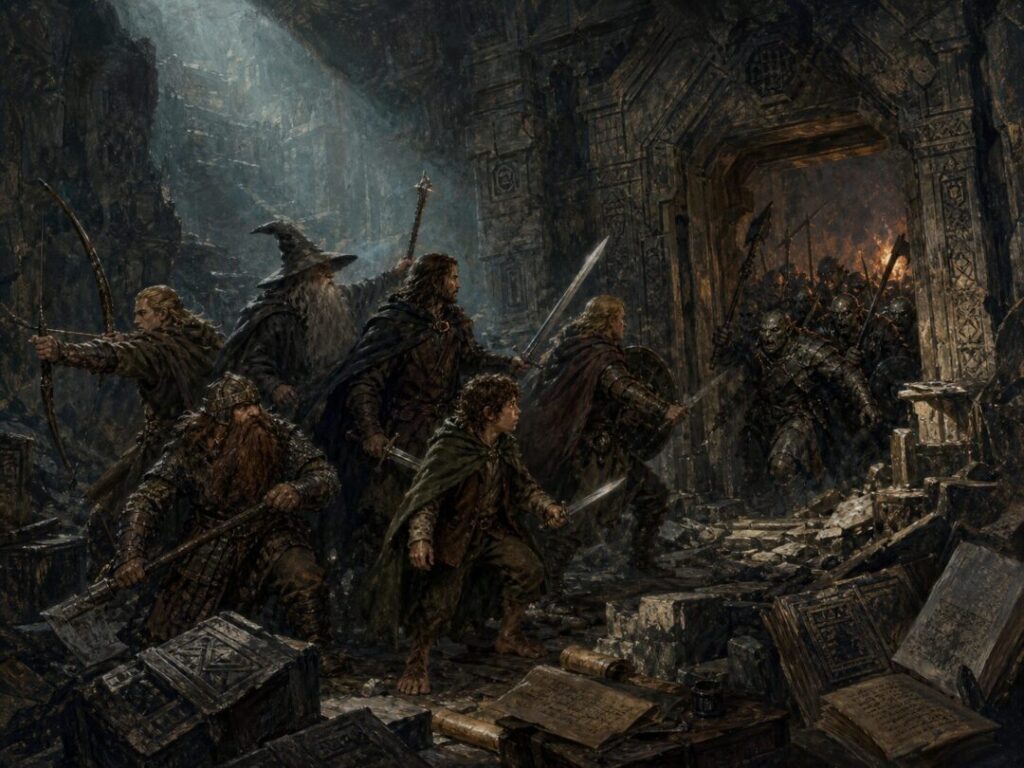
The orcs are now part of a long history of war stretching back into the Elder Days. They serve Sauron, inhabit Moria, fight for Saruman, raid Rohan, march in Mordor, and appear in the armies of the War of the Ring.
The word “orc” fits this darker, broader world.
It feels harder than “goblin.” It sounds less like a nursery-tale monster and more like something belonging to ancient hatred, military command, and the languages of Middle-earth.
But the older word does not disappear completely.
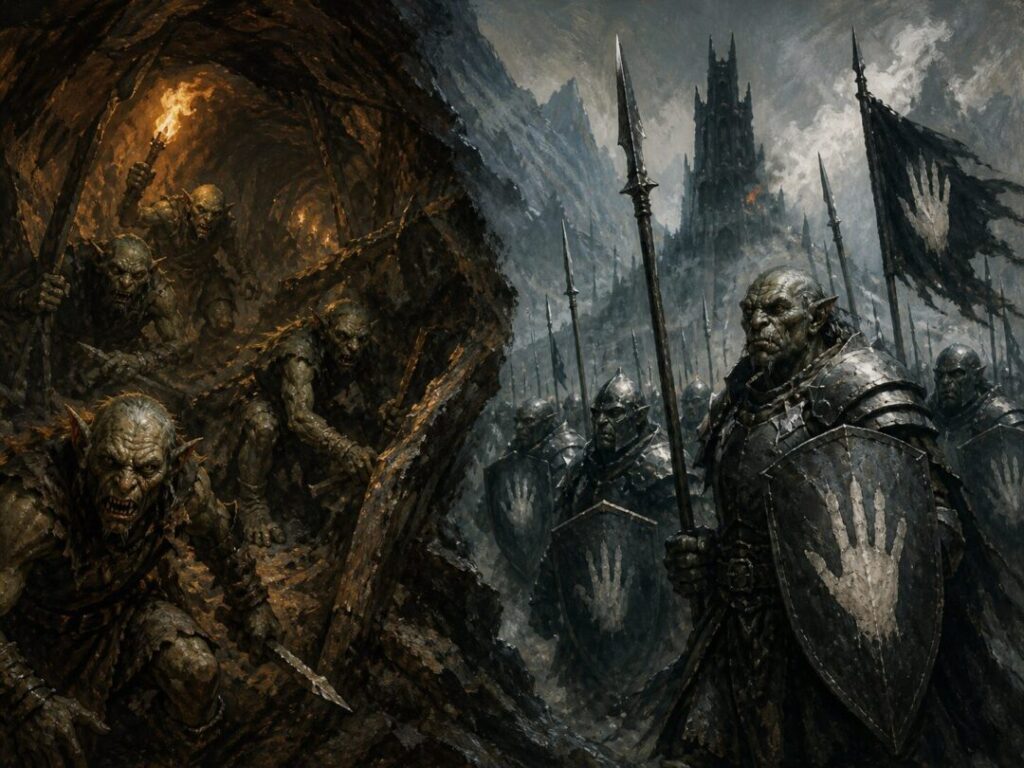
“The Lord of the Rings” still uses “goblin” at times. One especially important example appears when the text refers to “goblin-soldiers of greater stature” bearing the White Hand of Isengard. These are not a separate goblin race suddenly appearing beside orcs. They are clearly within the same enemy world as Saruman’s orc-forces.
This is why the distinction cannot be reduced to “goblins are from The Hobbit and orcs are from The Lord of the Rings.”
The terms overlap.
The later story prefers “orc,” but it does not erase “goblin.”
The Misty Mountain Problem
A common explanation is that goblins are simply the smaller cave-dwelling orcs of the Misty Mountains.
This is understandable, because the most famous goblins in The Hobbit do come from the Misty Mountains. They live underground, move through tunnels, and attack Thorin and Company beneath the mountains.
But this is too rigid.
The texts do not state that “goblin” means only a Misty Mountain orc. Nor do they present “goblin” as the official name of a separate mountain species.
What they do show is that orcs differ.
Some are smaller.
Some are larger.
Some are stronger.
Some are more accustomed to caves and tunnels.
Some serve great powers.
Some seem more like raiders, soldiers, or slaves within their own brutal societies.
So it is fair to say that many of the goblins Bilbo meets are mountain-orcs.
It is not safe to say that goblins, as a category, are a separate race from orcs.
That distinction goes beyond what the books clearly establish.
What About Uruk-hai?
The Uruk-hai are where the question becomes more complicated.
The word “Uruk” is connected with orcs, and in the Third Age it is especially associated with large soldier-orcs. The Uruk-hai of Isengard are stronger, more disciplined, and more able to endure daylight than many of the orcs we see elsewhere.
But this does not make them non-orcs.
They are a kind or class of orc, not a separate creature unrelated to orcs and goblins.
This is important because readers often imagine a ladder:
goblin → orc → Uruk-hai
As if these were three species increasing in size and strength.
The books do not give us that neat ladder.
A better way to think of it is this:
“Orc” is the broad and preferred term.
“Goblin” is a translation or alternate English word for the same kind of being.
“Uruk” and “Uruk-hai” refer to great fighting-orcs, especially in the context of Mordor and Isengard.
“Snaga” is used among orcs for lesser or slave-orcs.
That still leaves room for differences in size and rank. But it keeps the categories closer to the text.
The Role of Translation
One of the most easily missed parts of Middle-earth is that the story is presented as a translated record.
Names are not always simple labels. They often represent words from other languages, rendered into English for the reader.
This is especially true of peoples and places.
The same thing may be known by different names depending on whether it is being described in Elvish, Westron, Rohirric, Black Speech, or another tongue. “Orc” belongs within that web of names. “Goblin” functions as a familiar English rendering.
That is why the question “are orcs and goblins the same?” can be misleading.
In-universe, different peoples may use different words. Out-of-universe, the story’s tone also affects which English word appears. Bilbo’s adventure leans toward “goblin.” The War of the Ring leans toward “orc.”
But the enemy being named is fundamentally the same broad people.
The difference is linguistic and literary before it is biological.
Why They Feel Different Anyway
Even after knowing this, many readers still feel that goblins and orcs are different.
That feeling is not foolish.
It comes from the way the stories present them.
The goblins of The Hobbit are theatrical. They sing. They shout. Their king sits in an underground hall. Their danger is real, but the narration around them has a dark fairy-tale rhythm.
The orcs of The Lord of the Rings feel harsher. We overhear their military arguments. We see their rivalries, fear, cruelty, discipline, and resentment. They belong to armies. They carry tokens of larger powers. They are part of a war that threatens the whole age.
So the atmosphere changes.
The word “goblin” makes us think of tunnels and traps.
The word “orc” makes us think of Mordor, iron, shields, whips, and marching feet.
But that is a difference in presentation, not proof of a separate race.
Bilbo’s goblins are seen through the doorway of a children’s adventure that has turned dangerous. Frodo’s orcs are seen inside a world moving toward catastrophe.
The shadow is the same.
The story has grown darker around it.
What the Books Do Not Say
It is also important to be careful about what the texts do not confirm.
They do not give a fixed biological taxonomy of goblins and orcs.
They do not say that goblins are always smaller.
They do not say that all orcs are larger than goblins.
They do not say that goblins are a separate species bred apart from orcs.
They do not provide one tidy chart that explains every tribe, name, rank, and variation.
The origins of orcs themselves are a difficult subject in the wider legendarium, with different explanations appearing in different writings. That larger question should not be flattened into certainty where the texts remain complex.
For this topic, the safest statement is simple:
In the published narrative world of The Hobbit and The Lord of the Rings, “goblin” and “orc” refer to the same broad kind of creature, though different groups of orcs vary greatly.
Anything beyond that needs careful qualification.
So Why Does the Confusion Persist?
The confusion survives because later fantasy often made the distinction sharper.
Games, films, and adaptations frequently separate goblins and orcs visually or biologically. Goblins become smaller cave-creatures. Orcs become larger warriors. Uruk-hai become something even more distinct.
That structure is easy to understand, and it works well visually.
But the books are not built that way.
They are built from language, history, and layered storytelling.
The same enemy can be called by different names because the tale is passing through different voices. Bilbo’s story does not sound like Frodo’s. A name used in a children’s adventure may later appear under a harsher form in an epic of war.
That does not mean the earlier word was wrong.
It means the lens has changed.
The Real Answer
So are orcs and goblins really the same thing?
Yes—in the books, they are best understood as the same broad race or people under different names.
But the full answer is richer than a simple yes.
“Goblin” is the word that dominates The Hobbit, where the story moves through mountains, riddles, and fairy-tale danger.
“Orc” is the word that dominates The Lord of the Rings, where that same danger is drawn into the ancient history of Morgoth, Sauron, Mordor, Isengard, and the wars of the Third Age.
The difference is not that Bilbo fought one species and Frodo faced another.
The difference is that Bilbo first met the terror in a story that still had the shape of a fireside tale.
Frodo met it when the full shadow behind that terror had finally come into view.
The goblins under the Misty Mountains and the orcs of the War of the Ring are not cleanly separate creatures.
They are the same darkness, named in different voices.
And once that becomes clear, the shift from “goblin” to “orc” stops being a contradiction.
It becomes one of the quiet signs that Middle-earth itself has deepened beneath our feet.
Sources & Notes
- J.R.R. Tolkien, The Hobbit, Author’s Note — states that “orc” is usually translated as “goblin” or “hobgoblin” for the larger kinds, directly supporting the shared terminology.
- J.R.R. Tolkien, The Hobbit, Chapter 3, “A Short Rest” — Elrond explains Orcrist as “Goblin-cleaver,” linking the Elvish orc-root with the English word goblin inside the story.
- J.R.R. Tolkien, The Lord of the Rings, Appendix F, “The Languages and Peoples of the Third Age” — discusses Orcs, Black Speech, and translation, useful for the article’s language-and-names angle.
- J.R.R. Tolkien, The Lord of the Rings, Book III, Chapter 7, “Helm’s Deep” — describes Saruman’s White Hand troops as “goblin-soldiers of greater stature,” showing overlap between goblin wording and orc armies.
- J.R.R. Tolkien, The Lord of the Rings, Book III, Chapter 3, “The Uruk-hai” — gives the Uruk-hai/snaga contrast and supports treating Uruks as a class or kind of orc rather than a separate non-orc species.