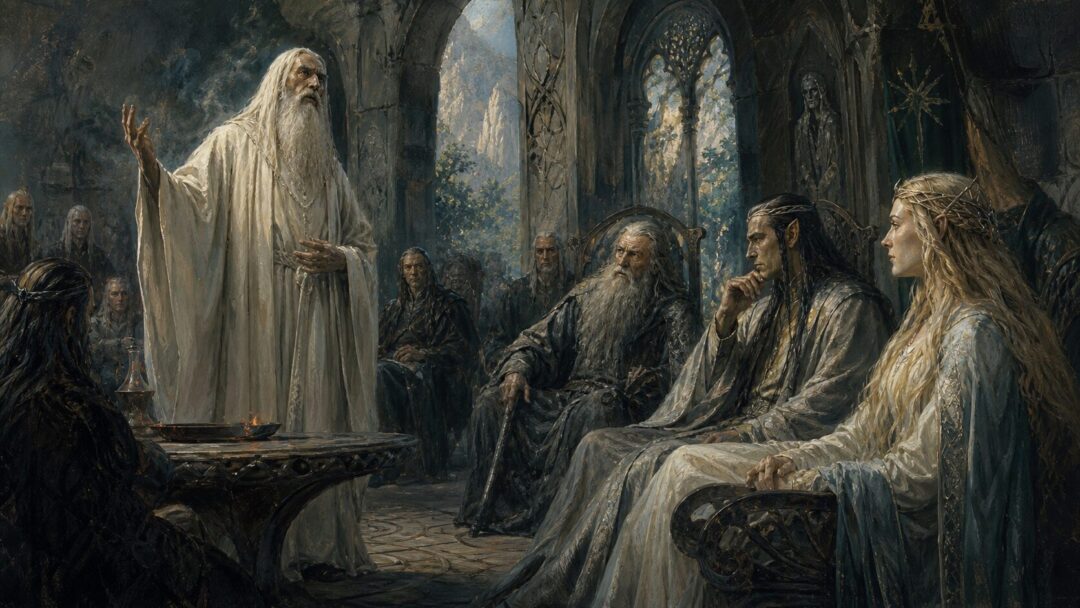
Most people imagine Saruman’s mistake as a failure of insight.
He was proud.
He was arrogant.
He underestimated the Shadow.
That is true in one sense—but it is not the whole answer.
Saruman did not simply fail to recognize that Sauron might return. By the time the question became urgent, the Wise already had strong reason to fear that the Necromancer of Dol Guldur was Sauron. Gandalf entered Dol Guldur and confirmed it. When he returned to the White Council, the issue was no longer merely whether some evil had taken root in southern Mirkwood.
It was whether the Wise would act against Sauron before he grew stronger.
And Saruman said no.
That refusal is one of the most revealing moments in the history of the Third Age.
Because Saruman’s delay was not born only from caution. The texts make clear that something else had already begun inside him.
He had started to desire the One Ring.

Saruman Did Not Think Sauron Was Gone Forever
The first mistake is assuming Saruman believed Sauron could not return.
That is not what the story shows.
Sauron had already “returned” in a meaningful sense. He was not yet openly ruling in Mordor, and he had not declared himself, but his will had gathered again. His shadow lay over Mirkwood. Dol Guldur had become a stronghold of fear. The Wise did not fully understand the danger at first, and for a time some believed the Necromancer might be one of the Nazgûl.
But Gandalf discovered otherwise.
The power in Dol Guldur was Sauron.
So Saruman’s later behavior cannot be explained as simple ignorance. He knew enough to understand the danger. He knew enough to debate it. He knew enough to oppose Gandalf’s call for action.
That is where the darker possibility enters.
Saruman did not seem to believe that Sauron would never return. Rather, he behaved as if Sauron’s return could be managed, delayed, or used.
And that is a very different kind of error.
The White Council and the Refusal to Strike
In the year 2851 of the Third Age, the White Council met. Gandalf urged an attack on Dol Guldur.
Saruman overruled him.
This moment is easy to pass over, but it matters enormously. Saruman was not merely another voice in the room. He was the head of the White Council. He was regarded as the greatest in knowledge of Sauron’s devices, especially the Rings of Power. His judgment carried weight.
So when he advised against open action, the Council listened.
On the surface, Saruman could appear cautious. Perhaps Sauron was still weak. Perhaps the Wise should watch and wait. Perhaps open conflict would reveal too much or provoke a danger before they were ready.
But the later explanation strips away that innocent reading.
It afterwards became clear that Saruman had already begun to desire the One Ring for himself. He hoped that if Sauron were left alone for a time, the Ring might reveal itself, seeking its master.
This is the key.
Saruman was not only thinking about Sauron.
He was thinking about the Ring.

The Ring Changed the Question
To the Wise, Sauron’s return was a threat.
To Saruman, it also became an opportunity.
The One Ring had been lost since Isildur’s death near the Gladden Fields. Most of the Wise did not know where it was. Some may have hoped it was gone beyond recovery. Saruman himself publicly argued that it had likely been carried down the Anduin into the Sea.
But his private actions tell another story.
He began searching near the Gladden Fields.
That detail is devastating. If Saruman truly believed the Ring had been swept far away beyond reach, why search near the place where Isildur fell? The text does not require us to imagine a secret scene or invent a hidden confession. The contradiction is already there.
In public, Saruman calmed the Council.
In private, he searched.
That does not prove every thought in his mind, and the texts do not give us a full inner monologue. But they strongly imply that Saruman’s argument about the Ring being lost was useful to him. If the Wise believed the Ring was beyond recovery, they would not search too urgently. If Sauron remained in Dol Guldur, perhaps the Ring might stir. And if Saruman could find it first, he would no longer need to remain merely one of the Wise.
He could become a power in his own right.
Why Let Sauron Remain?
This is the heart of the question.
Why would Saruman allow Sauron time?
Because he seems to have believed he could benefit from the delay.
The texts suggest that Saruman hoped the Ring might reveal itself if Sauron were “let be for a time.” That idea is chilling. Saruman understood that the Ring was not an ordinary lost object. It had a will toward its master. It could abandon one bearer and come into the possession of another. It had left Gollum, and later events would show how perilous its movements could be.
Saruman may have believed that Sauron’s growing activity would draw the Ring into the open.
This was not loyalty to Sauron.
It was rivalry.
Saruman did not want Sauron restored in full strength. He did not want the Dark Lord to recover the Ring. But he was willing to let Sauron remain active long enough for the Ring to become findable.
That is the terrible narrowness of his calculation.
He thought he could stand close to the fire without being burned.
The Lie About the Sea
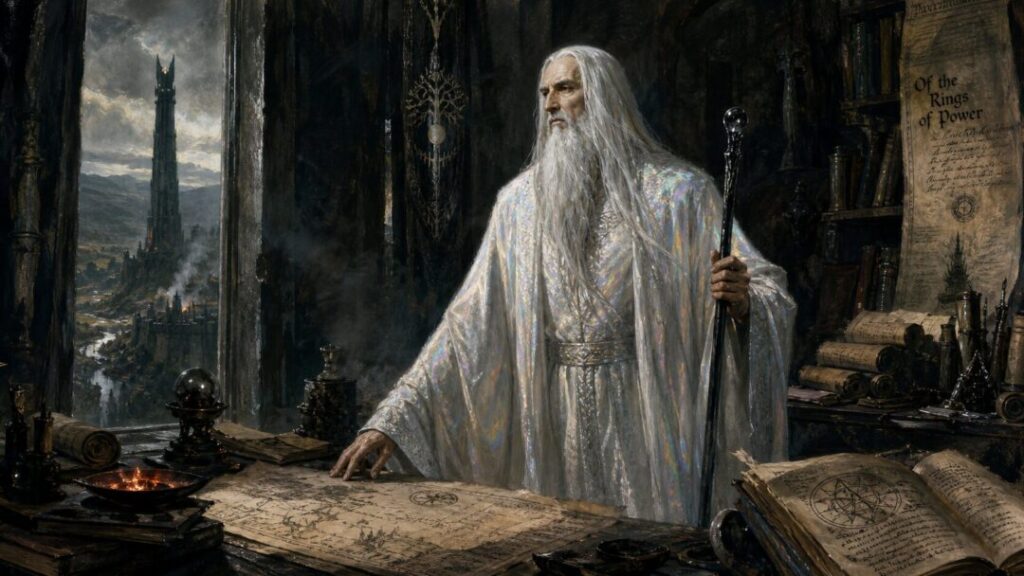
Saruman’s claim that the Ring had gone down the Anduin and into the Sea is one of the most important parts of his deception.
On one level, it sounds reasonable enough to calm fear. The Ring had been lost in the river long ago. Ages had passed. The world had changed. If it had been carried away, then perhaps no one could recover it—not Sauron, not the Wise, not any power in Middle-earth.
But Saruman’s own search near the Gladden Fields makes the claim suspect.
The careful way to say this is that the texts do not show Saruman admitting, “I lied.” But his conduct strongly undermines his public certainty. He used the possibility of the Ring’s loss to quiet others while acting as though the Ring might still be found.
That is why Saruman’s danger is not merely that he desired power.
It is that he used wisdom as a covering for desire.
He knew enough history to sound convincing.
He knew enough lore to silence anxiety.
He knew enough about the Rings to make others trust his judgment.
And all the while, his own will was bending toward the very thing he claimed was beyond reach.
Why He Finally Agreed to Attack Dol Guldur
Saruman did eventually agree to act.
In 2941, the White Council drove Sauron from Dol Guldur. At first glance, this might look like Saruman finally accepted Gandalf’s warnings.
But again, the deeper motive appears more complicated.
By then, Saruman had become alarmed that Sauron himself was searching the Anduin near the Gladden Fields. That changed the situation. As long as Saruman imagined that he alone might profit from Sauron’s presence, delay served him. But if Sauron was searching the same region, delay became dangerous.
So Saruman yielded.
Not necessarily because he had abandoned his private desire, but because Sauron was now too close to the prize.
This makes the attack on Dol Guldur feel very different. It was a victory for the White Council, but not a simple triumph of unity. One of its chief architects was already compromised by ambition.
Sauron withdrew, but not in ruin. He had already prepared for his return to Mordor.
Saruman had helped drive him from one fortress—yet the delay had not destroyed the larger danger.
Saruman’s Error Was Not Ignorance
Saruman’s great mistake was not that he failed to believe Sauron could return.
His mistake was believing that he could outmaneuver that return.
He thought he could use Sauron’s movement to locate the Ring. He thought he could keep the Wise inactive while preserving his own advantage. He thought knowledge would protect him from corruption.
That last point matters most.
Saruman was not a fool. He was learned, powerful, persuasive, and subtle. But in Middle-earth, knowledge without humility becomes dangerous. Saruman studied the devices of the Enemy so closely that he began to admire the methods he was meant to resist.
By the time he openly revealed himself to Gandalf in Orthanc, his fall was already far advanced. He spoke of joining with Sauron, or of taking the Ring and ordering the world by force. But the roots of that fall reached further back.
They began in the quiet compromises.
In the delayed decisions.
In the convenient arguments.
In the private search beneath public certainty.
The Shadow Behind Saruman’s “Wisdom”
This is what makes Saruman so frightening.
He did not begin as a servant of Sauron in any simple, open way. The texts present his corruption as gradual. He was drawn by pride, impatience, and the desire to command events rather than serve the good.
He did not merely want safety.
He wanted control.
That is why the question “Why did Saruman think Sauron would not return?” almost gives him too much innocence. It imagines him as someone who misread the age.
But Saruman read much of it correctly.
He knew Sauron was dangerous.
He knew the Ring mattered.
He knew the Wise feared its recovery.
He knew where Isildur had fallen.
He knew enough to search.
His failure was moral before it was strategic.
He did not deny the Shadow because he could not see it. He delayed action because some part of him wanted what the Shadow might reveal.
The Real Answer
So why did Saruman seem to believe Sauron would not return?
Because that appearance served him.
He could calm the White Council by saying the Ring was lost. He could resist Gandalf without seeming openly treacherous. He could present delay as prudence. He could let Sauron remain in Dol Guldur while privately hoping the Ring might become traceable.
But the texts do not support the idea that Saruman truly believed Sauron was harmless or permanently gone.
The darker answer is that Saruman knew the danger—and still chose to wait.
He waited because he desired the Ring.
He waited because he believed he could manage Sauron’s return.
He waited because pride had already taught him to trust his own designs more than the wisdom he was supposed to serve.
And that is why Saruman’s fall is so unsettling.
It does not begin with armies pouring out of Isengard.
It begins with a voice in council saying that there is no need to act yet.
It begins with a wise man giving a reasonable answer for an unreasonable delay.
It begins with the belief that evil can be used safely, so long as one is clever enough.
Middle-earth proves him wrong.
Sources & Notes
- J.R.R. Tolkien, The Lord of the Rings, Appendix B, “The Tale of Years,” Third Age 2851 and 2941 — directly states that Gandalf urged an attack on Dol Guldur, Saruman overruled him, and later agreed when Sauron began searching near the Gladden Fields.
- J.R.R. Tolkien, The Lord of the Rings, Book II, Chapter 2, “The Council of Elrond” — gives Gandalf’s account of Saruman’s Ring-lore, his claim that the Ring had gone down Anduin to the Sea, and his later desire to use or master it.
- J.R.R. Tolkien, Unfinished Tales, “The Hunt for the Ring” — expands on Saruman’s secret interest in the Gladden Fields and his efforts to watch or search the region where Isildur lost the Ring.
- J.R.R. Tolkien, The Silmarillion, “Of the Rings of Power and the Third Age” — summarizes Sauron’s return as the Necromancer of Dol Guldur, the Wise’s discovery of his identity, and the later assault that drove him back to Mordor.