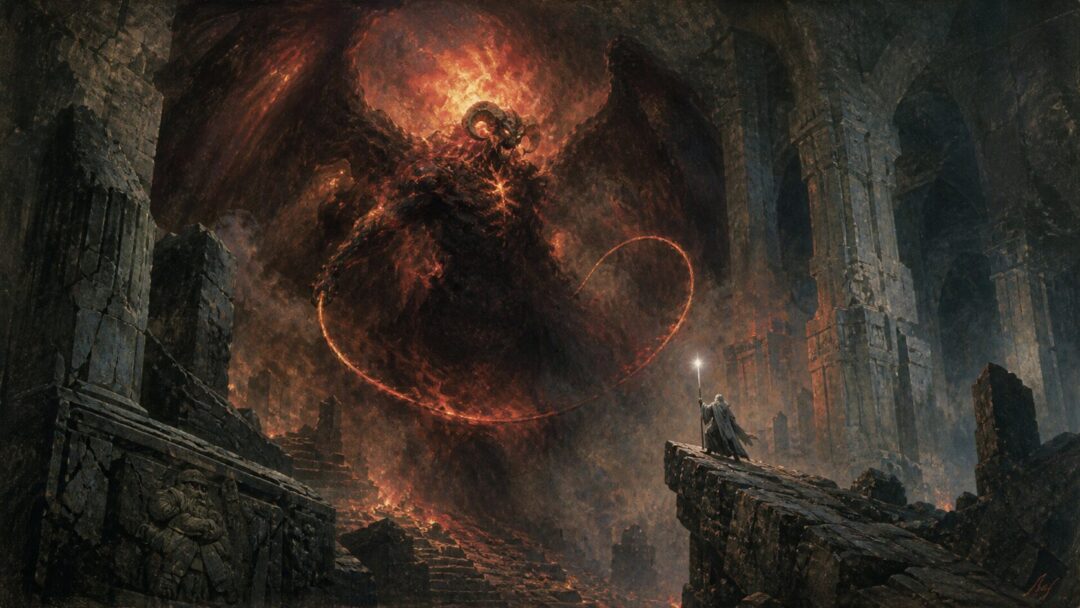
At first, the answer seems obvious.
A Balrog with the One Ring would be stronger.
More fire.
More shadow.
More terror.
A creature already powerful enough to drive the Dwarves from Moria would become nearly unstoppable.
But that answer misses the most important thing about the Ring.
The One Ring was not made as a simple weapon. It was not a blade that made its wielder hit harder, or a jewel that poured out raw magical strength. Its deepest purpose was domination.
It was made to rule.
To bind.
To bend other wills.
So the real question is not whether the Ring would make a Balrog more dangerous.
Of course it would.
The real question is what kind of danger it would create.
Because a Balrog is not an orc, a troll, a dragon, or a corrupted mortal king. A Balrog is something older and deeper: one of the Maiar, fallen into the service of Morgoth, clothed in terror, shadow, and flame.
That makes the scenario far stranger than “monster finds magic ring.”
It becomes a collision between two ancient evils.
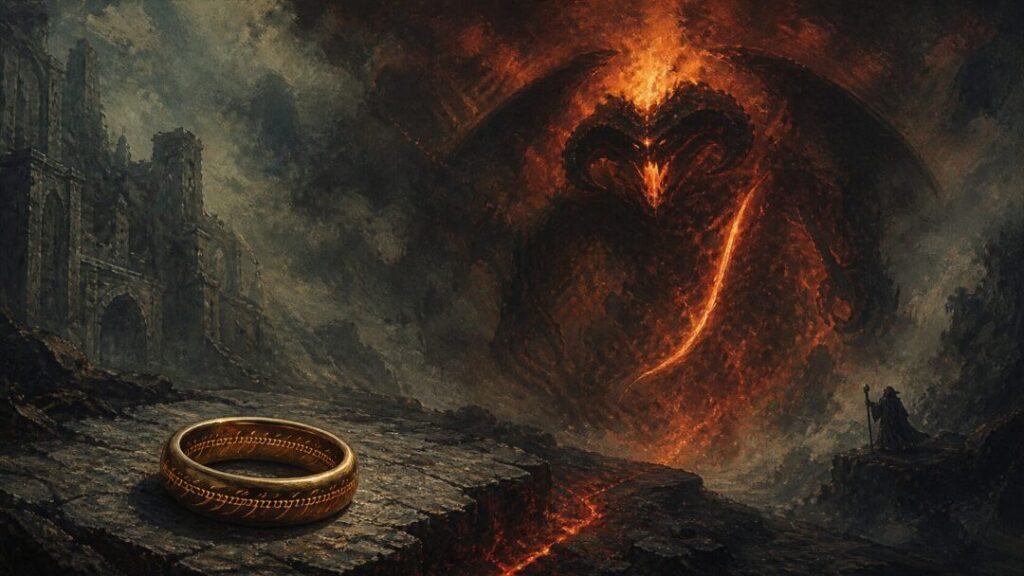
The Ring Does Not Give Everyone the Same Power
The first mistake is imagining that the Ring works like a fixed tool.
It does not.
The texts show that the Ring affects different bearers differently. Hobbits become invisible when they wear it. Gollum is prolonged by it and consumed by it. Boromir imagines using it as a weapon of command. Galadriel understands that if she took it, the temptation would not be petty survival, but rule.
The Ring gives power according to the measure of the possessor.
That does not mean every bearer can immediately use it fully. Frodo could not become a Dark Lord simply by putting it on. Before someone could truly use that power, they would need strength of will, knowledge, and the ability to dominate others.
This matters enormously.
A Balrog has none of the smallness of a Hobbit. It is not a simple physical monster. It is a fallen spirit of great age and terror. If such a being possessed the Ring, the result would almost certainly be more serious than invisibility or unnaturally prolonged life.
The Ring would find something in the Balrog to magnify.
But what it would magnify is the frightening part.
What a Balrog Actually Is
A Balrog is not merely a demon-shaped creature that breathes fire.
In the older lore, the Balrogs are among the corrupted Maiar: spirits who entered the world and became servants of Morgoth. They are associated with flame, darkness, fear, and destructive power. The Balrog in Moria, known as Durin’s Bane, is one of these beings.
This places Balrogs in the same broad order of existence as Sauron and Gandalf.
That does not mean a Balrog is equal to Sauron. The texts do not say that. Sauron is repeatedly shown as a being of immense craft, malice, and command. His power is not simply that he is ancient, but that he is a maker, deceiver, ruler, and organizer of evil.
A Balrog’s terror is different.
It is not subtle.
It is not diplomatic.
It is not shown building empires through persuasion.
It appears as ruin, fear, and overwhelming force.
This distinction is essential. The One Ring was made by Sauron, and it reflects Sauron’s mode of evil. It is not just power. It is ordered domination.
So a Balrog taking the Ring would not simply become “more like Morgoth.”
It would be touched by the surviving will and method of Sauron.
Would the Ring Make a Balrog Invisible?
This is one of the most interesting parts of the question.
For mortals such as Bilbo and Frodo, the Ring causes invisibility because it draws the wearer partly into the unseen world. But that effect is not necessarily the Ring’s greatest or most universal power.
A Balrog is already a spiritual being, though embodied. The texts do not give us an example of a Balrog wearing the Ring, so we cannot state with certainty what would happen visually.
The safest answer is this:
Tolkien never directly states whether a Balrog would become invisible if it wore the One Ring.
But it is unlikely that invisibility would be the most important effect.
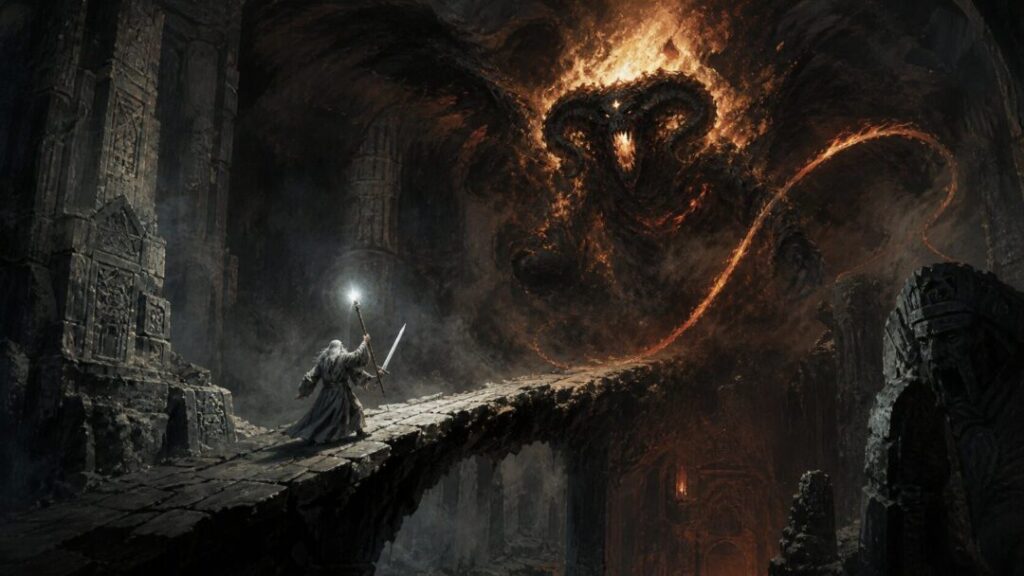
A Balrog is already a creature of shadow and flame. Its terror is not based on being seen clearly in ordinary terms. When the Fellowship encounters Durin’s Bane, the impression is not of a normal body with a neat outline, but of darkness, fire, menace, and immense spiritual dread.
So if the Ring affected its appearance, the result might not resemble Bilbo vanishing at a party.
That would be speculation.
What can be said more securely is that the Ring’s deeper power—domination of will—would matter far more than whether the Balrog became invisible to ordinary eyes.
The Ring Would Magnify Command, Not Just Fire
A Balrog already inspires terror.
That is not merely a mood around it. Fear is part of how it appears in the story. Durin’s Bane is not just dangerous because it can kill. It is dangerous because its presence overwhelms. The Fellowship feels it before fully understanding what it is. Gandalf recognizes the threat as something far beyond ordinary enemies.
Now imagine the One Ring added to that.
The Ring would not need to make the Balrog taller.
It would not need to make its whip longer.
It would not need to make its flame hotter.
The true horror would be will.
A Balrog with the Ring might become more capable of commanding lesser creatures, imposing terror, and bending minds beneath it. This is interpretation, but it follows from what the Ring is made to do: strengthen domination according to the bearer’s measure.
The Balrog’s native dread would be sharpened into rule.
Not just fear.
Obedience.
Not just destruction.
Mastery.
That is what makes the scenario so dangerous.
A Ring-bearing Balrog would not merely burn a hall. It might gather servants. It might command orcs more effectively. It might become a dark power in its own right, at least for a time.
But that phrase matters: for a time.
Because the Ring is never truly neutral.
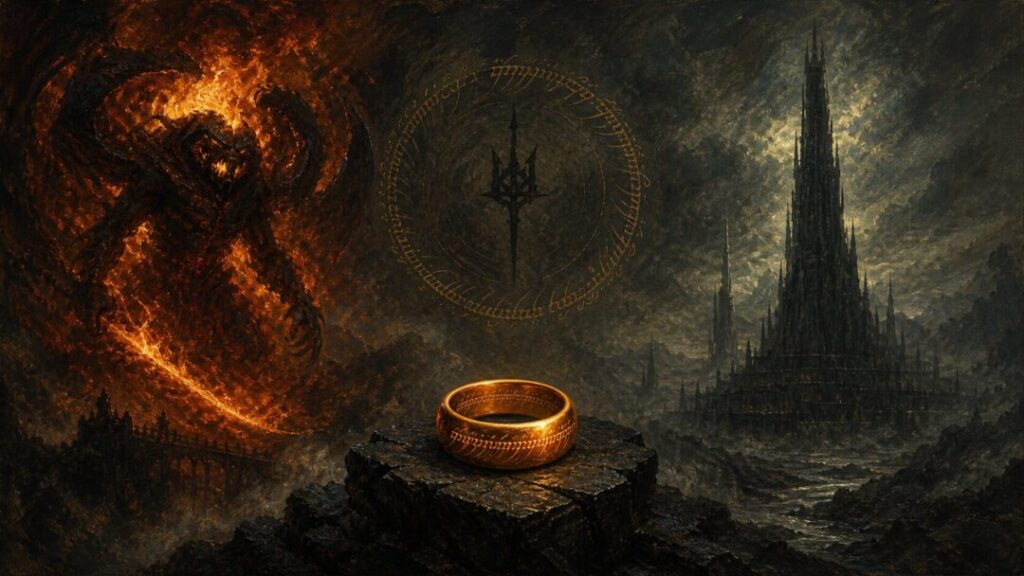
The Ring Belongs to Sauron
This is the trap hidden inside the whole question.
The Ring can be used by others. That is part of its danger. Boromir believes it can save Gondor. Galadriel imagines what she might become if she accepted it. Gandalf refuses it because he knows the temptation would work through his desire to do good.
But the Ring has an allegiance.
It was made by Sauron.
It contains much of his power.
It was designed as his instrument of rule.
A powerful bearer might attempt to claim it. In the case of Gandalf, Tolkien’s own explanation suggests that such a struggle would become a contest between the Ring’s true allegiance to Sauron and the strength of the one who possessed it.
That is crucial.
If even Gandalf claiming the Ring would not make the situation simple, then a Balrog claiming it would not be simple either.
The Balrog might use it.
The Balrog might become more terrible.
The Balrog might even become a rival threat.
But nothing in the texts allows us to say confidently that a Balrog could permanently master the Ring and overthrow Sauron.
That would go beyond the evidence.
Could a Balrog Defeat Sauron With the Ring?
This is where the answer must be careful.
A Balrog is a Maia. Sauron is also a Maia. But “same order of being” does not mean “equal in power.” Among the Ainur, there are differences of stature, knowledge, purpose, and authority.
Sauron was not merely strong. He was especially skilled in craft, manipulation, and domination. The Ring was an extension of his own will. It was made by him, for him, and in a sense remained oriented toward him.
A Balrog, by contrast, is never shown as a maker of ruling devices or a strategist of the same kind. Its power is terrifying, but the texts do not portray Balrogs as Sauron-like rulers.
So could a Balrog use the Ring to challenge Sauron?
Possibly, in a limited and dangerous sense.
Could it permanently supplant him as true master of the Ring?
The texts do not confirm that, and the safer answer is no—or at least, not that we can know.
The Ring would give the Balrog power, but it would also bring the Balrog into direct contact with Sauron’s will.
That means the Balrog would not simply become independent.
It would become contested.
Morgoth’s Servant Holding Sauron’s Ring
Here is the most unsettling part.
A Balrog is a creature of Morgoth’s corruption.
The One Ring is Sauron’s work.
Those evils are related, but not identical.
Morgoth’s evil is vast, ruinous, and bound into the marring of the world itself. Sauron’s evil is more concentrated: order without mercy, control without freedom, domination shaped into system.
A Balrog belongs to the older terror.
The Ring belongs to the later one.
So if a Balrog took the Ring, the result would be a fusion of two modes of darkness: Morgoth’s ancient fire and Sauron’s ruling will.
This is not directly described in the texts, so it must be treated as interpretation. But it is a conservative interpretation based on what these beings and objects are.
The Balrog would bring terror and ruin.
The Ring would press that terror toward mastery.
That is worse than simple destruction.
A destroying thing may pass through and leave ashes.
A ruling thing remains.
Would Sauron Want a Balrog to Have the Ring?
Probably not for long.
Sauron wanted the Ring returned to himself. The whole War of the Ring turns on that fact. The Ring in the hands of any mighty being would be a grave danger because it could become a rival center of power.
A Balrog with the Ring would not be a loyal servant merely because both are evil.
Evil in Middle-earth often competes with itself. Sauron does not rule because all dark things naturally love him. He rules by fear, will, organization, and force.
A Balrog possessing the Ring might be useful only in the most temporary sense if it caused chaos among Sauron’s enemies. But as a lasting situation, it would be intolerable.
The Ring was Sauron’s.
He would seek it.
And if the Balrog claimed it, the Ring itself would remain bound to the question of Sauron.
That means the Balrog’s possession of it would not end the struggle.
It would intensify it.
Why Durin’s Bane Did Not Seize the Ring
Another tempting question is why the Balrog in Moria did not simply take the Ring from Frodo.
The text never says that Durin’s Bane knew Frodo carried the One Ring.
That must be our starting point.
The Balrog encounters the Fellowship in Moria, and Gandalf confronts it. Nothing in the narrative confirms that the Balrog understood the Ring was present, desired it, or recognized Frodo as its bearer.
It is possible to speculate that a being of such power might have sensed something unusual. But the story does not state this.
What the text does show is that Gandalf sees the Balrog as an immediate threat that must be stopped. The confrontation becomes a battle between Gandalf and Durin’s Bane, not a contest over the Ring.
So any claim that the Balrog ignored the Ring because it did not want it, or because it could not use it, goes beyond the evidence.
The better answer is simpler:
We are not told that it knew.
The Most Likely Effect
So what would the One Ring do to a Balrog?
The most lore-consistent answer is this:
It would magnify the Balrog’s native power according to its stature, especially in fear, command, and domination. It might give the Balrog greater ability to impose its will on lesser beings. It would almost certainly make it more dangerous. But it would also bind the Balrog’s fate to Sauron’s will, because the Ring was never free of its maker.
That is the central paradox.
The Ring would empower the Balrog.
But it would also endanger it.
Not physically, perhaps. Not immediately.
Spiritually.
A Balrog was already corrupted. The Ring would not need to seduce it toward evil in the way it tempted Boromir or Frodo. It would have different material to work with: pride, wrath, terror, domination, and ancient allegiance to darkness.
The Ring would not redeem those things.
It would organize them.
It would give them focus.
And then, sooner or later, the deeper contest would begin.
The Real Horror Is Not a Stronger Balrog
A Balrog with the One Ring is frightening not because it would become a larger monster.
That is the shallow version.
The deeper horror is that the Ring might give direction to its terror.
Durin’s Bane destroyed Khazad-dûm and became a nightmare beneath the mountains. But it did not become a Dark Lord of Middle-earth. It did not build Barad-dûr. It did not forge rings, corrupt kingdoms, and attempt to order the world under a single will.
The One Ring points toward exactly that kind of domination.
So the terrifying image is not merely a Balrog standing in flame with the Ring on its hand.
It is a Balrog no longer content to haunt the deep places.
A Balrog that commands.
A Balrog that gathers.
A Balrog that becomes, even briefly, a throne of shadow and fire.
And yet even then, the Ring would whisper back toward its maker.
That is why the scenario has no clean victory for the Balrog.
The Ring would make it greater.
But greatness through the Ring is never freedom.
It is another form of bondage.
The Final Answer
The One Ring would not simply “upgrade” a Balrog.
It would likely amplify what the Balrog already was: terror, fire, shadow, and overwhelming will. It might make the Balrog a far more dangerous commander of lesser beings. It might create a temporary rival to Sauron. It might even produce one of the most terrible powers remaining in the Third Age.
But it would not make the Balrog the true master of the Ring in any simple or certain way.
The Ring belonged to Sauron.
Its power was his power.
Its purpose was his purpose.
Its deepest pull was toward him.
So the final image is not a Balrog becoming free through the Ring.
It is a Balrog becoming more terrible while stepping into a trap made by another mind.
Morgoth’s old fire would burn brighter.
Sauron’s will would tighten around it.
And somewhere inside that storm of shadow, flame, pride, and domination, the Ring would still be doing what it was made to do.
Not merely to strengthen.
To rule.
Sources & Notes
- J.R.R. Tolkien, The Letters of J.R.R. Tolkien, Letter 131 — explains that Sauron put much of his own power into the Ruling Ring and made it chiefly as an instrument for dominating other wills.
- J.R.R. Tolkien, The Silmarillion, “Valaquenta: Of the Enemies” — identifies Balrogs as Maiar corrupted by Melkor, spirits of fire and shadow who became demons of terror.
- J.R.R. Tolkien, The Lord of the Rings, Book II, Chapter 5, “The Bridge of Khazad-dûm” — presents Durin’s Bane as shadow and flame, a threat Gandalf recognizes as far beyond ordinary enemies.
- J.R.R. Tolkien, The Lord of the Rings, Book I, Chapter 2, “The Shadow of the Past” — shows the Ring’s varied effects on bearers, including invisibility, unnatural preservation, corruption, and its drive to return to Sauron.
- J.R.R. Tolkien, The Letters of J.R.R. Tolkien, Letter 246 — discusses what might happen if a being such as Gandalf claimed the Ring, including the tension between the Ring’s allegiance to Sauron and another powerful will.