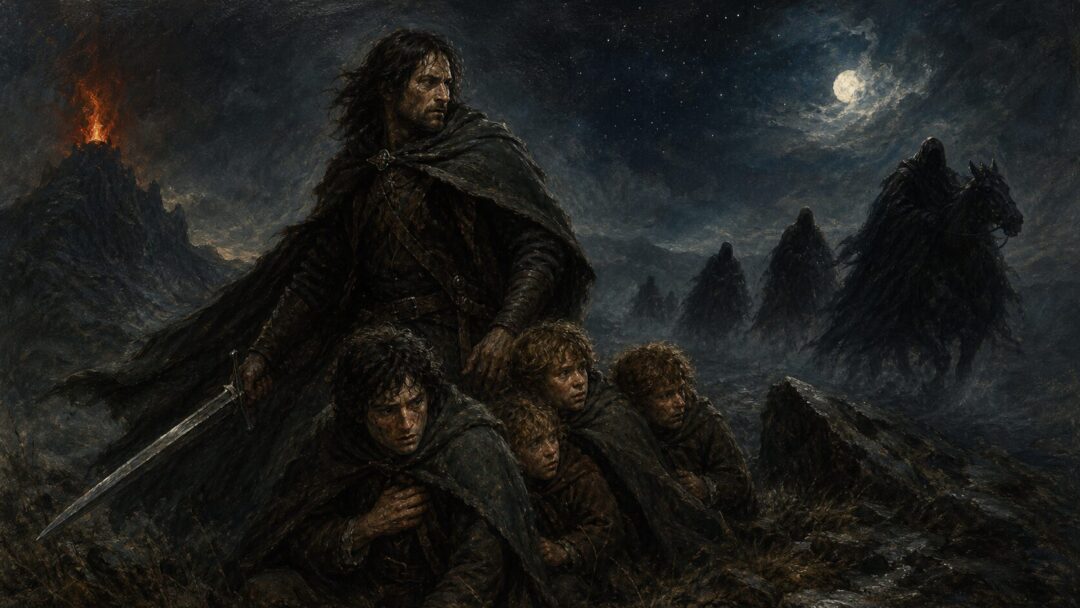
At first, the answer seems like it should be simple.
Aragorn was the heir of Isildur. He was raised in Rivendell. He walked beside Frodo Baggins after the One Ring had been found again. He sat at the Council of Elrond when the fate of the Ring was debated. He passed through Lothlórien, where Galadriel bore one of the Three. He was fostered by Elrond, who held Vilya.
If anyone among Men in the late Third Age seems likely to have come into contact with a Ring of Power, it is Aragorn.
And yet the texts are far more careful than that.
They place Aragorn close to the Rings again and again. They surround him with Ring-bearers. They make his entire destiny depend on the history of the One Ring, from Isildur’s failure to Frodo’s burden.
But when the question becomes direct contact, the answer narrows sharply.
Arathorn is easier.
Aragorn is more interesting.
Because with Aragorn, the most important thing may not be that he touched a Ring of Power.
It may be that he came so close—and did not.
The First Confusion: Aragorn’s Own Ring
Any discussion of Aragorn and the Rings has to begin with one object that causes constant misunderstanding:
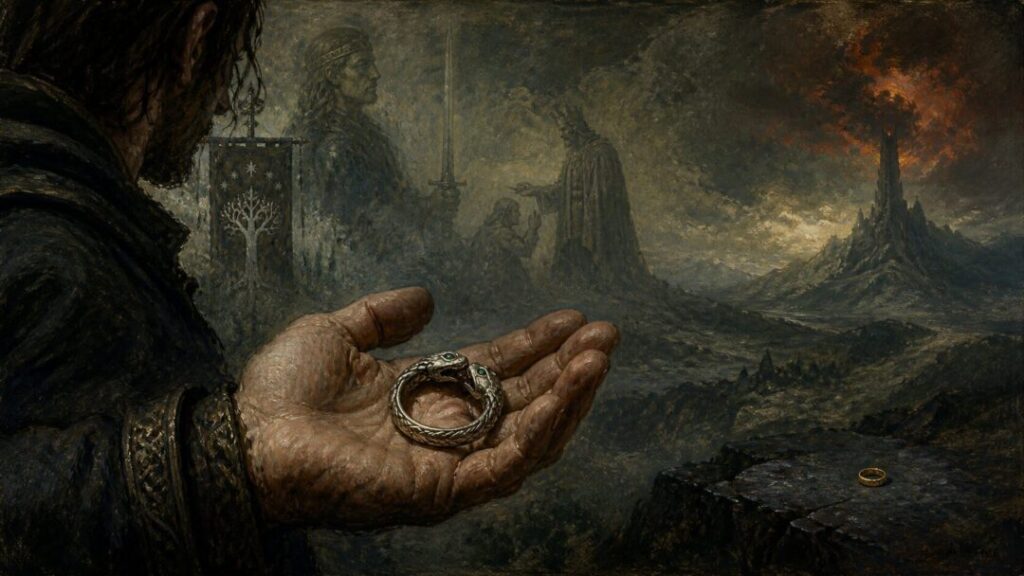
The Ring of Barahir.
This was the ring Aragorn wore as an heirloom of his house. It was ancient, far older than the Rings of Power, and its history reached back into the First Age. It had belonged to Finrod Felagund and was given to Barahir, ancestor of Beren, as a token of friendship and oath.
Through long descent, loss, survival, and inheritance, it eventually became one of the treasures of the Dúnedain.
Aragorn later gave it to Arwen in Lothlórien when they pledged themselves to one another.
Because it is a famous ring, and because Aragorn is so deeply connected with the history of the One Ring, readers sometimes wonder whether the Ring of Barahir was itself a Ring of Power.
It was not.
This is the first important distinction.
The Ring of Barahir was an heirloom, a sign of lineage and oath-bound friendship. It was not one of the Three, the Seven, the Nine, or the One. It was not made under Sauron’s deception in the Second Age. It was not bound to the Ruling Ring. The texts do not describe it as possessing the kind of power associated with the Rings made in Eregion.
So yes, Aragorn certainly had direct contact with a great and ancient ring.
But not with a Ring of Power.
That matters, because the Ring of Barahir represents something almost opposite to the One Ring.
The One Ring is domination.
The Ring of Barahir is memory.
The One Ring bends wills.
The Ring of Barahir preserves a promise.
The One Ring tries to make all things serve one master.
The Ring of Barahir marks an old bond freely given.
Aragorn’s own ring is not a secret weapon. It is a sign that his claim is rooted not merely in blood, but in loyalty, endurance, and the long memory of the West.
What About Arathorn?
Arathorn II, Aragorn’s father, leaves a much smaller footprint in the narrative.
He was Chieftain of the Dúnedain after his father Arador was slain. He married Gilraen. Their son Aragorn was born in T.A. 2931. Two years later, in T.A. 2933, Arathorn was killed while riding against Orcs with Elladan and Elrohir.
After his death, Gilraen brought Aragorn to Rivendell, where Elrond fostered him and concealed his true name and lineage for many years.
That is essentially where Arathorn’s story ends.
There is no textual evidence that Arathorn ever came into direct contact with any Ring of Power.
He did not live to see the One Ring return to the knowledge of the Wise. He died decades before Bilbo’s ring was revealed as the Ruling Ring. Nothing in the known narrative places him in the presence of the One, the Three, the Seven, or the Nine.
Could Arathorn have been near Elrond while Elrond possessed Vilya?
The texts do not say.
That kind of possibility must be treated carefully. The Dúnedain had ties with Rivendell, and Arathorn rode with Elrond’s sons. But Tolkien never states that Arathorn saw, touched, handled, or knowingly encountered Vilya.
So the conservative answer is clear:
Arathorn is not shown to have had direct contact with a Ring of Power.
Anything beyond that would be speculation.
Aragorn and the One Ring
Aragorn’s case is very different.
He absolutely came near the One Ring.
He met Frodo in Bree after Frodo had already carried it from the Shire. He guided the Hobbits through the wild. He defended them at Weathertop after Frodo put on the Ring and was wounded by the Witch-king. He accompanied Frodo to Rivendell. He sat in the Council where the Ring was revealed and its fate debated.
After the Fellowship was formed, Aragorn travelled as one of the Nine Walkers, guarding the Ring-bearer from Rivendell through Moria and into Lothlórien, and then down the Anduin toward Parth Galen.
So if the question is whether Aragorn was ever in the presence of a Ring of Power, the answer is yes.
Unquestionably.
He was in the presence of the One Ring for a long and dangerous part of the story.
But if the question is whether Aragorn ever physically touched, wore, carried, or handled the One Ring, the answer becomes much more restrained.
The texts never clearly show him doing so.
That silence is important.
Frodo carries the Ring. Bilbo carried it before him. Sam briefly bears it in Mordor. Gollum possessed it for centuries. Isildur took it from Sauron’s hand after the Dark Lord’s defeat. Déagol found it. Sméagol murdered for it.
But Aragorn is never added to that list.
He is near it, but he is not its bearer.
He guards the Ring-bearer, but he does not take the burden.
He understands its danger, but he does not make it his tool.
This is not a minor detail. Aragorn’s entire identity is shaped by the shadow of Isildur, the ancestor who took the Ring and did not destroy it. The temptation for Aragorn is not merely personal power. It is ancestral repetition.
He is the heir of the man who failed at the Cracks of Doom.
And yet Aragorn’s role in the story is not to seize the Ring and prove he can master it.
His role is to refuse that pattern.
The Heir of Isildur Does Not Repeat Isildur
One of the quiet strengths of Aragorn’s story is that he is not tested in exactly the same way Isildur was.
Isildur took the Ring after Sauron’s overthrow. He claimed it as weregild for his father and brother. He did not destroy it. That decision allowed the Ring to survive into the Third Age.
Aragorn inherits the consequences of that failure.
He carries the broken sword of Elendil’s house. He bears the burden of a kingdom lost. He lives under a hidden name for much of his early life. His path to kingship passes through exile, patience, and service rather than conquest.
So when the One Ring comes again into the open, Aragorn’s position is perilous.
He has the bloodline.
He has the claim.
He has the need.
No one could argue that Gondor was safe, or that the West had strength to spare. Boromir’s temptation is built on that exact logic: why not use the Enemy’s weapon against him?
Aragorn never takes that road.
He does not demand the Ring from Frodo.
He does not propose that it be brought to Minas Tirith.
He does not claim that the heir of Isildur has some special right to decide its fate.
Instead, he joins the Company as a servant of the Quest.
That is one of the clearest contrasts between Aragorn and the failure of the past. He does not heal Isildur’s mistake by proving that a stronger Man could wield the Ring correctly.
He heals it by refusing the idea that anyone can.
Did Aragorn See the Ring?
Here again, the answer should be phrased carefully.
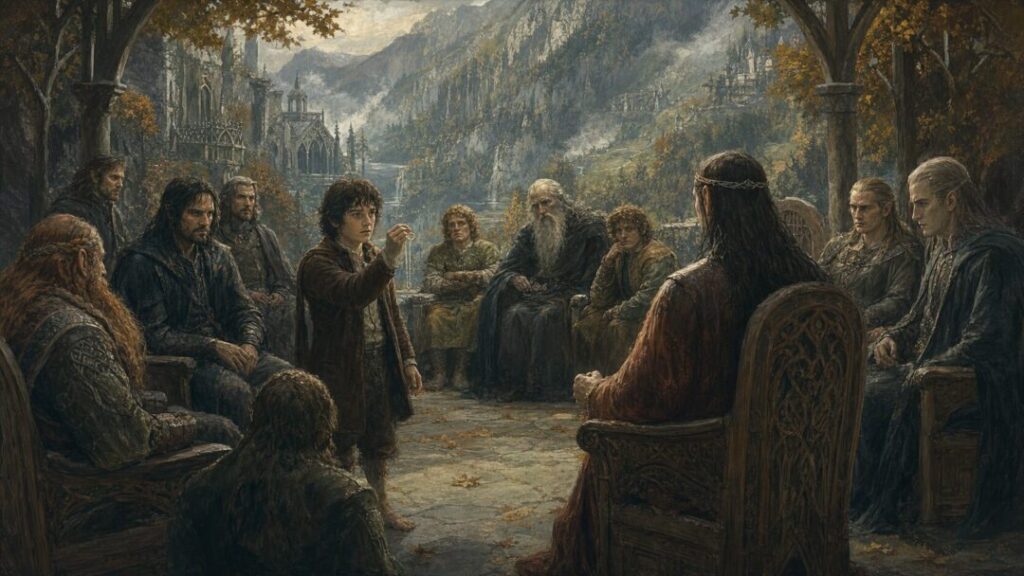
At the Council of Elrond, Frodo reveals the Ring. Aragorn is present. So it is reasonable to say Aragorn was present when the One Ring was shown.
But “seeing” in Tolkien’s world is not always a simple matter.
The Ring is small, plain, and often hidden. Much of its danger lies not in spectacle, but in desire. The text does not need to linger on Aragorn staring at it, because Aragorn’s response is already clear from his actions.
He understands what it is.
He understands what it threatens.
He understands that the path forward is not use, but destruction.
That makes Aragorn very different from those who imagine the Ring primarily as an opportunity.
Boromir sees a weapon.
Sauron sees the recovery of his own power.
Saruman imagines himself as a rival master.
Gollum sees his Precious.
Aragorn sees the shape of a disaster that must not be repeated.
That may be why the story keeps him near the Ring without ever letting him become a Ring-bearer. His greatness is not measured by how close he can come to power while remaining unchanged. No one is truly safe on those terms.
His greatness is measured by the fact that he does not claim closeness as entitlement.
What About the Three Elven Rings?
The next possibility is more subtle.
Aragorn spent much of his youth in Rivendell, and Elrond bore Vilya, one of the Three Rings of the Elves. Aragorn also entered Lothlórien, where Galadriel bore Nenya. Later he travelled and fought alongside Gandalf, who bore Narya.
This means Aragorn spent significant time in the company of all three bearers of the Three.
But this does not prove direct contact with the Rings themselves.
The Three were not displayed openly through most of the Third Age. They were hidden from Sauron, and their bearers used them in secrecy. The texts reveal them fully only at the end, after the destruction of the One Ring has broken their power.
Frodo is shown Nenya by Galadriel, but that scene belongs to Frodo and Sam, not Aragorn. Elrond’s Vilya is revealed openly at the Grey Havens, where Frodo sees it before the ship departs. Aragorn is not part of that final departure scene. Gandalf’s Narya is also revealed in that final context.
So while Aragorn was certainly close to the bearers of the Three, the texts do not clearly state that he touched, handled, or even knowingly saw their Rings.
This is a crucial distinction.
Aragorn lived under the protection of powers greater and older than himself. Rivendell and Lothlórien were preserved in part by the hidden strength of the Three. But Aragorn’s own road does not depend on possessing that power.
He receives counsel from Elrond.
He receives blessing and testing in Lothlórien.
He receives guidance from Gandalf.
But the Rings remain with their appointed bearers.
Aragorn’s kingship is not built on Elven magic.
It is built on endurance, rightful lineage, humility before the Quest, and the willingness to spend himself in service of a hope he may never see fulfilled.
The Strange Importance of Not Touching
The most revealing answer, then, is not simply “yes” or “no.”
Arathorn: no known direct contact.
Aragorn: direct proximity, yes. Confirmed physical contact, no.
That distinction opens the deeper meaning of the story.
Aragorn’s life is surrounded by Rings, but not governed by them.
His ancestor took the One.
His foster-father held one of the Three.
The woman he loved was the granddaughter of Galadriel, bearer of Nenya.
His companion Gandalf bore Narya.
His path to kingship depended on the destruction of Sauron’s Ring.
And yet Aragorn himself is never made a Ring-bearer.
This is not because he is irrelevant to the Ring’s story.
It is because he is essential in another way.
He represents the restoration of Men without the use of the Enemy’s method. He becomes king not by mastering the Ring, but by helping create the conditions in which it can be destroyed.
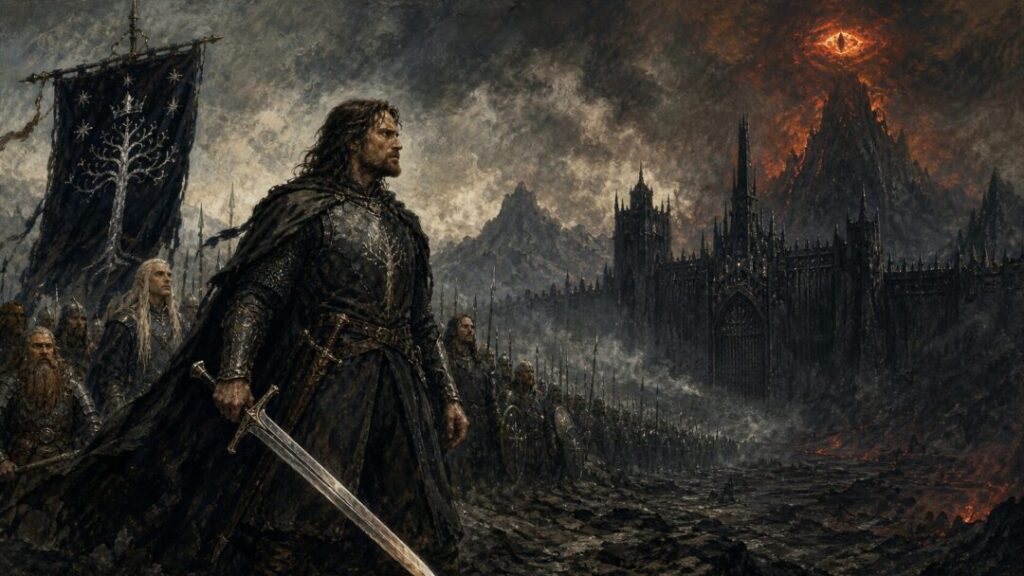
At the Black Gate, Aragorn’s final great act before the Ring’s destruction is not conquest. It is a diversion. He draws Sauron’s eye away from Mordor’s interior, risking everything on the possibility that Frodo and Sam may still succeed.
That is the opposite of Ring-lordship.
The Ring concentrates power inward.
Aragorn spends power outward.
The Ring says: take, possess, command.
Aragorn’s road says: serve, endure, surrender the outcome.
Why This Matters
So did Arathorn or Aragorn ever come into direct contact with a Ring of Power?
For Arathorn, the answer is no evidence.
For Aragorn, the answer depends on what “contact” means.
If it means being near a Ring of Power, then yes. Aragorn was near the One Ring and lived among the bearers of the Three.
If it means touching, wearing, carrying, or handling one, the texts do not show that he ever did.
And that absence feels deliberate.
Aragorn is the heir of the man who took the Ring, but he is not healed by taking it again. He is not a better Isildur because he can wield the Ring wisely. He is a better heir because he refuses the entire logic of possession.
He does not need the One Ring to become king.
In fact, he can only become king in the world that exists after it is destroyed.
That is the quiet answer hidden inside the question.
Aragorn comes close enough to the Rings for the danger to matter.
But he remains just outside their grasp.
And in Middle-earth, that may be one of the clearest signs that he was ready to rule.
Sources & Notes
- J.R.R. Tolkien, The Lord of the Rings, Appendix A, “The Númenórean Kings,” section (v), “Here Follows a Part of the Tale of Aragorn and Arwen” — gives Aragorn’s descent, Arathorn’s death, his fostering by Elrond, and the Ring of Barahir as an heirloom rather than a Ring of Power.
- J.R.R. Tolkien, The Lord of the Rings, Book II, Chapter 2, “The Council of Elrond” — places Aragorn at the council where Frodo’s Ring is identified and the decision is made that it must be destroyed, not used.
- J.R.R. Tolkien, The Lord of the Rings, Book I, Chapter 10, “Strider,” and Book II, Chapter 3, “The Ring Goes South” — show Aragorn guarding and travelling with Frodo as Ring-bearer without becoming the Ring’s bearer himself.
- J.R.R. Tolkien, The Lord of the Rings, Book II, Chapter 7, “The Mirror of Galadriel” — Frodo perceives Nenya on Galadriel’s hand, illustrating how one of the Three could be hidden from others even in Lothlórien.
- J.R.R. Tolkien, The Silmarillion, “Of the Rings of Power and the Third Age” — summarizes the Three, the Seven, the Nine, and the One, and distinguishes the Rings of Power from older heirlooms such as the Ring of Barahir.