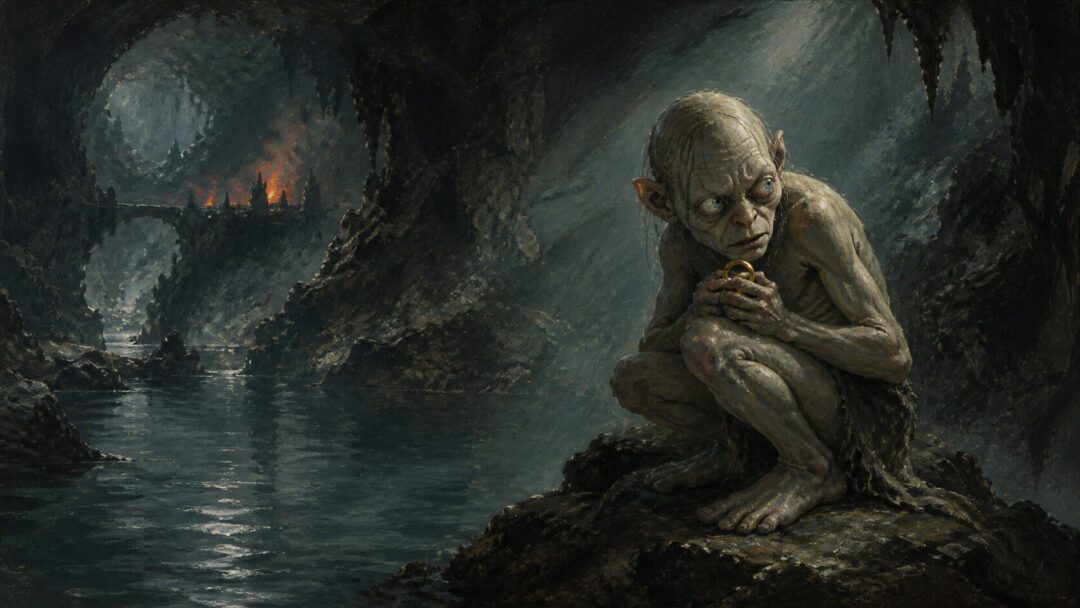
Gollum calls the Ring “my precious” so often that it becomes almost inseparable from him.
He does not speak of it like an object. He speaks of it like a living thing, a secret companion, a wound, a treasure, and a self. Long before Frodo carries it toward Mordor, Gollum has already spent centuries whispering over it in the dark beneath the Misty Mountains.
So the question seems obvious.
If Gollum kept claiming the Ring as his own, why did Sauron not know?
Why did no alarm rise in Barad-dûr? Why did the Eye not turn at once toward the roots of the mountains? Why was Gollum able to keep the One Ring hidden for so long while speaking of it with exactly the kind of possessive hunger the Ring was made to inspire?
The answer is not that Gollum’s claim was harmless.
It was not harmless at all.
But it was not the same kind of claim Frodo makes at Mount Doom.
And that difference is everything.
The Ring Is Not a Simple Signal
A common misunderstanding about the One Ring is that it functions like a beacon.
In that version of the story, whenever someone puts it on, uses it, or claims it, Sauron should instantly know where it is. But the books do not support such a simple rule.
Bilbo uses the Ring many times after finding it. Gollum had used it before him. Frodo uses it more than once before reaching Mordor. These moments are dangerous, but they do not automatically reveal the Ring’s location to Sauron.
The Ring draws attention. It exposes the bearer more deeply to the Unseen. It brings the wearer closer to powers and beings that exist in that hidden realm. The Ringwraiths, especially, are able to perceive more than ordinary creatures can.
But the Ring is not presented as a device that sends Sauron a clear message every time someone says, “This is mine.”
That matters because Gollum’s possession of the Ring is private, hidden, and ignorant.
He does not know what he has.
He does not understand Sauron.
He does not attempt to rule through the Ring.
He clings to it.
And clinging is not the same as mastery.
Gollum’s “My Precious” Is Possession, Not Dominion
Gollum’s claim over the Ring is intense, but it is also small.
That word is not meant as an insult. It is the tragedy of him.
Gollum does not imagine himself as a Dark Lord. He does not dream of commanding armies, overthrowing kingdoms, or bending the wills of Elves and Men. His desires are narrow and secretive. He wants the Ring because it is his. Because he lost himself to it. Because after centuries in the dark, he can hardly separate the Ring from his own identity.
He calls it precious because it has become the center of his life.
But this is not a conscious attempt to use the Ring according to its highest purpose.
The One Ring was made to dominate the bearers of the other Rings and to extend Sauron’s will. Its deepest power concerns rule, mastery, and control. Gollum’s possessiveness is real, but he is not wielding that power in any meaningful way.
He is being possessed as much as possessing.
That is why his language alone does not trigger the moment we later see in Mordor. Gollum can say “mine” endlessly, but the word is the cry of an addict, not the declaration of a rival power.
Sauron Did Not Know Where the Ring Was
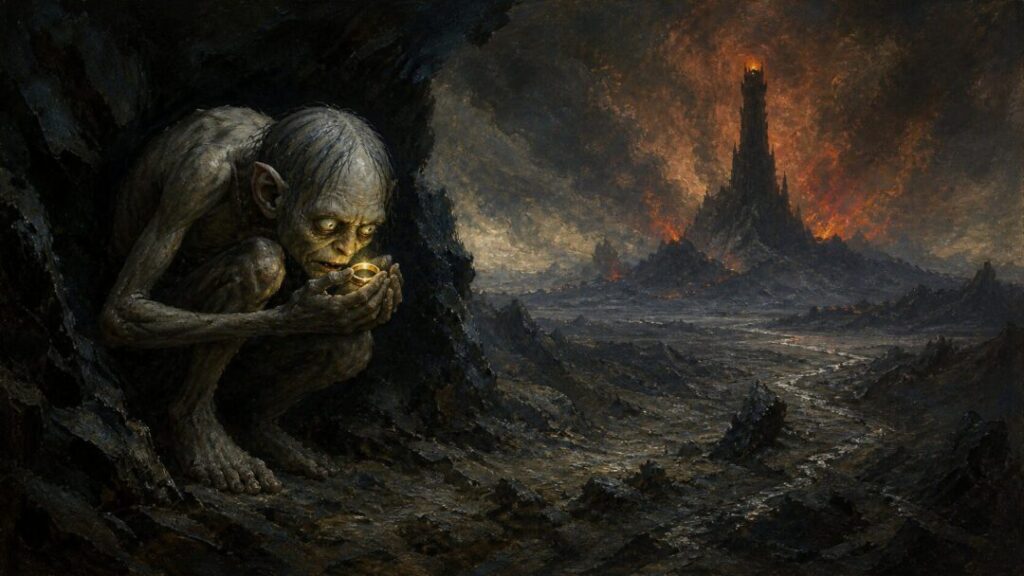
By the time of the War of the Ring, Sauron desperately wants the Ring back.
But for a long time, he does not know where it is.
This is crucial. Sauron eventually learns important clues from Gollum, but only after Gollum is captured and questioned in Mordor. The information that matters is not “Gollum called it his own.” It is that the Ring had been taken by someone named Baggins, from a place called the Shire.
Even then, Sauron does not possess perfect knowledge.
He has clues. He has servants. He sends the Ringwraiths to search. But he is still operating through investigation, pursuit, fear, and deduction.
That alone proves the Ring was not constantly reporting its position to him.
If Sauron could simply feel where the Ring was whenever its bearer desired it, the hunt would have been very different. There would have been no need to extract names from Gollum. No need to search for the Shire. No need for the Black Riders to question, threaten, and hunt across Eriador.
The story shows something far more frightening than a magical tracking device.
It shows a Dark Lord powerful enough to corrupt, perceive, and dominate, yet still limited by ignorance, pride, and incomplete information.
Why Frodo’s Claim Was Different
The key comparison is Frodo at Mount Doom.
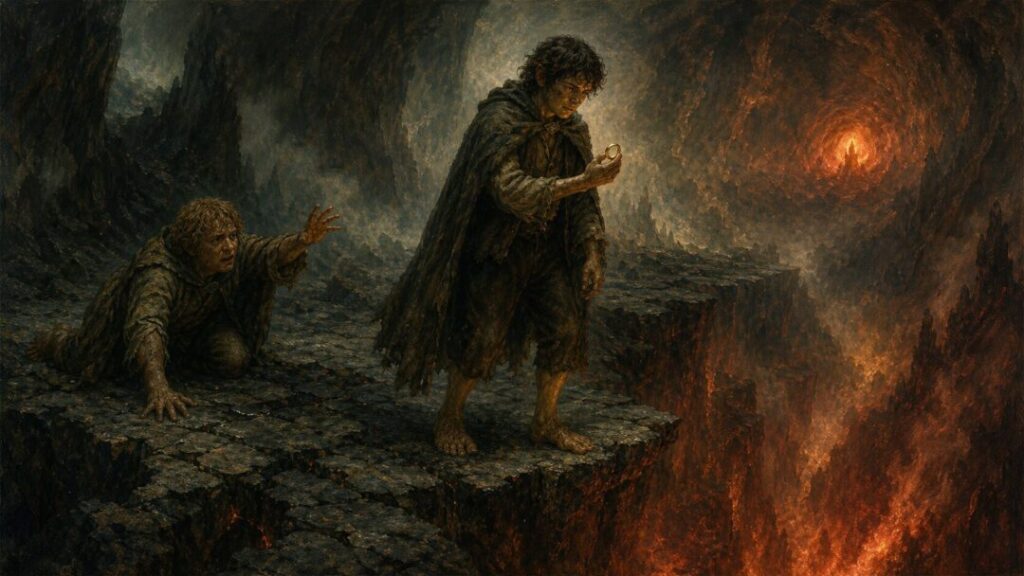
At the end of the Quest, Frodo stands inside Sammath Naur, the Chambers of Fire, where the Ring was forged. There, at the edge of destruction, he finally fails to give it up.
He says he will not do what he came to do.
He claims the Ring for his own.
Then he puts it on.
This is not just another moment of temptation. It happens in the place where the Ring’s power is most intimately rooted. The Ring is at the Fire where it was made, in the heart of Sauron’s own realm, at the one location where it can be unmade.
That is why Sauron’s realization comes like a catastrophe.
The texts present the moment as sudden, devastating, and complete. Sauron becomes aware not merely that someone somewhere wants the Ring, but that the Ring is in the one place he never imagined his enemies would take it.
His failure is not that he had ignored a signal for centuries.
His failure is that he never truly believed anyone would try to destroy the Ring.
The Place Matters
This is one of the most important details.
Gollum in the Misty Mountains is far from Mordor, hidden under stone, using the Ring for petty survival and secret murder. Bilbo later carries it in ignorance. Frodo carries it unwillingly and mostly resists using it.
But Frodo’s final claim happens in Sammath Naur.
That location changes the meaning of everything.
The Ring is not merely being worn. It is being claimed at the place of its making, in the land of its maker, at the brink of its destruction. Sauron’s attention is suddenly drawn because the impossible truth is revealed: his enemies have brought the Ring not to wield it against him, but to the only place where it can be destroyed.
Gollum’s centuries of possessive speech never placed Sauron in that danger.
Frodo’s single act did.
That is why the same basic word — mine — can mean two very different things depending on who says it, where they say it, and what is happening around it.
Amon Hen Shows the Danger Without Making It Absolute
There is another important moment before Mordor.
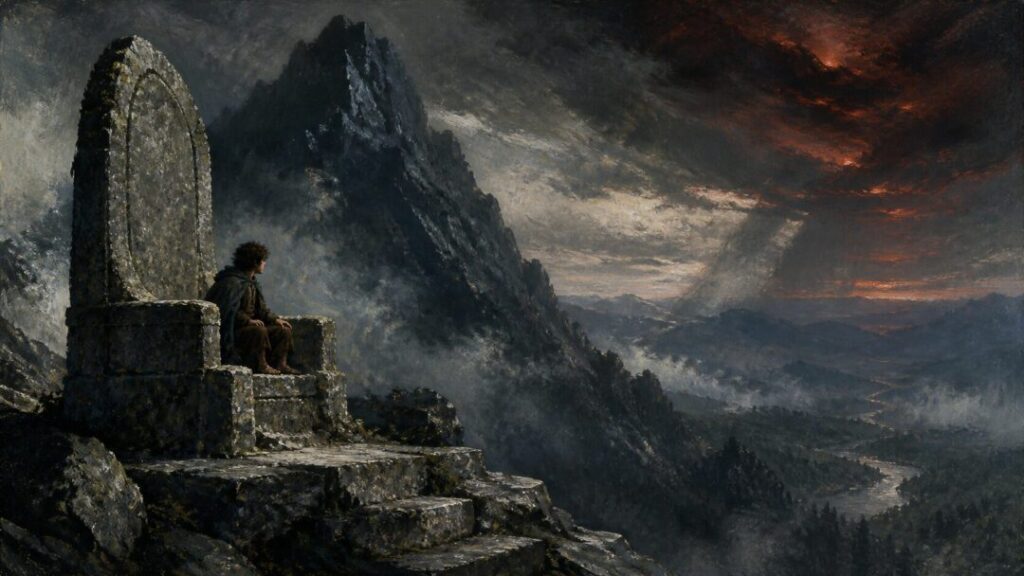
At Amon Hen, Frodo puts on the Ring and sits upon the Seat of Seeing. He perceives far-off places, and eventually his awareness is drawn toward Mordor. There, the Eye begins searching for him.
This moment shows that wearing the Ring can become spiritually and mentally dangerous in a very direct way.
But it also shows that perception is not automatic or simple.
Frodo is not instantly seized the moment the Ring touches his finger. The danger grows through circumstance: the Ring, the Seat, Frodo’s own fear, and the searching will of Sauron. Gandalf’s opposing will also plays a role in the struggle, helping Frodo escape that terrible attention.
So even here, the pattern holds.
The Ring exposes.
It tempts.
It draws the bearer toward powers that can perceive and command.
But it does not behave like a bell that rings in Barad-dûr every time someone claims ownership.
Gollum Was Useful to the Ring
There is also a darker possibility, though it must be phrased carefully.
The texts do not state that the Ring consciously “planned” in a human sense. But they do suggest that the Ring can abandon a bearer when it serves its return to its master. Gandalf says the Ring left Gollum, and that this was the strangest event in its history up to that point.
From that, it is fair to say the Ring’s movement is not random in the ordinary sense.
Yet Gollum’s long possession did not bring it closer to Sauron. In fact, it kept the Ring hidden. That seems like a failure from the Ring’s point of view.
But Gollum also became part of the chain of events by which the Ring was finally found, hunted, and carried into the wider world again. The full meaning of his role only becomes clear at the end, when his obsession brings him to Mount Doom.
This does not mean Gollum was secretly serving the good.
He was not.
Nor does it mean the Ring intended its own destruction.
That would go beyond what the text supports.
But the story does show that Gollum’s possessiveness, misery, and pursuit become essential to the Ring’s fate. He is not an accident outside the story’s moral design. He is one of its sharpest instruments.
Sauron’s Blind Spot
Sauron’s greatest weakness is not lack of power.
It is imagination.
He understands domination because domination is what he desires. He understands fear, ambition, conquest, secrecy, and the hunger to possess. What he does not understand is the willingness to destroy power rather than use it.
This is why the Quest can succeed at all.
Sauron assumes that anyone who truly understands the Ring will want to wield it. He fears a rival Ring-lord. He watches the strong. He is drawn to Aragorn when Aragorn reveals himself through the palantír. He prepares for war because war is the language he understands.
The idea that two small Hobbits would carry the Ring into Mordor in order to unmake it does not fit the shape of his mind.
Gollum saying “my precious” would not challenge that worldview.
It would confirm it.
Of course creatures want the Ring. Of course they cling to it. Of course they cannot let it go.
That is exactly what Sauron expects.
What he does not expect is mercy, endurance, pity, and the long road into the Fire.
Gollum Did Not Alert Sauron Because He Was Already Defeated by the Ring
In the end, Gollum’s claim does not alert Sauron because it is not a true act of mastery.
It is captivity.
Gollum calls the Ring his own, but the words are hollow in the deepest sense. He does not command it. He does not understand it. He does not rise through it into power. He shrinks around it until almost nothing remains of Sméagol except hunger, memory, and need.
That is the horror of Gollum.
He says “my precious” as if he owns the Ring.
But the story shows the opposite.
The Ring owns him.
Frodo’s claim at Mount Doom is different because it happens at the center of the Ring’s power, at the crisis of the Quest, when the Ring is no longer merely being hidden, carried, or coveted. It is being claimed in the place where it can either return to the world in terror or be destroyed forever.
That is the moment Sauron sees.
Not because the word “mine” has magical force by itself.
But because, at last, the Ring is revealed where Sauron never believed it could be.
Gollum’s “my precious” was the sound of a creature lost in the dark.
Frodo’s claim was the sound of the Dark Lord’s entire design breaking open.
And by the time Sauron understood the difference, it was already too late.
Sources & Notes
- J.R.R. Tolkien, The Fellowship of the Ring, Book I, Chapter 2, “The Shadow of the Past” — Gandalf explains that the Ring left Gollum and was trying to return to its master, while Gollum himself did not understand what he had.
- J.R.R. Tolkien, The Fellowship of the Ring, Book II, Chapter 2, “The Council of Elrond” — Gollum’s capture reveals “Shire” and “Baggins,” showing Sauron needed interrogation and search rather than receiving the Ring’s location automatically.
- J.R.R. Tolkien, The Fellowship of the Ring, Book II, Chapter 10, “The Breaking of the Fellowship” — Frodo’s vision on Amon Hen shows the Eye searching and the Ring’s peril without making detection instantaneous or mechanical.
- J.R.R. Tolkien, The Return of the King, Book VI, Chapter 3, “Mount Doom” — Frodo claims the Ring in Sammath Naur, and Sauron suddenly understands the danger at the place where the Ring was forged and can be destroyed.
- J.R.R. Tolkien, The Letters of J.R.R. Tolkien, Letter 131 — Tolkien describes Sauron’s will to dominate and possess, which supports the article’s point about his blind spot toward renouncing or destroying power.