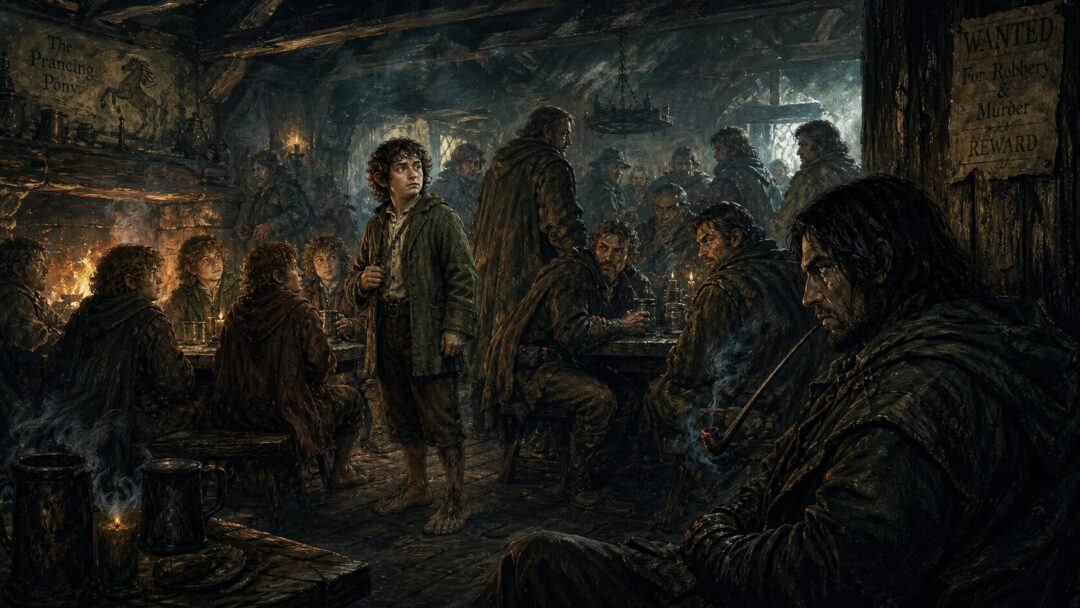
When Frodo Baggins reaches Bree, he believes he is still hidden.
He is no longer traveling as Frodo Baggins of Bag End. He is “Mr. Underhill,” a harmless-sounding Hobbit from nowhere in particular. The name is small, ordinary, and easy to overlook. That is the point.
But the Prancing Pony is not as safe as it first appears.
The inn is crowded. News travels quickly there. Men from the South are present. Local Hobbits are curious. Pippin is too talkative. Merry is outside in the dark. Gandalf is missing. And somewhere nearby, the Black Riders are still searching for “Baggins.”
Then Frodo notices a weather-beaten Man sitting in the shadows.
He is called Strider.
And before long, it becomes clear that this stranger knows more than he should.
He knows Frodo is not merely “Mr. Underhill.”
He knows the Hobbits are in danger.
He knows Gandalf is involved.
And after Frodo vanishes in front of the whole common-room, he understands that the danger has become immediate.
So how did Strider know Frodo’s real identity?
The answer is not that he magically guessed it.
The answer is that Strider was already part of the story long before Frodo entered the inn.
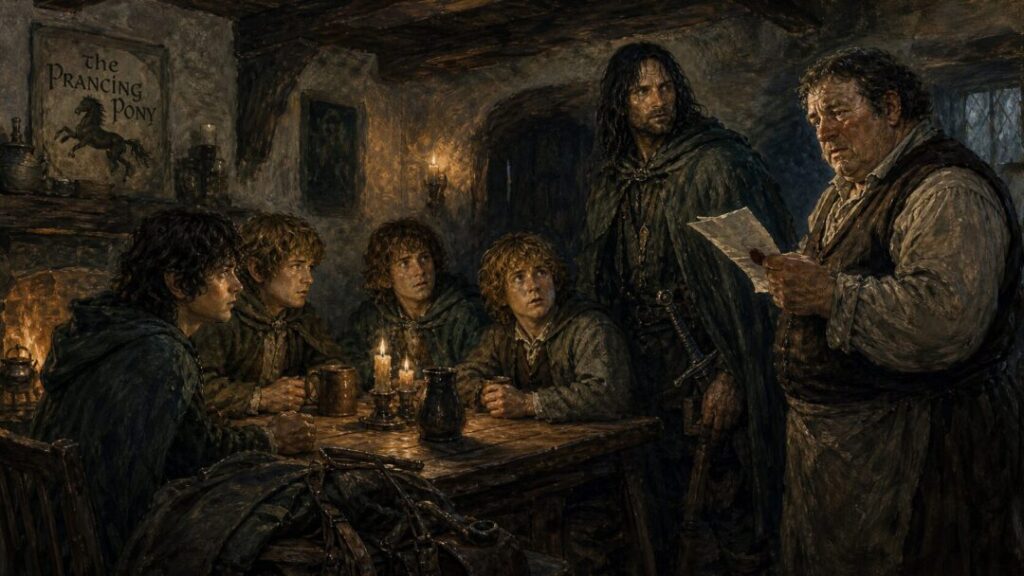
Frodo’s Disguise Was Never Meant to Fool Everyone
The name “Underhill” was not a random invention made at Bree.
Frodo had been warned to travel under another name because the name Baggins had become dangerous. By the time he leaves the Shire, Sauron has already learned two pieces of information from Gollum: “Shire” and “Baggins.”
That is why Frodo’s real name matters so much.
To the ordinary people in Bree, “Baggins” might mean little or nothing. But to the Black Riders, it is the name attached to the Ring’s trail. It is the clue that has drawn them westward. If that name is spoken in the wrong place, at the wrong time, it can become almost a summons.
So Frodo’s disguise has a practical purpose.
It is not meant to deceive Gandalf’s friends.
It is meant to keep strangers from connecting him with the name the Enemy is hunting.
This distinction is important.
Strider did not have to be fooled by the name “Underhill.” In fact, for the plan to work, he needed to know that Underhill was Baggins.
The disguise was for enemies and careless listeners, not for the people trying to keep Frodo alive.
Gandalf Had Already Prepared the Way
The clearest reason Strider knew about Frodo is Gandalf.
Before Frodo reached Bree, Gandalf had already come to the Prancing Pony. He was in haste and deeply concerned. He wrote a letter for Frodo and left it with Barliman Butterbur, instructing him to send it to the Shire.
That letter is crucial.
In it, Gandalf warns Frodo to leave Bag End soon and make for Rivendell. He tells him that he may meet a friend on the Road: a Man called Strider. Gandalf describes Strider and says plainly that he knows their business and will help.
This means Strider was not simply a suspicious stranger who happened to be in the right inn.
He was already known to Gandalf.
He already knew enough about the danger to help.
And Gandalf intended Frodo to recognize him as an ally.
But the letter never reached Frodo in time.
Butterbur forgot to send it. This failure nearly ruins the plan. Frodo arrives in Bree expecting Gandalf, not Strider. He has no reason to trust the dark Ranger in the corner, and that uncertainty makes the scene far more tense.
From Strider’s side, however, the situation is different.
He knows Gandalf’s business.
He knows a Hobbit connected to that business may come through Bree.
And he knows that the name Baggins must be treated with care.
So when a party of Shire Hobbits arrives under the name Underhill, Strider is not beginning from ignorance.
He is watching for exactly this kind of sign.
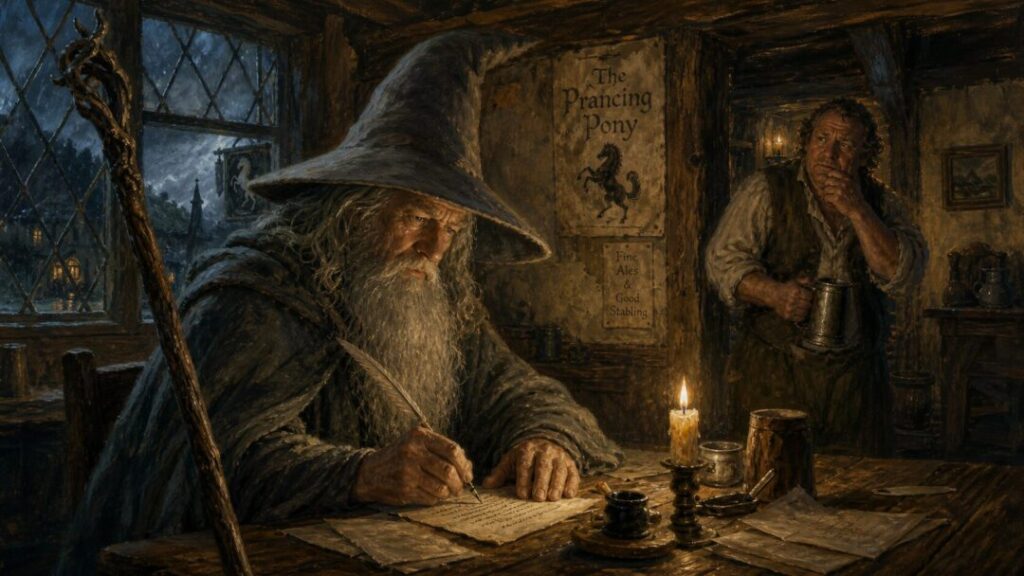
Butterbur Was Told More Than He Remembered
Gandalf did not only write the letter.
He also spoke to Butterbur.
The innkeeper was told to expect a Hobbit using the name Underhill, whose real name was Baggins. This matters because it shows that Frodo’s alias was part of a shared arrangement. Gandalf was not relying on chance. He left instructions in Bree for the very situation that later unfolded.
Butterbur, however, is not an ideal guardian of secrets.
He is kind-hearted and well-meaning, but forgetful and overwhelmed. He forgets the letter. He delays. He becomes confused at exactly the moment clarity is needed most.
This is one of the quiet dangers of the Bree chapters.
The fate of the Ring briefly depends on an innkeeper remembering a message.
That sounds almost absurd, but it fits the moral texture of the story. Great events often turn on small acts of faithfulness, forgetfulness, courage, or failure. Butterbur does not betray Frodo. He simply fails to do what he promised.
And that failure leaves Frodo exposed.
Without the letter, Frodo has no written proof that Strider is Gandalf’s friend. Without Gandalf present, the Hobbits must decide whether to trust a grim-looking Ranger they do not understand.
Strider knows more than Frodo because Gandalf prepared him.
Frodo knows less than he should because the message meant for him never arrived.
Strider Was Listening Before He Spoke
At the Prancing Pony, Strider does not rush forward immediately.
He watches.
This is not cowardice or theatrical mystery. It is caution. The common-room is full of unknown people, and Frodo’s party is already drawing attention. A Ranger revealing too much too quickly could make matters worse.
Strider sees the danger before the Hobbits do.
Pippin begins telling stories too freely. He comes dangerously close to speaking about Bilbo’s farewell party, and therefore about matters connected to the Ring. Frodo tries to distract the room with a song. Then he slips, falls, and the Ring goes onto his finger.
The text leaves room for the Ring’s own influence here. Frodo does not deliberately put it on in order to vanish. The event is strange, sudden, and disastrous. What matters is the result: the entire room sees a Hobbit disappear.
For most of the guests, this is shocking or ridiculous.
For Strider, it is much worse.
He knows enough to understand that Frodo has just revealed himself in a way that cannot be undone. Even if the crowd does not understand what it witnessed, rumors will spread. Questions will be asked. And if servants of the Enemy hear of a vanishing Hobbit named Underhill, the disguise will no longer protect him.
This is why Strider’s warning afterward feels so sharp.
Frodo has not merely embarrassed himself.
He has stepped into the open.
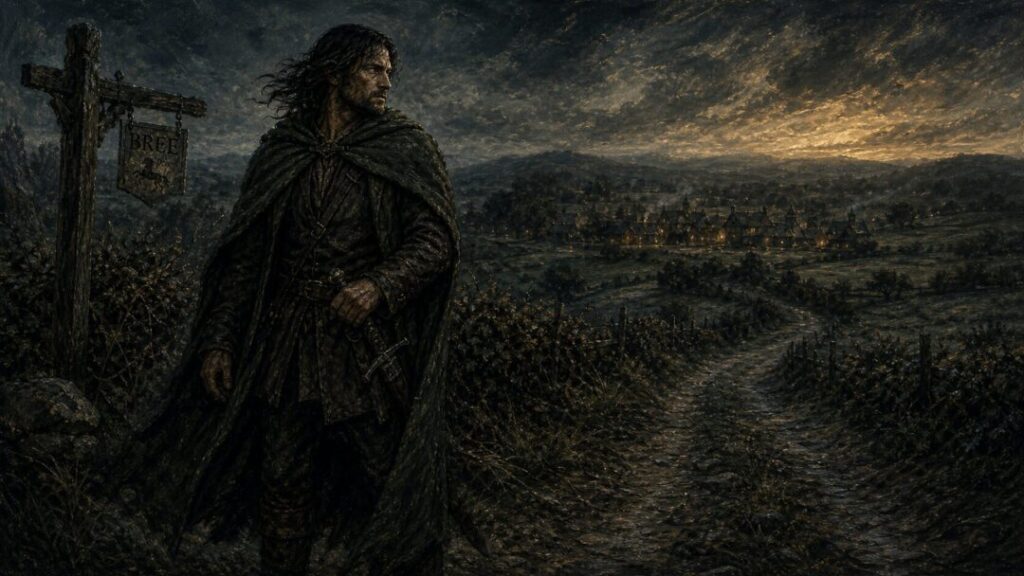
Strider Knew the Larger Danger Around “Baggins”
Strider’s knowledge also reaches beyond Bree.
He is not only a friend of Gandalf. He is Aragorn, one of the Dúnedain of the North, and his people have long guarded lands that rarely thanked or recognized them. The Shire itself survives in part because dangers are kept away by people its inhabitants scarcely know exist.
The texts do not require us to imagine that Aragorn knew every detail of Frodo’s daily life before Bree. That would go beyond what is stated.
But they do show that Aragorn was already deeply involved in Gandalf’s struggle against Sauron’s search for the Ring. He had helped Gandalf in the hunt for Gollum. He knew that Gollum had possessed dangerous knowledge. He knew that the Enemy’s attention had turned toward the name Baggins and the Shire.
So when Frodo appears in Bree, Strider’s concern is not based on one clue alone.
It is based on a pattern.
A Hobbit from the Shire.
A false name prepared by Gandalf.
A delayed journey.
Black Riders on the roads.
A vanishing trick connected to a ring.
And a name the Enemy is hunting.
Strider does not need omniscience.
He has enough pieces to recognize the danger.
Why Frodo Was Right to Be Suspicious
It is easy, after knowing who Strider really is, to wonder why Frodo hesitates.
But Frodo’s caution is justified.
Gandalf is missing. The letter has not arrived. The Riders are near. Frodo has already learned that appearances can be deceptive. A grim Man in a corner who seems to know his secret is not automatically comforting.
In fact, from Frodo’s limited point of view, Strider is deeply alarming.
He knows too much.
He asks for a private conversation.
He speaks as though he has been watching them.
He admits he has been looking for Frodo.
That is exactly the sort of thing an enemy might say.
This is why Gandalf’s letter becomes so important once Butterbur finally produces it. The letter does not merely explain Strider. It gives Frodo a way to test him.
Gandalf includes the verse beginning “All that is gold does not glitter,” and identifies Strider’s true name as Aragorn. Strider then confirms the connection by revealing the broken sword and accepting the identity hidden behind his rough appearance.
The scene turns on recognition.
Frodo must learn that the dangerous-looking stranger is actually the ally Gandalf meant him to find.
And Strider must persuade Frodo without forcing him.
The Riddle Reveals More Than a Name
The verse in Gandalf’s letter does more than prove that Strider is trustworthy.
It reframes him.
Until this point, Strider appears to be only a wandering Ranger. Suspicious, weathered, and perhaps useful, but not obviously noble. The riddle reveals that there is more beneath the surface.
“All that is gold does not glitter” is not just a poetic flourish.
It is a warning against judging by outward appearance.
The same principle applies to Frodo in reverse. Frodo appears to be a small Hobbit traveling under a false name, but he carries a burden that great lords would fear to touch. Strider appears to be a rough wanderer, but he is heir to a far greater history than the people of Bree imagine.
In that room, both identities are hidden.
Frodo is more than Underhill.
Strider is more than Strider.
And Gandalf’s letter is the bridge that allows both truths to be spoken safely.
The Meeting Was Planned, But Still Nearly Failed
One of the most striking things about the Prancing Pony episode is how fragile it is.
Gandalf planned for Frodo to go to Rivendell.
He prepared a warning.
He identified Strider as a helper.
He trusted Butterbur to send the message.
And still, almost everything goes wrong.
The letter is delayed. Frodo leaves the Shire later than Gandalf wished. The Black Riders reach Bree. The Hobbits attract attention. Frodo accidentally reveals the Ring’s power in public. Merry encounters danger outside. The inn itself becomes unsafe.
Strider’s presence is the one part of the plan that still holds.
He is there when Gandalf is not.
He recognizes the danger when Butterbur is confused.
He acts when the Hobbits are exposed.
That is why the answer to the original question matters.
Strider knew Frodo’s real identity because Gandalf had trusted him with the secret. But he also knew what that secret meant. He understood that “Frodo Baggins” was no longer just a Hobbit’s name. It was a trail the Enemy was following.
To know Frodo’s identity was to know the stakes.
Why This Scene Changes Aragorn’s Role
The Prancing Pony is the first time Frodo meets Strider, but it is not the beginning of Strider’s service.
That is the hidden weight of the scene.
Aragorn enters the story as though he has stepped out of nowhere, but he has not. He belongs to the long, unseen labor that has kept the North from falling into greater darkness. He is one of those who guard roads other people travel without fear, and borders other people do not know are defended.
This is why his knowledge feels unsettling at first.
He has been living in the hidden layer of Middle-earth.
Frodo has only just entered it.
To the Hobbits, Bree is a strange town on the edge of the familiar world. To Strider, it is a dangerous crossing point in a much larger war. He sees what they cannot yet see. He understands that their journey is not merely a flight from the Shire, but part of a struggle already moving around them.
That difference in vision is what makes him necessary.
Frodo has courage.
Sam has loyalty.
Merry and Pippin have heart.
But at Bree, they need someone who knows the roads, the Enemy’s reach, and the cost of being careless.
They need Strider before they understand why.
The Real Answer
So how did Strider know Frodo’s real identity?
Because Gandalf told him enough to recognize him.
Because Butterbur had been instructed to expect “Underhill,” though he failed to deliver the warning in time.
Because Aragorn was already involved in the hidden struggle surrounding the Ring.
Because “Baggins” was not just a family name anymore, but a dangerous clue known to the Enemy.
And because Strider was watching carefully in a place where Frodo could not afford to be seen.
The scene works because both sides are partly in the dark.
Frodo does not know whether Strider can be trusted.
Strider does not know exactly how much Frodo understands.
Butterbur does not realize how badly his forgetfulness has endangered them.
And the guests in the common-room do not understand what they have witnessed when Frodo vanishes.
But Strider understands enough.
That is why he feels so dangerous before he feels reassuring.
He is not a random stranger who guesses Frodo’s secret. He is the hidden answer to a plan that almost failed.
And that makes the Prancing Pony far more than a meeting place.
It is the moment when Frodo’s small disguise breaks, the Enemy’s shadow draws nearer, and the last unknown guardian of the road finally steps out of the dark.
Sources & Notes
- J.R.R. Tolkien, The Lord of the Rings, Book I, Chapter 9, “At the Sign of the Prancing Pony” — Frodo travels in Bree as Mr. Underhill and accidentally vanishes before the common-room.
- J.R.R. Tolkien, The Lord of the Rings, Book I, Chapter 10, “Strider” — Gandalf’s delayed letter names Strider as a friend, links Underhill with Frodo Baggins, and gives the Aragorn verse as proof.
- J.R.R. Tolkien, The Lord of the Rings, Book I, Chapter 11, “A Knife in the Dark” — Strider responds to the danger after Bree and explains how quickly news of the vanishing Hobbit can serve the Riders.
- J.R.R. Tolkien, The Lord of the Rings, Book I, Chapter 2, “The Shadow of the Past” — Gollum has revealed “Shire” and “Baggins,” making Frodo’s real name dangerous before he reaches Bree.
- J.R.R. Tolkien, The Lord of the Rings, Book II, Chapter 2, “The Council of Elrond” — Aragorn’s earlier hunt for Gollum shows he was already involved in Gandalf’s wider Ring business before meeting Frodo.