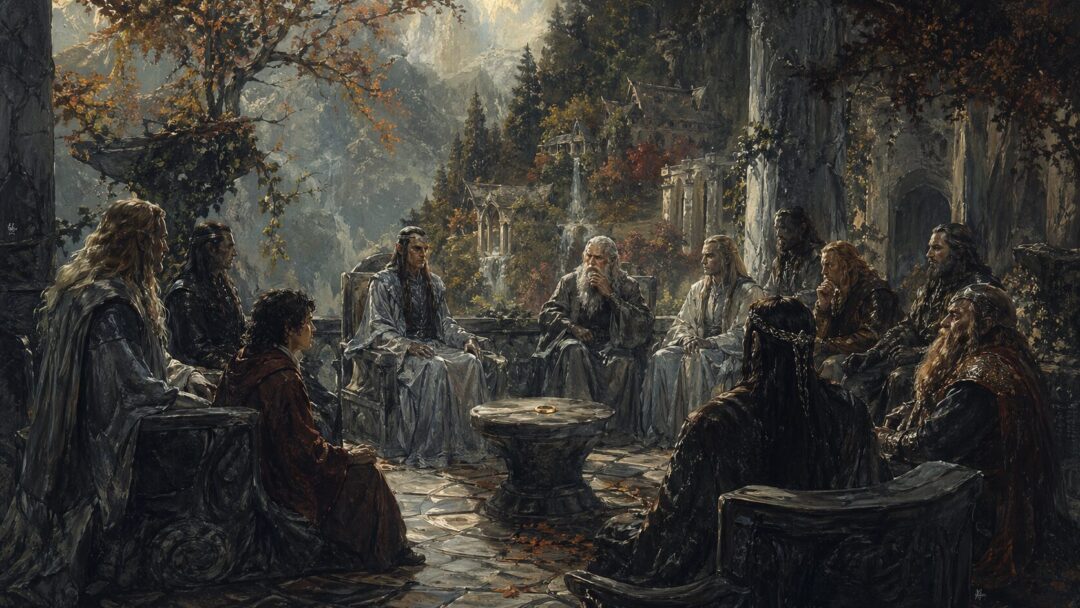
When readers ask how Gandalf intended Frodo to destroy the Ring, the obvious answer seems almost too obvious.
He meant for Frodo to carry it into Mordor, reach the Crack of Doom, and throw it into the fire.
That is certainly the outward plan.
But once the question is asked carefully, something unsettling appears inside it.
Because Gandalf knows what the Ring is.
He knows it does not merely tempt. It overmasters. He knows it corrupts the weak, the noble, and the wise alike. At the Council of Elrond, the Ring is rejected not only as evil, but as something that cannot be wielded safely even for a righteous end. The road to Mount Doom is chosen because the Ring can be destroyed nowhere else, not because anyone speaks confidently about the final act itself.
And that difference matters.
The text gives us a destination with certainty.
It does not give us a simple method.
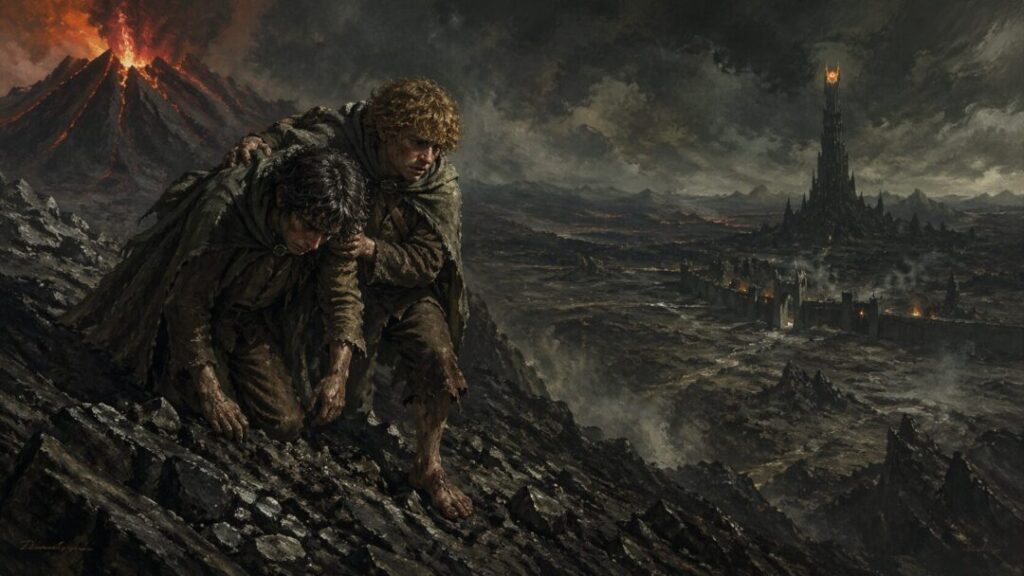
The Council Chose the Only Road, Not an Easy One
At Rivendell, the Wise eliminate every alternative.
They do not keep the Ring.
They do not use it.
They do not send it into the West.
They do not trust the sea to hide it.
They do not imagine that someone strong enough could master it without becoming another dark lord in time.
That leaves only one answer: the Ring must go back to the Fire in which it was made.
This is often remembered as a bold plan.
In the chapter itself, it sounds much closer to necessity.
The Quest exists because all other options are worse. Gandalf even argues that the apparent madness of the plan is one of its few advantages. Sauron understands power, possession, and domination. What he does not understand is the possibility that someone who has the Ring would seek to destroy it. That blind spot makes the Quest conceivable at all.
But that still does not tell us how Gandalf imagined the end.
It only tells us why the journey had to begin.
Gandalf Never Promises That Frodo Will Be Able to Let It Go
This is the point many summaries flatten.
The Council resolves where the Ring must be taken. It does not contain a speech in which Gandalf explains how Frodo will stand over the Fire and defeat the Ring by an act of pure will. Frodo volunteers to take the Ring, but even in that moment he says he does not know the way. The emphasis is on burden, service, and acceptance of the task, not mastery of the final temptation.
That silence becomes more striking the farther the story goes.
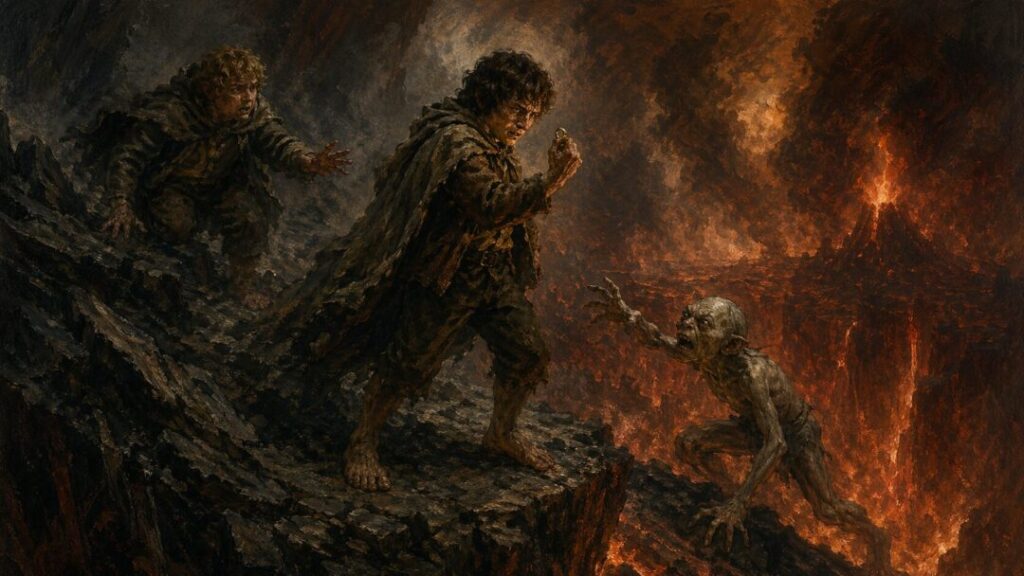
As Frodo approaches Mordor, the Ring grows heavier, more possessive, more immediate. By the time he reaches Mount Doom, the burden is no longer abstract. It has consumed nearly all his strength. In the chapter “Mount Doom,” Frodo does not cast it away. He claims it. Gollum seizes it, and the Ring is destroyed only when Gollum falls into the Cracks of Doom. In the book, Frodo does not push him. Gollum falls in his own ecstatic triumph.
That ending is not a minor twist.
It is the answer to the question the story has been asking all along.
What Tolkien Later Clarified About Frodo at the End
The clearest explanation comes outside the narrative, in a letter published by the Tolkien Estate.
There, Tolkien says directly that Frodo’s action at Mount Doom was not a simple moral failure. He writes that at the last moment the pressure of the Ring would reach its maximum and be impossible for anyone to resist. He adds that Frodo, after all he had endured, would have been incapable of voluntarily destroying it.
That statement changes the question.
If no one could simply resist the Ring there, then Gandalf cannot reasonably be understood as planning around Frodo’s unaided willpower.
Not because Frodo is weak.
Because the Ring at the place of its making is beyond the strength of any bearer.
Tolkien goes even further. He says Frodo’s true heroism lies in bringing the quest to the utter limit of what was possible for him. Frodo’s achievement is not that he succeeded by sheer internal strength at the final instant. It is that he carried the burden as far as any creature could carry it.
So if that is true, what was Gandalf trusting?
Gandalf’s Hope Was Larger Than Willpower
The story itself points in one direction again and again.
Pity.
Early on, Gandalf rebukes Frodo for speaking too quickly of Gollum’s death. He insists that Bilbo’s pity may yet rule the fate of many. That line can seem merely moral on a first reading. By the end, it turns out to be structural. Gollum remains alive because Bilbo spared him, because Frodo spares him, and because Sam finally spares him on the slopes of Mount Doom. Without that chain of mercy, Gollum is not there at the end. Without Gollum, the Ring is not destroyed in the form the story gives us.
This does not mean Gandalf knew every step in advance.
The texts do not say that.
What they do show is that Gandalf repeatedly acts as though mercy toward Gollum matters beyond present understanding. He does not treat pity as a side virtue. He treats it as part of the deep logic of the Quest.
That is a different kind of strategy.
Not a blueprint.
A moral alignment with how victory can happen in Middle-earth.
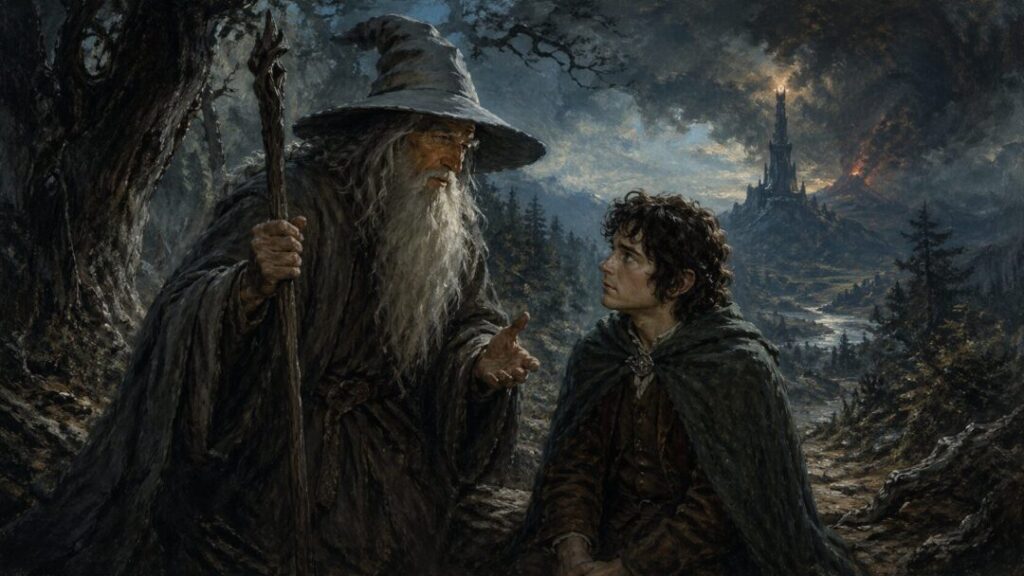
The End Depends on Providence, Not Calculation Alone
Tolkien’s later explanation also introduces another word essential to understanding the ending: providence.
In the same discussion of Frodo’s “failure,” Tolkien says Frodo’s mercy helps create the situation in which the Quest can finally be achieved, and that the outcome involves grace or providential aid beyond the characters’ full control. Frodo is not absolved because the standard became lower. He is upheld because he exhausted his strength in a task whose completion required more than strength.
That matches the tone of Gandalf throughout the book.
He often speaks as though events may be “meant” without becoming predictable. He does not claim to see the whole design. He acts in trust that obedience, pity, and refusal of domination matter even when the path ahead is obscured. The Council’s plan reflects that same pattern. They know what must be done. They do not know how the final success will arrive.
So the most accurate answer is also the least mechanical.
Gandalf intended Frodo to bring the Ring to the Fire.
He did not possess, and likely did not claim to possess, a detailed humanly manageable account of the final act.
Did Gandalf Expect Gollum to Be the Means?
Here the answer must be careful.
The text does not say Gandalf foresaw the exact scene in Sammath Naur. He does not predict that Gollum will bite off Frodo’s finger and tumble into the abyss. Any claim stronger than that would go beyond the evidence.
But the text does support something more precise than mere accident.
Gandalf already believes Gollum has a part yet to play. Tolkien later ties Frodo’s mercy directly to the Ring’s destruction. In that sense, Gollum is not an irrelevant interruption. He is part of the moral architecture of the ending.
Tolkien even speculates in that same later discussion that, under different conditions, a partially redeemed Gollum might have ended by casting himself into the fire voluntarily. That is not what happens in the finished story, so it cannot be treated as canon fact about events. But it does reveal how closely the themes of pity, Gollum, and the Ring’s destruction are linked in Tolkien’s own mind.
The Real Shape of Gandalf’s Plan
So how did Gandalf intend Frodo to destroy the Ring?
Not by simple confidence that Frodo would prove stronger than the Ring at the last possible instant.
Rather, by sending the Ring-bearer to the only place where destruction was possible, under a strategy Sauron could not imagine, while preserving the moral conditions under which the Quest might be completed when strength alone failed.
That includes secrecy.
It includes endurance.
It includes refusal to seize power.
And it includes mercy toward a creature almost everyone else would have killed.
This is why the ending feels both shocking and inevitable.
Frodo does not conquer the Ring in the way heroic fantasy often trains readers to expect. He reaches the appointed place, gives all that can be given, and fails at the exact point where success by mere force of will was never truly possible. Yet the Quest succeeds anyway, not apart from his mercy, but partly because of it.
And that may be the real answer hidden inside Gandalf’s plan.
He did not intend Frodo to win by domination over the Ring.
He intended him to carry it as far as it could be carried, and trusted that power was not the deepest law governing its end.
Sources & Notes
- J.R.R. Tolkien, The Lord of the Rings, Book I, Chapter 2, “The Shadow of the Past” — Gandalf’s warning that Bilbo’s pity may rule many fates establishes Gollum’s future importance.
- J.R.R. Tolkien, The Lord of the Rings, Book II, Chapter 2, “The Council of Elrond” — the Council rejects using or hiding the Ring and chooses the perilous road to Orodruin as the only way to unmake it.
- J.R.R. Tolkien, The Lord of the Rings, Book VI, Chapter 3, “Mount Doom” — Frodo claims the Ring at Sammath Naur, and its destruction comes through Gollum’s seizure and fall.
- J.R.R. Tolkien, The Letters of J.R.R. Tolkien, Letter 246 — Tolkien explains Frodo’s final failure under the Ring’s maximum pressure, and frames the outcome in terms of mercy, grace, and providence.