At first glance, the question sounds almost too easy.
Why would Sauron want mithril?
Because it is rare.
Because it is valuable.
Because dark lords gather powerful things.
That answer feels satisfying for about three seconds.
Then the problem begins.
Middle-earth usually gives us enough structure to understand why something matters. The One Ring has a purpose. The Silmarils have a history. The palantíri have a defined function. Even when the story leaves some edges in shadow, it usually tells us enough to grasp the shape of the thing.
But mithril sits in a more interesting place than that.
It is not merely treasure. It is one of the most extraordinary materials in the legendarium: immensely precious, incredibly strong, light to wear, and important enough to appear in some of the greatest works of Dwarven and Elvish craft. By the later ages, after the loss of Númenor, Khazad-dûm was the only known source left. A single mithril coat was said to be worth more than the Shire.
So when the tradition appears that Sauron was gathering mithril, the point is not simply that he desired wealth.
The point is that he wanted one of the rarest strategic materials in Middle-earth.
And yet the final text does something frustrating.
It never fully tells us why.
Mithril Is More Than Treasure
To understand the question, we have to begin with what mithril actually is in the world of the story.
Mithril is famed for being both beautiful and practical. It is light, supple, and astonishingly strong. That is why Bilbo’s coat of mithril mail can save Frodo’s life again and again, and why Gandalf treats its value as almost beyond reckoning.
But its significance goes beyond armor.
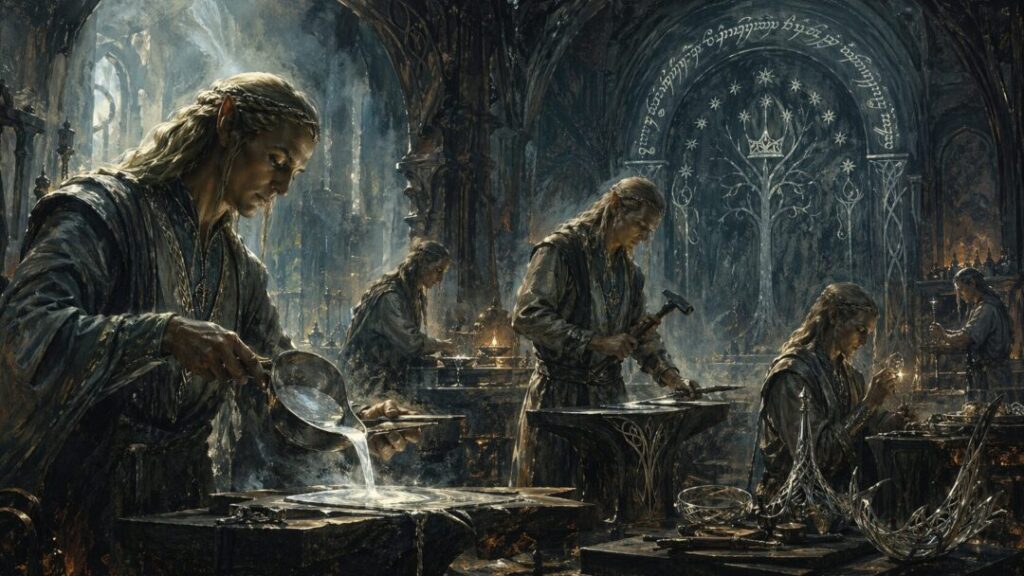
The Elves of Eregion worked mithril into some of their highest craft. Nenya, one of the Three Rings, was made of mithril. Ithildin, the substance used in the moonlit designs and writing on the Doors of Durin, was made from mithril as well. In other words, mithril belongs not only to wealth and warfare, but also to preservation, artistry, secrecy, and refined making.
That is important.
Because Sauron is not merely a conqueror. He is also a maker.
Before he becomes the Dark Lord of the War of the Ring, he is already a being deeply bound up with craft, design, order, and domination through things made. The Rings of Power are the clearest example of this. His evil is not chaotic destruction for its own sake. It is control expressed through skill, structure, and the subordination of other wills.
Once mithril is placed next to that pattern, the question changes.
Sauron does not need mithril merely because it is expensive.
He would need it because it is the kind of material from which enduring power can be embodied.
What the Published Story Actually Says
Here the evidence becomes more careful.
In the published The Lord of the Rings, Gandalf explains the greatness of Moria in terms of mithril. He notes its immense worth and rarity. Tolkien Gateway’s summary, drawing on those passages, also notes that after the Downfall of Númenor and the removal of Aman, Moria became the only source of mithril left in the world.
That alone makes mithril politically important.
Any power in Middle-earth that could control the last meaningful supply of mithril would hold something more than a luxury resource. It would possess a material useful in armor, gates, elite workmanship, and objects of very high craft. The reforged Great Gate of Minas Tirith in the Fourth Age is made of mithril and steel, which shows just how suitable the metal remained for monumental and defensive works.
The story also places mithril close to Sauron in one memorable way.
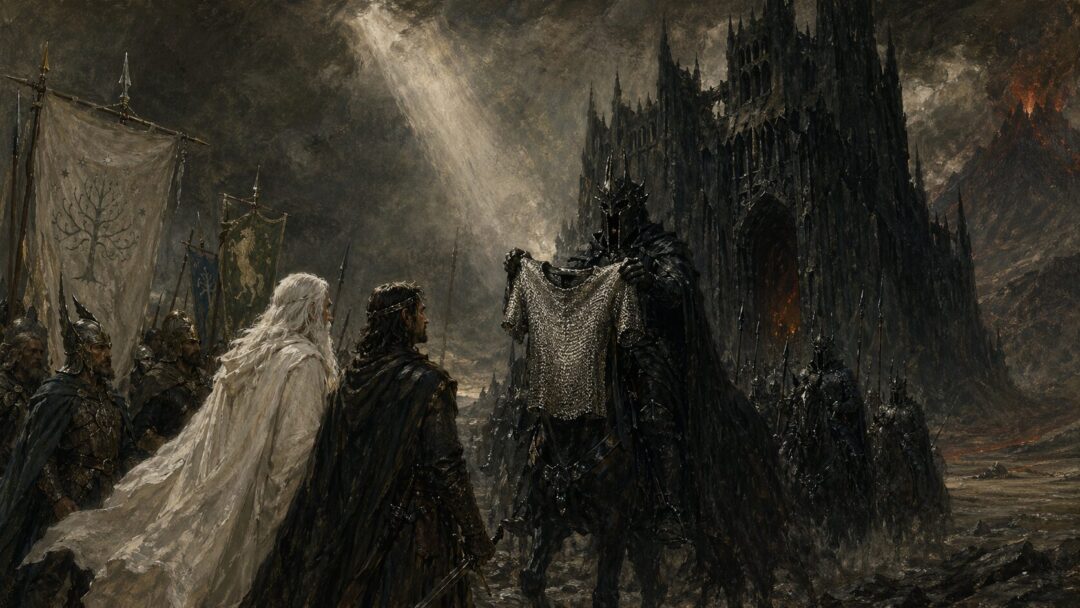
At the Black Gate, the Mouth of Sauron displays Frodo’s mithril coat before the Captains of the West. That scene does not prove any larger plan for mithril, but it does remind us that Sauron’s side recognized the object immediately as a thing of great significance. The coat is not random loot. It is a token of dread precisely because it is rare, recognizable, and bound to a deeper history of power and loss.
Still, none of this answers the central question directly.
The final published narrative does not say, “Sauron wanted mithril in order to do X.”
That absence is real, and it matters.
The One Place the Answer Almost Appears
The nearest thing to an answer comes not in the final narrative, but in an earlier draft.
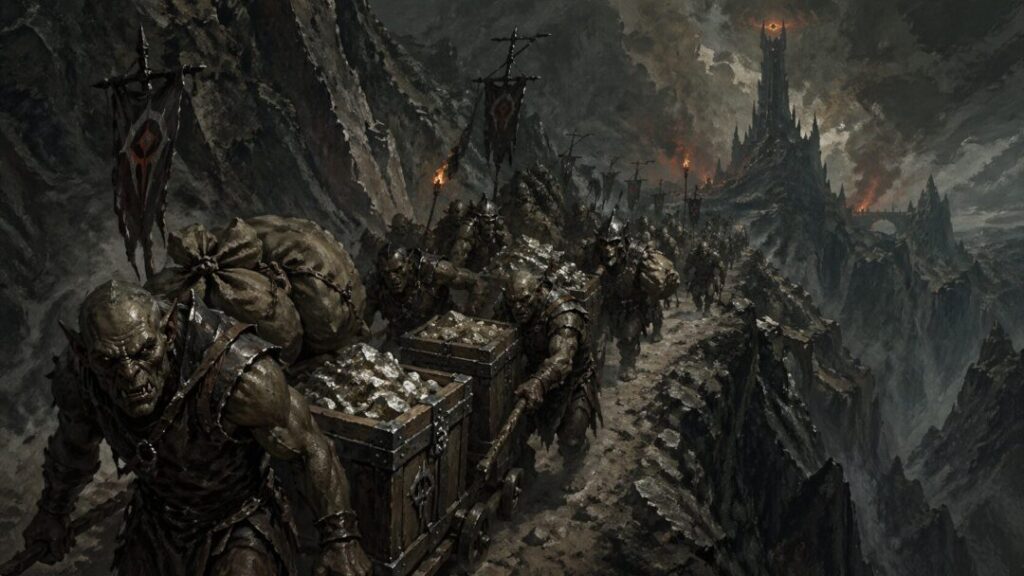
A note preserved in The Treason of Isengard says that Orcs plundered mithril and paid it as tribute to Sauron, who was collecting it “for some secret purpose” and “not for beauty.” A related draft goes slightly further and connects that secret purpose to “the making of weapons of war.”
That is valuable evidence.
But it must be handled carefully.
This is not a settled statement in the final published The Lord of the Rings. It is an earlier textual stage. That means we can use it to illuminate a line of thought, but not to pretend the matter is closed. Under a strict lore standard, the strongest claim we can make is this:
There is direct draft evidence that Sauron gathering mithril was at one point linked to a secret military purpose, likely involving war-making.
And then the final text chooses not to spell that out.
That choice is almost as interesting as the note itself.
Why Mithril Would Matter to Sauron
Even if we stay conservative, the logic inside the world is clear enough.
Mithril is extraordinarily strong and light. It is adaptable to armor. It appears in high Elvish craftsmanship. It can be used in hidden inscriptions and in great architectural works. It is scarce enough to be worth immense wealth and strategically important enough to shape the history of Khazad-dûm.
For Sauron, all of that would be useful.
Not because he has aesthetic taste in the ordinary sense, but because he consistently seeks things that preserve power, embody command, and outlast resistance. He forges the One Ring as an instrument of domination over other makers and bearers. He wages war not only with brute force, but with engines, walls, towers, and systems of control.
So while we should not claim more than the texts allow, the published evidence and draft note align in one direction:
If Sauron wanted mithril, he almost certainly wanted it as a material of power, durability, and war rather than ornament.
That is not fan-fiction.
That is the most cautious reading of the evidence we actually have.
Why the Final Text Leaves the Question Open
This is where the question becomes literary rather than merely factual.
Why leave the matter unresolved?
Part of the answer may be simple restraint. Middle-earth does not explain every logistical intention of its villains. Sauron’s designs are often seen from the outside, through rumor, fear, inference, and fragments. That distance helps preserve his scale. He is more terrifying when some of his plans are only partly visible. This is an inference about narrative method, not a direct statement from the text. But it fits the way Sauron often appears in the story: less as a confessional character than as a pressure exerted on the world.
There is also a thematic reason.
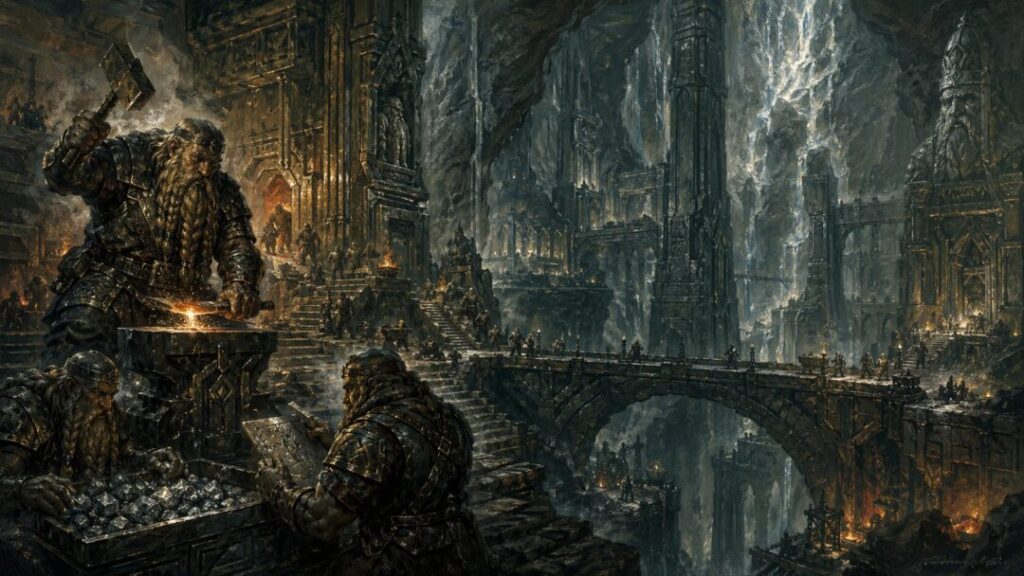
Mithril belongs to the greatest achievements of free peoples. Dwarves mine it. Elves refine it. It appears in hidden beauty, in rings, in gates, in heirlooms, in works of patience and skill. Sauron wanting mithril is therefore not just an industrial question. It is part of his larger pattern: the desire to seize what others have made and bend it toward domination.
That makes the mystery sharper.
The point may not be to list the exact weapons or machines he intended to build.
The point may be to show that nothing precious, durable, or masterfully made lies outside his appetite.
The Deeper Answer
So what does Sauron need with mithril?
If we answer only from the final published text, the honest reply is that we are never given a complete explicit explanation.
If we include the early draft evidence, the picture becomes clearer: Sauron was imagined as gathering mithril not for beauty, but for some secret purpose connected to war.
And if we set that beside everything else the legendarium tells us about mithril, the deeper answer comes into focus.
He needs it because mithril is the perfect material for a will like his.
Rare.
Hard to destroy.
Useful in armor, gates, and master-craft.
Bound to some of the finest making in Middle-earth.
A thing that can preserve form and confer advantage long after lesser materials fail.
In other words, Sauron does not desire mithril merely because it is precious.
He desires it because it is the kind of substance from which power can be made to endure.
And the most unsettling part is that the text never fully opens his hand and shows us the final design.
It lets us see the metal.
It lets us see the hunger.
It lets us glimpse the purpose.
Then it stops.
And that silence is exactly why the question lingers.
Sources & Notes
- J.R.R. Tolkien, The Lord of the Rings, Book II, Chapter 4, “A Journey in the Dark” — Gandalf explains mithril’s lightness, strength, rarity, and immense worth in Moria.
- J.R.R. Tolkien, The Lord of the Rings, Book II, Chapter 7, “The Mirror of Galadriel” — Galadriel’s Ring, Nenya, is described as being wrought of mithril.
- J.R.R. Tolkien, The Lord of the Rings, Book V, Chapter 10, “The Black Gate Opens” — the Mouth of Sauron displays Frodo’s mithril-coat as a significant captured token.
- J.R.R. Tolkien, The Lord of the Rings, Book VI, Chapter 5, “The Steward and the King” — the renewed Great Gate of Minas Tirith is made of mithril and steel.
- J.R.R. Tolkien, The Treason of Isengard, “The Mines of Moria” drafts — earlier Moria material has Orcs sending mithril to Sauron for a secret purpose, not for beauty, with war-making implied in related drafting.
- J.R.R. Tolkien, The Letters of J.R.R. Tolkien, Letter 131 — Tolkien frames Sauron’s evil as ordered domination, useful context for reading his interest in rare craft-materials.