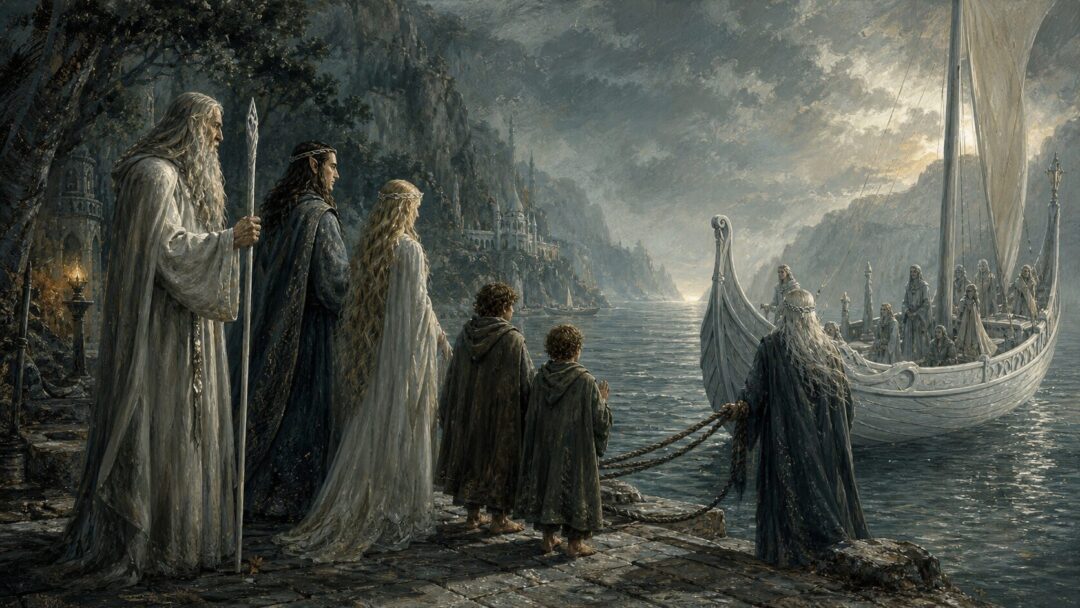
When Gandalf leaves Middle-earth, the story does something very unusual.
It stops.
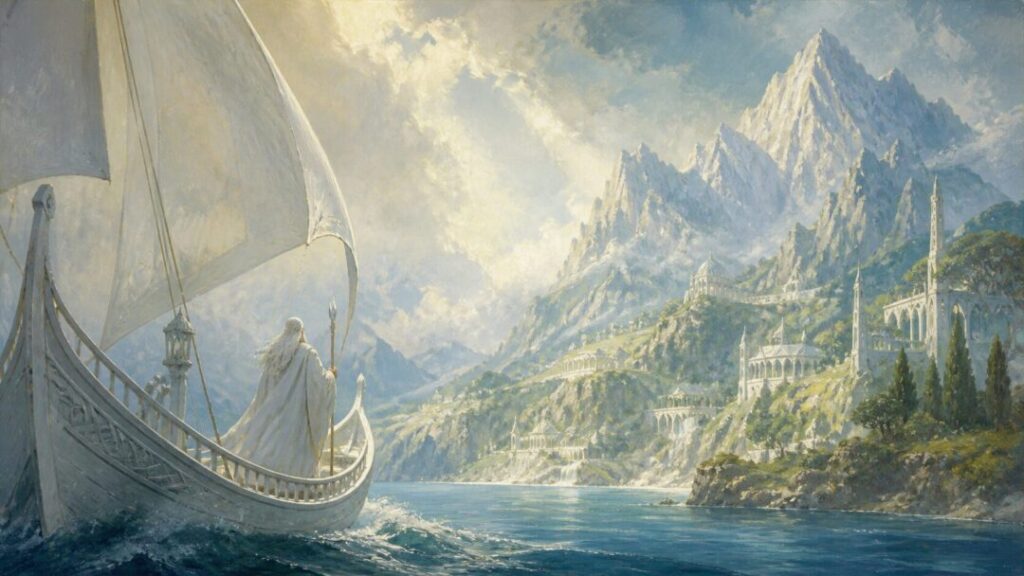
There is no scene of his arrival in Valinor. No description of the White Ship reaching the shores of Aman. No account of the Valar receiving him. No final conversation with Manwë, Varda, Nienna, or any of the Powers who first sent the Istari into Middle-earth.
We see the departure.
We do not see the return.
That absence has led to one of the quietest but most fascinating questions in the legendarium:
What happened to Gandalf when he arrived in Valinor in the Fourth Age?
The safest answer is also the most important one: the texts never directly tell us.
But they give us enough to understand the shape of the answer. Gandalf’s return was not simply the retirement of a beloved wizard. It was the completion of a mission that had lasted through the long struggle against Sauron, cost him death, and ended only when the One Ring was destroyed.
To understand what happened when he went West, we first have to understand what Gandalf really was.
Gandalf Was Not Originally Gandalf
In Middle-earth, he was known by many names.
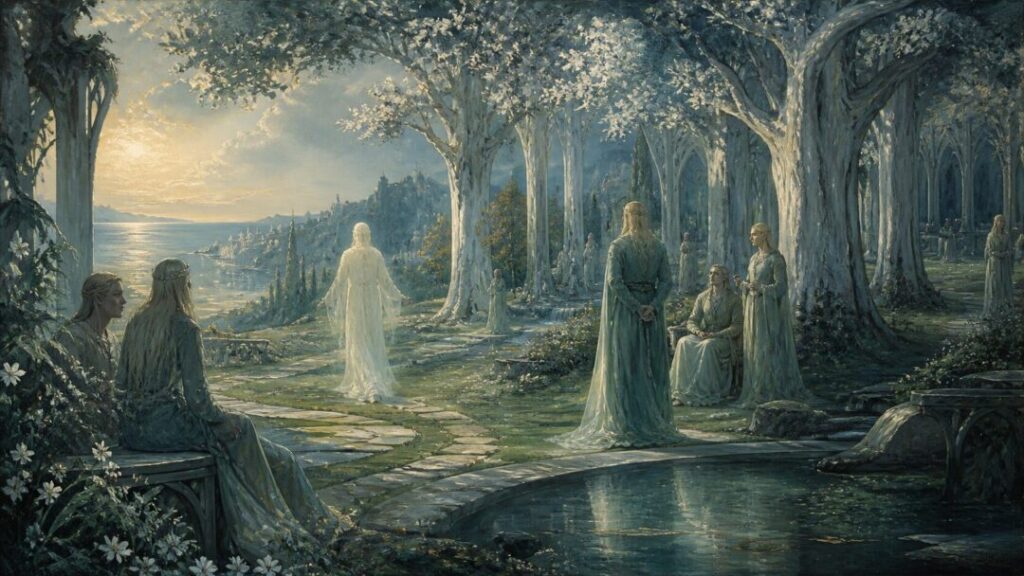
To many of the Elves, he was Mithrandir, the Grey Pilgrim. To the Dwarves, he was Tharkûn. In the North, he was Gandalf. But he himself says that in the West, in his youth, he was called Olórin.
That name matters.
Gandalf was not a mortal man who became wise. He was one of the Maiar, a spiritual being of the same order as those who served the Valar. He was not equal to the Valar themselves, but he belonged to the same deeper, older world that existed before the histories of Elves, Men, Hobbits, or Dwarves unfolded in Middle-earth.
Before he was sent across the Sea, Olórin was associated with the West. The traditions concerning him connect him with wisdom, pity, patience, and the hidden strengthening of others. This is essential to understanding his later role.
Gandalf did not come to Middle-earth as a conqueror.
He came as a guide.
The form of the old wandering wizard was not a disguise in the simple sense. It was the form in which his mission had to be carried out. The Istari were sent under limits. They were not meant to dominate the peoples of Middle-earth or oppose Sauron by matching raw power with raw power.
That is why Gandalf’s greatest victories are often indirect.
He counsels Thorin’s company.
He sets events in motion that lead to the death of Smaug.
He discovers the truth of the Ring.
He helps form the Fellowship.
He strengthens Théoden.
He guides Aragorn.
He stands against despair.
Again and again, Gandalf’s power is not domination.
It is awakening.
The Mission of the Istari
The Wizards were sent by the Valar during the Third Age to help resist Sauron.
That point is often misunderstood. They were not sent to replace the courage of Elves and Men. They were not sent to become kings. They were not sent to build empires of their own.
Their task was to assist the Free Peoples against the Shadow.
This is why Saruman’s failure is so severe. Saruman does not merely make mistakes. He abandons the purpose of the Istari. He begins to desire mastery. He studies the devices of the Enemy too closely. He seeks the Ring for himself. In doing so, he becomes a distorted image of the very power he was sent to oppose.
Gandalf is different.
He fears Sauron. He doubts his own strength. He does not want the Ring. When Frodo offers it to him, Gandalf refuses with real terror, knowing that through him the Ring would wield a power too great and terrible.
That refusal is one of the clearest signs of his faithfulness.
Gandalf’s strength lies partly in knowing what he must not become.
By the end of the War of the Ring, this mission has been fulfilled. Sauron is overthrown. The Ring is destroyed. Aragorn is crowned. The age changes. The great labor for which Gandalf was sent is finished.
So when Gandalf sails West, he is not fleeing failure.
He is returning after completion.
Why the Text Does Not Show His Arrival
The absence of an arrival scene is not a gap to be filled with invented details.
It is part of the meaning.
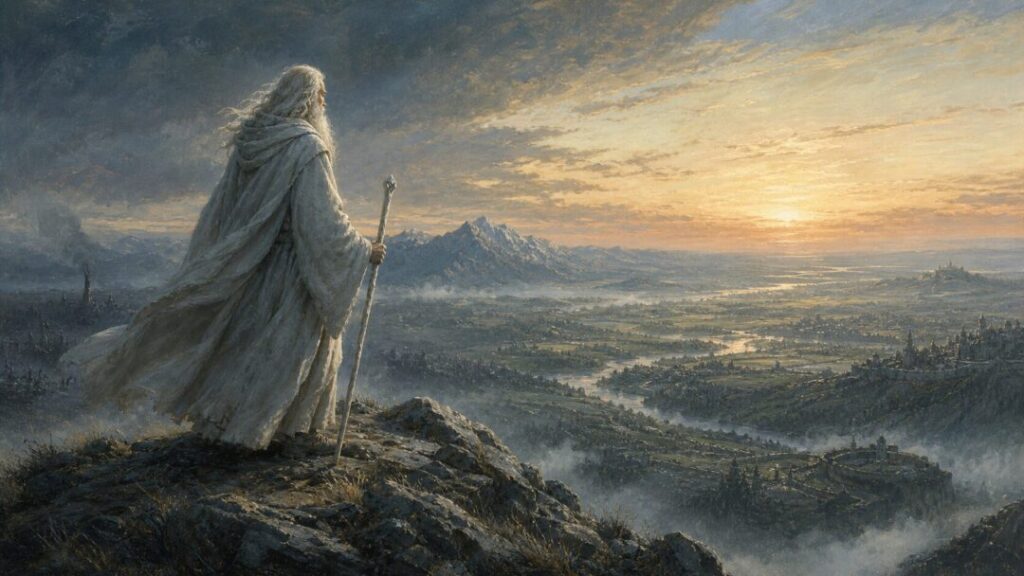
Middle-earth is the stage of the story. Gandalf’s work belongs there. Once he leaves it, the tale no longer follows him, because the role we know him by has ended.
This is why it is risky to imagine too much.
The texts do not say that Gandalf was greeted with ceremony.
They do not say that he was praised before the Valar.
They do not say exactly what happened to his body.
They do not say whether Frodo or Bilbo saw him differently after reaching the West.
They do not describe him laying down his staff or resuming a visible form as Olórin.
All of that would be speculation.
But the silence does not mean nothing happened. It means the story has passed beyond the borders of what the narrative chooses to reveal.
Gandalf’s arrival in Valinor belongs to the hidden side of the world.
And that is fitting, because Olórin himself had always been connected with hidden wisdom rather than public glory.
Did Gandalf Stop Being Gandalf?
This is the heart of the question.
When Gandalf reached Valinor, did he remain Gandalf the White? Or did he become Olórin again?
Canon does not give a direct answer.
The careful answer is this: Gandalf was always Olórin, but “Gandalf” was the name and role he bore in Middle-earth. When that mission ended, it is reasonable to interpret that the special office of the Istar also ended.
But that must remain interpretation.
The texts support the idea that Gandalf’s identity is deeper than his wizard-form. He existed before that form. He came from the West. He had a name there before Middle-earth knew him. He was sent, and after the task was complete, he returned.
So it is not likely that he became some entirely new being on arrival.
Nor is it accurate to say that “Gandalf died” when he reached Valinor. He had already passed through death after the battle with the Balrog, and had been sent back until his task was done.
What likely ended was not his existence, but his mission as Gandalf in Middle-earth.
The old man with the staff was the form in which Olórin walked among Hobbits, kings, Dwarves, and Elves. Once he returned to Aman, that form may no longer have been necessary.
But again, the texts do not explicitly describe the change.
The strongest phrasing is this:
Gandalf returned to the West as Olórin, his task as one of the Istari fulfilled.
Anything beyond that becomes interpretation.
The Meaning of His Death and Return
Gandalf’s return to Valinor cannot be separated from what happened in Moria.
On the Bridge of Khazad-dûm, Gandalf faces the Balrog and falls. His body dies. His spirit passes beyond ordinary experience, and he later says that he strayed out of thought and time before being sent back.
This is not a simple recovery.
It marks a turning point in his mission.
Gandalf the Grey falls in sacrifice. Gandalf the White returns with greater authority, not because he seized power, but because he remained faithful when everything seemed lost.
That distinction matters.
Saruman sought to exalt himself and fell.
Gandalf gave himself up and was sent back.
The contrast is one of the deepest moral patterns in the story.
Power grasped becomes corruption.
Power received for service becomes responsibility.
When Gandalf finally sails West, he has already passed through the central test of his mission. He has faced a servant of the ancient darkness. He has died. He has returned. He has completed the work for which he was sent back.
Valinor is not the reward for that one moment.
It is the homecoming after the whole burden.
Gandalf’s Return Was Different from Frodo’s
Gandalf sails on the same ship as Frodo and Bilbo, but his reason for going is not the same.
Frodo and Bilbo go as Ring-bearers. Their passage West is an act of healing and mercy. They are mortals, and the Undying Lands do not make them immortal. For them, the West offers rest from wounds that Middle-earth cannot fully heal.
Gandalf is different.
He is not a mortal seeking healing in the same sense. He is a Maia returning to the land from which he came. He does not go because the Ring wounded him as it wounded Frodo or Bilbo. He goes because his work in Middle-earth is complete.
Yet there is still a kind of release in his departure.
Gandalf had carried care for Middle-earth for a very long time. He had wandered, labored, feared, hoped, and resisted the Shadow without claiming lordship over those he helped. Even as the White, he does not settle into rule. After Aragorn’s crowning and the ordering of the restored kingdom, Gandalf’s role diminishes naturally.
The world no longer needs a hidden emissary from the West.
It needs Men to govern their own age.
So Gandalf leaves.
Not because Middle-earth has rejected him.
Because his task there is done.
What About Narya, the Ring of Fire?
Gandalf was one of the Keepers of the Three Rings.
He bore Narya, the Ring of Fire, which had been given to him by Círdan when he first came to Middle-earth. Círdan perceived something in him and entrusted the Ring to him, saying it might aid him in his labors.
Narya’s power was not a weapon in the ordinary sense. Its association is with kindling hearts, resisting weariness, and strengthening courage. That fits Gandalf’s work perfectly.
But after the destruction of the One Ring, the power of the Three Rings faded. Their age was over. The Keepers passed West, and the great works sustained by the Three could no longer remain as they had been.
So Gandalf’s bearing of Narya at the end is deeply symbolic.
He leaves Middle-earth with the Ring whose purpose matched his own: not domination, but encouragement.
Yet by the time he reaches the West, that age has ended.
The fire he carried had already done its work.
Was Gandalf Judged in Valinor?
The texts never describe a judgment scene for Gandalf after his return.
That is important.
It is tempting to imagine Gandalf standing before the Valar to give account of his mission. But canon does not show this, and it should not be presented as fact.
What the texts do show is that Gandalf’s success is already evident in Middle-earth. Sauron has fallen. The Ring is destroyed. Saruman has failed and been cast down. Aragorn has returned. The Shire, though wounded, is healed. The Third Age has ended.
Gandalf does not need a courtroom scene to prove his faithfulness.
The history itself bears witness.
There is, however, a sharp contrast with Saruman. After Saruman’s death, his spirit looks toward the West, but a wind comes from the West and turns it away. This strongly implies rejection, though the exact metaphysical details are not fully explained.
No such rejection is attached to Gandalf.
Gandalf sails West openly, in the company of Elrond, Galadriel, Frodo, and Bilbo, on the White Ship from the Grey Havens.
His departure is peaceful.
That peace is the closest thing the narrative gives us to an answer.
Why Gandalf Could Finally Rest
Gandalf is often remembered for action: arriving unexpectedly, warning, arguing, laughing, vanishing, returning, commanding, and confronting darkness.
But beneath all of that is weariness.
He bears knowledge others do not have. He sees danger earlier than others see it. He understands the stakes of the Ring long before most of Middle-earth realizes what has returned.
And still, he must work through patience.
He cannot simply take over.
He cannot force Frodo to endure.
He cannot compel Théoden forever.
He cannot make Denethor hope.
He cannot carry the Ring himself.
His task is powerful precisely because it is restrained.
That kind of mission costs something.
So when Gandalf arrives in Valinor, the most lore-faithful answer is not that he receives a crown, a throne, or some dramatic transformation.
The answer is quieter.
He returns to the West.
He is released from the errand of the Istari.
He is no longer needed as the Grey Pilgrim or the White Rider.
He is once again Olórin, though the texts do not show us exactly how that return appeared.
The wizard’s road ends where it began.
The Real Mystery of Gandalf’s Ending
The mystery is not whether Gandalf was welcomed home.
Everything in the structure of the story suggests that he was.
The real mystery is that the narrative refuses to turn that homecoming into spectacle.
That restraint is part of the beauty of his ending.
Gandalf spent the Third Age helping others reach their appointed moments. Bilbo found the Ring. Frodo carried it. Aragorn claimed the kingship. Théoden rose from despair. Faramir resisted temptation. The Shire was saved by its own people.
Gandalf’s work was everywhere, but it was rarely centered on himself.
So it is fitting that his final reward, if we may call it that, is not narrated as triumph.
It is simply departure.
The ship passes into the West.
Middle-earth continues without him.
The Fourth Age begins.
And somewhere beyond the circles of the story, the one called Gandalf is no longer wandering roads in a battered cloak, carrying the burden of a world at war.
He has gone home.
Not as a conqueror.
Not as a ruler.
But as the servant who finished his task and laid it down.
Sources & Notes
- J.R.R. Tolkien, The Lord of the Rings, Book IV, Chapter 5, “The Window on the West” — gives Gandalf’s own list of names, including Olórin in the West, supporting the article’s distinction between Gandalf’s Middle-earth role and deeper identity.
- J.R.R. Tolkien, Unfinished Tales, “The Istari” — identifies Olórin as one of the Maiar, explains the Wizards’ mission from the Valar, and stresses their limits against ruling or matching Sauron by force.
- J.R.R. Tolkien, The Lord of the Rings, Book III, Chapter 5, “The White Rider” — describes Gandalf’s death after the Balrog and his being sent back “until my task is done,” central to his later return West.
- J.R.R. Tolkien, The Silmarillion, “Of the Rings of Power and the Third Age” — summarizes the coming of the Istari, Gandalf’s faithfulness, and the end of the Third Age after Sauron’s fall.
- J.R.R. Tolkien, The Lord of the Rings, Book VI, Chapter 9, “The Grey Havens” — shows Gandalf leaving Middle-earth on the White Ship with the Ring-bearers and the Keepers of the Three, with Narya visible.