At first glance, it seems like a very small moment.
The War of the Ring is over. Saruman has been defeated. Aragorn has been crowned. The company is travelling north after the wedding of Aragorn and Arwen and the funeral of Théoden, and on the road home they come again to Isengard.
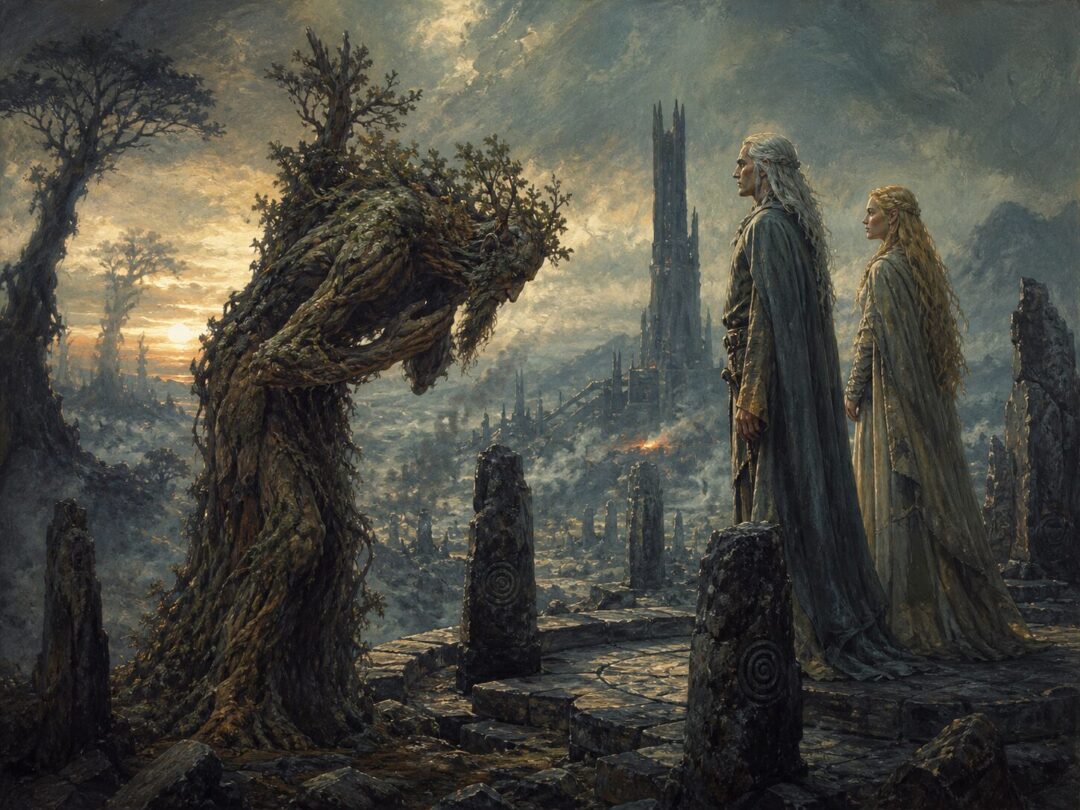
There they find Treebeard.
He is no longer the wrathful leader of the Ents marching against Saruman. He is older again, slower again, full of news, regret, and strange courtesy. He speaks of Saruman’s release. He speaks of the changing world. And then he remembers his manners.
Treebeard offers rest.
He also suggests that some of the company might pass through Fangorn Forest and so shorten the road home. The text specifically says that he looked at Celeborn and Galadriel.
And they do not go.
That is the puzzle.
Because this is not a meeting between strangers. Treebeard knows them. He bows to them with great reverence. He speaks as if they have not met for a very long time, but as if their meeting belongs to an ancient friendship or at least an ancient recognition.
So why do Galadriel and Celeborn not enter Fangorn?
The most important answer is also the most easily missed:
The text never says directly.
There is no hidden explanation given later. No stated feud. No rule forbidding them to enter. No suggestion that Treebeard would refuse them. Any answer must therefore be careful. What we can do is follow the clues the story actually gives us.
Celeborn’s Warning Was Real
The question begins much earlier, in Lothlórien.
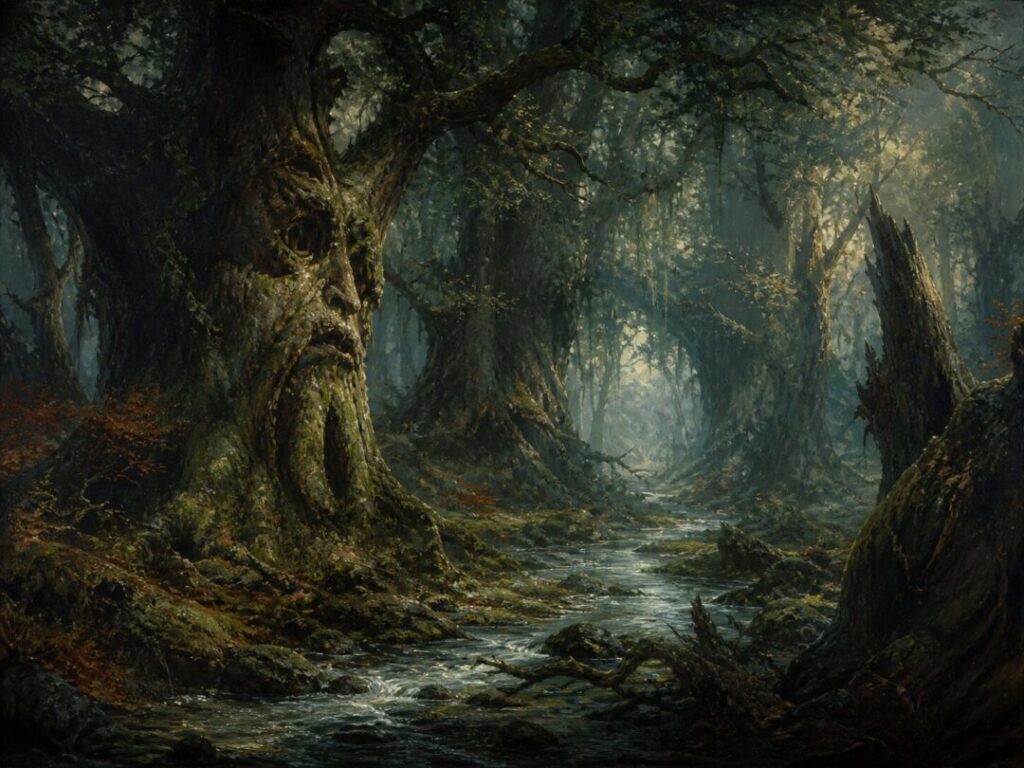
When the Fellowship leaves the Golden Wood, Celeborn gives them counsel about the road ahead. He warns them not to go too far up the Entwash, and not to risk becoming entangled in Fangorn Forest.
This matters because Celeborn does not speak as an ignorant outsider. He is one of the Wise, a lord of Lórien, and someone whose memory reaches far back into the older world. His warning is not presented as panic or superstition.
Fangorn is strange.
It is little known.
And people can come to grief there.
Later, when Merry and Pippin meet Treebeard and ask why Celeborn warned them, Treebeard’s answer is fascinating. He does not say Celeborn was wrong. He says that he might have given the same warning if the travellers had been going the other way.
Do not risk getting entangled in Lothlórien.
That is the heart of the matter.
Treebeard understands the warning because Fangorn and Lórien are alike in one important way: both are old, guarded, perilous places. Not evil. Not hostile by nature. But not open to just anyone.
This is not fear between enemies.
It is caution between powers.
Fangorn Is Not Simply a Forest
To ordinary travellers, Fangorn might look like a dark and dangerous wood.
But Fangorn is not merely a collection of trees.
It is the remnant of something much older. Treebeard remembers forests that once stretched across lands now changed or ruined. He sings of places from the Elder Days. He speaks of trees that are sleepy, half-awake, or even becoming Entish. He admits that he does not understand everything that goes on in the forest himself.
That admission is important.
Treebeard is Fangorn, in a sense. The forest bears his name. He is the oldest of the Ents still walking in Middle-earth. Yet even he does not claim complete mastery over everything within the wood.
So Celeborn’s warning makes sense.
Fangorn is not a place where ordinary categories hold steady. Some trees are just trees. Some are not. Some may be more awake than they appear. Some remember hurts. Some may not welcome axes, strangers, or hurried feet.
This does not mean Fangorn is evil.
It means Fangorn is alive in a way most travellers are not prepared to understand.
Lórien Is Also Dangerous
Treebeard’s reply about Lórien is just as important as Celeborn’s warning about Fangorn.
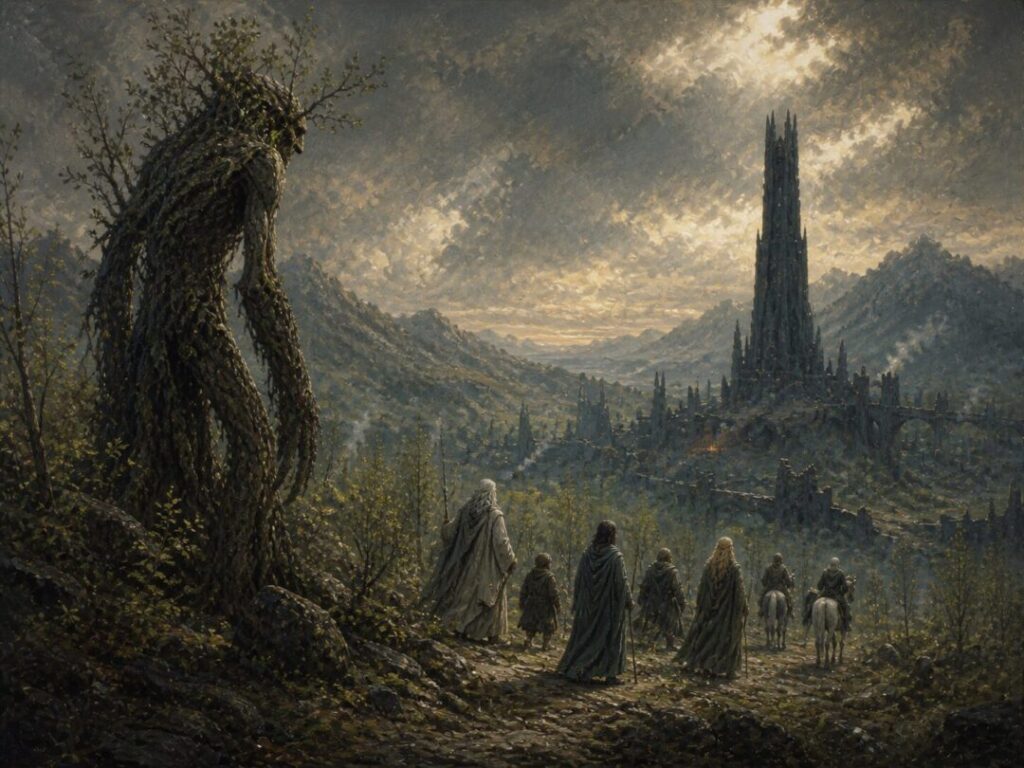
Lothlórien is beautiful. But beauty in Middle-earth is not the same as safety.
The Fellowship enters Lórien only under unusual circumstances, after great peril and with Aragorn as guide. Even then, they are watched, challenged, blindfolded, and brought carefully into the hidden realm. Lórien has survived because it is guarded, secret, and set apart from the ordinary flow of the world.
Treebeard knows this.
He calls it a queer land, not casually open to strangers. He is surprised the hobbits got in at all, and even more surprised that they got out.
This is not an insult.
It is recognition.
Fangorn and Lórien are mirrors of a kind. One is Entish, wild, deep-rooted, and difficult even for outsiders to read. The other is Elvish, preserved, radiant, and protected from the decay around it. Both are remnants of an older Middle-earth. Both have borders that matter.
So when Celeborn warns against Fangorn, and Treebeard answers by warning against Lórien, the story is not showing us hostility.
It is showing us two ancient realms acknowledging each other’s danger.
Treebeard’s Invitation Changes the Meaning
That is why the later scene at Isengard is so moving.
Treebeard is not warning anyone away now. He is inviting.
He offers rest. He offers the shorter road through Fangorn. And he looks toward Celeborn and Galadriel.
This is a remarkable gesture.
Earlier, Fangorn was a place of danger and uncertainty. Now its master is opening the way, at least for those whom he knows and honours. The invitation is not general tourism. It is personal.
And still, Galadriel and Celeborn do not take it.
The text says that all except Legolas must now take their leave and depart either south or west. Legolas, who had long desired to see Fangorn, is the one who remains interested in the forest. For him, Fangorn is still a wonder to be visited.
For Galadriel and Celeborn, something else is happening.
They are not merely choosing a route.
They are approaching the end of an age.
Their Road Is Not Just a Road
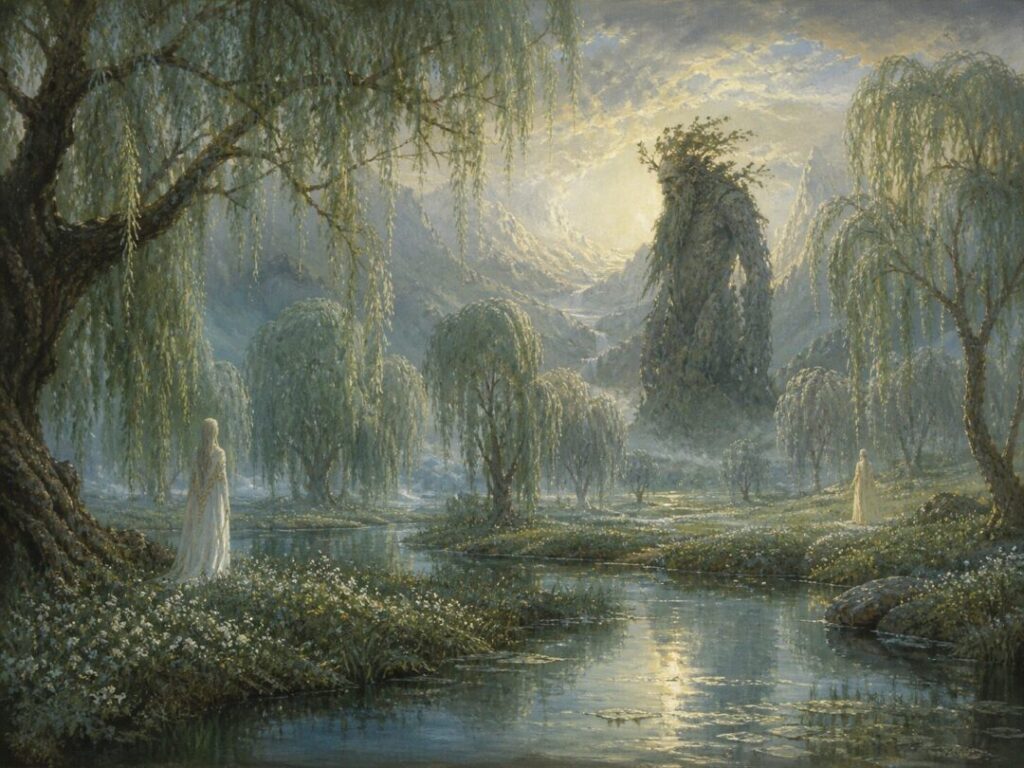
Later, the text explains that Galadriel, Celeborn, and their people travel by the western roads because they have much to speak of with Elrond and Gandalf. They eventually linger in Eregion before another parting, and then turn eastward by the Redhorn Gate and the Dimrill Stair toward their own country.
This gives us the practical reason.
They have conversations to finish.
They have farewells to make.
They are not simply trying to reach Lórien by the shortest path.
That matters because the journey after the War is not written like an ordinary return trip. It is a chain of partings. Aragorn parts from his companions. Théoden is buried. Éomer remains in Rohan. Treebeard is left behind. Saruman is encountered one last time. Then come the farewells near Eregion. Eventually Frodo, too, will leave the Shire and pass over the Sea.
The road is structured around endings.
So when Treebeard offers a shorter way home, the refusal is not necessarily about Fangorn being unwelcome. It may simply be that this is not the road they are meant to take.
Their road lies with Elrond and Gandalf for a while longer.
And that road is a road of memory.
Galadriel Already Knows This Is the Last Meeting
Treebeard senses the same thing.
When he says farewell, he does not speak lightly. He bows three times to Celeborn and Galadriel, and says that it is sad they should meet only thus at the ending. The world is changing, he says, and he does not think they will meet again.
Celeborn answers cautiously: he does not know.
Galadriel answers more clearly: not in Middle-earth.
That is the closest the scene comes to explaining everything.
Galadriel does not say, “We will return by another road.”
She does not say, “We will visit Fangorn later.”
She does not soften the moment into ordinary politeness.
She places their next possible meeting beyond the present shape of the world.
Her words about the lands under the wave being lifted again and the willow-meads of Tasarinan belong to a deep memory of lost lands and a hope beyond the ordinary history of Middle-earth. The line is beautiful, but it is not simple optimism. It is a farewell so vast that it reaches beyond the world as the characters know it.
For Treebeard, this may be the last meeting.
For Galadriel, in Middle-earth, it is.
This Is Not Fear
One common reading is that Galadriel and Celeborn refuse Fangorn because they are afraid of it.
The text does not support that as a direct claim.
Celeborn respects Fangorn enough to warn others about it. Treebeard respects Lórien enough to say the same in return. But when they meet, there is reverence, not hostility.
Treebeard bows.
Celeborn calls him Eldest.
Galadriel speaks to him in language touched with ancient sorrow and hope.
Nothing here suggests personal fear. Nothing suggests that Treebeard would harm them. Nothing suggests an old feud between Lórien and Fangorn.
A safer reading is this:
They understand what Fangorn is.
And because they understand it, they do not treat it casually.
To enter Fangorn is not the same as taking a shortcut through a normal woodland. It means entering one of the last deep places of the Elder Days, a realm where memory is not dead and the trees themselves may have will, anger, or grief.
For Legolas, that is a marvel still ahead.
For Galadriel and Celeborn, it may be a memory too heavy to reopen.
That last sentence is interpretation, not stated fact. But it fits the emotional shape of the scene.
Lórien and Fangorn Are Both Passing Away
There is another layer.
By this point, the One Ring has been destroyed. The Three Rings of the Elves have lost their power. Lórien cannot remain what it was. Its preservation, its golden stillness, its resistance to time — all of that is ending.
Fangorn, too, belongs to a diminishing world.
The Entwives are lost. The Ents are few. Treebeard speaks often with the melancholy of one who has seen too much vanish. Even after the victory over Saruman, there is no promise that the Ents will flourish again as they once did.
So the meeting at Isengard is not simply between old friends.
It is between two fading modes of being.
Lórien is the guarded Elvish memory of beauty.
Fangorn is the guarded Entish memory of the living woods.
Both have survived into the late Third Age.
Neither can truly command the future.
That is why Treebeard’s line hurts so much. “The world is changing” is not just an observation. It is the truth beneath the entire chapter.
Why the Forest Is Not Entered
So why do Galadriel and Celeborn not enter Fangorn?
The most lore-accurate answer is layered.
Practically, they are travelling west with Elrond and Gandalf because they have much to discuss, and their journey is shaped by partings rather than speed.
Textually, the scene never says that they refuse out of fear, hostility, or some hidden law.
Thematically, their choice belongs to the ending of the Third Age. Fangorn is not merely a road home. It is an ancient realm, one that would turn this farewell into something else. But the story does not let that happen.
Treebeard and Galadriel do not receive a long reunion.
They receive a brief meeting at the edge of change.
That is the tragedy.
The door opens, but only enough for them to recognize one another before it closes again.
The Quiet Sadness of the Scene
This is why the moment stays with so many readers.
There is no battle here. No Ring. No throne. No great speech before armies.
Only an Ent, two Elven rulers, and the knowledge that even the oldest friendships can be overtaken by the changing world.
Treebeard would have welcomed them.
Celeborn cannot say for certain that they will never meet again.
Galadriel knows that, in Middle-earth, they will not.
And that is probably the real reason the forest remains unentered.
Not because Fangorn is an enemy.
Not because Galadriel and Celeborn are afraid.
But because the time for such meetings has passed.
The old powers of Middle-earth do not end all at once. They pass in moments like this: courteously, sorrowfully, almost quietly.
A road is offered.
A forest waits.
And the Lady of Lórien says farewell.
Sources & Notes
- J.R.R. Tolkien, The Lord of the Rings, Book II, Chapter 8, “Farewell to Lórien” — gives Celeborn’s warning not to become entangled in Fangorn and frames the forest as strange and little-known even to the Wise.
- J.R.R. Tolkien, The Lord of the Rings, Book III, Chapter 4, “Treebeard” — has Treebeard answer the warning by comparing Fangorn and Lórien as perilous old realms where outsiders may be ensnared.
- J.R.R. Tolkien, The Lord of the Rings, Book VI, Chapter 6, “Many Partings” — contains Treebeard’s invitation at Isengard, his reverent farewell to Celeborn and Galadriel, and Galadriel’s “not in Middle-earth” reply.
- J.R.R. Tolkien, The Lord of the Rings, Book VI, Chapter 6, “Many Partings” — also explains the western road with Elrond and Gandalf, so the choice is a farewell journey rather than a simple shortcut home.
- J.R.R. Tolkien, The Silmarillion, “Of the Rings of Power and the Third Age” — supports the wider theme that after the One Ring’s destruction the works and guarded realms sustained by the Three Rings would fade.