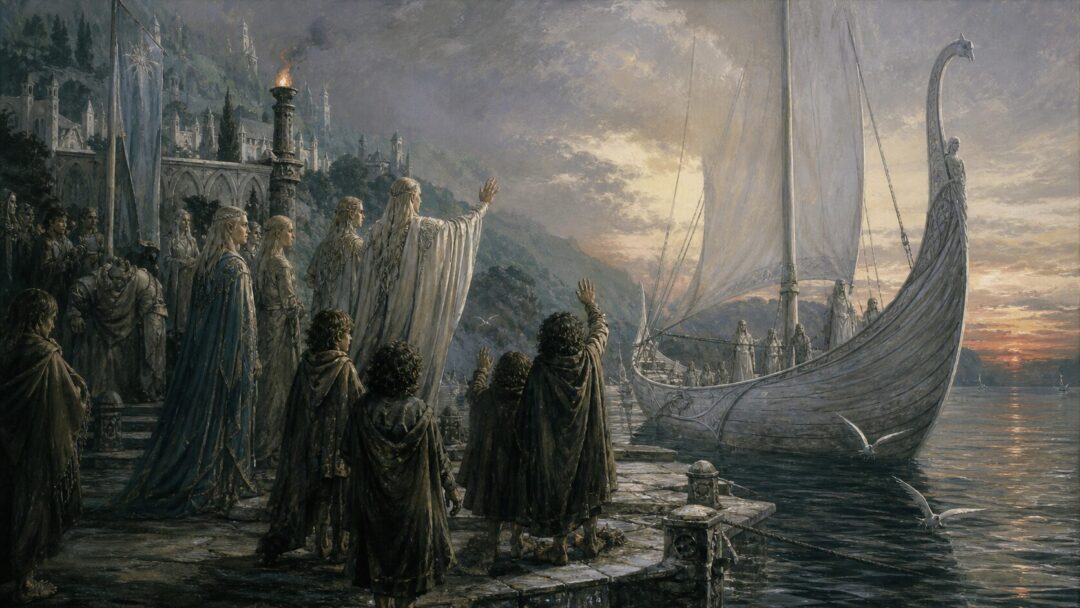
At the end of The Lord of the Rings, Middle-earth looks as if it has been restored.
Sauron is overthrown. The One Ring is destroyed. The King returns to Gondor. The Shire, after its own bitter scouring, begins to heal. Trees are replanted. Homes are rebuilt. The long fear that had crept westward is finally broken.
And then the Ring-bearers begin to leave.
Frodo goes first, with Bilbo, Gandalf, Elrond, and Galadriel. Much later, according to the tradition preserved in the Appendices, Samwise Gamgee also passes over Sea, and is remembered as the last of the Ring-bearers.
It is one of the most beautiful endings in Middle-earth.
It is also one of the saddest.
Because the Ring-bearers do not leave simply because they have been rewarded. They leave because the end of the Ring is also the end of the world they once belonged to.
For some, the Ring left wounds.
For others, its destruction ended their power.
For all of them, remaining in Middle-earth would mean living in a world that could no longer truly sustain them.
The Undying Lands Are Not a Reward in the Simple Sense
The first mistake is to imagine the Undying Lands as a kind of heaven.
They are not.
Mortals who go West do not become immortal. Bilbo, Frodo, and Sam remain mortal. Their nature is not changed by sailing over the Sea. The name “Undying Lands” refers to Aman, the realm associated with the Valar, the Maiar, and the Elves — not to a place where death is magically removed from Men, Hobbits, or Dwarves.
This matters because it changes the meaning of the Grey Havens.
Frodo is not escaping death.
Bilbo is not being made young again.
Sam is not receiving endless life.
What is offered is something quieter and more merciful.
Rest.
Healing.
Peace, if it can be found before death.
The West is not a prize placed at the end of the quest. It is a place where certain wounds may be eased because Middle-earth can no longer ease them.
That distinction is everything.
Frodo Did Not Leave Because He Failed
Frodo’s departure is often misunderstood.
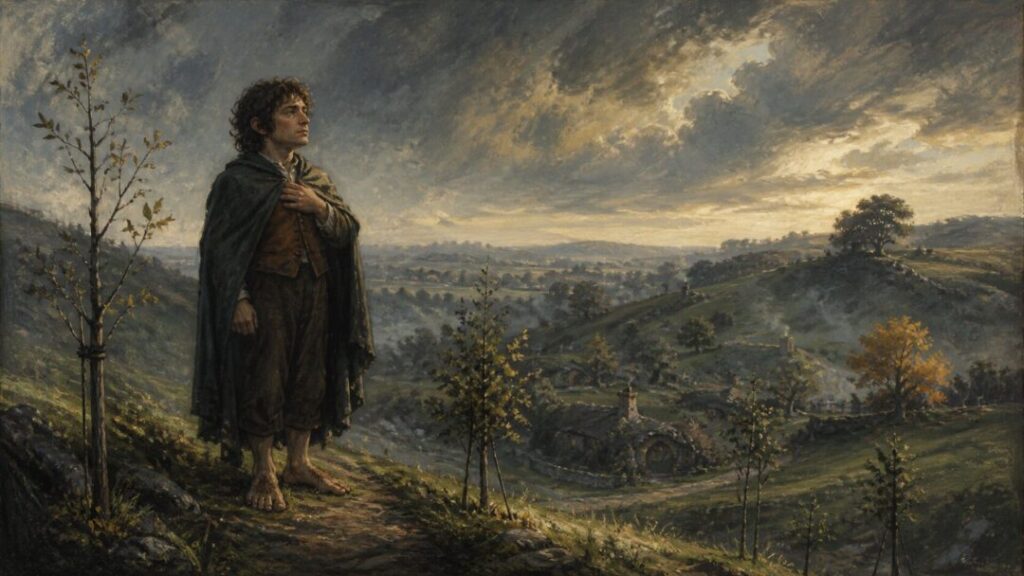
He saves the Shire, but he cannot remain in it. He returns home, but the return is incomplete. He is honored, loved, and surrounded by familiar things — Bag End, the Party Field, Sam, the green country he crossed half the world to preserve.
And still, he cannot stay.
The reason is not that Frodo is weak. It is that he has been wounded beyond ordinary healing.
At Weathertop, the Morgul-knife leaves a hurt that never fully disappears. In Shelob’s lair, he is stung and nearly lost. In Mordor, the Ring presses on him until, at the very end, his strength is exhausted.
After the victory, Frodo describes himself as wounded by “knife, sting, and tooth, and a long burden.” That last phrase is the key. The Ring itself was not merely an object he carried. It was a spiritual weight that worked on the will, the memory, the desire, and the self.
When the Ring is destroyed, its physical burden ends.
But Frodo’s wound does not vanish with it.
This is why his ending feels so different from Aragorn’s. Aragorn receives a kingdom. Sam receives a home, a family, and a future. Merry and Pippin return enlarged into the life of the Shire.
Frodo returns diminished.
Not morally diminished. Not dishonored. But inwardly spent.
The Shire is healed, yet Frodo cannot be healed by the Shire.
Bilbo’s Wound Was Quieter, But Still Real
Bilbo’s departure is gentler, but not less important.
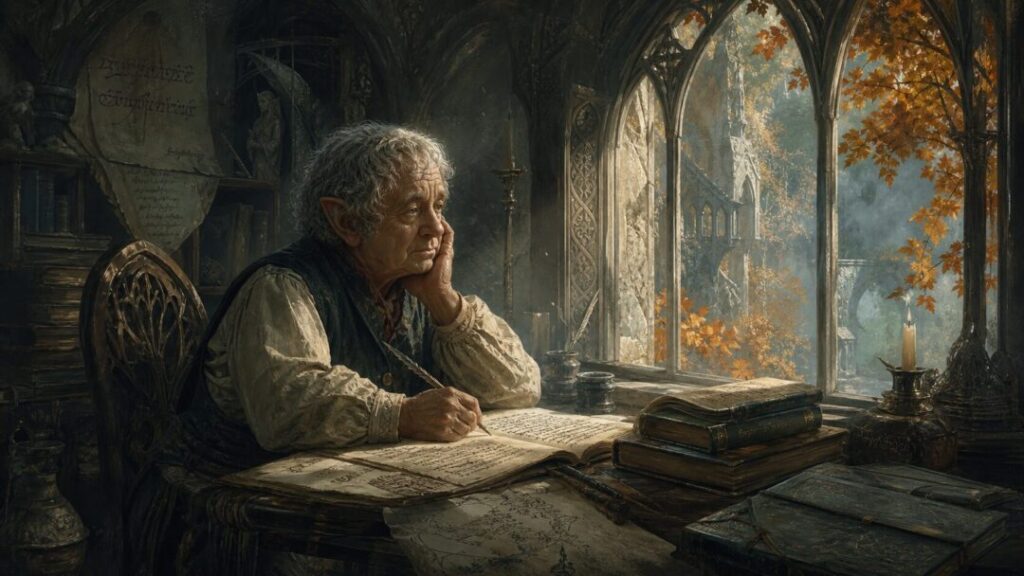
He bore the Ring for about sixty years. He did not know what it was for most of that time. He did not seek world dominion. He did not become a tyrant or a servant of Sauron. In many ways, Bilbo’s resistance is remarkable.
But resistance is not immunity.
The Ring stretched his life. It preserved him unnaturally. It also left behind a trace of possessiveness that did not fully disappear when he surrendered it.
This is visible in Rivendell, when Bilbo asks Frodo what became of “my ring.” He is old and confused, but the words still reveal something deeper: the Ring had not passed through his life without leaving a mark.
That is why his journey West is not just companionship for Frodo, though that matters deeply. Bilbo is the one Hobbit Frodo most loves, and Frodo would hardly find peace even in an earthly paradise without someone of his own kind.
But Bilbo also needs mercy in his own right.
He carried the Ring longer than anyone in the story except Gollum and Sauron. He gave it up willingly, which no one should treat lightly. Yet the cost remained.
The Undying Lands do not erase Bilbo’s mortality.
They offer him a gentler end.
Sam’s Departure Comes Later — And That Matters
Sam does not leave with Frodo.
This is essential.
At the Grey Havens, Sam remains in Middle-earth because his life still belongs there. He has Rosie. He has children yet to come. He has the Shire to restore. His part in healing the world is not finished when the ship sails.
In fact, Sam’s staying is one of the reasons the ending hurts so much. Frodo must leave, but Sam must live. He must go back to Bag End and continue, carrying both grief and gratitude into ordinary days.
Only much later, after Rosie dies, does the tradition say Sam rides out from Bag End, comes to the Tower Hills, and passes over Sea. He is remembered as the last of the Ring-bearers.
Sam’s claim is different from Frodo’s and Bilbo’s. He bore the Ring only briefly, in Mordor, after he believed Frodo dead. He willingly returned it to Frodo, which is one of the most extraordinary acts in the story.
The texts do not describe Sam’s inner need for healing in the same way they describe Frodo’s. So we should be careful not to overstate it. But the fact that he is named “last of the Ring-bearers” strongly connects his final journey to the burden he once carried.
Sam’s life in Middle-earth is full.
But even he is eventually drawn into the same mercy.
The Bearers of the Three Rings Faced a Different Ending
Frodo, Bilbo, and Sam bore the One Ring.
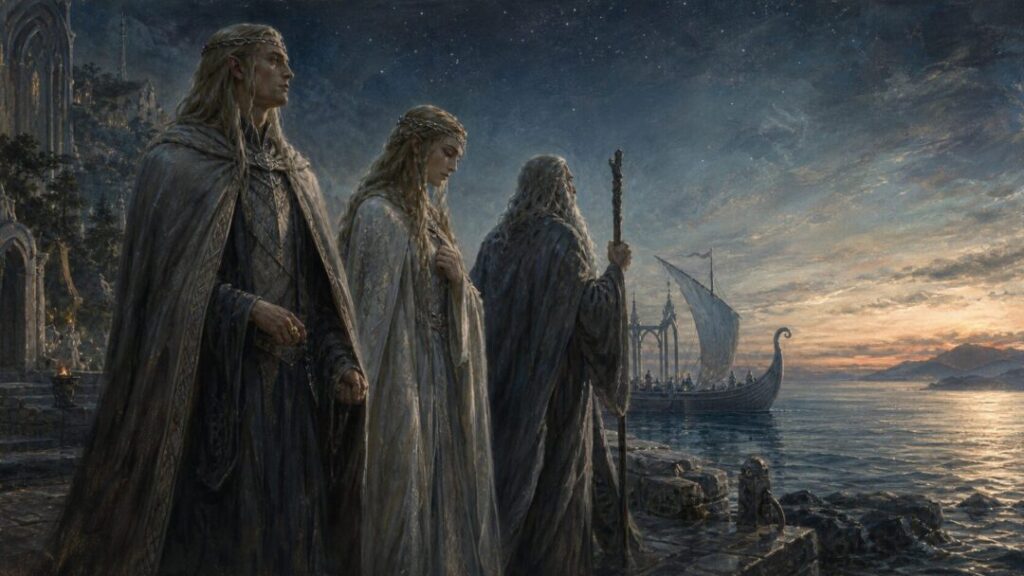
Gandalf, Elrond, and Galadriel bore the Three.
Their reason for leaving is related, but not identical.
The Three Rings were not made by Sauron, but they were still bound to the fate of the One. Once the One Ring was destroyed, the power of the Three failed. What they had preserved could no longer be preserved in the same way.
This is especially important for Rivendell and Lothlórien.
These realms are not merely beautiful places. They are pockets of memory, preservation, and resistance against decay. Elrond and Galadriel have used their Rings to maintain something of the Elder Days within Middle-earth.
But after the Ring is destroyed, that age ends.
Galadriel had already spoken of this in Lothlórien. If Frodo succeeded, her power would diminish, and she would go into the West. If he failed, all would be laid bare to the Enemy.
There was no path in which Lórien remained unchanged.
Victory saved Middle-earth from Sauron.
But it also ended the long Elvish preservation of Middle-earth.
Gandalf’s Work Was Complete
Gandalf’s departure is different again.
He is not leaving because he is wounded by the One Ring. He is not fading like the Elves. His role is bound to his mission.
Gandalf was sent to Middle-earth to oppose Sauron, not by matching him in domination, but by guiding, encouraging, awakening courage, and helping free peoples resist the Shadow. Once Sauron is defeated, Gandalf’s work in Middle-earth is complete.
This is why his leaving feels so calm.
He does not need a throne.
He does not found an order.
He does not remain as an advisor to the new king.
His task was never to rule the restored world.
It was to help bring that restoration about.
When the Ring is destroyed and the Age changes, Gandalf can depart. His part in the story is finished, and unlike Frodo, his leaving is not primarily a wound. It is a completion.
Elrond and Galadriel Could Not Preserve the Old World Any Longer
Elrond and Galadriel are among the greatest remaining figures of the Elder Days in Middle-earth.
Their departure is not only personal. It is historical.
Elrond has kept Rivendell as a refuge of lore, memory, healing, and counsel. Galadriel has preserved Lothlórien as a land where time seems to move differently, untouched by much of the decay outside its borders.
But this preservation depends on a world that is passing away.
When the Three Rings lose their power, the Elven realms cannot remain what they were. The beauty may linger for a time. Memory may endure. But the deep enchantment that held back fading is gone.
For Elrond, there is also personal sorrow. Arwen chooses mortality and remains with Aragorn. Elrond sails West, and their separation is part of the cost of the new age.
For Galadriel, the departure is the end of a long exile and a long test. She has refused the One Ring when Frodo offered it. She has chosen diminishment rather than domination. Her leaving is not defeat, but it is still a surrender of power.
The Elves do not leave because Middle-earth is worthless.
They leave because their time in it is over.
The Fourth Age Belongs to Men
The departure of the Ring-bearers marks the beginning of the Fourth Age.
That age is not evil. It is not a lesser age in a moral sense. The return of the King is a real healing, and the dominion of Men is part of the rightful unfolding of the world.
But it is a narrower age.
The great Rings are gone. The visible presence of the Elves fades. The high enchantments withdraw. The world becomes more ordinary, more historical, more like our own.
This is why the ending is bittersweet.
Middle-earth is saved, but not preserved unchanged.
The victory over Sauron does not restore the Elder Days. It makes room for a new age, and that new age requires many ancient things to depart.
The Ring-bearers leave because they belong to the great crisis that ended the Third Age. Once that crisis is over, they cannot all simply settle into the world that follows.
Some are too wounded.
Some are too ancient.
Some have completed the purpose for which they came.
Some have lost the power by which they remained.
The Grey Havens Are About Mercy, Not Escape
The Grey Havens scene is not triumphant in the usual sense.
There are no armies.
No crowns.
No victory speeches.
There is a ship, a farewell, and a grief that cannot be repaired by staying.
That is why the scene remains so powerful. It refuses to pretend that victory undoes every wound. Frodo saved the Shire, but he cannot enjoy it as Sam can. Bilbo gave up the Ring, but the Ring still marked him. The Elves helped preserve Middle-earth, but their preserving power has ended.
The world is healed.
But not everyone who helped heal it can remain.
This is one of the deepest truths in the story. Some burdens change the bearer forever. Some victories cost more than anyone can see from the outside. Some acts of mercy come not as glory, but as permission to lay the burden down.
The Ring-bearers leave Middle-earth because the Ring has ended, and with it, the age shaped by the Rings.
For Frodo and Bilbo, the West offers healing.
For Sam, it offers a final grace after a full life.
For Gandalf, it marks the completion of his mission.
For Elrond and Galadriel, it is the passing of the Elven age.
They do not leave because Middle-earth was not worth loving.
They leave because they loved it, fought for it, preserved it, suffered for it — and could no longer belong to it in the same way.
That is why the Grey Havens hurt.
Not because the story ends in despair.
But because even in victory, something beautiful must pass away.
Sources & Notes
- J.R.R. Tolkien, The Lord of the Rings, Book VI, Chapter 9, “The Grey Havens” — Frodo names his lingering wounds from “knife, sting, and tooth, and a long burden” before sailing West with Bilbo, Gandalf, Elrond, and Galadriel.
- J.R.R. Tolkien, The Lord of the Rings, Appendix B, “The Tale of Years” — records the end of the Third Age, the Ring-bearers’ departures, and Samwise’s later tradition as the last of the Ring-bearers to pass over Sea.
- J.R.R. Tolkien, The Lord of the Rings, Book II, Chapter 7, “The Mirror of Galadriel” — Galadriel says that if Frodo succeeds, the power of the Three will diminish and Lórien will fade, forcing a choice between departure and diminishment.
- J.R.R. Tolkien, The Silmarillion, “Of the Rings of Power and the Third Age” — explains the relation of the Three Rings to the One, their loss of power after its destruction, and the passing of the Keepers over Sea.
- J.R.R. Tolkien, Unfinished Tales, “The Istari” — gives the Wizards’ mission as guidance and encouragement against Sauron rather than rule, supporting Gandalf’s departure once that mission is fulfilled.
- J.R.R. Tolkien, The Letters of J.R.R. Tolkien, Letter 246 — discusses Frodo’s wounds, his final failure at the Sammath Naur, and his passage West as a special grace for healing before death.