The scene is so famous that many people remember it more simply than it is written.
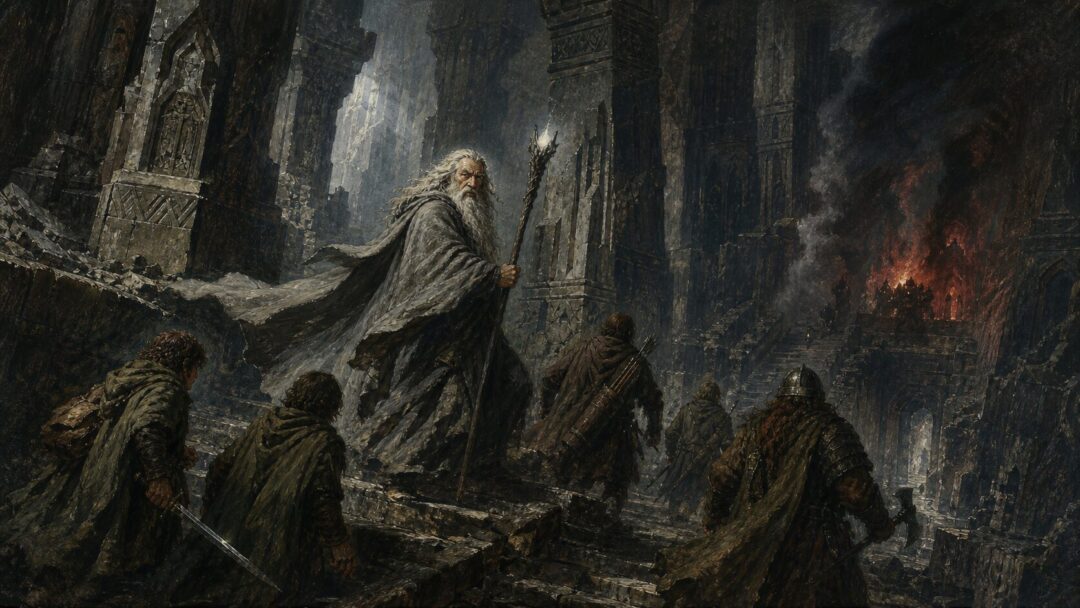
The Fellowship is fleeing through Moria. Behind them comes a terror of fire and shadow. Gandalf turns on the narrow bridge, confronts the creature, and speaks as if he knows exactly what stands before him.
A Balrog.
Durin’s Bane.
The ancient horror beneath Khazad-dûm.
But in the book, the revelation is more careful than that.
Gandalf does not begin the Moria journey knowing with certainty that Durin’s Bane is a Balrog. At least, the text never says that he does. In fact, the strongest evidence points the other way. When Gandalf first encounters the power behind the pursuing enemy, he admits that he does not know what it is.
That detail changes the entire scene.
Because “Durin’s Bane” and “Balrog” are not the same kind of name.
One is a title of ruin.
The other is a recognition of what that ruin truly was.
Durin’s Bane Was a Name of Dread, Not a Classification
To understand the question, we have to begin with the name itself.
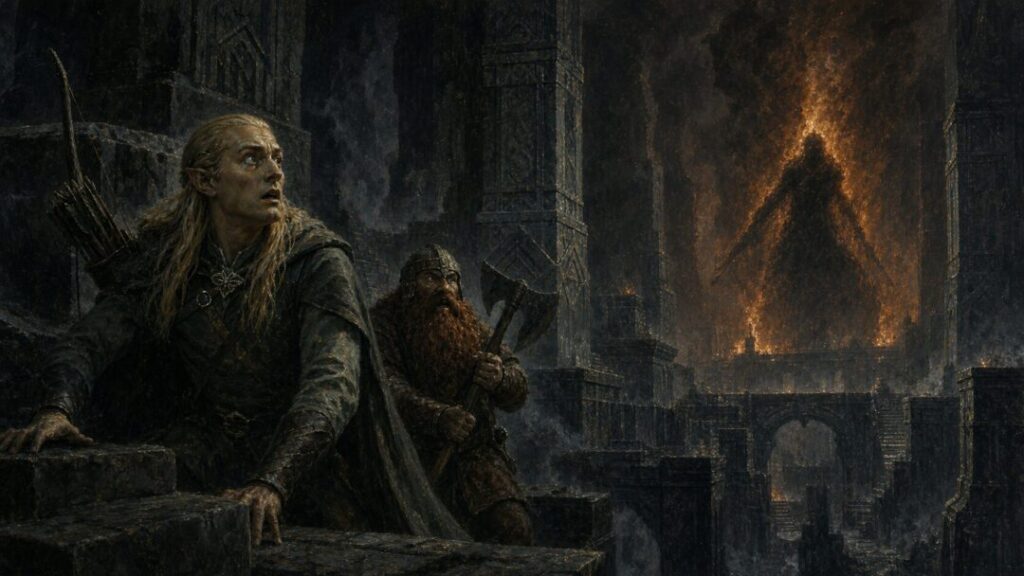
“Durin’s Bane” means exactly what it sounds like: the doom or destroyer of Durin. It refers to the creature that slew Durin VI, King of Khazad-dûm, after the Dwarves delved too deep beneath the mountains. The following year, Náin I was also slain, and the Dwarves abandoned their ancient home.
But the name does not explain the creature’s nature.
It does not say “Balrog.”
It does not say “Maia.”
It does not identify the being in terms of the Elder Days.
It is a Dwarven name rooted in catastrophe.
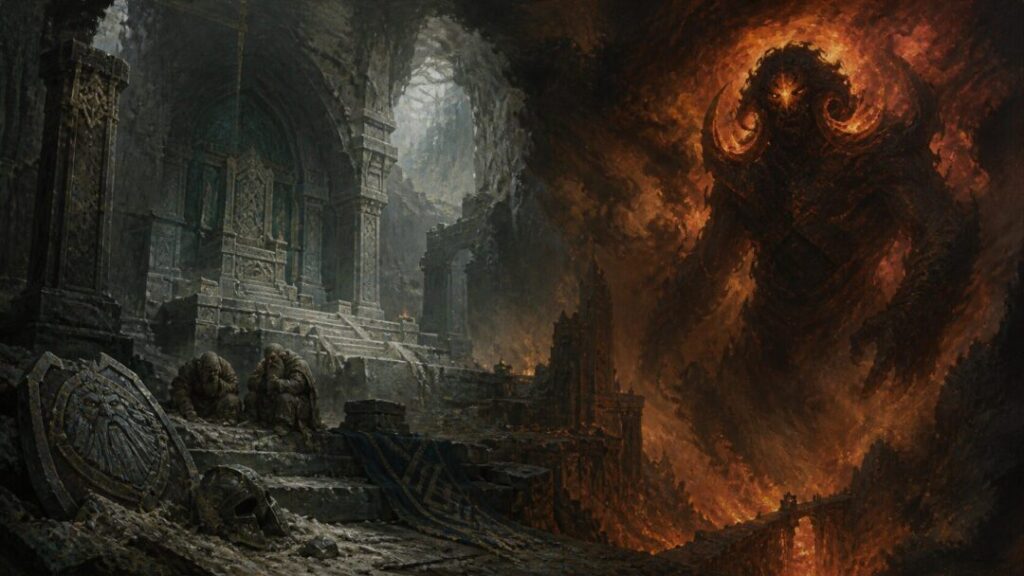
From the perspective of Durin’s Folk, the creature was the terror that ended Khazad-dûm. That was enough. It killed their king, broke their kingdom, and turned the greatest mansion of the Dwarves into the Black Pit.
So when Gimli later cries, “Durin’s Bane,” he is not identifying a species in the way Legolas does.
He is recognizing the nightmare of his people.
Gandalf Did Not Know at First
This is the part that often gets flattened in memory.
Before the Balrog appears openly, Gandalf has already encountered its power. In the Chamber of Mazarbul, he tries to hold a door shut against something terrible on the other side. The contest nearly breaks him. He says afterward that he has met his match, and that he cannot guess what the thing was.
That line matters.
Gandalf is not pretending ignorance. The text gives no reason to think he is hiding certainty from the Fellowship. The simplest reading is that he truly does not yet know.
He knows the enemy is powerful.
He knows it is far beyond ordinary Orcs or Trolls.
He knows it has challenged him in a way few beings in Middle-earth could.
But he has not yet seen it clearly.
And in Moria, that distinction is everything.
The deep places of the world contain old things. Gandalf himself later speaks of nameless things beneath the earth, older than Sauron, which even he does not wish to describe. So when a terrible power presses against him in the dark, he does not immediately leap to “Balrog.”
He waits until the thing is revealed.
Legolas Names It First
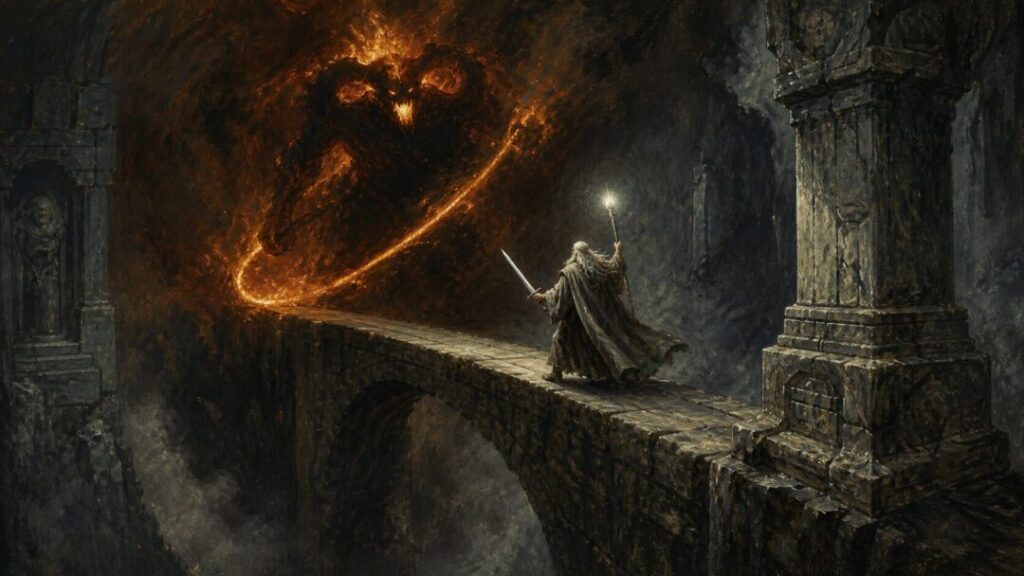
When the creature finally comes into view near the Bridge of Khazad-dûm, the first clear identification does not come from Gandalf.
It comes from Legolas.
He cries out that a Balrog has come.
This is not accidental. Legolas is an Elf, and Elvish memory reaches back into the ancient wars against Morgoth. Balrogs were not vague monsters to the lore of the Elves. They were terrors of the First Age, servants of Morgoth, associated with flame, shadow, and ruin.
That does not mean Legolas had personally seen one before. The text does not say that, and it would be unsafe to claim it as fact.
But he knows what a Balrog is.
He has inherited a world in which that name still carries the weight of ancient fear.
So when the shape appears—the shadow, the fire, the form of terror—Legolas understands what he is seeing before Gimli does.
And his reaction is not curiosity.
It is horror.
Gimli Recognizes the Same Creature Differently
Immediately after Legolas names the creature as a Balrog, Gimli responds with another name:
Durin’s Bane.
This is one of the most powerful moments in the scene because two histories collide in a single instant.
Legolas sees the horror through the memory of the Elder Days.
Gimli sees it through the wound of Khazad-dûm.
To the Elves, it is a Balrog: one of the ancient demons of Morgoth.
To the Dwarves, it is Durin’s Bane: the destroyer that drove them from their greatest kingdom.
Both names are true.
But they do not carry the same meaning.
“Balrog” tells us what kind of being it is.
“Durin’s Bane” tells us what it did.
That is why Gandalf does not need to choose between the names. Once the truth is revealed, both names lock into place. The nameless fear of Moria is not merely some unknown underground terror. It is one of the great horrors of the ancient world, surviving into the Third Age.
“Now I Understand”
Gandalf’s reaction after Legolas speaks is crucial.
He says, in effect, that he now understands.
That is the turning point.
The earlier mystery is solved. The terrible strength he felt at the door now has a name. The presence pursuing them through Moria is not only dangerous; it belongs to an order of evil far older than the current war.
This also explains why Gandalf immediately tells the others that the creature is beyond them.
Aragorn and Boromir are brave. Gimli is stout-hearted. Legolas is ancient by mortal standards. But none of them can face a Balrog in any meaningful way.
Gandalf can, not because he is simply a stronger warrior, but because he is a being of a higher order, sent in the form of an old man, yet not merely an old man. The confrontation on the bridge is not a normal battle between a wizard and a monster.
It is a clash between powers from before the familiar history of the Third Age.
Why Didn’t Everyone Already Know?
A natural question follows.
If Durin’s Bane had destroyed Khazad-dûm more than a thousand years earlier, why did no one know it was a Balrog?
The safest answer is that the texts do not show the Dwarves clearly identifying it at the time.
They knew a terrible being had been awakened. They knew it killed Durin VI. They knew it made Moria uninhabitable. But knowing that a horror exists is not the same as knowing what kind of horror it is.
The Dwarves were not scholars of Balrogs in the same way the Elves preserved memories of the wars against Morgoth. Their name for the creature came from the disaster it caused, not from a taxonomy of ancient evil.
The outside world also had little direct knowledge of what remained in Moria. Even at the Council of Elrond, the Dwarves speak of the old terror in fearful terms, but the exact nature of Durin’s Bane is not laid out plainly before the Fellowship enters the mines.
So Gandalf may have known the name “Durin’s Bane.”
He may have known the old stories of Moria’s fall.
But the text does not support the claim that he knew, before the bridge, that Durin’s Bane was a Balrog.
The Balrog Was Not Serving the Moment Like an Orc Captain
Another mistake is to treat Durin’s Bane as if it were just another servant in Sauron’s war machine.
The Balrog was a servant of Morgoth from the ancient world. It had hidden beneath the Misty Mountains after the ruin of Morgoth’s power. In the Third Age, it dwelt in Moria, where Orcs and other evil things also gathered, but the texts do not give us a simple chain of command in which the Balrog is merely taking orders from Sauron.
That matters because Gandalf’s recognition is not “this is one of Sauron’s creatures.”
It is deeper and worse than that.
The Fellowship has stumbled into the presence of something that should have belonged to a far older age of the world.
The War of the Ring is already dangerous enough. But for a moment in Moria, the past itself rises out of the dark.
Why Gandalf Uses the Word “Balrog”
So why does Gandalf call it a Balrog and not simply Durin’s Bane?
Because once the creature is revealed, “Balrog” is the more complete answer to what stands before him.
“Durin’s Bane” is local, historical, and Dwarven.
It tells the Fellowship why Moria fell.
But “Balrog” tells Gandalf what kind of enemy he is facing.
It tells him why the contest at the door felt so terrible. It tells him why the others must flee. It tells him why this battle cannot be handed off to swords, arrows, or axes.
Gandalf does not reject the name Durin’s Bane. The name remains true.
But on the bridge, he is not merely confronting the killer of a Dwarven king.
He is confronting a demon of the ancient world.
That is why the scene feels so immense. The Fellowship is not just escaping a mine. They are passing, for one terrible moment, through a surviving wound from the wars of the Elder Days.
The Real Answer
The answer, then, is not that Gandalf always knew and chose the more dramatic name.
The answer is that the truth unfolds in stages.
First, Moria is haunted by a nameless fear.
Then Gandalf feels a power he cannot identify.
Then Legolas sees it and names it: Balrog.
Then Gimli understands the Dwarven horror behind that name: Durin’s Bane.
Then Gandalf understands what he must do.
That sequence is the heart of the scene.
The terror of Moria is not explained before it appears. It is revealed. And each character recognizes it through the history they carry.
Legolas brings the memory of the Elves.
Gimli brings the grief of the Dwarves.
Gandalf brings the knowledge of what such a foe means in the present hour.
And when he stands on the bridge, he is not merely naming the monster.
He is naming the scale of the danger.
Durin’s Bane was the title of an old catastrophe.
Balrog was the truth behind it.
Sources & Notes
- J.R.R. Tolkien, The Lord of the Rings, Book II, Chapter 5, “The Bridge of Khazad-dûm” — Gandalf’s door-contest, Legolas’s cry of “A Balrog!”, Gimli’s “Durin’s Bane!”, and Gandalf’s “Now I understand” supply the article’s central sequence.
- J.R.R. Tolkien, The Lord of the Rings, Appendix A, “Durin’s Folk” — records that Durin VI and Náin I were slain after the Dwarves delved too deep, and that the terror was remembered as Durin’s Bane.
- J.R.R. Tolkien, The Silmarillion, “Valaquenta: Of the Enemies” — identifies the Balrogs, or Valaraukar, as ancient spirits of fire and shadow in Melkor’s service, giving the name its Elder Days weight.
- J.R.R. Tolkien, The Lord of the Rings, Book II, Chapter 2, “The Council of Elrond” — the Dwarves’ anxious uncertainty about Balin’s colony helps explain why Moria’s old fear was known before its nature was plainly revealed.
- J.R.R. Tolkien, Unfinished Tales, “The Istari” — useful background for Gandalf as one of the emissaries sent in bodily form, which frames why his stand against a Balrog is more than an ordinary fight with a monster.