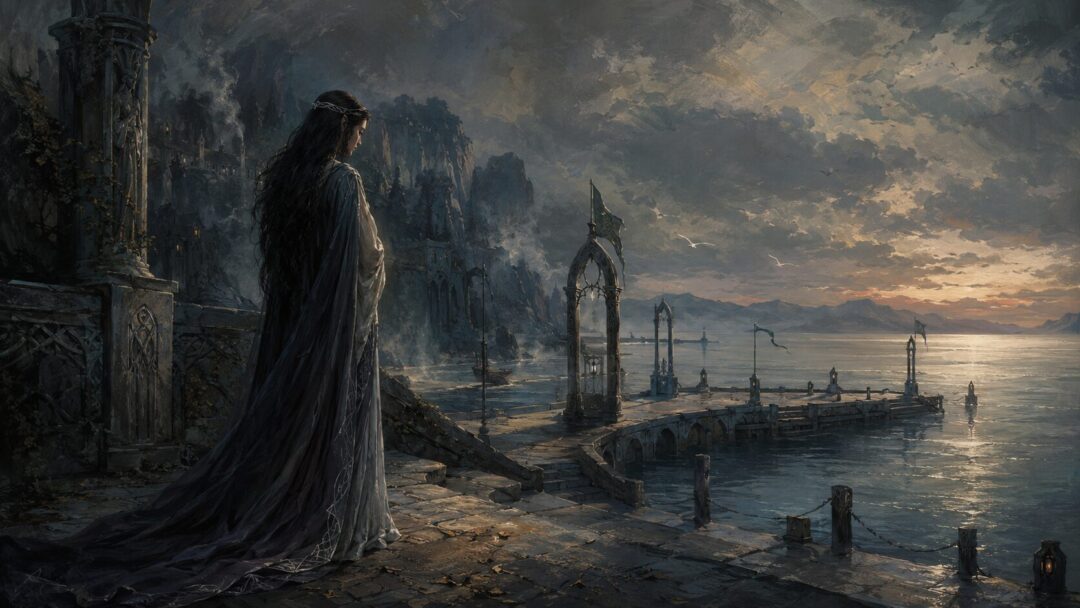
At the end of the Third Age, the Sea becomes a symbol of release.
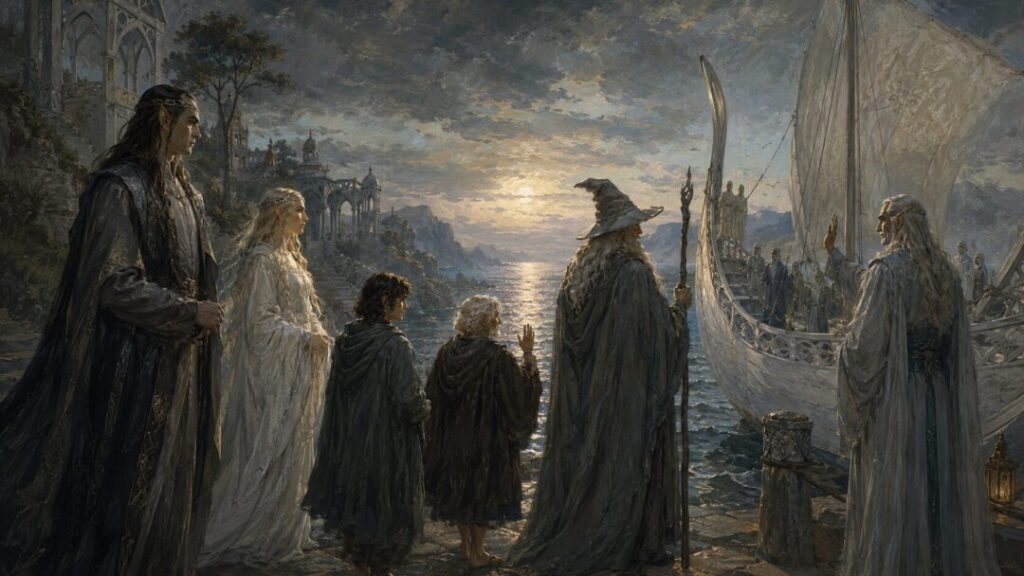
Elrond sails.
Galadriel sails.
Gandalf sails.
Bilbo and Frodo, though mortal, are permitted to go with them.
The Grey Havens become the last visible threshold between Middle-earth and the Undying Lands. For the Elves, it is a homecoming. For Frodo and Bilbo, it is a mercy. For Gandalf, it is a return after long labour.
But Arwen does not go.
This is what makes her ending so painful. She is Elrond’s daughter. She is of the Half-elven line. She has lived for thousands of years with the life of the Eldar. If anyone seems as though she should have a place on the ships, it is Arwen Undómiel.
And yet, after Aragorn’s death, she says that there is no ship now that would bear her away.
At first, this sounds like a matter of timing. The ships have left. The harbour is empty. The chance is gone.
But the deeper answer is not about missing a ship.
It is about the choice Arwen made long before.
The Ships Were Never Just Transportation
The ships that leave from the Grey Havens are not ordinary vessels.
They do not simply cross the ocean as ships once did in the Elder Days. After the Downfall of Númenor and the changing of the world, the way to the West is no longer open to ordinary mariners. The Straight Road remains only by special grace, and it is not a route that mortals can simply discover or claim.
For the Elves, sailing West is part of their nature and destiny. They belong ultimately to the world until its end, and Aman is the deathless land appointed for them and the Powers. Their departure from Middle-earth is not death. It is removal from a world that is fading for them.
This matters because the Grey Havens are not a universal escape door.
They are not heaven.
They are not a reward system.
They are not open to anyone who has suffered enough.
When mortals are allowed to sail, it is exceptional.
That exception is the key to understanding Frodo and Bilbo. It is also the key to understanding why Arwen’s case is completely different.
Why Frodo Could Go
Frodo is allowed to sail because he is a Ring-bearer.
But even that must be understood carefully.
Frodo does not go West to become immortal. The Undying Lands do not make mortals deathless. That is one of the most common misunderstandings of the ending. Mortals who are permitted to dwell in Aman remain mortal. Their death is delayed or gentled, but not abolished.
Frodo’s voyage is therefore not an escape from the fate of Men.
It is a healing.
By the time the Shire is restored, Frodo is not restored with it. His wounds remain. The knife-stroke from Weathertop, the burden of the Ring, the torment of the Quest, and the memory of what happened at the Cracks of Doom do not vanish simply because Sauron is defeated.
The world is saved, but Frodo is not made whole.
That is why his departure is so quiet and sorrowful. He does not leave because he no longer loves the Shire. He leaves because the Shire can no longer heal what has been broken in him.
His passage West is a special grace given to one who carried the impossible burden of the Ring.
It does not contradict mortality.
It comforts mortality.
Why Bilbo Could Go
Bilbo’s case follows the same pattern.
He too bore the One Ring, though he did not understand its full nature when he first possessed it. He kept it for many years, and even though he showed remarkable resistance by giving it up voluntarily, the Ring still affected him.
It stretched his life.
It marked him.
It left him diminished when its power was gone.
Bilbo’s passage is not a grand reward for adventure. It is not a prize for being clever in a dragon’s lair or brave beneath the Misty Mountains.
It is mercy for a Ring-bearer.
Like Frodo, Bilbo remains mortal. The West does not erase death for him. It gives him rest before death.
That distinction is essential.
Frodo and Bilbo are not allowed to sail because mortals may freely enter the Undying Lands. They are allowed because their wounds are bound to a burden no mortal was meant to carry, and because a special permission is granted to them.
Their voyage is an exception.
Arwen’s choice is not.
Why Gandalf Could Go
Gandalf’s departure belongs to another category entirely.
He is not a mortal man. He is one of the Istari, known in the West as Olórin, a Maia sent into Middle-earth to oppose Sauron not by domination, but by counsel, courage, and guidance.
His body in Middle-earth can suffer. He can be weary. He can die in the form he has taken, as he does after the battle with the Balrog. But his nature is not the nature of Men, Hobbits, or Dwarves.
When Gandalf sails West, he is not being granted the fate of Elves or the healing of a mortal Ring-bearer in the same sense as Frodo.
He is returning.
His task is finished. Sauron has fallen. The age in which the Istari were needed has passed. Gandalf leaves Middle-earth because his mission there has ended.
So the question should not be, “Why could Gandalf go when Arwen could not?”
Gandalf’s road was always different.
He came from the West under authority.
He laboured in Middle-earth for a purpose.
And when that purpose was fulfilled, he went back.
Arwen was not returning to her origin in that way. She was choosing her end.
Arwen’s Choice Was Real
Arwen was one of the Half-elven.
That does not simply mean she had mixed ancestry in a casual sense. Her line descends from unions of Elves and Men, most famously through Eärendil and Elwing, and the Half-elven were given a choice of kindred. Elrond chose the fate of the Elves. His brother Elros chose the fate of Men and became the first king of Númenor.
Arwen inherited that possibility of choice through Elrond.
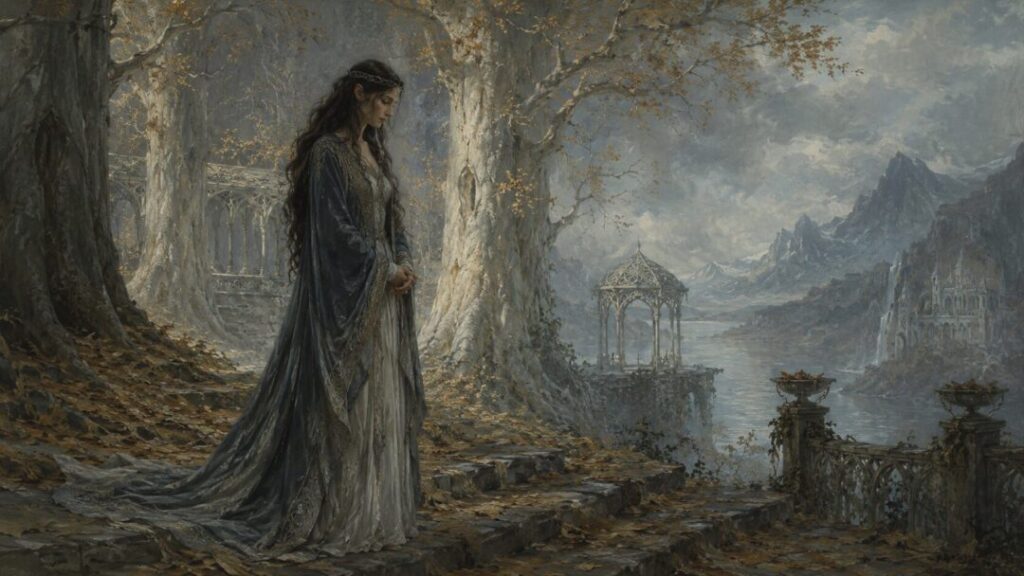
For most of her long life, she lived as one of the Eldar. But by choosing Aragorn, she also chose the mortal fate. This is not presented as a temporary condition. It is not treated as a vow she can revoke when sorrow becomes too heavy.
Her love for Aragorn is inseparable from the doom she accepts.
That is why her story echoes Lúthien. Lúthien also chose mortality for love of Beren. Arwen’s choice is not identical in every detail, but the parallel is unmistakable within the story. She becomes, in the later age, the great reflection of that older tragedy.
The beauty of the choice is real.
So is the cost.
She Did Not Merely Miss Elrond
One of the most heartbreaking details is that Arwen is separated from Elrond.
When Elrond sails West, father and daughter are divided not merely by distance, but by fate. The Sea lies between them, but the deeper separation is a doom “beyond the end of the world.”
That phrase matters.
Arwen is not simply staying behind for a few mortal years before taking a later ship. Her decision has placed her where Elrond cannot follow, and where she cannot follow him. Elrond remains within the destiny of the Elves. Arwen has accepted the destiny of Men.
This is why her remaining in Middle-earth is not just romantic devotion.
It is irreversible loss.
She gives up more than a homeland. She gives up the road back to her people, her father, and the deathless life she once possessed.
The tragedy is not that Arwen loves Aragorn.
The tragedy is that love opens a door that closes another behind her.
Why “No Ship” Could Bear Her
When Arwen says there is no ship that would bear her hence, the statement should not be reduced to harbour logistics.
Yes, the great departures have already happened. Elrond has gone. The time of the Elves has ended. Middle-earth has passed into the Dominion of Men.
But the more important truth is that Arwen is no longer walking the Elven road.
A ship to the West would not undo her mortality. It would not restore her former fate. It would not reunite her permanently with Elrond in the destiny of the Eldar. Mortals who enter Aman still die, and Arwen’s sorrow is not merely that she will die, but that she has now come to understand mortality from within it.
This is the bitter turn in her story.
Earlier, she chose mortality for love. After Aragorn dies, she experiences its full weight. She had accepted the Gift of Men, but only when the hour comes does she feel how bitter that gift can be to receive.
That does not mean the Gift is evil.
The legendarium is careful here. Death for Men is not originally a punishment in the same way many readers might assume. It is a mystery, a departure beyond the circles of the world. But to the Elves, who remain bound to Arda, it is terrifying because it is unknown.
Arwen, who was born among Elves, must now face that unknown.
No ship can carry her away from it.
Frodo’s Voyage Was Healing, Not Escape
This is where the contrast with Frodo becomes clearest.
Frodo goes West because he cannot be healed in Middle-earth. His voyage is compassionate. It is a response to wounds.
But Frodo is not rejecting mortality. He is not trying to become an Elf. He is not being restored to an immortal fate he once possessed.
He remains what he is.
Arwen’s situation is different because she once had another path available. She could have gone West with Elrond. She could have remained within the fate of the Eldar. But she chose otherwise.
For Frodo, the West is a place of healing before the end.
For Arwen, the West would represent the path she has renounced.
That is why the same Sea can mean two very different things.
To Frodo, it is mercy.
To Gandalf, it is return.
To Elrond, it is homecoming.
To Arwen, it is the life she gave up.
The Loneliness of Arwen’s Ending
After Aragorn dies, Arwen leaves Minas Tirith and goes to Lórien.
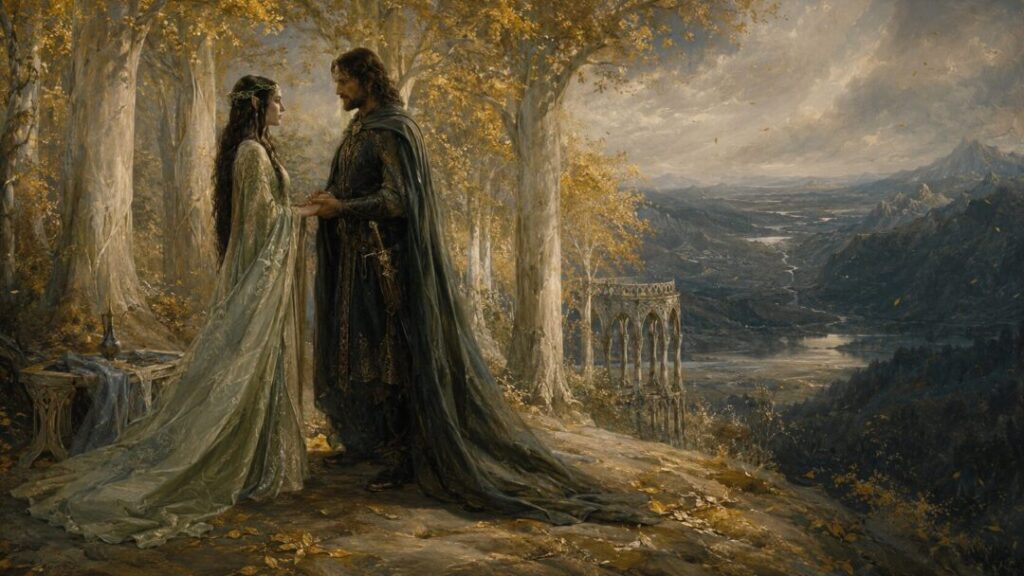
But Lórien is no longer what it was. Galadriel has gone. The power of her Ring has ended. The golden wood is fading into memory. Arwen comes at last to Cerin Amroth, the place bound to her betrothal with Aragorn, and there her story ends.
The loneliness of this matters.
She does not die in splendour at court. She does not sail into the light with the Elves. She does not receive a visible consolation that removes the pain of her choice.
She goes to a place of memory.
And there, with the leaves fallen and the age changed, Arwen dies as one who has chosen the fate of Men.
It is one of the quietest endings in The Lord of the Rings, and one of the most devastating.
Not because it is cruel.
Because it is complete.
The Real Answer
So why could Arwen no longer go on a ship when Gandalf and Frodo could?
Because Gandalf was not mortal in the same way. He was a Maia returning West after his appointed work was done.
Because Frodo was a mortal Ring-bearer granted exceptional healing, not immortality.
And because Arwen had chosen the fate of Men.
Her choice was not symbolic. It was not temporary. It was not cancelled by grief. Once she bound her life to Aragorn’s, she accepted the road that leads beyond the world, not the road that bends back to Aman.
The ships could cross the Sea.
They could not cross the boundary of her chosen doom.
That is what makes Arwen’s final scene so powerful. The tragedy is not that nobody came for her. The tragedy is that no coming ship could give her back what she had freely surrendered.
Arwen did not miss the last ship.
She had already chosen a different shore.
Sources & Notes
- J.R.R. Tolkien, The Lord of the Rings, Appendix A, “The Tale of Aragorn and Arwen” — Arwen’s choice of the fate of Men, her parting from Elrond, the “no ship” line, and her death at Cerin Amroth.
- J.R.R. Tolkien, The Lord of the Rings, Book VI, Chapter 9, “The Grey Havens” — Frodo, Bilbo, Gandalf, Elrond, and Galadriel depart from Middle-earth by ship.
- J.R.R. Tolkien, The Silmarillion, “Akallabêth” — after the Downfall of Númenor, the world is changed and the Straight Road remains only for those permitted to take it.
- J.R.R. Tolkien, The Silmarillion, “Of the Voyage of Eärendil and the War of Wrath” — the Half-elven choice is established through Eärendil, Elwing, Elrond, and Elros.
- J.R.R. Tolkien, The Letters of J.R.R. Tolkien, Letter 154 — Frodo’s passage West is described as healing before death, not a grant of immortality to a mortal.