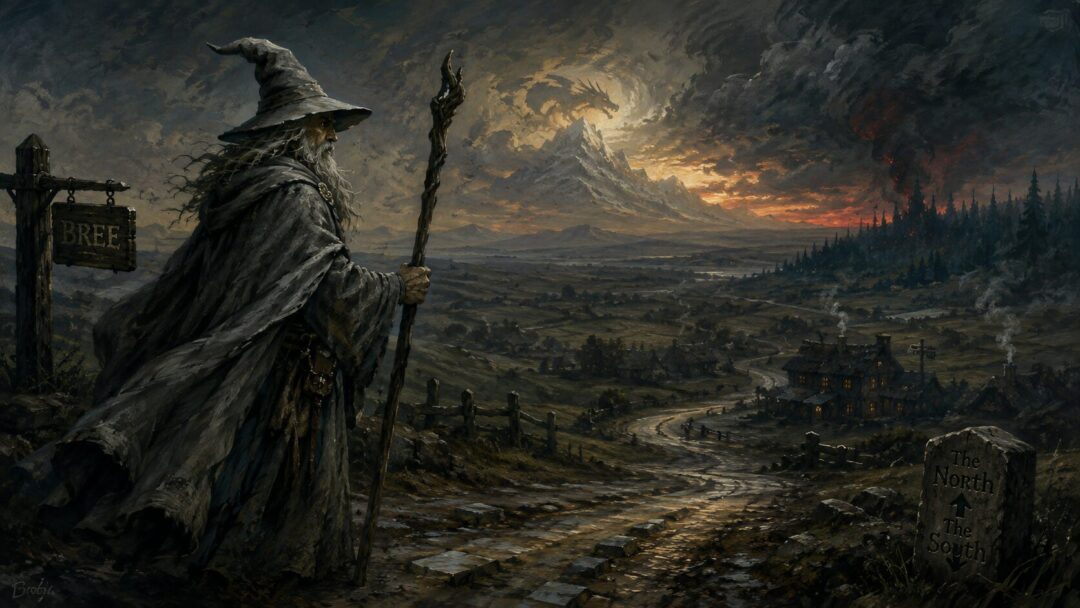
It seems like the obvious question.
If Gandalf was powerful enough to face the Balrog in Moria, if he was one of the Wise, if he understood ancient powers better than almost anyone else in Middle-earth, then why did he not simply go to the Lonely Mountain and fight Smaug himself?
Why send thirteen Dwarves and one nervous Hobbit into danger?
Why trust a secret door, an old map, and a burglar who had never seen a Dragon before?
At first, the answer appears simple: Smaug was too powerful.
But that is only part of it, and perhaps not even the most important part.
The deeper answer is that Gandalf was not trying to win a duel.
He was trying to prevent a future war.
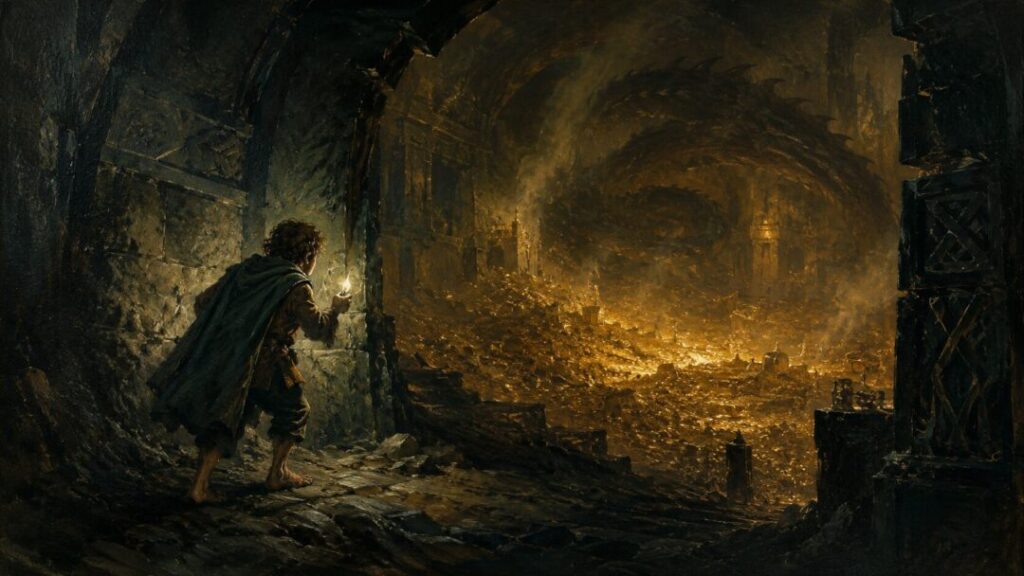
Smaug Was Not Just a Dragon
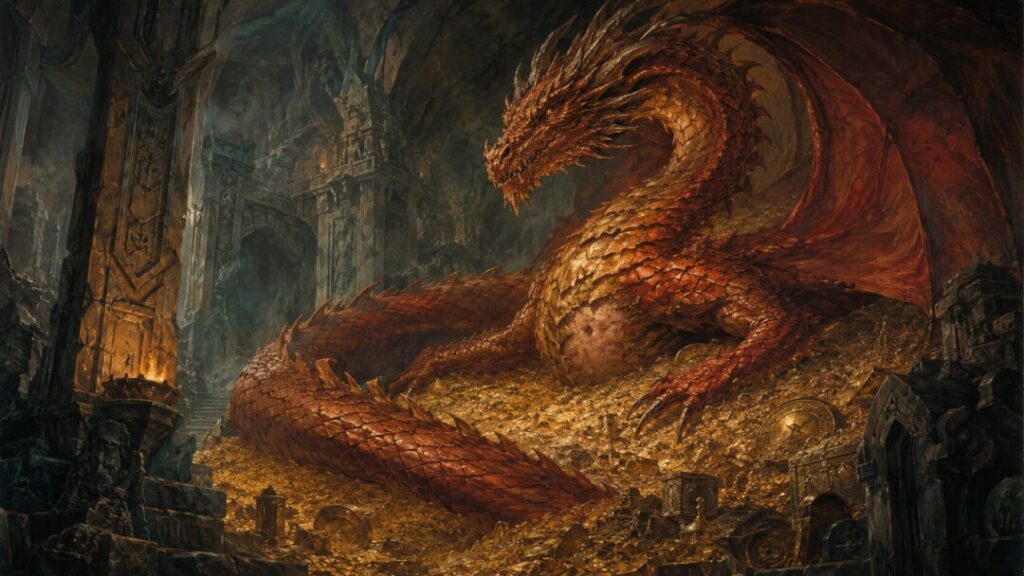
Smaug was terrifying in the most immediate sense.
He had destroyed the Kingdom under the Mountain. He had burned Dale. He had driven Thrór and his people into exile. For many years, he remained in Erebor, sleeping on the treasure of the Dwarves and turning the Lonely Mountain into a place of dread.
But Gandalf saw more than the ruin of one kingdom.
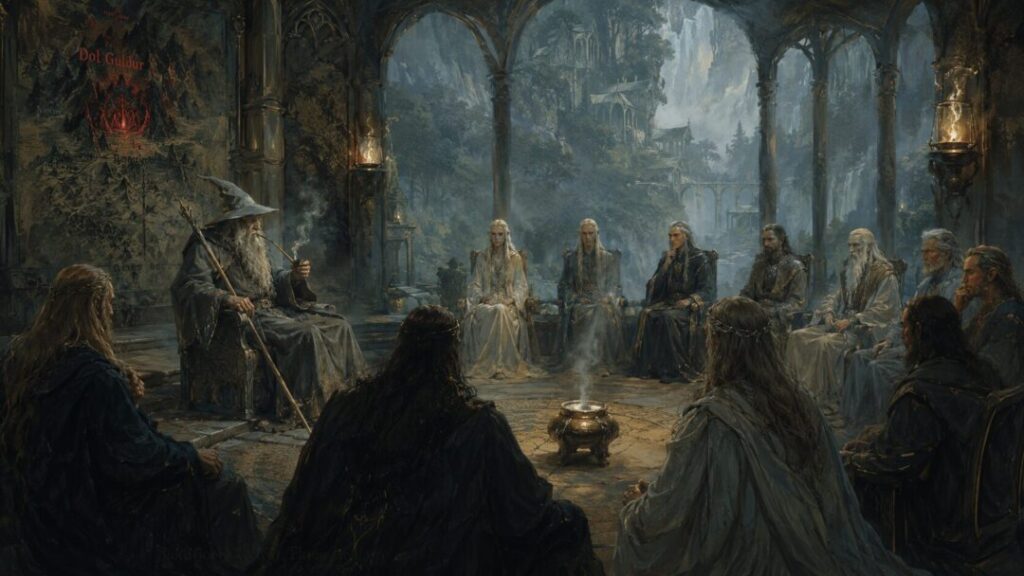
In The Quest of Erebor, the danger is placed in a wider frame: Smaug could become a terrible weapon if Sauron used him. At that time, Sauron was not yet openly in Mordor. He was the dark power in Dol Guldur, in southern Mirkwood, and Gandalf had already discovered that this “Necromancer” was not merely some lesser sorcerer.
That changes everything.
Smaug was not merely a treasure-hoarding beast. He was a threat sitting in the North at exactly the wrong moment in history.
Erebor had fallen. Dale had fallen. The strong northern barrier that might have resisted armies from the East or attacks through the northern passes was gone. If Sauron grew stronger while Smaug remained in the Mountain, the North could become horribly exposed.
Gandalf was not thinking like an adventurer.
He was thinking like a guardian.
A Direct Attack Was Not the Same as a Solution
This is where the question becomes more complicated.
Could Gandalf have fought Smaug?
The texts never give a simple answer. They do not say, “Gandalf was too weak to face him.” They also do not say, “Gandalf could certainly have killed him.” Any absolute answer goes beyond what we are told.
What we can say is that a direct fight would have been reckless.
Smaug was ancient, cunning, armored, and devastating. He was not a mindless animal. In The Hobbit, he is intelligent, suspicious, proud, and dangerous in speech as well as in fire. A direct confrontation inside or near the Mountain would not have guaranteed anything except catastrophe if it failed.
And failure would not have been private.
If Gandalf marched openly against Smaug and lost, the Dragon would be alerted. The Dwarves’ hopes would be ruined. The North would remain defenseless. Sauron’s shadow would continue to grow. Worse still, the Enemy might become aware that the Wise were moving pieces against him.
Gandalf needed Smaug dealt with.
But he needed it done in a way that did not begin the war too soon.
Gandalf Was Not Sent to Conquer Middle-earth
There is another reason Gandalf’s choices matter.
He was one of the Wizards, the Istari. The Wizards were not simply wandering magicians who could use unlimited force whenever they wished. They were sent to Middle-earth to aid the Free Peoples against Sauron, but their work was meant to be done through counsel, persuasion, encouragement, and the awakening of resistance—not by seizing power for themselves. The lore of the Istari stresses that they were embodied, limited, and not meant to dominate by force or fear.
This does not mean Gandalf never fought.
He clearly did. He fought the Balrog. He opposed the Nazgûl. He stood in moments of direct peril.
But those moments do not make him a conqueror.
Gandalf’s deepest pattern is not to replace the courage of others with his own power. He kindles courage in others. He brings the right people together. He sees the hidden importance of those whom the proud overlook.
That is exactly what happens with the Quest of Erebor.
Thorin wants revenge and restoration.
The Dwarves want their home and treasure.
Bilbo wants, at first, to be left alone.
But Gandalf sees that all of these smaller motives may become part of something larger.
Why Bilbo Was the Key
If Gandalf had wanted brute force, Bilbo would have made no sense.
That is the point.
Bilbo was not chosen because he was strong. He was not chosen because he had experience. He was not chosen because he looked heroic.
He was chosen because he was unexpected.
In The Quest of Erebor, Gandalf’s reasoning includes the fact that Smaug would not recognize the scent of a Hobbit. This matters because the plan was not to storm the Mountain. It was to enter it secretly. Bilbo was to be a burglar, not a warrior.
That detail is easy to miss, but it is crucial.
Smaug knew Dwarves. He knew Men. He knew the patterns of greed, pride, fear, and flattery. But a Hobbit from the Shire was outside his expectations.
Bilbo’s smallness became a kind of protection.
Not absolute protection. Not safety.
But possibility.
And in Middle-earth, possibility often matters more than visible power.
The Secret Door Was the Strategy
The map and key were not decorative adventure objects.
They were the entire logic of the plan.
A frontal attack on Erebor would have been madness. Smaug had destroyed armies and cities. The Mountain was his lair. To challenge him openly would be to meet him on terms he understood perfectly.
The secret door offered a different kind of contest.
It allowed the company to approach Smaug through stealth rather than battle. It allowed Bilbo to enter where an army could not. It allowed knowledge to be gained before action was taken.
And knowledge is what ultimately makes Smaug vulnerable.
Bilbo does not kill the Dragon. Gandalf does not kill the Dragon. Thorin does not kill the Dragon.
But Bilbo discovers the bare patch in Smaug’s armor, and that information reaches Bard through the thrush. Bard then shoots the fatal arrow when Smaug attacks Lake-town.
This chain of events is fragile.
It depends on secrecy, chance, courage, old knowledge, and small acts performed at the right moment.
That is very different from a wizard’s duel.
It is also far more characteristic of the moral shape of Middle-earth.
Gandalf Had Another Enemy in Mind
Gandalf’s concern with Smaug was tied to his concern with Dol Guldur.
The White Council had already debated action against the shadow there. Gandalf had urged an attack earlier, but Saruman resisted. In 2941, the same year as the Quest of Erebor, the White Council finally moved against Dol Guldur, and Sauron withdrew to Mordor.
This timing matters.
The Quest of Erebor was not an isolated treasure hunt happening beside unrelated events. It belonged to the same gathering crisis.
In the south of Mirkwood, Sauron was preparing for open return.
In the North, Smaug occupied the Mountain.
If both threats remained unchecked, the future War of the Ring could have looked very different.
This does not mean Gandalf controlled every outcome. He did not. The texts repeatedly show that even the Wise do not see all ends.
But Gandalf understood enough to know that Smaug had to be removed before Sauron could make use of him.
And he understood that the North had to be restored.
The North Needed a King, Not a Wizard
There is another quiet truth behind Gandalf’s plan.
Even if Gandalf had somehow killed Smaug alone, that would not have restored Erebor.
A dead Dragon would leave a mountain full of treasure, competing claims, old grudges, and no settled order. The Dwarves still had to return. Thorin still had to confront his inheritance. Dale still had to be part of the world again. The peoples of the North still had to become capable of resistance.
Gandalf could not simply solve that by force.
Middle-earth did not need a wizard standing over a conquered hoard.
It needed living peoples restored to courage, place, and responsibility.
That is why Thorin’s role matters, even with all his flaws. That is why Bard matters. That is why the rebuilding of Dale and Erebor matters. By the time of the War of the Ring, the North is not empty. It resists.
The death of Smaug makes that possible.
But the death alone is not the whole victory.
The Balrog Comparison Misleads Us
Many readers bring up the Balrog.
If Gandalf could fight the Balrog, why not Smaug?
But the situations are not the same.
In Moria, Gandalf confronts the Balrog because there is no other choice. The Fellowship is trapped. The enemy is upon them. Gandalf stands on the bridge to prevent immediate disaster.
That is not a planned campaign of conquest.
It is a desperate act of protection.
And Gandalf dies from it.
That detail should not be ignored. His victory over the Balrog is not proof that direct combat was easy or preferred. It shows the cost of such a confrontation, even for him.
With Smaug, Gandalf had time to plan. He had a map. He had Thorin’s claim. He had the chance to use secrecy. He had the possibility of involving someone Smaug would not expect.
So he chose the path that gave Middle-earth a future, not the path that looked most heroic.
The Real Answer
Gandalf did not simply fight Smaug because Smaug was not simply a monster to be slain.
He was a strategic danger in the North.
He was a possible weapon for Sauron.
He occupied a kingdom whose restoration mattered.
And he could not be approached as though Middle-earth were saved by power alone.
The texts do not require us to believe Gandalf was helpless. They also do not allow us to claim he could have defeated Smaug with certainty. The safest answer is more subtle: Gandalf chose not to make the matter a direct contest of power because that was not his mission, not his method, and not the wisest strategy.
He needed a burglar.
He needed Thorin’s claim.
He needed the secret door.
He needed the Dragon disturbed in a way that would expose what force might never have found.
And above all, he needed the North awakened before the Shadow fully returned.
That is why the Quest of Erebor begins in such an unlikely way.
Not with a host.
Not with a challenge.
Not with Gandalf raising his staff before the gates of the Mountain.
But with a knock on a round green door in the Shire.
Because the answer to Smaug was never going to look like power.
It was going to look like Bilbo Baggins.
Sources & Notes
- J.R.R. Tolkien, Unfinished Tales, “The Quest of Erebor” — Gandalf explains that Smaug in the North could become a devastating weapon if Sauron used him, placing Thorin’s quest inside the larger strategy against the Shadow.
- J.R.R. Tolkien, Unfinished Tales, “The Istari” — the Wizards are sent to aid and counsel resistance to Sauron, not to dominate Middle-earth by open rule or overwhelming force.
- J.R.R. Tolkien, The Hobbit, Chapter 12, “Inside Information” — Bilbo’s secret entry, his conversation with Smaug, and the discovery of the bare patch show why stealth and knowledge mattered more than a direct challenge.
- J.R.R. Tolkien, The Hobbit, Chapter 14, “Fire and Water” — Bard kills Smaug only after the thrush carries Bilbo’s information about the weak spot, completing the fragile evidence chain the article describes.
- J.R.R. Tolkien, The Lord of the Rings, Appendix B, “The Tale of Years” — the chronology links the Quest of Erebor with the White Council’s attack on Dol Guldur and later shows Erebor and Dale resisting Sauron’s forces in the War of the Ring.