At first glance, Frodo’s journey looks like the opposite of loneliness.
He does not leave the Shire alone. He begins with Sam, Merry, and Pippin. He is helped by Aragorn, protected by the Fellowship, sheltered in Rivendell and Lothlórien, guided for a time by Gollum, and loved with almost unbreakable loyalty by Samwise Gamgee.
If the story has one emotional image that most readers carry with them, it is not Frodo standing alone.
It is Sam beside him.
And yet the deeper movement of the Quest is more painful than that.
The closer Frodo comes to Mordor, the more the Ring makes his burden impossible to share. Not because friendship fails. Not because Sam is weak. Not because the Fellowship was false.
But because the Ring works inward.
It attacks the place where companionship cannot fully reach.
The Quest Begins With Fellowship
When Frodo accepts the task at the Council of Elrond, he does not do so as a hero eager for glory. He speaks because no one else can safely solve the problem of the Ring.
The Wise cannot use it. Boromir’s desire to turn it against Sauron reveals the danger plainly. Even good intentions become perilous when the Ring is involved, because the Ring is not a neutral weapon waiting for the right hand.
It was made by Sauron. Its purpose is mastery.
That matters for Frodo’s loneliness.
From the beginning, the task is surrounded by help but not transferable. Elrond does not force the burden onto Frodo. The text is careful about that. Frodo chooses it freely, and the Fellowship is formed to aid him.
But aid is not the same as replacement.
The others can protect the Ring-bearer. They can guide him. They can fight beside him. They can die for him.
They cannot become him.
This is the first quiet loneliness of Frodo’s role: he is accompanied, but the burden has already marked out a space only he can occupy.
The Ring Makes Help Dangerous
The breaking of the Fellowship shows why Frodo cannot simply remain surrounded by strength.
Boromir is not evil. He is proud, desperate, and deeply burdened by the war against Mordor, but he is not a servant of Sauron. That is exactly what makes his fall so frightening.
The Ring does not need Boromir to hate Middle-earth. It only needs him to believe that power can be seized for a good cause.
When Boromir tries to take the Ring from Frodo, Frodo learns something terrible. The danger is not only outside the company. It can move through the company itself.
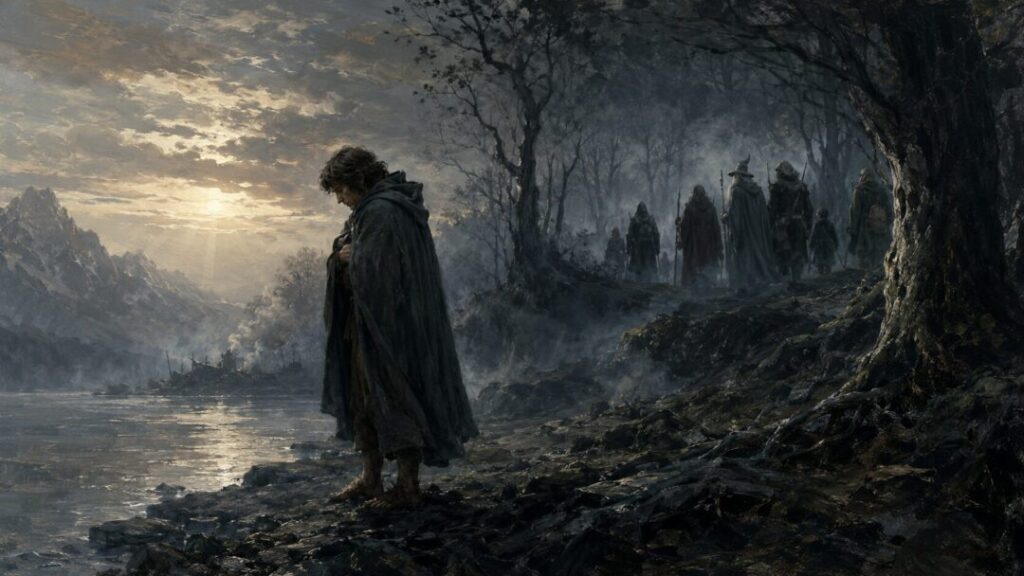
After that moment, Frodo’s decision to go on alone is not just secrecy or panic. It is a grim recognition of what the Ring does to those near it.
The Fellowship was created to protect the Quest.
But the Ring can turn protection into possession.
That is why Frodo’s isolation deepens. The more precious and dangerous the Ring becomes, the harder it is for anyone to stand near him without being tested by it.
Sam Can Follow, But He Cannot Replace Frodo
Sam’s loyalty is the great answer to Frodo’s loneliness, but it is not a complete escape from it.
This is important.
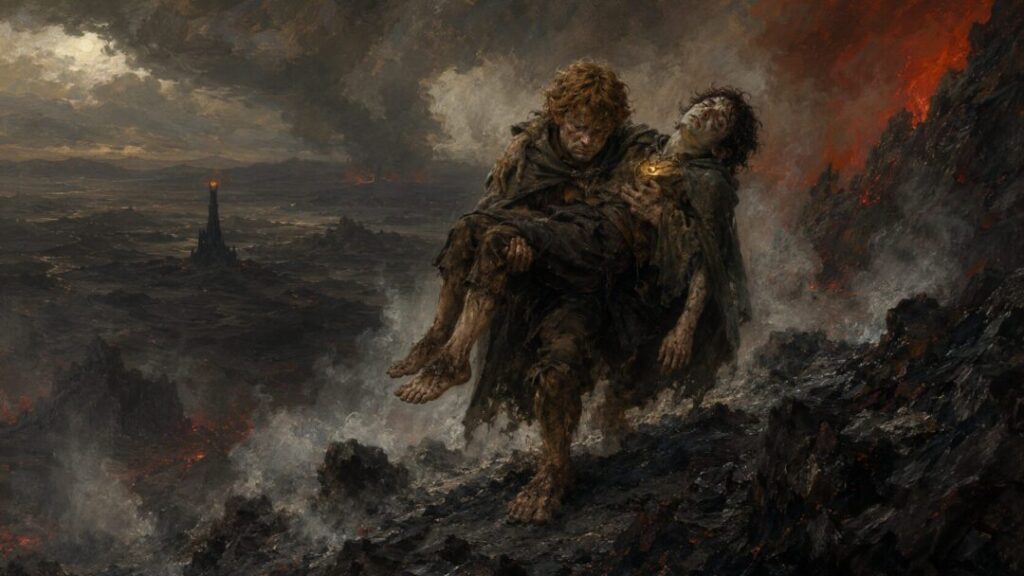
The story never suggests that Sam’s love is useless. Without Sam, Frodo almost certainly would not reach Mordor. Sam rescues him from the tower of Cirith Ungol. Sam gives him strength when Frodo has almost none left. Sam carries food, water, hope, and finally Frodo himself.
But Sam cannot carry the burden in Frodo’s place.
He briefly bears the Ring after believing Frodo dead. During that time, he is tempted too. His temptation is shaped by his own nature: visions of himself as a mighty figure making Mordor into a garden. The vision is almost comic in scale, but the danger is real. The Ring speaks to the bearer through what the bearer can imagine.
Sam rejects it, and that matters.
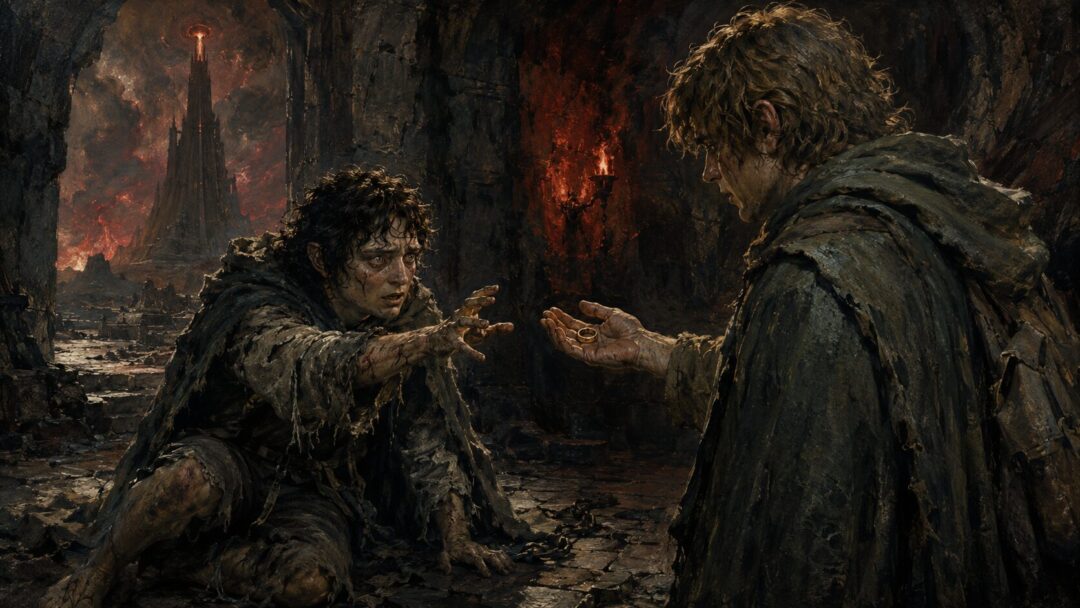
But when he returns the Ring to Frodo, the scene is painful because Frodo is already changed by possession. For a moment, he sees Sam not simply as his friend, but as someone who might keep the Ring from him.
That is one of the cruelest effects of the Ring.
It makes love feel like threat.
Sam has crossed Mordor for Frodo. He has risked everything for him. Yet the Ring can still create a flash of suspicion between them.
That is not because Frodo no longer loves Sam. It is because the Ring is tightening its hold.
Gollum Shows Frodo His Possible Future
Gollum’s presence makes Frodo’s loneliness even sharper.
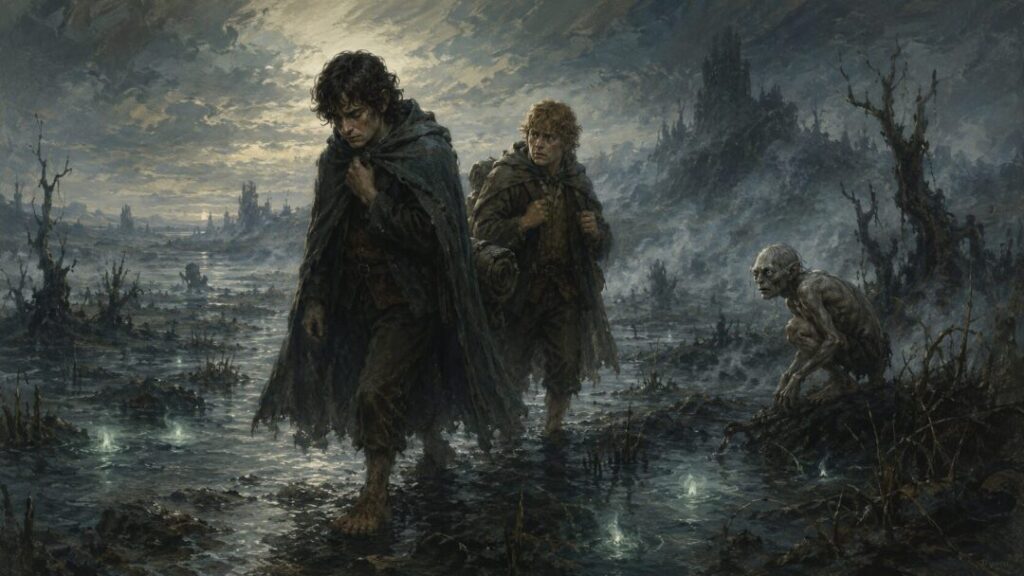
On one level, Gollum is a guide. He knows the hidden ways into Mordor. Without him, Frodo and Sam would not know the path through the Dead Marshes or toward Cirith Ungol.
But Gollum is also a warning.
He is what long possession can do to a creature. He has been divided against himself. His love and hatred of the Ring have eaten through his identity until even his name becomes unstable: Sméagol and Gollum, memory and appetite, pity and malice.
Frodo sees this more clearly than Sam does.
Sam mostly sees danger, treachery, and a miserable creature who might betray them. He is not wrong. Gollum is dangerous. He does betray them.
But Frodo also sees kinship.
This does not mean Frodo is already like Gollum in every way. The text does not say that. Frodo remains merciful, courageous, and morally awake for much of the journey.
But the longer he carries the Ring, the more Gollum becomes a living image of what possession can make of a bearer.
That knowledge isolates Frodo.
Sam can hate Gollum more simply. Frodo cannot. Frodo knows, in a way Sam does not fully know, that Gollum is not merely an enemy outside him.
He is a possibility ahead of him.
Mordor Removes Every Comfort
By the time Frodo and Sam enter Mordor, the loneliness of the burden becomes physical.
The landscape itself offers almost nothing that nourishes ordinary life. Water is scarce. Food is failing. The air is oppressive. The land is watched, poisoned, and emptied of comfort.
This matters because Frodo is not only carrying an object. He is carrying it into the place where its maker’s power is strongest.
The Ring grows heavier in meaning as well as in felt burden. Frodo becomes increasingly exhausted, and his inner world narrows. He thinks less of return, less of ordinary life, less of the Shire as a living place he expects to see again.
Sam still remembers. Sam thinks of food, gardens, stories, and home. That memory helps keep the Quest human.
But Frodo is being drawn toward something more barren.
Near the end, he tells Sam that he cannot recall the taste of food, the sound of water, or the touch of grass. That moment is devastating because it shows what the Ring and Mordor together have done.
They have not only weakened his body.
They have cut him off from the remembered texture of life.
The Ring Does Not Simply Tempt Frodo With Power
One reason Frodo’s loneliness is so subtle is that his temptation is not always described in the same way as Boromir’s or Sam’s.
Boromir imagines using the Ring as a weapon. Sam briefly imagines a heroic transformation of Mordor into a garden. Galadriel sees clearly the terrible form her own greatness might take if she accepted the Ring.
With Frodo, the final danger becomes more inward and more absolute.
At the Cracks of Doom, he does not declare a plan to overthrow Sauron or rule kingdoms. He claims the Ring for his own.
That distinction matters.
By then, the Ring’s victory over Frodo is not expressed as a grand political program. It is possession itself. The Ring has brought him to the point where letting go is no longer something he can do by unaided will.
This is why his loneliness reaches its darkest form at the very place where the Quest is supposed to end.
No friend can make that final surrender for him.
Sam can stand there. Gollum can attack. Providence, pity, and earlier mercy can turn the catastrophe into deliverance.
But Frodo himself has reached the limit.
The Ring-bearer is most alone at the edge of the Fire.
Victory Does Not Undo the Isolation
After the Ring is destroyed, Middle-earth is saved.
But Frodo is not simply restored.
This is one of the most important truths in the ending of The Lord of the Rings. The Shire can be scoured and healed. Gardens can grow again. The rightful king can return. The Shadow can pass.
Yet Frodo remains wounded.
His old hurts return on their anniversaries. The wound from Weathertop, Shelob’s sting, and the memory of the burden do not disappear just because the Ring is gone. The book does not present Frodo as corrupted beyond mercy, but it also refuses to pretend that victory erases what he endured.
That is why his return to the Shire is so bittersweet.
Sam can marry Rosie. Merry and Pippin can grow into honored figures. The Shire can remember the Travellers as heroes, even if it does not fully understand what happened beyond its borders.
Frodo, however, cannot fully re-enter the life he saved.
He has become too deeply marked by the road.
Why Sam’s Love Still Matters
None of this makes Sam’s companionship smaller.
It makes it greater.
Sam’s love does not save Frodo by magically removing the burden. It saves him by staying as near as anyone can stay.
That is a more serious kind of friendship than simple rescue.
Sam cannot enter the deepest chamber of Frodo’s suffering. He cannot take the Ring’s pressure into himself without becoming a Ring-bearer too. He cannot heal every wound afterward. He cannot make Frodo belong again in the Shire.
But he can refuse to abandon him.
He can carry him when he cannot walk.
He can remember hope when Frodo cannot.
He can remain faithful even when Frodo is altered by something Sam does not fully understand.
That is why the story is not saying friendship fails.
It is saying that love has limits, and that those limits do not make love meaningless.
Sam cannot carry the Ring for Frodo.
But he can carry Frodo.
The Loneliness of the Ring-bearer
The Ring makes Frodo alone because it turns the burden inward.
It cannot be solved by numbers. A larger army would not make it safer. A stronger warrior would not make it purer. A wiser lord might be more dangerous, not less.
The Ring isolates because it creates a private struggle around possession, fear, temptation, pity, memory, and will.
Frodo is surrounded by some of the greatest help Middle-earth can offer. Still, the central cost falls on him in a way no one else can fully share.
That is the sorrow at the heart of his heroism.
He does not save the world by being untouched.
He saves it by carrying the touch of evil farther than anyone could reasonably bear, and by remaining merciful long enough for mercy to matter at the end.
Frodo’s loneliness is not a failure of friendship.
It is the price of being the Ring-bearer.
And that is why his final departure from Middle-earth feels less like an escape than a mercy.
The Shire was saved.
But Frodo could not be fully saved by the Shire.
Sources & Notes
- J.R.R. Tolkien, The Lord of the Rings, Book II, ch. 2 “The Council of Elrond”: Frodo freely accepts the Ring-bearer’s task after the Wise reject using the Ring and Boromir’s proposal exposes its danger.
- J.R.R. Tolkien, The Lord of the Rings, Book II, ch. 10 “The Breaking of the Fellowship”: Boromir’s attempt to seize the Ring shows how even loyal strength near Frodo can become a threat, prompting Frodo’s lonely departure.
- J.R.R. Tolkien, The Lord of the Rings, Book IV, ch. 1 “The Taming of Sméagol”: Frodo’s pity and insight into Gollum mark a Ring-bearer’s kinship that Sam cannot fully share.
- J.R.R. Tolkien, The Lord of the Rings, Book VI, ch. 1 “The Tower of Cirith Ungol”: Sam’s brief Ring-bearing and Frodo’s fierce reaction when it is returned show both Sam’s loyalty and the Ring’s power to make love feel dangerous.
- J.R.R. Tolkien, The Lord of the Rings, Book VI, ch. 3 “Mount Doom”: Frodo’s loss of ordinary memory, failure to surrender the Ring, and final deliverance through Gollum bring the Ring-bearer’s isolation to its crisis.
- J.R.R. Tolkien, The Lord of the Rings, Book VI, ch. 9 “The Grey Havens”: Frodo’s recurring wounds and departure from Middle-earth support the article’s point that saving the Shire does not mean he can fully return to it.