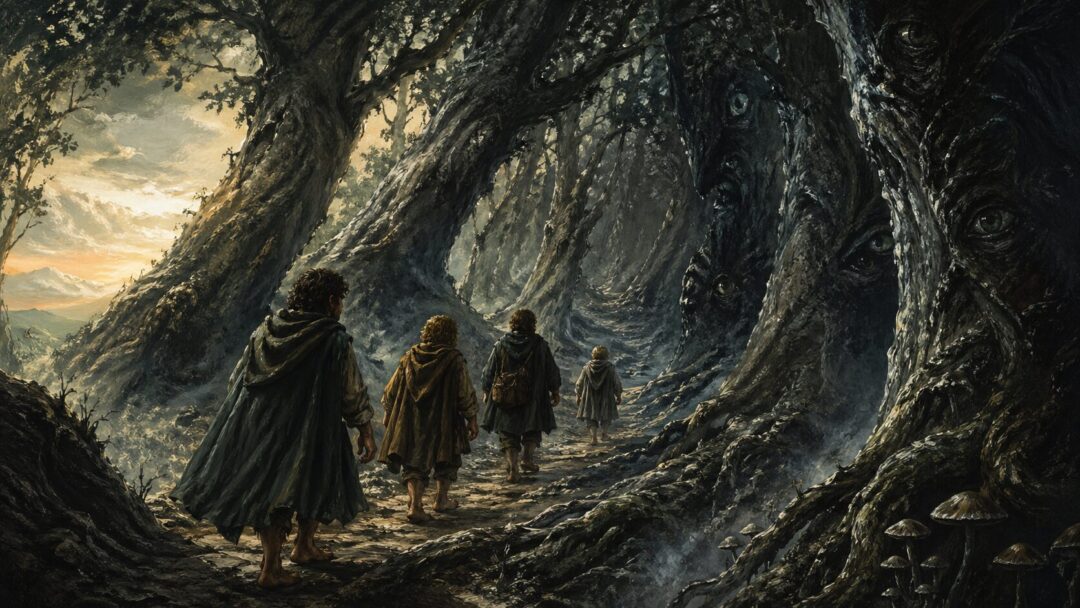
For many readers, Tom Bombadil is the great missing figure of the Lord of the Rings films.
The films give us the Shire, Rivendell, Moria, Lothlórien, Rohan, Gondor, Mordor, and the Grey Havens. They show the Ring’s terror, the breaking of the Fellowship, the fall of Boromir, the return of the King, and the final mercy shown to Frodo.
And yet one of the strangest figures in the book is absent completely.
No Old Forest.
No Goldberry.
No house of Tom Bombadil.
No Barrow-downs.
No moment where the Ring itself seems to fail in the hands of someone who does not desire it.
For some, this has always felt like a loss. For others, it was an obvious cut. But the real answer is more interesting than simply saying Tom was “too weird” for the films.
Tom Bombadil was not removed because he did not matter.
He was removed because he mattered in a way the films could barely afford to explain.
Tom Bombadil Appears Before the Story Has Fully Narrowed
In the book, Tom enters early in The Fellowship of the Ring, after Frodo and his companions leave the Shire but before they reach Bree.
This matters.
At that point, the story has not yet become the grand war-tale most viewers associate with The Lord of the Rings. The hobbits are not yet in Rivendell. The Fellowship has not been formed. Aragorn has not been revealed in his full importance. The Ring’s history is still unfolding slowly.
The early chapters still have something of the older, wandering quality of The Hobbit. The world is dangerous, but it is also full of odd songs, old paths, strange houses, talking trees, and ancient things that do not immediately explain themselves.
Tom belongs to that world.
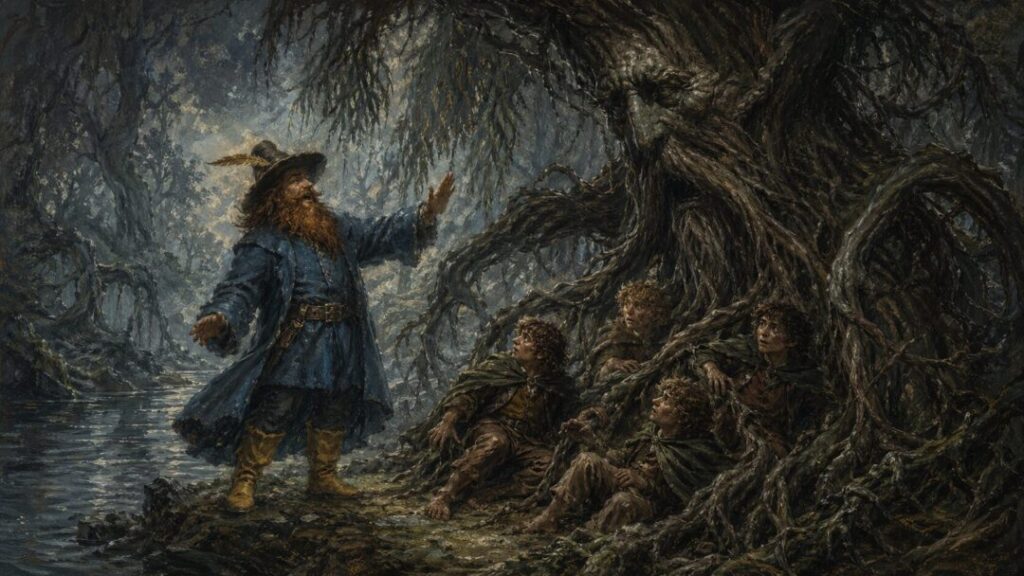
He does not arrive like a commander, a wizard, or a lord. He comes singing through the trees, and his first major act is not to reveal lore or give a strategy. He rescues the hobbits from Old Man Willow.
Then he brings them into his home, where Goldberry is waiting.
This section slows the journey. It lets the hobbits pass through a pocket of Middle-earth that feels almost outside the main war. The Shadow is present, but not supreme. Danger exists, but it is not yet organized into armies and sieges.
On the page, that pause is part of the enchantment.
In a film, it creates a structural problem.
The Films Needed Urgency
The film version of The Fellowship of the Ring is built around speed and pressure.
Frodo receives the Ring.
The Black Riders begin hunting.
Gandalf is delayed and imprisoned.
The hobbits flee the Shire.
Bree becomes dangerous.
Weathertop nearly kills Frodo.
Rivendell becomes the place where the true question must be faced: what can be done with the Ring?
That chain of events gives the film momentum.
Every scene pushes Frodo closer to the realization that the Ring is not just a dangerous heirloom. It is the central weapon of the Enemy. If Sauron regains it, the free peoples of Middle-earth are in mortal peril.
Tom Bombadil interrupts that momentum.
Not in the sense that his chapters are meaningless. They are not. But they do not move the film version of the plot in the same direct way. Tom does not send Frodo to Rivendell with a new mission. He does not join the Fellowship. He does not reveal the Ring’s full history. He does not fight the Nazgûl. He does not confront Sauron.
He opens the world sideways.
That is one of the reasons he is so memorable in the book.
It is also one of the reasons he is so difficult in a film.
Tom Creates a Question the Films Would Have to Answer
The greatest problem is not simply time.
It is the Ring.
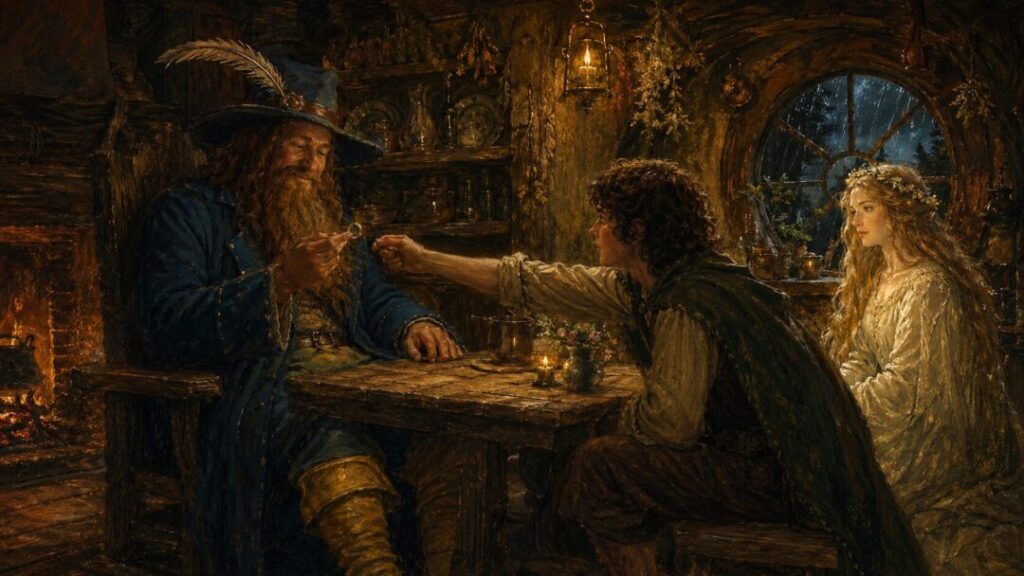
In Tom’s house, Frodo gives him the Ring. Tom handles it without fear. He puts it on, but he does not disappear. When Frodo later puts it on, Tom can still see him. The Ring does not seem to claim any authority over him.
This is one of the most astonishing scenes in the early book.
But it also raises an immediate question:
If Tom Bombadil is untouched by the Ring, why not give it to him?
The book does not ignore this. At the Council of Elrond, that very possibility is discussed. The answer is subtle. Tom is not presented as someone who can defeat the Ring. Gandalf says the Ring has no power over him, but that Tom cannot alter it or break its power over others.
That distinction is crucial.
Tom is not stronger than Sauron in a simple military or magical sense. He is not a secret weapon. His freedom from the Ring does not make him the solution to the Ring.
He stands outside its kind of power.
That is a beautiful idea, but it requires explanation. Without it, a film audience might reasonably wonder why the entire quest is necessary at all.
The movies are already asking viewers to understand Isildur, Sauron, the Rings of Power, the Nazgûl, Gandalf’s absence, Aragorn’s identity, Elrond’s counsel, and Frodo’s burden.
Adding Tom would require adding another idea entirely:
Someone can be beyond the Ring’s temptation and still be unable to save Middle-earth from it.
That is not impossible to film.
But it is not simple.
Tom Is Not a Plot Device
One of the most common misunderstandings about Tom Bombadil is that he must either be essential to the plot or useless.
The book is more subtle than that.
Tom is not essential in the same way Gandalf is essential. He does not guide the entire quest. He is not essential in the same way Aragorn is essential. He does not restore the kingship of Gondor. He is not essential in the same way Sam is essential. He does not carry Frodo up the slopes of Mount Doom.
Tom’s importance is different.
He reveals that Middle-earth is not only a battlefield.
It is a world.
There are places, beings, and powers in it that do not exist merely to serve the war against Sauron. Tom’s land is one of those places. It has danger, but also delight. It has memory, but not ambition. It has power, but not domination.
This matters because the Ring tries to reduce everything to mastery.
Who will possess?
Who will command?
Who will bend others to their will?
Tom quietly refuses that entire pattern.
He is not useful to the Ring because he does not desire what the Ring offers.
But the films, by their nature, had to turn the story into a clearer forward movement. The central question became more immediate: how does the Ring get from the Shire to Mount Doom?
Tom does not fit easily into that shape.
The Barrow-downs Were Also Lost
Cutting Tom also meant cutting another major episode: the Barrow-downs.
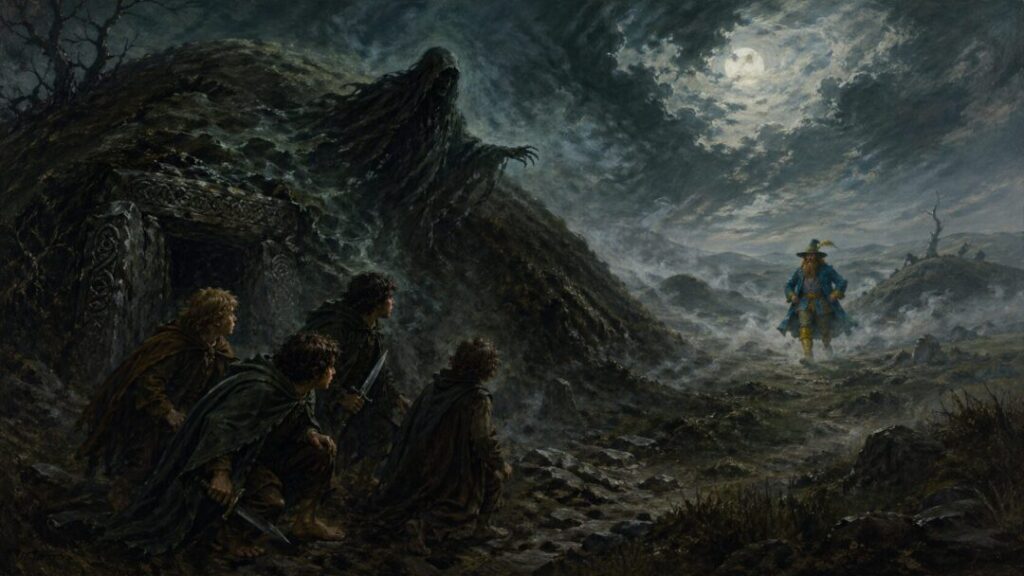
In the book, after leaving Tom’s house, the hobbits are trapped by a barrow-wight. Frodo wakes in darkness and calls for Tom, who comes and breaks the power of the wight. The hobbits are rescued, and they receive blades from the barrow.
This matters later, especially for Merry.
In the book, Merry’s sword has a history connected with the wars against Angmar. When he strikes the Witch-king during the Battle of the Pelennor Fields, that blade helps make the blow significant. The film simplifies this. Merry still plays his vital role, but the older history of the weapon is mostly removed.
That is a real loss.
The Barrow-downs deepen the sense that the hobbits are walking through layers of forgotten history. Before they ever see Minas Tirith or hear the full tale of Númenor, they pass through the remains of older wars.
Middle-earth is not new to darkness.
The Shadow has risen before.
The films chose a different path. They kept the forward thrust of the quest and removed much of the older, stranger material between the Shire and Bree.
That choice made the story cleaner.
It also made the world slightly less haunted.
Why the Cut Makes Sense
It is easy to say the films should have included Tom anyway.
For readers who love him, the absence can feel severe. Tom’s chapters are unlike anything else in the story. They give The Fellowship of the Ring a strange early texture that no later section quite repeats.
But adaptation is not the same as transcription.
A book can pause for mystery. A film must decide how long the audience can remain inside that pause before the main movement begins to weaken.
Tom would require songs.
Goldberry would require introduction.
Old Man Willow would require setup.
The Barrow-downs would require another danger after the Old Forest.
The Ring’s failure to affect Tom would require careful explanation.
The Council would need to address why Tom cannot simply be the keeper of the Ring.
All of this could be done.
But it would change the shape of the film.
The first film already has an enormous task: make the audience understand the Ring, fear the Riders, trust Strider, mourn Gandalf, form the Fellowship, and end with its breaking. Adding Tom would not simply add scenes. It would add a different kind of meaning.
That meaning is valuable.
But it is not efficient.
Why the Cut Still Hurts
And yet the loss is real.
Without Tom Bombadil, the films become more tightly centered on the War of the Ring. That makes them powerful, dramatic, and clear. But it also means viewers miss one of the book’s quietest revelations:
Sauron is not the measure of all things.
The Ring is terrifying, but it is not the whole truth of Middle-earth. There are things it cannot understand because they do not desire domination. There are places where the logic of possession does not rule. There are beings who are not waiting to become weapons in someone else’s war.
Tom embodies that.
He is not an answer to Sauron.
He is a contradiction to Sauron.
That is why he matters.
Not because he can march to Mordor. Not because he can unmake the Ring. Not because he is secretly the greatest power in Middle-earth.
He matters because he shows that power is not the only kind of greatness.
The Films Chose the Quest Over the Mystery
The film trilogy had to make a choice.
It chose the road.
The chase from the Shire.
The wound at Weathertop.
The Council of Elrond.
The breaking of the Fellowship.
The long road to Mordor.
The return of the King.
That choice gave the films their urgency and emotional force. It helped make the Ring feel like a burden that could not be set aside. It kept the story moving toward the one place where the Ring’s fate could truly be decided.
But the book has room for something else.
It has room for a figure who steps into the story, refuses to be explained, saves the hobbits, laughs at the Ring, and then remains behind.
Tom Bombadil is not a missing general.
He is not a missing wizard.
He is not a missing solution.
He is a reminder that Middle-earth is larger than the story being told.
And perhaps that is the real reason his absence still fascinates people.
The films cut him because the quest needed to move.
The book keeps him because the world needed to breathe.
Sources & Notes
- J.R.R. Tolkien, The Fellowship of the Ring, Book I, Chapters 6–8: Tom’s rescue of the hobbits, his house with Goldberry, and the Barrow-downs episode establish the material omitted before Bree.
- J.R.R. Tolkien, The Fellowship of the Ring, Book I, Chapter 7, “In the House of Tom Bombadil”: Tom handles the Ring, puts it on without vanishing, and can still see Frodo when Frodo wears it.
- J.R.R. Tolkien, The Fellowship of the Ring, Book II, Chapter 2, “The Council of Elrond”: the Council explicitly considers giving the Ring to Bombadil and rejects it because he would not be a reliable keeper or a means to defeat Sauron.
- J.R.R. Tolkien, The Return of the King, Book V, Chapter 6, “The Battle of the Pelennor Fields”: Merry’s blow against the Witch-king is tied to the older history of his blade from the Barrow-downs.
- Peter Jackson, Fran Walsh, and Philippa Boyens, The Lord of the Rings: The Fellowship of the Ring, Special Extended Edition writers’/director commentary: the film adaptation discussion frames Bombadil as a beloved but structurally difficult detour from Frodo’s central Ring quest.