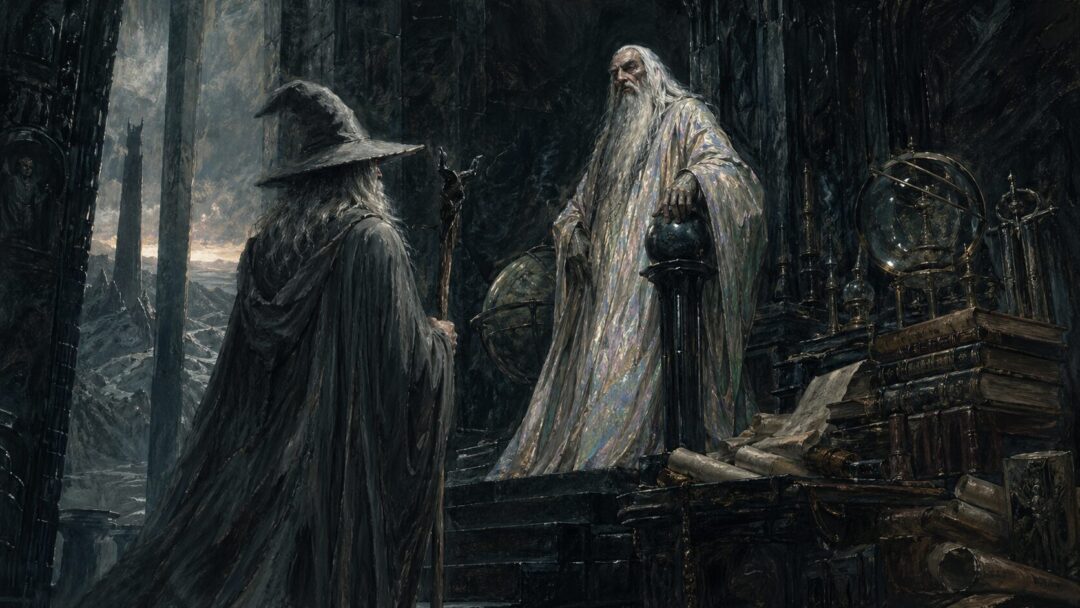
When Gandalf is trapped on the pinnacle of Orthanc, the scene feels almost strange in hindsight.
Saruman has revealed himself.
He has betrayed the White Council.
He has turned from counsel to domination.
He has begun seeking the One Ring for himself.
And Gandalf, of all people, now knows it.
So the question seems unavoidable.
Why does Saruman leave him alive?
Why not kill Gandalf immediately, remove the danger, and keep Isengard’s treason hidden?
At first glance, Saruman’s choice looks like arrogance or narrative convenience. But within the logic of Middle-earth, it makes far more sense than it appears.
Saruman does not simply want Gandalf gone.
He wants what Gandalf knows.
And that difference changes the whole scene.
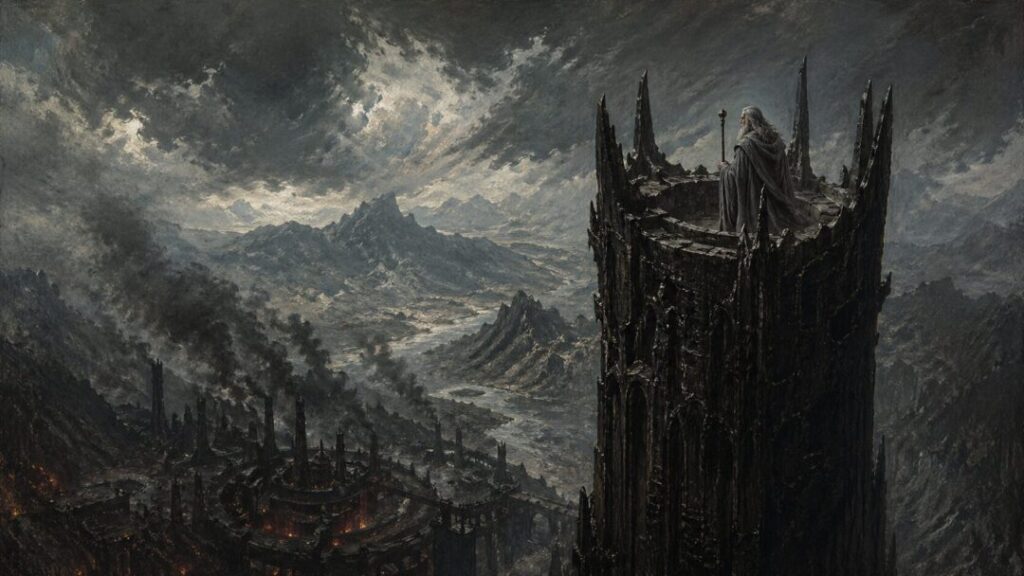
Saruman’s Problem Was the Ring
By the time Gandalf comes to Isengard, Saruman is already far from the path he was meant to follow.
He has studied the lore of the Rings. He has watched the movements of Sauron. He has used the Orthanc-stone, and through it his mind has been drawn into a dangerous contest with Mordor.
But Saruman’s position is still unstable.
He does not yet possess the One Ring.
That is the fact everything turns on.
Saruman may have power, servants, knowledge, and a fortress that few can assail. But without the Ring, his ambitions remain incomplete. He is neither fully allied with Sauron nor truly able to overthrow him. He is playing a double game, and double games require information.
Gandalf is valuable because Gandalf has been close to the Ring without Saruman fully understanding how.
Saruman suspects that Gandalf’s long interest in the Shire is not accidental. He knows Gandalf has been concerned with Hobbits. He knows Bilbo once possessed a strange ring. And when Gandalf comes to Orthanc, Saruman tries to discover how much he knows.
This is why killing Gandalf would not solve Saruman’s problem.
A dead Gandalf cannot reveal the Ring’s location.
A dead Gandalf cannot explain what has been hidden in the Shire.
A dead Gandalf cannot be pressured, persuaded, or forced into helping Saruman’s design.
Saruman’s first instinct is not murder.
It is possession.
Saruman Wanted Gandalf to Submit
Saruman does not begin by throwing Gandalf from the tower.
He speaks.
That matters.
He offers Gandalf a vision of power: the old order fading, the rise of a new strength, and the possibility of joining with that strength rather than resisting it. His words are not merely threats. They are an attempt at recruitment.
Saruman wants Gandalf to accept his logic.
Not because he loves Gandalf.
Not because he still values friendship in a pure sense.
But because Gandalf would be more useful alive than dead.
If Gandalf joined him, Saruman would gain legitimacy, counsel, and perhaps access to knowledge he desperately needed. Gandalf had moved through the Shire. Gandalf had dealt with Bilbo and Frodo. Gandalf had confirmed the Ring’s identity before many others understood what was happening.
To Saruman, that knowledge is a weapon.
And Saruman’s great flaw is that he increasingly thinks of everything in those terms.
People become tools.
Wisdom becomes calculation.
Speech becomes domination.
Friendship becomes leverage.
So when Gandalf refuses, Saruman does not immediately destroy him.
He tries another form of control.
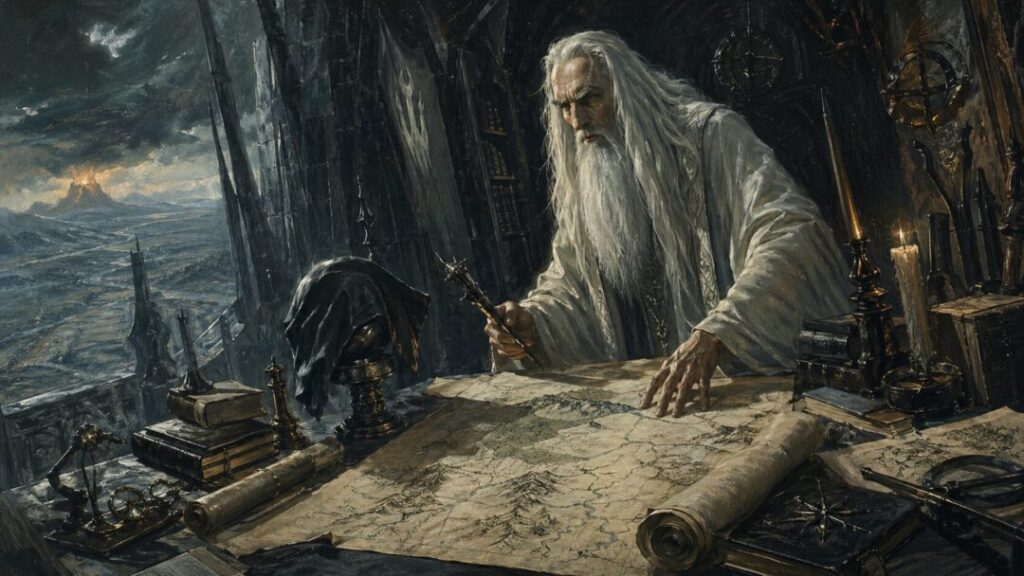
Orthanc Was a Prison Built for Delay
The pinnacle of Orthanc is not chosen at random.
It is almost impossible to escape without aid. Gandalf is placed high above Isengard, exposed, watched, and cut off from the road. He cannot simply walk away. He cannot reach the outside world. He cannot warn the Free Peoples.
From Saruman’s point of view, this is enough.
Gandalf has been removed from the board.
But he has not been wasted.
That is the cold practicality of the choice.
Saruman can keep him there while events develop. Perhaps Gandalf will weaken. Perhaps fear, hunger, cold, or isolation will make him speak. Perhaps Saruman will find the Ring by other means, and Gandalf will no longer matter. Perhaps Sauron will move first, and Saruman can adapt to the new balance of power.
The important thing is time.
Saruman believes he can control time.
He believes he can delay Gandalf, manipulate Sauron, search for the Ring, and prepare Isengard all at once. His choice to imprison Gandalf rather than kill him is part of that larger pattern.
He is not acting like a simple servant of Mordor.
He is acting like a rival power trying to keep every possible advantage.
Killing Gandalf May Have Carried Risks
The texts do not give us a direct statement saying Saruman feared the consequences of killing Gandalf. So we should be careful here.
But the situation itself allows a conservative interpretation.
Gandalf is not an ordinary old man. He is one of the Istari, sent into Middle-earth in bodily form, limited in power, yet still far greater than he appears. His death is possible, as the later battle with the Balrog shows. But killing him is not necessarily simple, quiet, or without consequence.
Saruman may have been stronger in his own house. He had servants. He had Orthanc. He had surprise.
But a direct attempt to slay Gandalf could still have been dangerous.
It might have caused a struggle.
It might have damaged Saruman’s secrecy.
It might have forced him to reveal more of his strength too early.
It might have cost him servants or exposed his treachery before he was ready.
Imprisonment is safer.
It avoids immediate conflict while achieving the main goal: Gandalf cannot interfere.
This is very Saruman.
He prefers machinery, planning, coercion, and clever positioning. He does not want a heroic duel if a locked tower will do. He does not want to risk uncertainty when he believes a controlled situation can be arranged.
And that belief is exactly where he goes wrong.

Saruman Still Needed Secrecy
Saruman’s treason is not fully open at this point.
He has not yet declared himself openly against all the West. The White Council no longer functions as before, but many still know him as Saruman the White, the head of his order, the wise lord of Isengard.
If Gandalf simply vanished, questions might arise.
But if Gandalf were killed, the danger could be greater.
Again, the text does not tell us that Saruman reasoned this out in detail. But politically, his position depends on secrecy and timing. He has to manage what others know. He has to keep his real intentions hidden long enough to gain the Ring or strengthen Isengard.
A captive Gandalf is controllable.
A murdered Gandalf creates consequences Saruman may not be ready to face.
This matters because Saruman’s fall is not the fall of someone who has become reckless in every way. He is arrogant, yes. But he is also careful. He calculates. He watches. He waits. He uses others as pieces on a board.
And for a time, that makes him extremely dangerous.
The Tower Reveals Saruman’s Arrogance
The great irony is that Orthanc works too well in Saruman’s imagination.
From the top of the tower, Gandalf cannot climb down. He cannot escape by ordinary means. He is isolated from every road and messenger. To Saruman, the matter must have seemed settled.
But Saruman’s imagination has narrowed.
He sees walls, height, locks, servants, and strategy.
He does not account for pity, loyalty, chance, or providence.
Gwaihir comes unexpectedly. Gandalf is carried away. The prisoner Saruman tried to preserve as a source of information becomes the very witness who exposes him at the Council of Elrond.
This is one of the deeper patterns in the story.
Evil often misjudges what it cannot command.
Saruman understands systems of power. He understands fear. He understands ambition. He understands the desire to possess. But he does not understand the quiet forces that repeatedly undo such designs in Middle-earth.
He does not understand why Radagast’s message might lead to rescue.
He does not understand why Eagles may arrive beyond his calculation.
He does not understand why Gandalf, apparently defeated, is not truly beaten.
The top of Orthanc is meant to display Saruman’s control.
Instead, it reveals its limits.
Gandalf Was More Useful Alive Than Dead
So the simplest answer is also the most important one.
Saruman did not kill Gandalf because Gandalf was still useful.
He might be persuaded.
He might be broken.
He might reveal the Ring’s location.
He might remain imprisoned until Saruman no longer needed him.
He might serve as a hostage against events Saruman had not yet fully measured.
This does not mean Saruman was merciful.
It means his cruelty was strategic.
He did not spare Gandalf out of kindness. He kept him because he believed a living enemy could still be turned into an advantage.
And in that choice we see Saruman’s corruption clearly.
He no longer recognizes Gandalf as a fellow servant of the same mission. He no longer treats wisdom as something to be shared for the good of Middle-earth. He sees Gandalf as a locked box containing useful knowledge.
The tower becomes a physical image of Saruman’s mind: high, cold, brilliant, and closed.
The Mistake That Changed the War
Saruman’s decision fails because he mistakes restraint for control.
He thinks that because Gandalf cannot descend, Gandalf cannot act. He thinks that because Orthanc is strong, his plan is secure. He thinks that because he has chosen not to kill Gandalf, he has mastered the situation.
But Middle-earth does not work that way.
Gandalf escapes.
He reaches Rivendell.
He tells the Council what Saruman has become.
He later returns after death and renewal as Gandalf the White.
And in the end, Saruman is cast down from the very authority he tried to corrupt.
That is the hidden shape of the Orthanc episode.
Saruman does not leave Gandalf alive because he is foolish in a simple way.
He leaves him alive because he is proud in a very specific way.
He believes knowledge can be captured.
He believes time can be managed.
He believes other people’s wills can be bent.
He believes a tower can replace wisdom.
And for a while, it almost works.
But only almost.
Because Gandalf’s escape is not just a lucky reversal. It is the first visible crack in Saruman’s whole idea of power.
He tried to keep Gandalf alive in order to control the future.
Instead, he preserved the one witness who would help bring his treason into the light.
Sources & Notes
- J.R.R. Tolkien, The Lord of the Rings, Book II, Chapter 2, “The Council of Elrond” — Gandalf recounts Saruman’s offer of alliance, his desire for Ring-lore, and the imprisonment on the pinnacle of Orthanc.
- J.R.R. Tolkien, The Lord of the Rings, Book I, Chapter 2, “The Shadow of the Past” — Gandalf’s investigation of Bilbo’s ring and the Shire explains why Saruman would value Gandalf alive as a source of information.
- J.R.R. Tolkien, The Lord of the Rings, Appendix B, “The Tale of Years” — the chronology places Gandalf’s capture at Orthanc, Gwaihir’s rescue, and his later arrival at Rivendell.
- J.R.R. Tolkien, Unfinished Tales, “The Istari” — Saruman’s office, rivalry, and corruption frame why coercion and control fit his fall better than simple mercy.
- J.R.R. Tolkien, Letter 131 — Tolkien’s explanation of domination, machinery, and corrupted power supports the article’s reading of Saruman’s strategic cruelty and desire to master wills.