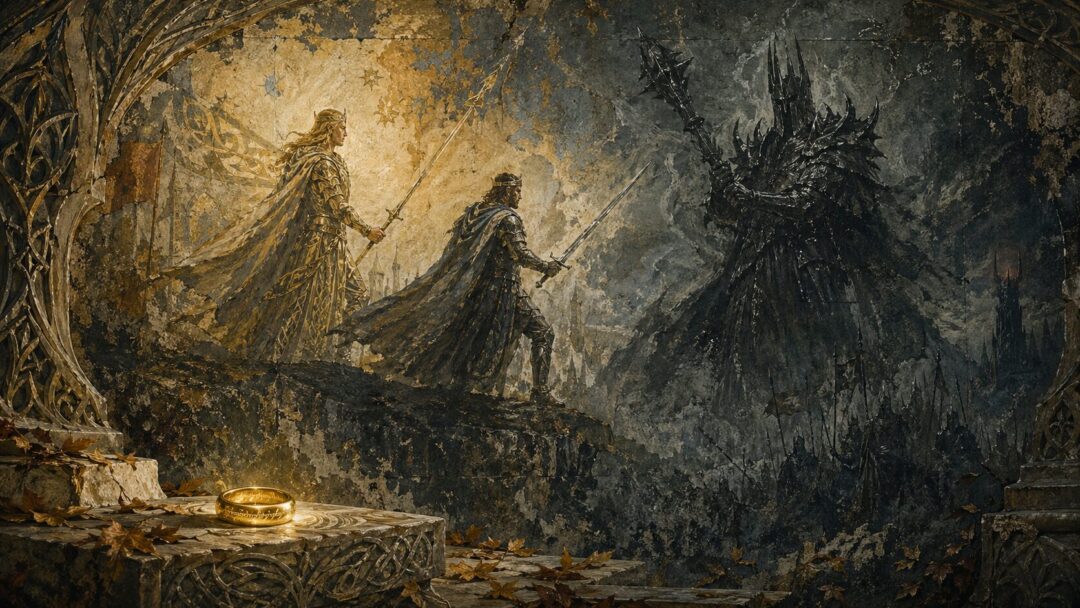
In Rivendell, memory is never just decoration.
That is why the image of the Last Alliance matters.
At first glance, it may seem like a small visual difference between two film trilogies. In The Hobbit, the depiction of the Last Alliance appears richer and more colorful. In The Lord of the Rings, the same ancient subject feels faded, worn, and almost swallowed by time.
It is easy to dismiss this as a production choice.
And outside the story, of course, it is one.
But inside the world of Middle-earth, the difference opens a much deeper question.
Why would the memory of the Last Alliance feel more alive in Bilbo’s story, but more ghostly in Frodo’s?
The answer is not simply that The Hobbit takes place earlier. Only seventy-seven years separate Bilbo’s first great adventure from the Council of Elrond. For Elves, and especially for Elrond, that is hardly a long span of time.
So the change is not really about years.
It is about meaning.
By the time Frodo reaches Rivendell, the Last Alliance is no longer safely ancient history. It has become unfinished business.
The Last Alliance Was Not Just a Battle
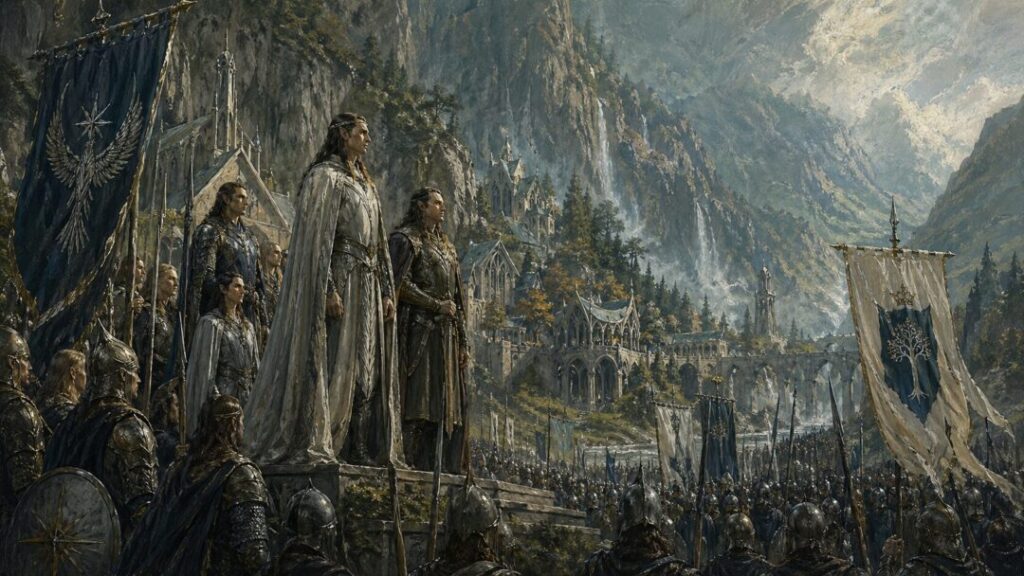
The Last Alliance of Elves and Men was one of the defining events of the Second Age.
It was formed by Gil-galad, the High King of the Noldor in Middle-earth, and Elendil, the lord of the Faithful Númenóreans who survived the Downfall of Númenor. Their purpose was clear: Sauron had to be opposed before he became too strong to resist.
The armies of Elves and Men gathered strength and passed through Imladris before marching east. That detail matters. Rivendell was not a distant observer of the Last Alliance. It was one of the places bound directly to its history.
Elrond did not merely preserve stories of that war.
He lived through it.
He had seen the great captains of the West go to war. He had seen the cost. He had stood close enough to the end of the Second Age to know that victory over Sauron was never clean, simple, or complete.
That makes any image of the Last Alliance in Rivendell more than a historical painting.
It is a wound remembered by someone who was there.
In The Hobbit, the Past Still Feels Distant
During the events of The Hobbit, Bilbo arrives in Rivendell as a guest in a world far older than he can understand.
To him, Rivendell is wonder.
It is music, rest, moonlit halls, Elvish wisdom, and a sense that the world is larger and stranger than the Shire ever suggested. The deeper wars of the Second Age are not yet Bilbo’s burden.
At this point in the story, the Ring is not understood by Bilbo as the One Ring. It is a useful, mysterious treasure found in the dark beneath the mountains. The Shadow is rising, but Bilbo does not know its full shape.
Even among the Wise, the danger of Sauron is not yet revealed to the ordinary peoples of the West in the way it will be later. The White Council moves against the Necromancer in Dol Guldur during this period, but Bilbo’s personal story remains framed as an adventure: trolls, goblins, riddles, spiders, Elven halls, a dragon, and the Lonely Mountain.
So if the Last Alliance appears in a richer, more colorful way in this earlier setting, it fits the emotional shape of the story.
The past still looks legendary.
It is terrible, yes. But it is also safely behind the world Bilbo thinks he is entering.
The image can still feel like glory.
By Frodo’s Time, the Same Image Has Changed
In The Lord of the Rings, Rivendell is not merely a house of refuge.
It is the last pause before the road to Mordor.
By the time Frodo arrives there, the Ring has been revealed. The Black Riders have crossed into the lands of the West. Gandalf has confirmed the danger. The servants of Sauron are searching. The old enemy is no longer a shadow in the background of old tales.
He is active.
That changes the meaning of the Last Alliance.
What once looked like an ancient victory now looks like a warning.
Because the Last Alliance did defeat Sauron’s bodily form. Gil-galad and Elendil overthrew him, though both were slain. Isildur cut the Ring from Sauron’s hand.
But Isildur did not destroy it.
That is the crack running through the whole memory.
The Last Alliance saved Middle-earth from immediate ruin, but it did not end the evil at its root. The Ring survived. Sauron’s power endured in it. And after long centuries, the same unfinished war returned.
So in Frodo’s time, the image of that alliance can no longer be seen as simple triumph.
It is the memory of a victory that failed to become final.
Elrond’s Memory Is Not Neutral
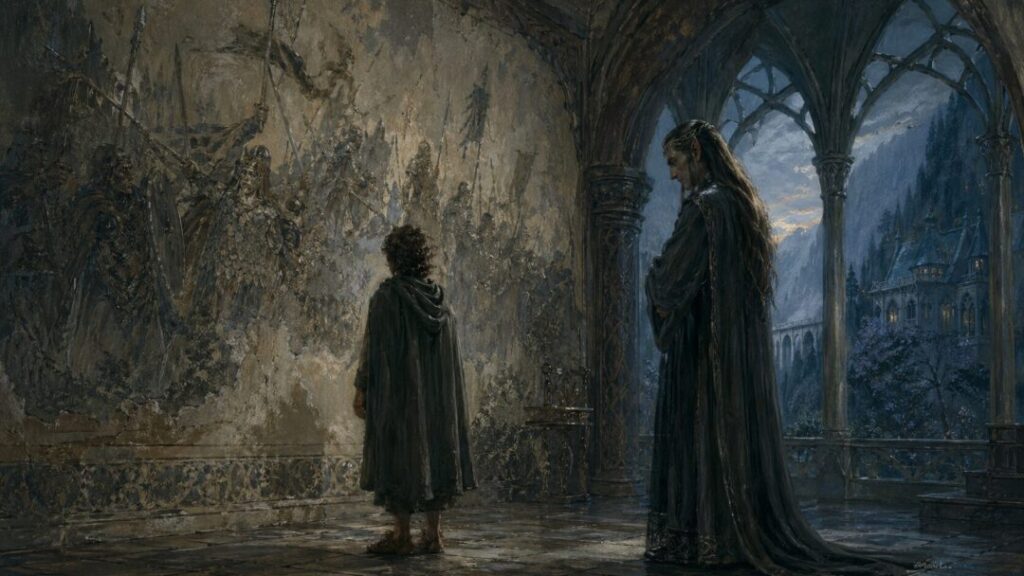
This is why the mural feels so different when seen through the emotional world of The Lord of the Rings.
Elrond’s relationship to the Last Alliance is deeply personal.
He was there when the Second Age ended. He remembered Gil-galad. He remembered Elendil. He remembered Isildur taking the Ring. He remembered the moment when the fate of the world might have turned another way.
The texts do not give us a scene of Elrond standing before a mural and explaining his feelings about it. So we should be careful not to invent a private emotion beyond what is stated.
But the broader implication is clear.
For Elrond, the War of the Ring is not a new crisis. It is the return of an old one.
That makes Rivendell’s faded imagery feel symbolically fitting. The past has not vanished, but it has grown heavy. It has lost the brightness of legend and taken on the ash-colored weight of consequence.
The Last Alliance is not remembered as a clean heroic tableau.
It is remembered as the beginning of the Ring’s long shadow over the Third Age.
The Fading of the Elves
There is another layer beneath this.
By the end of the Third Age, the Elves are fading from Middle-earth.
This does not mean they are weak in a simple sense. Rivendell remains powerful, wise, and protected. Elrond is still one of the greatest figures in the West. The Elven realms are still places of beauty and memory.
But their age is ending.
The power that preserves Rivendell and Lothlórien is bound up with the Three Rings. Once the One Ring is destroyed, the Three lose their power, and the Elven world in Middle-earth can no longer be maintained in the same way.
That future already hangs over The Lord of the Rings.
Even before the Ring is destroyed, the story is full of departure. The Sea calls. The old powers diminish. The great works of the Eldar are becoming memories.
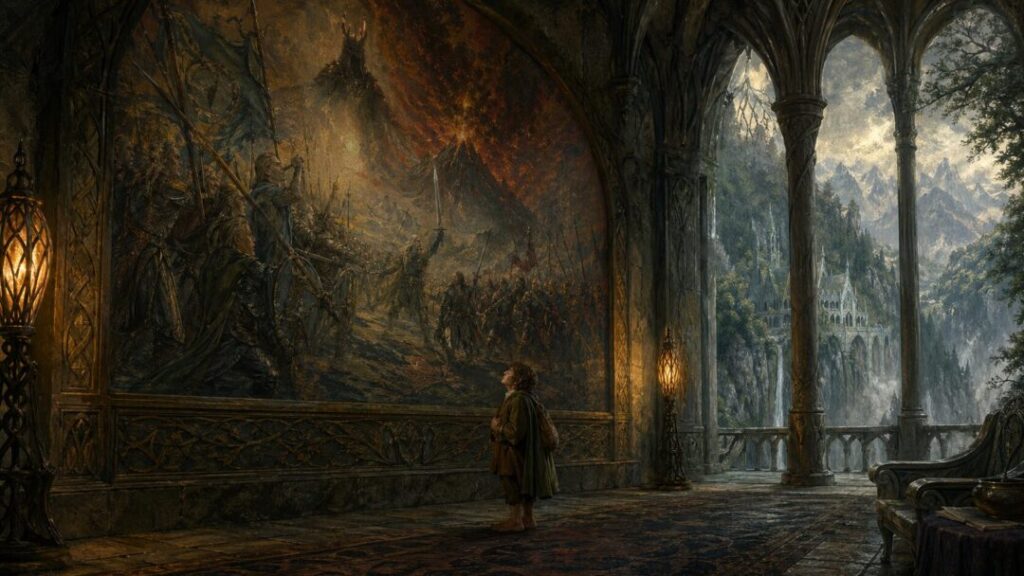
So a faded image in Rivendell feels right for Frodo’s story.
The Last Alliance was the high moment when Elves and Men stood together openly against Sauron. But by the late Third Age, that world is almost gone. Men will inherit the future. The Elves will leave. Rivendell itself will become a memory.
The mural is not just fading because it is old.
It is fading because the age that produced it is passing away.
Why The Hobbit Can Show It in Color
This is where the contrast with The Hobbit becomes interesting.
Bilbo’s story is set earlier, but more importantly, it is told with a different emotional light.
The world of The Hobbit still has fairy-tale brightness. Danger exists, but it often comes in the form of riddles, forests, treasure, and monsters. Even the darker forces remain partially veiled from Bilbo’s understanding.
Rivendell, in that story-world, can still appear as a place of ancient beauty that has not yet become a last refuge before catastrophe.
So the Last Alliance in color works as legend.
It says: once, great powers stood against darkness.
But in The Lord of the Rings, the faded version says something more painful:
Once, great powers stood against darkness—and it was not enough.
That is the emotional difference.
The same memory has changed because the Ring has returned to the center of the story.
It Is Not Canon, but It Is Lore-Friendly
A careful distinction is important here.
The books do not tell us that there was a specific Last Alliance mural in Rivendell that changed color over time. That is a film image, not a stated fact from the primary texts.
So we should not treat the visual difference as a canon event.
There is no textual passage saying Elrond repainted it, neglected it, preserved it, or allowed it to fade for symbolic reasons.
But as an adaptation choice, it is lore-friendly.
It fits the deeper movement of the story. It reflects the changing meaning of the Last Alliance between Bilbo’s adventure and Frodo’s quest. It also reflects the larger decline of the Elven world in Middle-earth.
In other words, the mural’s fading should not be read as a literal piece of confirmed lore.
It should be read as visual interpretation.
And as interpretation, it is unusually effective.
The Last Alliance Is a Mirror
The most powerful thing about the image is that it mirrors the whole story.
In the Second Age, Elves and Men united against Sauron.
In the Third Age, the Free Peoples must do so again.
But this time, victory cannot come from armies alone. The great host of the Last Alliance could overthrow Sauron’s body, but it could not heal the deeper danger while the Ring survived.
That is why Frodo’s quest is so different.
The answer is not another heroic battle in the same pattern. Aragorn can march. Gondor can stand. Rohan can ride. The captains of the West can challenge Sauron before the Black Gate.
But none of that can truly win the war unless the Ring is destroyed.
The faded mural almost seems to whisper this truth.
The old kind of victory is no longer enough.
The world does not need the Last Alliance repeated exactly.
It needs its failure completed.
Why the Difference Matters
That is why the color change feels meaningful.
In The Hobbit, the Last Alliance can still be seen as a shining image of the ancient past. It belongs to the world of songs, halls, maps, swords with old names, and legends that Bilbo is only beginning to touch.
In The Lord of the Rings, the same past has become a burden laid directly on Frodo.
The image is faded because the glory of that age is fading.
It is faded because Elrond’s world is nearing its end.
It is faded because the victory it remembers did not finish the work.
And it is faded because the Ring has returned, forcing Middle-earth to face the one thing the Last Alliance left undone.
So the difference is not merely visual.
It is thematic.
One version shows memory as legend.
The other shows memory as grief.
And once you see that, the faded image in Rivendell stops looking like background art.
It becomes one of the quietest warnings in the story.
The past is still there.
But it is losing color.
And unless the Ring is destroyed, everything the Last Alliance fought for will fade with it.
Sources & Notes
- J.R.R. Tolkien, The Silmarillion, “Of the Rings of Power and the Third Age” — the Last Alliance is formed by Gil-galad and Elendil, gathers at Imladris, and marches against Sauron.
- J.R.R. Tolkien, The Lord of the Rings, Book II, Chapter 2, “The Council of Elrond” — Elrond remembers the war, the deaths of Gil-galad and Elendil, Isildur taking the Ring, and the failure to destroy it.
- J.R.R. Tolkien, The Lord of the Rings, Book II, Chapter 2, “The Council of Elrond” — Frodo’s errand turns the old victory of the Last Alliance into unfinished business for the Third Age.
- J.R.R. Tolkien, The Lord of the Rings, Book VI, Chapter 9, “The Grey Havens” — the bearers of the Three Rings depart over Sea, fitting the article’s theme of the Elven age passing from Middle-earth.
- The Lord of the Rings: The Fellowship of the Ring and The Hobbit: An Unexpected Journey, dir. Peter Jackson — the Rivendell/Last Alliance imagery discussed here is a film-adaptation visual motif, not a stated book-canon event.