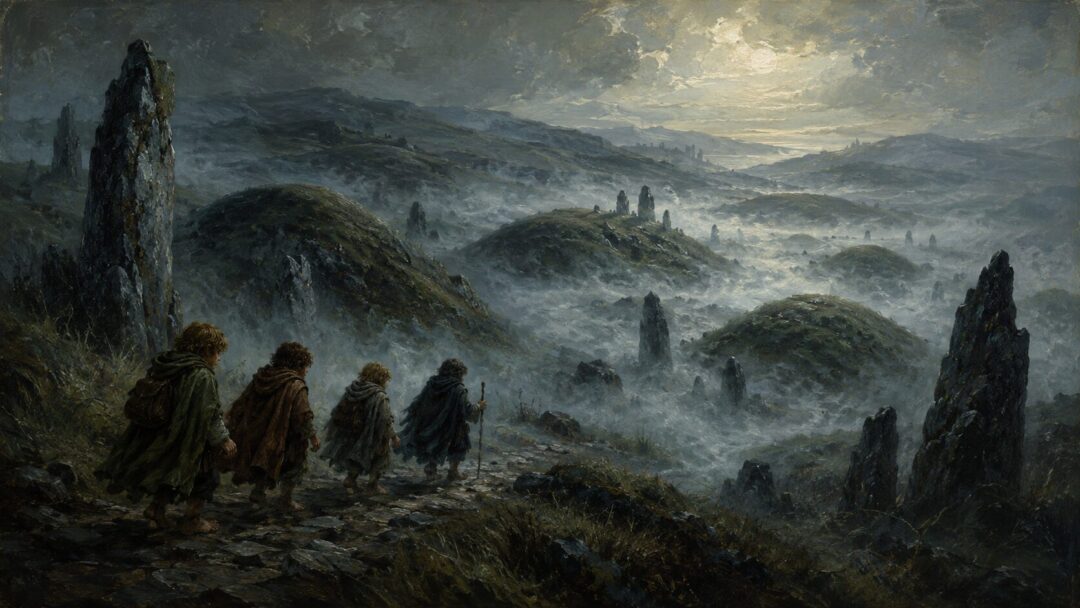
The Ring has already left the Shire. Black Riders are on the road. Bree is waiting ahead, with Strider, the Prancing Pony, and the first real turn toward the wide war of Middle-earth. So why does the story stop among lonely green hills, old stones, cold fog, and a dead man’s song?
At first glance, the Barrow-downs can feel like a strange delay: one more danger before the “real” plot begins. But that reading misses how carefully the episode is placed. Before the hobbits meet Aragorn, before they reach Rivendell, before the Company is formed, they are forced into a place where history itself has become a trap. The Barrow-downs are not only a haunted landscape. They are the first great lesson that Middle-earth is full of buried wars that are not finished.
The hobbits think they are simply trying to get to Bree. In truth, they cross a border between the comfortable memory of the Shire and the long, wounded memory of the world beyond it. The terror under the mound matters because it shows what the Quest is really moving through: not empty countryside, but a land where ancient defeat, old kingdoms, and the malice of Angmar still have consequences.
The First Time the Past Reaches Out and Grabs Them
The Barrow-downs come after the Old Forest and Tom Bombadil’s house, two chapters that already loosen the reader’s sense of ordinary time. The Shire is measured by meals, birthdays, names, lanes, and family gossip. Tom’s country is older, stranger, and less interested in hobbit categories. But the Barrow-downs go further. They do not merely feel old. They feel inhabited by a past that refuses to stay buried.
This is crucial. Up to this point, the Black Riders are the most obvious threat. They belong to Sauron’s present hunt for the Ring. The Barrow-wight, however, is different. It is not chasing Frodo down the road like a servant with orders. It belongs to a deeper historical wound. The hobbits have wandered into a place where the ruin of the North-kingdom still has teeth.
The mounds of the Barrow-downs, also called Tyrn Gorthad, are associated with very ancient burials and later with the Dúnedain of Cardolan. In the history preserved around the northern kingdoms, the place becomes dreadful after the fall and depopulation of Cardolan, when evil spirits from Angmar and Rhudaur enter the deserted mounds. That makes the Barrow-downs more than spooky scenery. They are a remnant of the Witch-king’s long war against Arnor, still dangerous centuries later.
The hobbits do not understand all of this when they stumble into the fog. That is part of the power of the scene. They experience the terror first, and the history only later begins to unfold. Middle-earth often works this way: the small characters suffer the consequences of wars and choices made long before they were born.
A Horror Scene About Forgetting
The Barrow-downs are terrifying because they turn memory into imprisonment. The hobbits are not attacked in a battlefield. They are taken into a tomb. The danger is stillness, coldness, sleep, and the loss of identity.
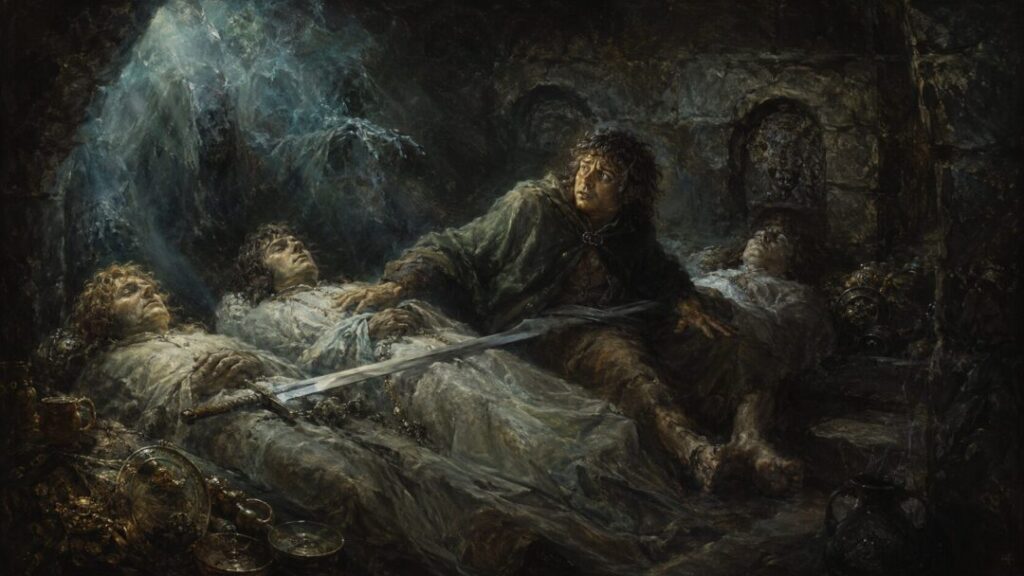
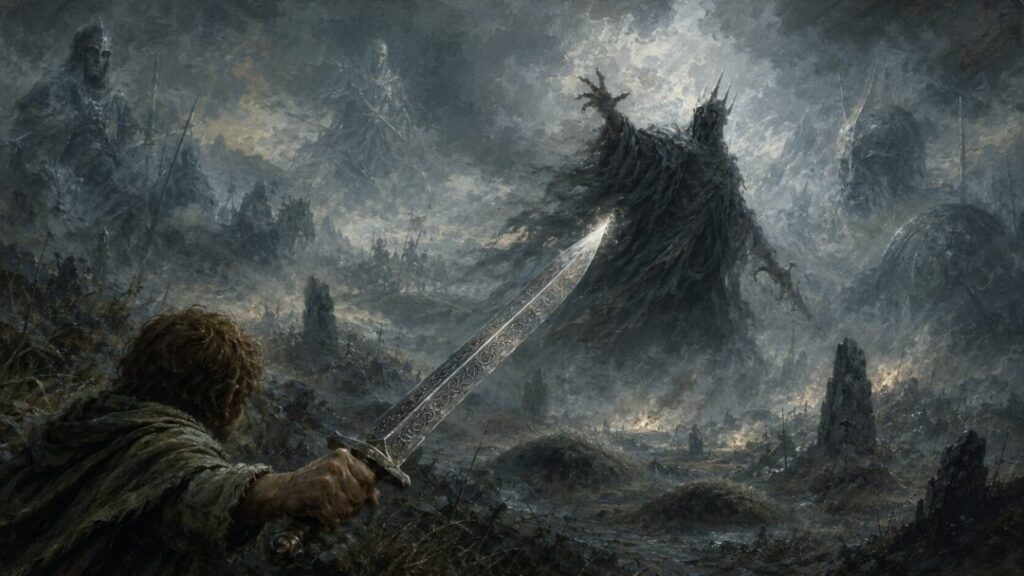
Inside the barrow, Frodo wakes in darkness and sees his friends laid out in a deathly ceremony, dressed in pale garments, with treasure and a sword across them. The scene is not simply a monster attack. It is a grotesque attempt to make the living belong to the dead. The wight’s chant reduces body, heart, and will to coldness. It is one of the earliest moments where Frodo is tempted toward paralysis and despair rather than direct combat.
This matters because the Ring’s war will not be won by strength alone. Again and again, the central danger is spiritual collapse: fear, possessiveness, domination, the desire to give up, the desire to use evil against evil. In the barrow, Frodo faces a smaller but symbolically powerful version of that danger. He can slip into the dead pattern around him, or he can act.
His action is not grand. He does not defeat the wight like a hero out of legend. He seizes a sword, strikes at the crawling hand, and calls for Tom Bombadil. Yet this is still a real moral turning point. Frodo could abandon the others and use the Ring to escape. The text makes that possibility feel near. Instead, he resists the impulse to save only himself.
That choice is easy to overlook because Tom arrives so decisively afterward. But before Tom’s rescue, Frodo’s loyalty has already mattered. The Barrow-downs are one of the first places where the Quest tests not Frodo’s knowledge or power, but his refusal to become isolated.
Tom Bombadil Is Not a Shortcut Around the Meaning
Some readers treat the Barrow-downs as important only because Tom Bombadil rescues the hobbits and gives them weapons. But Tom’s role does not erase the episode’s weight. If anything, his rescue makes the meaning stranger.
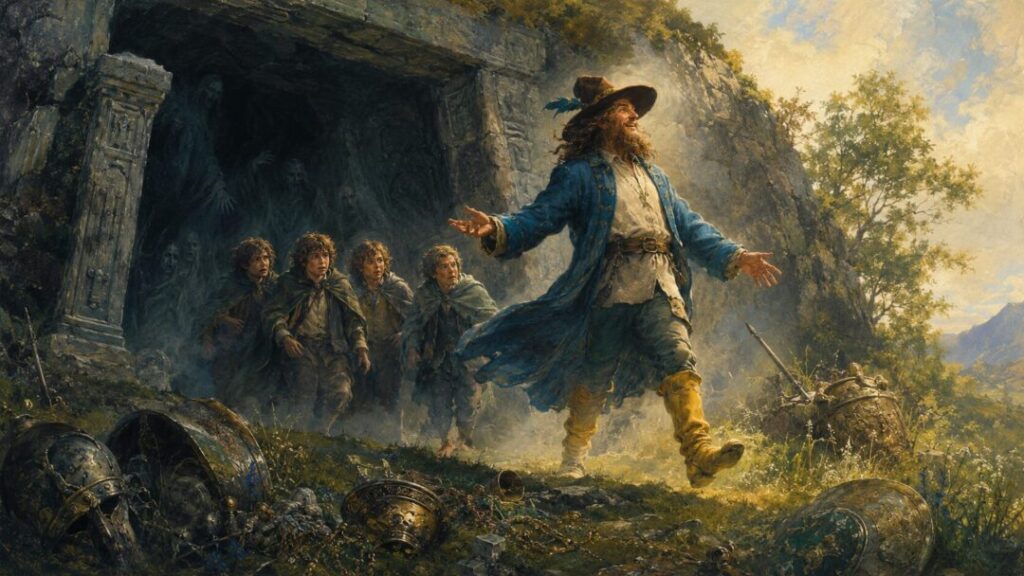
Tom enters the barrow singing, breaks the wight’s power, and brings the hobbits back into air and morning. He is not afraid of the wight, and his authority in that region is presented as deep and peculiar. Yet the story does not use him as a general answer to evil. Tom saves the hobbits in his own country, but he is not the solution to the Ring. At the Council of Elrond, the idea of giving him the Ring is rejected, not because he is weak in the ordinary sense, but because his nature and concern are not fitted to that burden.
This contrast is important. In the Barrow-downs, Tom is exactly the help the hobbits need. In the War of the Ring, he is not the answer Middle-earth needs. The episode therefore teaches a subtle rule: goodness is not always interchangeable. A power may be real, protective, and joyful, yet still not be the power appointed for every task.
Tom’s rescue also preserves the hobbits without making them untouched. They come out of the barrow changed. They have looked into an ancient darkness. They have been dressed for death. Their journey is no longer a frightened walk through unfamiliar country; it has become contact with the long defeat of the North.
The Blades Are the Hidden Payoff
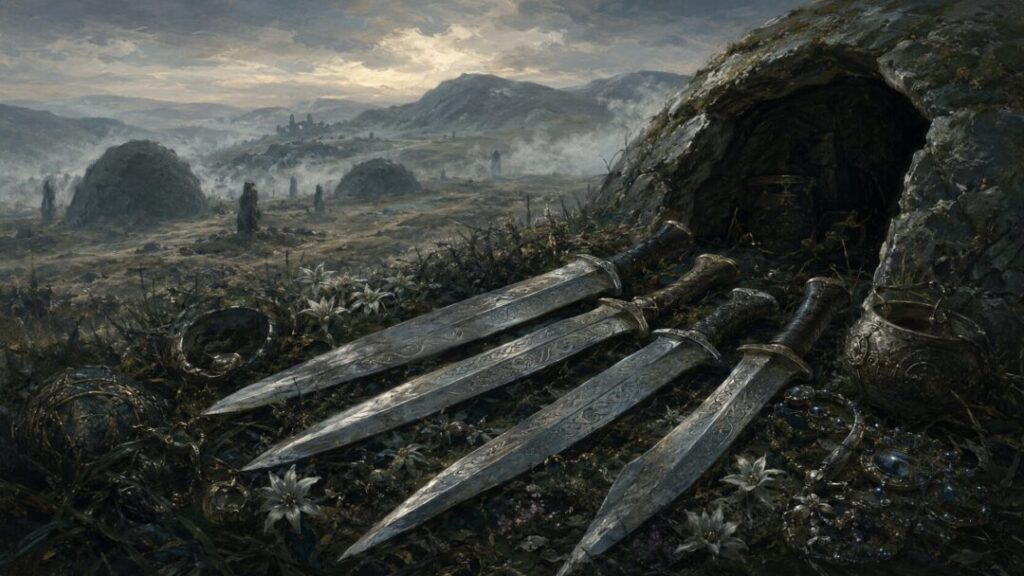
The most obvious reason the Barrow-downs matter comes much later, on the Pelennor Fields. Tom takes treasures from the mound and gives the hobbits long knives, often called the Barrow-blades or daggers of Westernesse. These are not random loot. They are weapons made by the Men of Westernesse in the North, bound up with the old struggle against Angmar.
This delayed importance is one of the most elegant pieces of narrative design in The Lord of the Rings. A chapter that may seem like a side-adventure secretly arms the story for one of its greatest reversals.
When Merry strikes the Witch-king during the Battle of the Pelennor Fields, his blade is not merely a convenient weapon. The text gives it a special significance: it was made in the ancient war against Angmar, and its wound helps break the spell that bound the Witch-king’s unseen sinews to his will. Éowyn’s deed remains her own, and the prophecy concerning the Witch-king is not reduced to a technical trick. But Merry’s blow matters enormously. The old weapon of the North finds its enemy at last.
That means the Barrow-downs are not detachable. Without that stop before Bree, Merry does not carry that blade. Without Merry’s blow, the confrontation with the Witch-king changes in meaning and possibly in outcome. A buried artifact from a fallen kingdom becomes the instrument through which an overlooked hobbit helps bring down the lord of the Nazgûl.
The irony is profound. Angmar helped ruin Cardolan. Evil spirits later haunted the tombs of that lost land. Yet inside one of those tombs remained a weapon made by the very people Angmar had fought. The Witch-king’s old war returns to him in the hand of someone he would never consider important.
The Barrow-downs Connect the Shire to Arnor
The episode also prepares the reader for a truth that becomes clearer later: the Shire has never been as separate from history as hobbits imagine.
The Shire exists in the old lands of Arnor, under a peace guarded by others. The Rangers are not yet explained when the hobbits pass through the Barrow-downs, but the geography is already teaching the lesson. The road to Bree does not run through neutral space. It runs through the remains of northern history: old kingdoms, old roads, old wars, old watchfulness.
This is why the Barrow-downs are placed before Bree and Strider. The hobbits first encounter the ruined past, and then they meet one of its living heirs. Aragorn is not simply a mysterious ranger who knows the road. He belongs to the same long history that produced the ruins, the blades, and the unfinished struggle with Angmar’s chief servant.
The Barrow-downs make Aragorn’s world feel necessary before he fully explains it. By the time the hobbits meet him, the reader has already felt the danger of a land where the past is not dead. Strider’s knowledge, caution, and grief belong to that landscape.
A Small Quest Inside the Great Quest
The Barrow-downs also form a miniature version of the larger story. The hobbits leave a place of comfort, enter a strange and hostile land, are separated by fear and confusion, descend into darkness, face death, resist despair, receive unexpected aid, and come out carrying gifts that will matter later.
That pattern echoes throughout the book. Moria will be a greater descent. Shelob’s lair will be a more terrible darkness. Frodo and Sam’s road into Mordor will strip the journey down to endurance, pity, and the refusal to abandon the task. The barrow is an early, compressed image of the same moral architecture.
It is especially important that the hobbits are not warriors when this happens. They are inexperienced, frightened, and still half-attached to the habits of home. Their courage is not presented as the absence of fear. It appears as action inside fear. Frodo’s choice in the barrow, Merry’s later use of the blade, and the hobbits’ eventual defense of the Shire all belong to the same slow revelation: small people can inherit enormous histories without becoming grandiose.
Why Cutting the Barrow-downs Changes the Story
It is easy to imagine a faster version of the journey: Shire, Black Riders, Bree, Strider. That version would still move the plot. But it would lose a layer of meaning.
Without the Barrow-downs, the early story becomes more purely a chase. With them, it becomes a passage through time. The hobbits are not merely escaping the servants of Sauron; they are entering a world where Sauron’s evil is only one part of a much older pattern of corruption, ruin, resistance, and memory.
The chapter also deepens the sense that providence in Middle-earth often works through things that seem accidental. The hobbits get lost. They are captured. They are rescued. They receive blades. Much later, one of those blades is exactly where it needs to be. The text does not require us to flatten this into a simple statement of fate. But it strongly invites a reading in which chance, mercy, and old history are quietly woven together.
That is why the Barrow-downs matter more than a detour before Bree. They are the first place where the hobbits learn that the road is built over graves. They are the place where Frodo chooses his friends over escape. They are the place where a dead kingdom places a weapon into living hands. And they are the place where the Witch-king’s ancient victory begins, without his knowledge, to turn against him.
The fog lifts. The hobbits go on to Bree. But something comes with them out of the mound: not only fear, not only memory, but the unfinished answer of the North.
Sources & Notes
- J.R.R. Tolkien, The Lord of the Rings, Book I, Chapter 8, “Fog on the Barrow-downs” — the hobbits are trapped in the barrow, Frodo resists using the Ring to abandon his friends, Tom breaks the wight’s power, and the hobbits receive the blades from the mound.
- J.R.R. Tolkien, The Lord of the Rings, Appendix A, “Annals of the Kings and Rulers,” I(iii), “Eriador, Arnor, and the Heirs of Isildur” — Tyrn Gorthad is tied to Cardolan and to evil spirits sent from Angmar and Rhudaur after the northern kingdom’s ruin.
- J.R.R. Tolkien, The Lord of the Rings, Book V, Chapter 6, “The Battle of the Pelennor Fields” — Merry’s Barrow-blade, forged in the old wars against Angmar, helps break the Witch-king’s unseen sinews before Éowyn’s final stroke.
- J.R.R. Tolkien, The Lord of the Rings, Book II, Chapter 2, “The Council of Elrond” — the Council’s discussion of Tom Bombadil shows why his local mastery and innocence do not make him the answer to the Ring’s war.
- J.R.R. Tolkien, The Lord of the Rings, Book II, Chapter 2, “The Council of Elrond” — Aragorn’s words about the Rangers protecting lands such as the Shire support the article’s point that hobbit peace rests on older northern history and watchfulness.