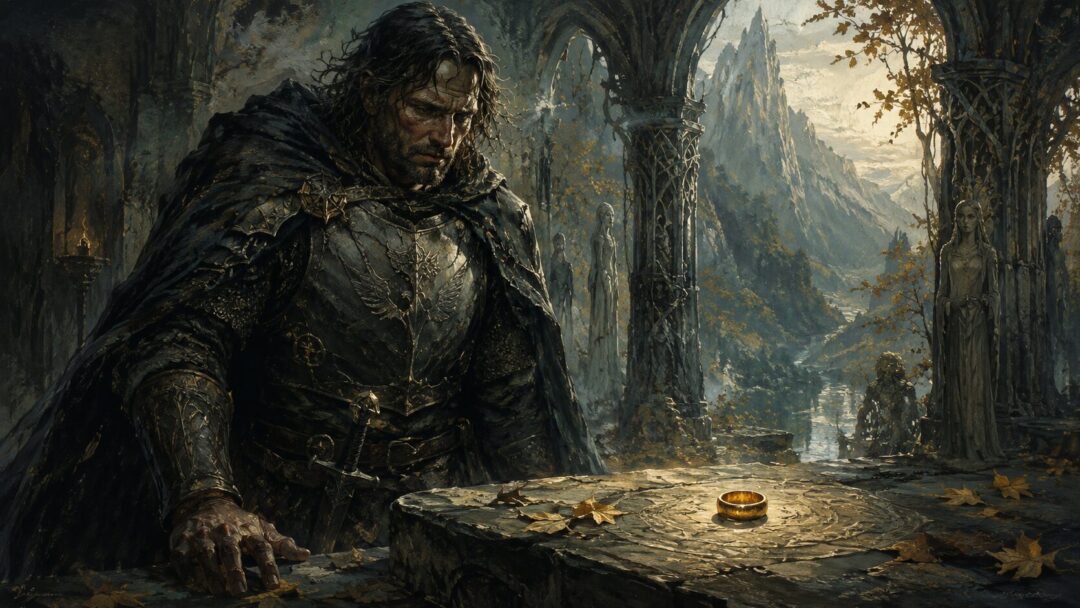
The One Ring did not usually tempt people by asking them to become servants of Sauron. That would have been too obvious. Its deeper cruelty was stranger and more intimate: it made ruin appear under the shape of responsibility.
Boromir did not look at the Ring and think first of betrayal. He thought of Gondor. Sam did not imagine himself as a tyrant for pleasure. He imagined Mordor made green. Galadriel did not need lessons in power, yet even she saw the terrible possibility of becoming a queen who would set things right by force. Gandalf feared the Ring precisely because he would desire to use it from pity.
That is the Ring’s most dangerous deception. It does not merely whisper, “Take power.” It whispers, “You are wise enough to use power well.”
And in Middle-earth, that is often where the fall begins.
The Ring Did Not Tempt Everyone the Same Way
The Ring was made by Sauron as an instrument of domination. Its central purpose was not simple invisibility, nor merely long life, nor a vague magical advantage. Those effects appear in the story, especially among mortals, but they are not the heart of it. The One Ring was bound to Sauron’s own power and will, and through it he sought mastery over the other Rings and over the wills of others.
That matters because the Ring’s temptation is not random. It works through desire, fear, pride, pity, and need. It does not offer every bearer the same fantasy. It presents each person with a version of power that feels personally justified.
To a warrior of a besieged kingdom, it can look like deliverance. To a gardener, it can look like healing the wounded earth. To a ruler, it can look like order. To the wise, it can look like the burden of necessary action.
This is why the Ring is more frightening than a simple cursed object. It does not only corrupt what is worst in a person. One reading of the story is that it can also twist what is best: courage, loyalty, mercy, imagination, and hope.
The cruelty is that the first step may not feel like a fall. It may feel like wisdom.
Boromir’s Hope Was Not False — But It Was Captured
Boromir is one of the clearest examples of this tragedy. He comes to Rivendell from a land that has fought Sauron’s strength for generations. Gondor is not an abstract cause to him. It is his city, his people, his father’s realm, the last great barrier before the West.
At the Council of Elrond, the Ring is revealed not as a weapon to be claimed, but as a peril to be destroyed. Yet Boromir struggles with that answer because it seems almost mad from the perspective of war. Here is a thing of immense power. Gondor is bleeding. Mordor is rising. Why not use the Enemy’s weapon against him?
The texts do not present Boromir as foolish for caring about Gondor. His error is not love of his people. His error is believing that a thing made for domination could be safely turned into an instrument of salvation.
That is what the Ring does to hope. It narrows hope until only control remains. Boromir begins with a real and honorable desire: defend the city he loves. But under the Ring’s pressure, that desire becomes possessive. He starts to see Frodo not as the appointed bearer of a terrible burden, but as someone withholding the one answer Gondor needs.
His fall is tragic because it is not born from emptiness. It grows out of urgency. The Ring makes desperate hope look like strategic wisdom.
Gandalf Feared Good Intentions More Than Open Malice
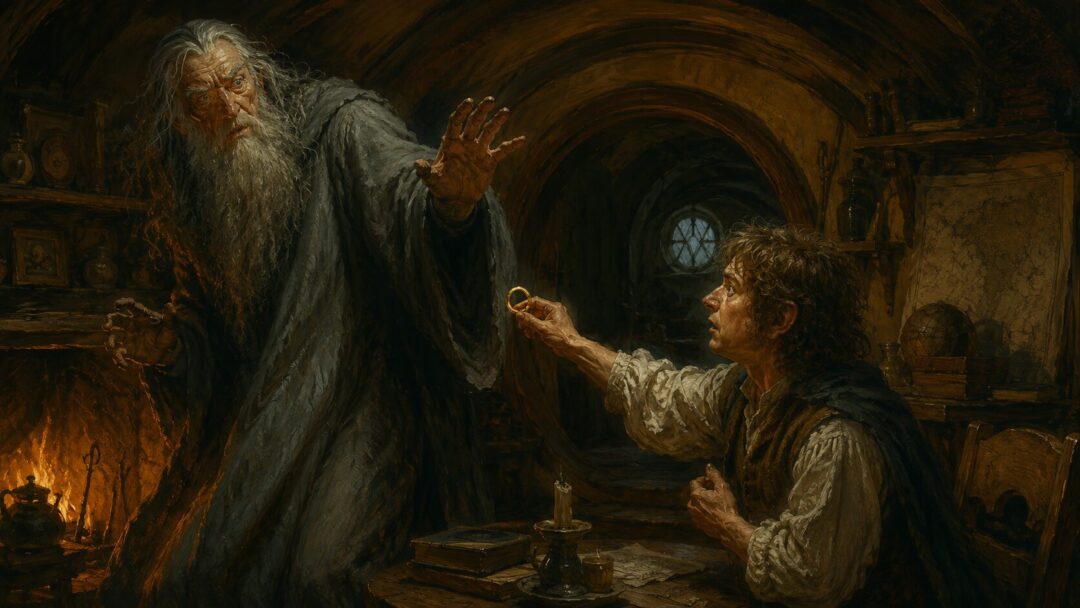
Gandalf’s refusal of the Ring is one of the most important moral moments in the story. When Frodo offers it to him in Bag End, Gandalf does not dismiss the danger because he is wise. He names wisdom as part of the danger.
He understands that he would be tempted to use the Ring from a desire to do good. That is a vital point. Gandalf is not afraid that he would suddenly become petty or cruel in an ordinary way. He fears what would happen if his pity, strength, and knowledge were joined to a device made for domination.
The Ring would not need to persuade Gandalf that evil is good. It would only need to persuade him that goodness needs force. That mercy requires command. That the weak must be protected by someone powerful enough to overrule everyone else.
This is why his refusal is not cowardice. It is humility. Gandalf knows that the Ring cannot be used as a neutral tool. Its very mode of power is mastery. To use it against Sauron would be to enter Sauron’s logic, even if the first intention were mercy.
The texts imply a severe rule of Middle-earth: some powers are not redeemed by good motives. Some tools shape the user more than the user shapes the tool.
Galadriel Saw the Beautiful Form of Tyranny
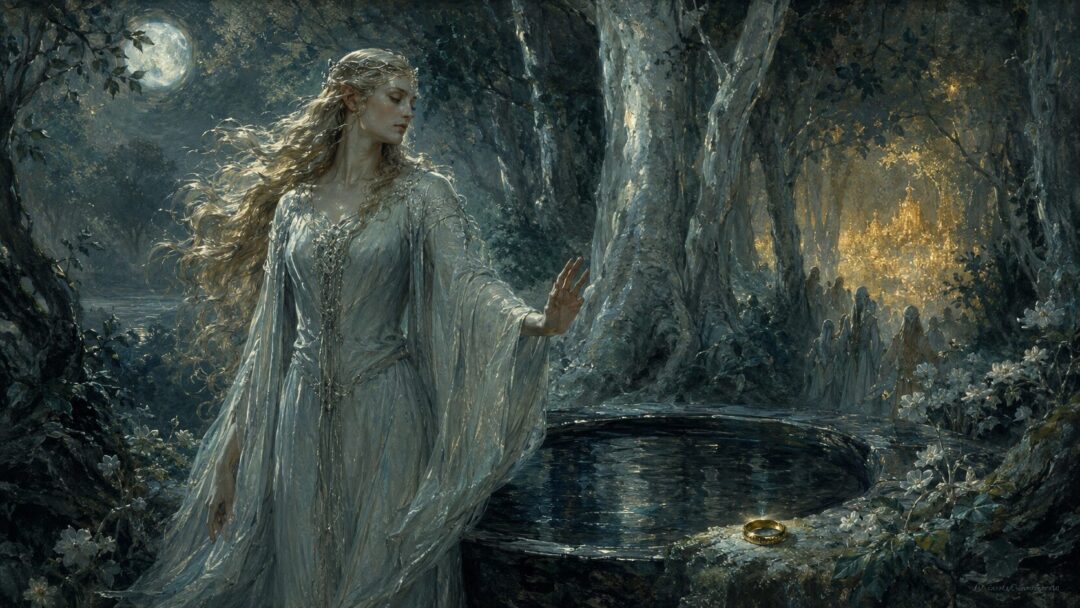
Galadriel’s temptation in Lothlórien is not the temptation of someone ignorant. She is ancient, perceptive, and already a bearer of one of the Three Rings. She understands preservation, loss, and the long defeat of the Elves in Middle-earth.
When Frodo offers her the One Ring, the danger becomes almost luminous. Galadriel imagines a form of rule that would not appear ugly at first. She would be great, beloved, beautiful, and terrible. Many would worship what she became. Her temptation reveals that domination does not always arrive in monstrous clothing. It can arrive radiant.
This is one reason the scene matters so deeply. Galadriel’s test is not whether she wants to serve Sauron. She clearly does not. The test is whether she will accept absolute power to defeat darkness, preserve beauty, and impose a better order.
Her refusal is bound to renunciation. She chooses to diminish and go into the West rather than seize a power that would magnify her beyond rightful limits. That choice is not small. It means accepting decline. It means letting go of a kind of earthly preservation that the Elves dearly desired.
The Ring offers hope without surrender. Galadriel’s wisdom is knowing that such hope is false.
Sam’s Vision Shows the Ring’s Subtlest Lie
Sam’s brief bearing of the Ring near Cirith Ungol is one of the most revealing moments in the entire story. Sam is not a king, wizard, captain, or ancient Elf. He is a hobbit, a servant, a gardener, and Frodo’s loyal companion. If anyone might seem too humble for grand temptation, it would be Sam.
Yet the Ring still finds an opening. It offers him a vision of himself as a great hero, overthrowing Sauron and turning Mordor into a garden. This is not random. Sam loves growing things. He hates the barrenness and cruelty of Mordor. He wants healing, not conquest for its own sake.
But the fantasy still contains command. Armies answer him. The land changes at his will. Even the dream of gardens becomes imperial when filtered through the Ring.
Sam resists partly because he remains grounded in his own proper scale. The text suggests that his plain hobbit-sense and his love for one small garden help save him from the vastness of the fantasy. He does not need all Mordor remade by his command. He knows, at some level, that such greatness is not his road.
This does not make Sam morally simple. It makes his humility powerful. The Ring tries to inflate his hope until it becomes domination. Sam survives because he can still recognize the difference between tending and ruling.
Frodo’s Burden Was Hope Without Control
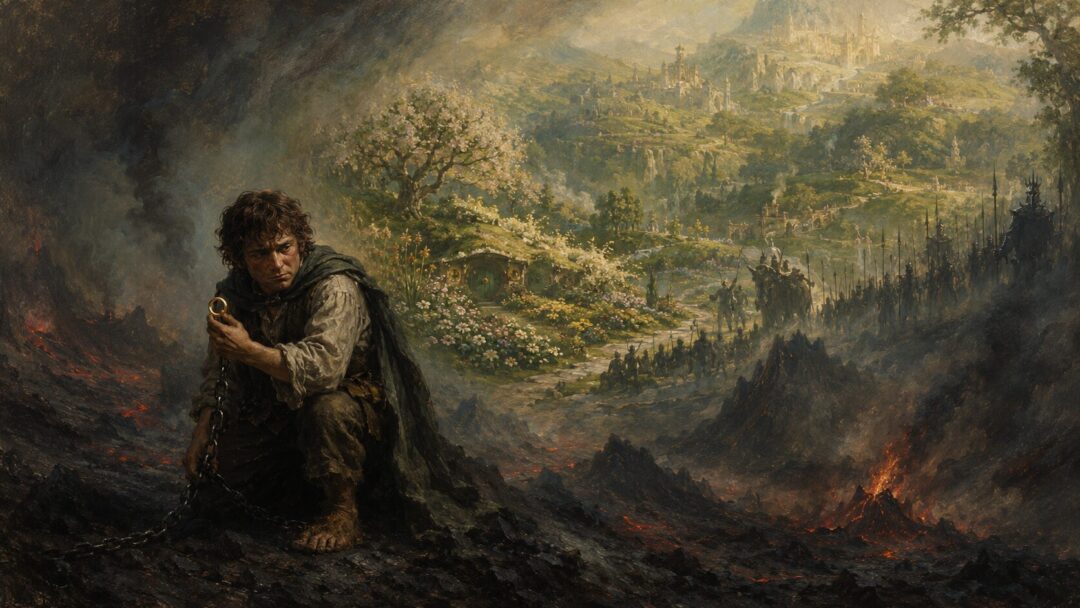
Frodo’s task is almost the opposite of what the Ring offers. The Ring offers the possibility of acting with overwhelming power. Frodo’s road requires endurance without mastery.
He does not march to Mordor as a conquering hero. He does not understand every turn of the road. He cannot defeat Sauron by strength. His courage is not the courage of control, but of continuing when control has vanished.
That is why the quest is so strange by the standards of ordinary war. The Wise do not send the Ring to Minas Tirith. They do not give it to the strongest. They send it with a hobbit into the Enemy’s land, hoping for a possibility that cannot be guaranteed by force.
This is not anti-wisdom. It is a different kind of wisdom. The Council’s decision is not based on optimism in the shallow sense. It is based on the recognition that using the Ring would almost certainly reproduce the evil they seek to destroy.
Frodo’s hope is therefore costly. It does not look like certainty. It looks like vulnerability, secrecy, endurance, and mercy. It has room for pity toward Gollum. It has room for weakness. It has room for failure.
And at the final moment, Frodo does fail to surrender the Ring by his own unaided will. That, too, is part of the terror of the object. The story does not pretend that even the noblest bearer can simply master it forever.
The Ring Turned “Necessary” Into a Dangerous Word
Again and again, the Ring’s logic hides inside necessity.
It would be necessary to save Gondor. Necessary to defeat Sauron. Necessary to preserve beauty. Necessary to heal Mordor. Necessary to protect the weak. These arguments are not absurd. That is why they are dangerous.
The Ring does not need to make evil attractive in a crude way. It only needs to make domination seem like the responsible answer to fear.
This is especially important because Middle-earth is genuinely in peril. The Shadow is not imaginary. Sauron is not a misunderstanding. There really are armies, betrayals, ruined lands, and ancient powers fading. The temptation of the Ring is powerful because the crisis is real.
That is the cruelest trick: when danger is real, control feels wise.
But the story repeatedly distinguishes wisdom from the will to master. Elrond, Gandalf, Galadriel, Aragorn, Faramir, and others are measured not only by what they can do, but by what they refuse to do. Restraint becomes a form of moral sight.
In that sense, the Ring is a test of interpretation. Can a person tell the difference between hope and possession? Between courage and pride? Between stewardship and domination? Between healing and control?
Faramir’s Refusal Matters Because He Rejects the Shortcut
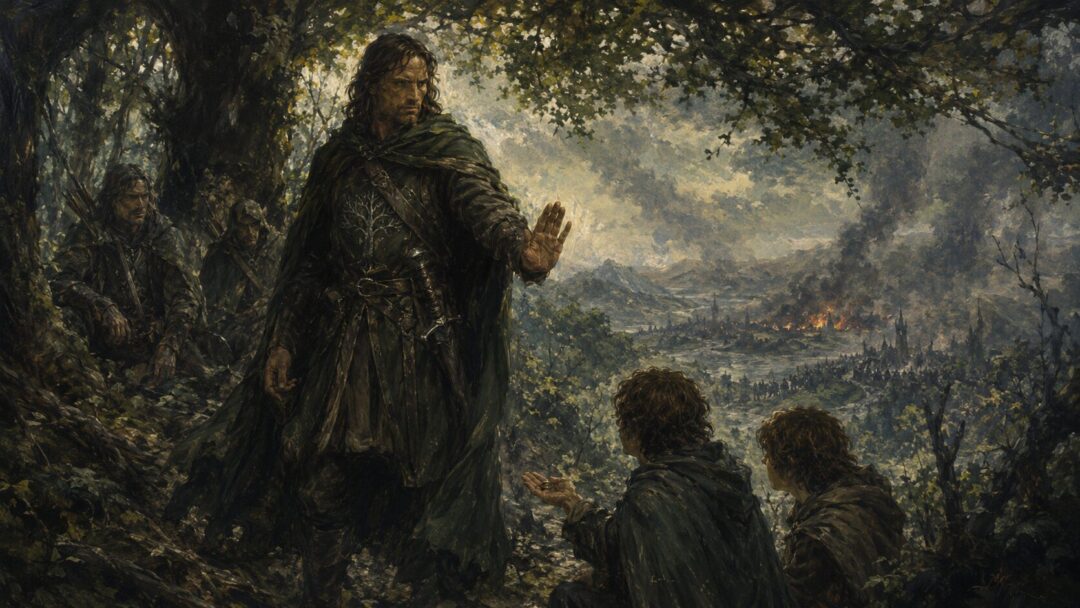
Faramir’s encounter with Frodo and Sam in Ithilien provides another angle on the same theme. He learns enough to understand that the hobbits carry something of immense danger and importance. He also has every worldly reason to desire an advantage for Gondor. His brother is dead, his city is threatened, and his father’s expectations weigh heavily over his house.
Yet Faramir refuses to seize the Ring. He does not do this because he lacks patriotism. He loves Gondor. But he understands, more clearly than Boromir did, that not every weapon of the Enemy can be turned to a noble use.
His refusal is not merely a character contrast with Boromir. It is a rejection of the Ring’s false wisdom. Faramir will not buy victory by becoming the kind of man who grasps at forbidden power.
The texts do not make him invulnerable or superhuman. Rather, they show a man whose ideals still place limits on his fear. That is crucial. The Ring thrives where fear persuades conscience to step aside.
The Real Hope Was Smaller, Stranger, and Stronger
The Ring’s counterfeit hope is grand. It imagines thrones, armies, commands, transformed landscapes, enemies overthrown by superior will. It promises an end to uncertainty.
The true hope of the story is humbler and more mysterious. A hobbit spares Gollum long before that mercy seems useful. A gardener refuses a vision too large for him. A broken creature falls with the Ring when strength has reached its limit. The Wise act, but they also renounce. Kingship returns, but not through the claiming of the Enemy’s weapon.
This does not mean power itself is always evil in Middle-earth. Aragorn wields authority rightly. Gandalf commands when he must. The Elves preserve what they can for a time. The difference is not between action and passivity. It is between power held in service and power seized as mastery.
The One Ring cannot offer service. It can only offer mastery disguised as service.
That is why its cruelest trick is not making evil look beautiful, though it can do that. Its cruelest trick is making domination look like the only mature response to danger. It makes surrender look irresponsible. It makes humility look naive. It makes mercy look weak. It makes hope without control look like folly.
Yet the story’s deepest wisdom lies there: in the refusal to save the world by becoming another lord of the Ring.
The Ring promises that if you are strong enough, wise enough, and noble enough, you can bend the world toward healing.
Middle-earth answers that some victories can only begin when that promise is refused.
Sources & Notes
- J.R.R. Tolkien, The Lord of the Rings, Book I, Chapter 2, “The Shadow of the Past” — Gandalf refuses Frodo’s offer of the Ring because he would wish to use it from pity and for good, making his fall especially dangerous.
- J.R.R. Tolkien, The Lord of the Rings, Book II, Chapter 2, “The Council of Elrond” — Boromir’s argument for using the Ring against Mordor, and Elrond’s answer that it belongs to Sauron and cannot be wielded safely, frame the Ring as false strategic wisdom.
- J.R.R. Tolkien, The Lord of the Rings, Book II, Chapter 7, “The Mirror of Galadriel” — Galadriel’s imagined transformation into a beautiful and terrible queen shows domination offered in a radiant, apparently saving form.
- J.R.R. Tolkien, The Lord of the Rings, Book IV, Chapter 5, “The Window on the West” — Faramir’s refusal to take the Ring, even for Gondor, directly contrasts patriotic need with the rejection of the Enemy’s weapon.
- J.R.R. Tolkien, The Lord of the Rings, Book VI, Chapter 1, “The Tower of Cirith Ungol” — Sam’s vision of himself as a great hero turning Mordor into a garden shows the Ring twisting even healing and humility toward command.
- J.R.R. Tolkien, The Letters of J.R.R. Tolkien, Letter 131 — Tolkien describes Sauron’s Ring as a means of power, domination, and control over other wills, supporting the article’s wider reading of mastery disguised as service.