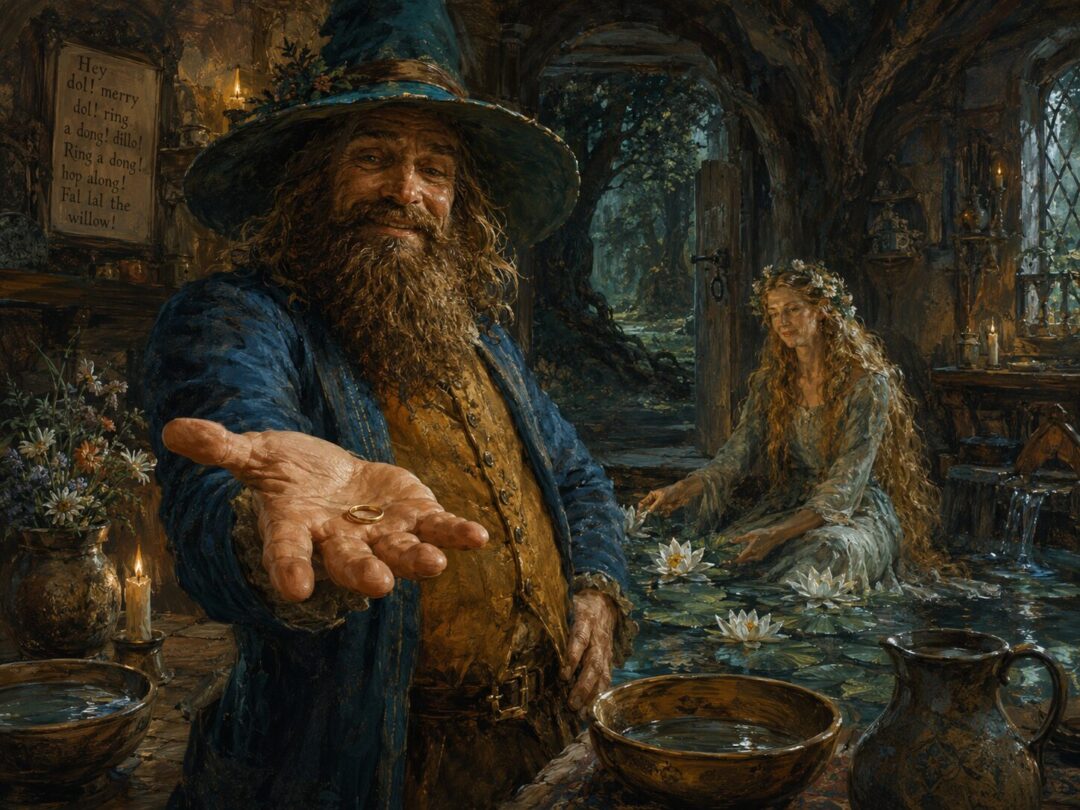
Most readers think Tom Bombadil is the mystery.
But Goldberry may be the reason the mystery cannot be solved in the usual way.
Tom is the figure everyone tries to classify. He is called “Eldest.” The Ring has no power over him. He remembers things that seem to reach back beyond the histories known to Elves and Men. At the Council of Elrond, he is remembered as “oldest and fatherless.”
And yet the story never tells us what he is.
That silence has produced countless theories. Tom has been read as a Maia, a nature-spirit, an embodiment of the Music, a figure outside the normal order of Middle-earth, or something deliberately left undefined. Some of those ideas are interpretations. Some are more speculative than others. None is directly confirmed in the narrative.
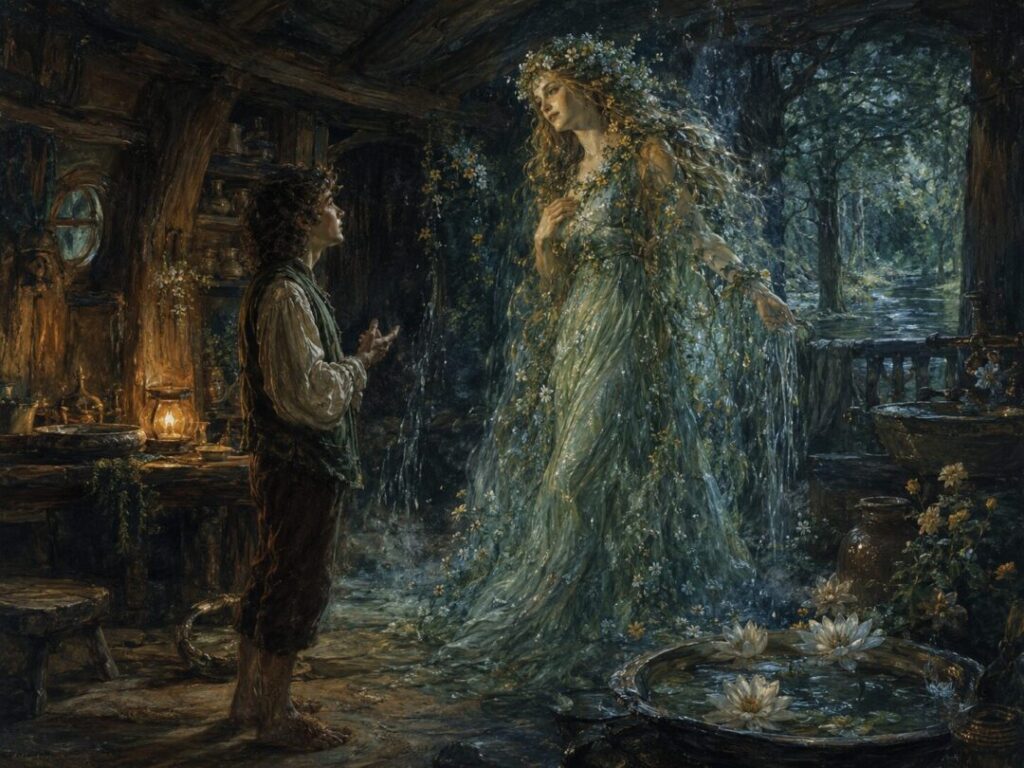
But before Frodo hears Tom speak at length about himself, he asks Goldberry a simpler question.
“Who is Tom Bombadil?”
Her answer is one of the strangest in The Lord of the Rings.
“He is.”
At first glance, that sounds like no answer at all.
It is not.
Goldberry Does Not Solve Tom
Goldberry is often treated as an extension of Tom’s mystery, and in one sense that is fair.
She is called the River-woman’s daughter. She is associated with water, flowers, rain, and the changing beauty of the river-land. Her exact nature is never explained. The text does not identify her as an Elf, a Maia, a mortal woman, or any named order of being.
That matters.
Goldberry is not a footnote to Tom. She is part of the atmosphere that surrounds him. When the hobbits enter Tom’s house, they do not simply meet an odd old being in the forest. They step into a place where the usual pressures of the wider story seem briefly suspended.
The Black Riders are still abroad.
The Ring is still dangerous.
The road to Mordor still lies ahead.
Yet in that house there is food, song, rest, water, light, and a sense of deep-rooted peace.
Goldberry is central to that.
She receives the hobbits. She gives the house much of its grace. Her presence makes Tom’s world feel less like a solitary oddity and more like a complete order of life.
That is why her answer matters so much.
She does not say Tom is a wizard.
She does not say he is one of the Powers.
She does not say he is a lord in disguise.
She does not even say he is “oldest.”
She says, “He is.”
“He Is” Is Not Ignorance
Goldberry’s answer is easy to misread as evasive.
Frodo asks a question the reader also wants answered. Goldberry appears to refuse the categories. But the way the scene is written does not suggest that she is confused or withholding something out of fear.
She answers calmly.
That calmness is important.
Goldberry does not treat Tom as a hidden danger. She does not act as if Frodo has asked something forbidden. She gives an answer that fits the world she inhabits.
To her, Tom is not first of all a problem of classification.
He is.
That does not mean he is divine. It does not mean he is outside creation. The text does not say those things, and they should not be stated as fact. But the wording does suggest that Tom’s identity is bound less to origin than to presence.
He is not defined by a mission.
He is not defined by a hierarchy.
He is not defined by possession, conquest, or descent.
He simply exists in fullness within his own bounds.
And that is already a profound contrast with the Ring.
The Ring Understands Desire
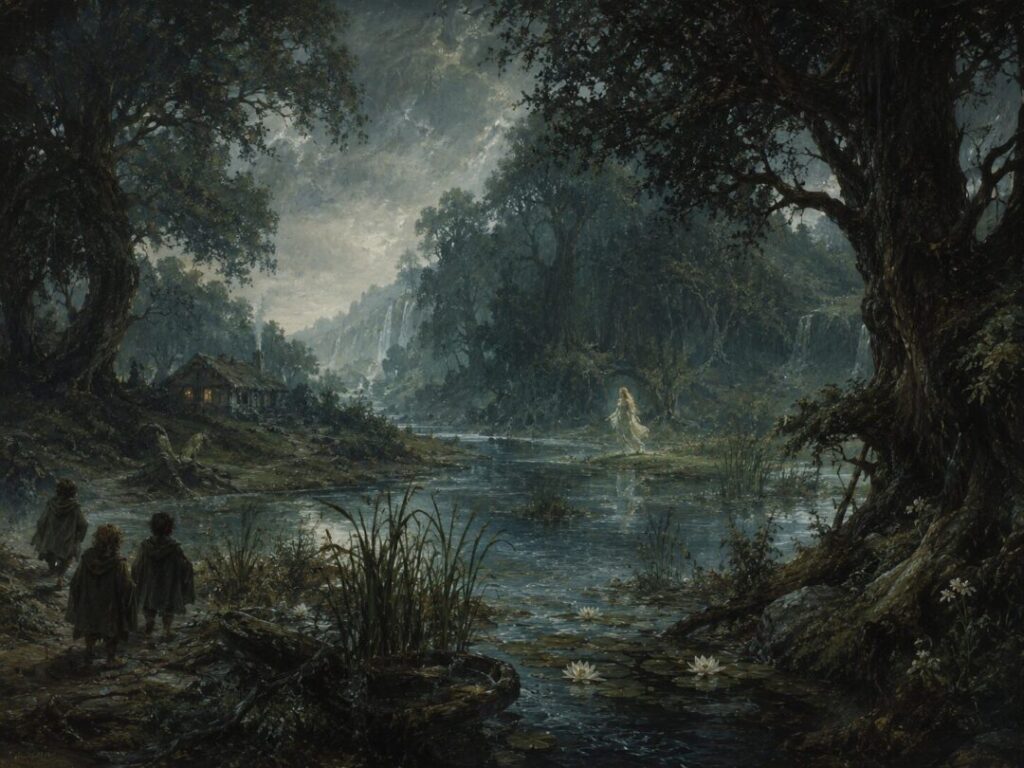
The One Ring works through power, fear, possession, and the will to command.
It tempts by offering enlargement. It draws out what someone might do if their will could be imposed on the world. Even those who desire good can be drawn toward domination through it.
That is why the Ring is so dangerous.
It does not merely tempt the cruel.
It tempts the noble.
It turns pity, justice, protection, and wisdom toward mastery.
Tom’s encounter with the Ring is therefore startling. He takes it, looks at it, makes it vanish, returns it, and when he puts it on, he does not disappear.
Later, at the Council of Elrond, this is not interpreted as Tom having power over the Ring in the ordinary sense. The point is more unsettling. The Ring has no power over him.
That distinction is crucial.
Tom is not presented as the secret weapon that can defeat Sauron. The Wise reject the idea of giving the Ring to him. Not because the Ring would immediately corrupt him, but because he would not treat it with the kind of urgent possessiveness that everyone else would. He might even forget it or misplace it.
That is not weakness in the ordinary sense.
It is a sign that Tom stands outside the Ring’s logic.
Goldberry Shows What That Looks Like
Goldberry helps us understand this without explaining it.
In Tom’s house, mastery does not look like domination.
Goldberry calls Tom “Master,” and Tom is described as master of wood, water, and hill within his own country. But this mastery is not conquest. He does not rule the Old Forest like a king ruling subjects. He does not bend the trees into obedience across the world. He does not expand his borders.
His power, if that is even the right word, is local.
It belongs to place.
It belongs to song.
It belongs to knowledge and harmony rather than possession.
Goldberry’s presence makes this clearer.
She is not conquered by Tom. She is not a servant. She is the Lady of the house, and the house bears her beauty as much as his strangeness. The domestic peace of their dwelling is not ordinary, but it is also not imperial. It does not seek to spread.
This is the opposite of the Ring.
The Ring always pushes outward.
Tom and Goldberry’s world remains bounded.
That boundary is one of the most important clues.
The River-Woman’s Daughter
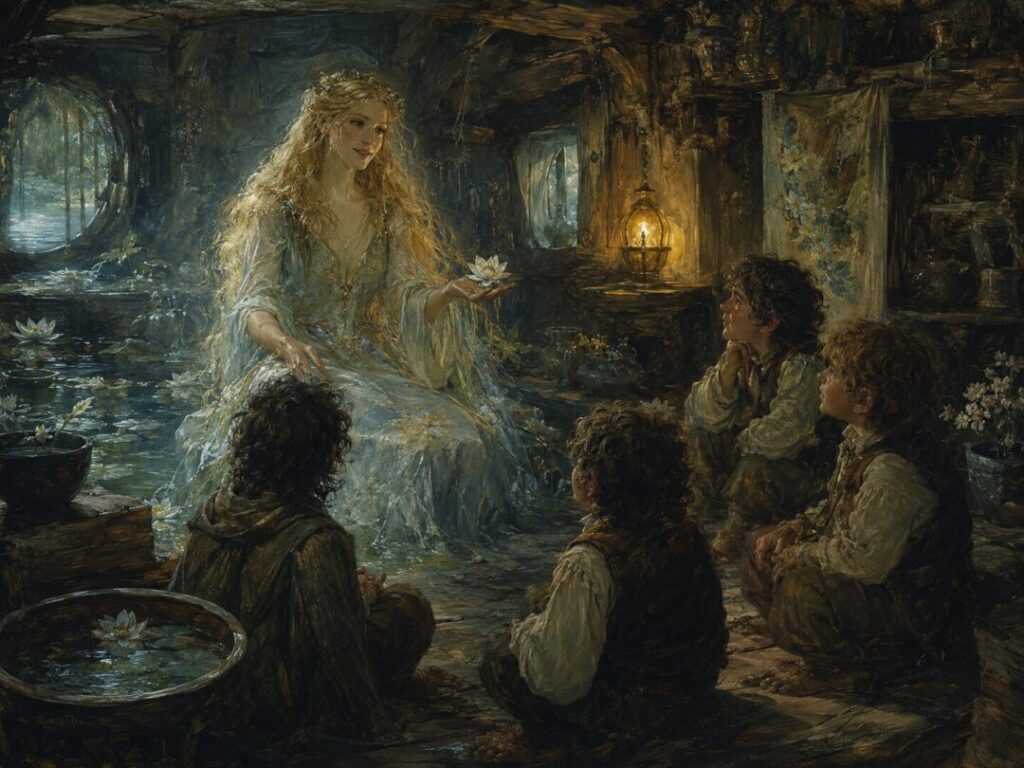
Goldberry’s title, “River-woman’s daughter,” is one of the few pieces of information the text gives us about her.
It strongly connects her with the Withywindle and the river-life of the Old Forest. But it does not tell us exactly what she is. The phrase sounds mythic, almost fairy-tale-like, but it is not converted into a formal category.
That uncertainty should be respected.
The safest reading is that Goldberry is associated with the natural life of the river-land in a way ordinary mortals are not. Beyond that, the text becomes less explicit.
This is where many theories go too far.
Calling Goldberry a river-spirit may be a reasonable interpretation, but it is still an interpretation. Calling her a Maia, an Elf, or a Vala’s servant goes beyond what the narrative confirms. The story gives us imagery, title, song, and presence. It does not give us a taxonomy.
And perhaps that is the point.
Goldberry reveals that not everything in Middle-earth is explained by classification. Some things are known by their relation to place, season, and song.
That is exactly how Tom is known too.
Why Goldberry’s Answer Changes the Question
Frodo asks, “Who is Tom Bombadil?”
Goldberry answers, “He is.”
The obvious frustration is that she has not answered the question in the form Frodo expected.
But perhaps Frodo asked the wrong kind of question.
The story is full of beings whose identity is tied to origin. Elves awaken. Men receive the Gift of mortality. Dwarves are made by Aulë and adopted into the world’s design. Wizards are sent with a purpose. The great Powers belong to a cosmic order.
Tom does not enter the narrative that way.
He is not given a genealogy.
He is not assigned a mission.
He is not placed in a hierarchy.
He is not explained through a maker, people, or destiny.
The more the reader tries to force him into one of those structures, the more resistant he becomes.
Goldberry’s answer suggests another way of reading him.
Not as a missing entry in an encyclopedia.
Not as a coded identity waiting to be decoded.
But as a being whose narrative purpose depends on remaining outside the machinery of power and explanation.
The Mystery Is Moral, Not Just Mythological
The deepest mystery of Tom Bombadil is not only “what kind of being is he?”
It is “what kind of freedom does he represent?”
Goldberry helps answer that.
She shows us a mode of life that is not driven by fear of loss. Her world is full of change: water, seasons, flowers, rain, evening, morning. Nothing about her presence suggests the desire to freeze the world in place.
That is important because the Ring is, in part, bound to the desire to control.
To possess is to prevent loss.
To dominate is to force the world into one’s own shape.
To seek absolute power is to refuse the humility of limits.
Tom and Goldberry live inside limits.
Their country is small. Their concern does not stretch across the whole war. Their house offers rest, but it does not replace the Quest. The hobbits cannot remain there forever. The Ring cannot be solved there.
This can feel disappointing.
But it is also the point.
Tom and Goldberry show a kind of peace that exists in Middle-earth but cannot be weaponized to save it.
Why Tom Cannot Be the Answer
This is why the Council’s discussion of Tom is so important.
If Tom were simply more powerful than Sauron, the solution would be easy. Give him the Ring. Let him guard it. Let his immunity end the crisis.
But the Wise understand that this will not work.
Tom’s freedom from the Ring does not make him the master of the war. It means he is not engaged with the Ring on the level where the war must be fought. He does not desire mastery, but he also does not take responsibility for the fate of all Middle-earth in the way the Council must.
That does not make him lesser.
It makes him different.
Goldberry prepares us to see this.
Her answer to Frodo is not the answer of someone describing a weapon. It is the answer of someone describing a reality.
Tom is.
He is not there to become useful.
He is not there to be explained into strategy.
He is not there to solve the plot.
He is there to reveal that there are things in Middle-earth older, stranger, and freer than the struggle for possession.
Goldberry Makes Tom More Mysterious, Not Less
In the end, Goldberry does not explain Tom Bombadil.
She prevents the wrong explanation.
Without her, Tom might be read only as an eccentric power: the strange old being who can handle the Ring and remain untouched. But with Goldberry, his world becomes more than a display of immunity.
It becomes a household.
A country.
A rhythm of water and weather.
A peace that does not grasp at permanence.
That is why “He is” may be the most precise answer the story can give.
It does not tell us what category Tom belongs to.
It tells us why categories fail.
Tom Bombadil is not mysterious because the story forgot to explain him. He is mysterious because the story uses him to show the limits of explanation itself.
And Goldberry is the one who quietly gives us the key.
The question is not only what Tom is.
The question is what kind of world can still contain someone like him—someone who does not seek the Ring, does not fear it, does not need it, and cannot be turned into an answer by those who do.
Goldberry’s answer is brief.
But once it is followed to its end, it changes the whole mystery.
Tom is not a riddle waiting to be solved.
He is a boundary.
And beyond that boundary, the Ring’s language of power simply stops making sense.
Sources & Notes
- J.R.R. Tolkien, The Lord of the Rings, Book I, Chapter 7, ‘In the House of Tom Bombadil’ — Goldberry’s ‘He is’ answer, her title as the River-woman’s daughter, and the household’s peace and song.
- J.R.R. Tolkien, The Lord of the Rings, Book I, Chapter 8, ‘Fog on the Barrow-downs’ — Tom’s rescue of the hobbits and the bounded, local character of his mastery over his own country.
- J.R.R. Tolkien, The Lord of the Rings, Book II, Chapter 2, ‘The Council of Elrond’ — the Wise discuss Tom as oldest, immune to the Ring’s pull, yet unsuitable as a guardian because he might forget or mislay it.
- J.R.R. Tolkien, The Lord of the Rings, Book I, Chapter 2, ‘The Shadow of the Past’ — Gandalf explains the Ring’s corrupting pull through desire, possession, and the will to use power.
- J.R.R. Tolkien, The Letters of J.R.R. Tolkien, Letter 144 — Tolkien describes Tom Bombadil as deliberately not explained and as representing a particular attitude toward the world rather than a strategic answer to Sauron.