When Frodo returns to the Shire, he is no longer carrying the One Ring.
That should feel like release.
The burden is gone. Sauron has fallen. The Quest has been achieved. The road that began in fear and secrecy has ended in victory beyond hope.
And yet, Frodo does not return empty-necked.
He wears another object on a chain.
Not a Ring.
Not a weapon.
Not a treasure with a long heroic name.
A white gem.
It appears so quietly in the story that it is easy to miss. Compared with the One Ring, the Phial of Galadriel, Sting, or the great Elven Rings, Frodo’s white gem seems almost small.
But that smallness is part of its meaning.
Because by the time Frodo wears it in the Shire, it has become one of the clearest signs that the War of the Ring did not end cleanly for the one who carried its heaviest burden.
The white gem is not just jewelry.
It is a gift for a wound that Middle-earth cannot fully heal.
The Gift Arwen Gives Frodo
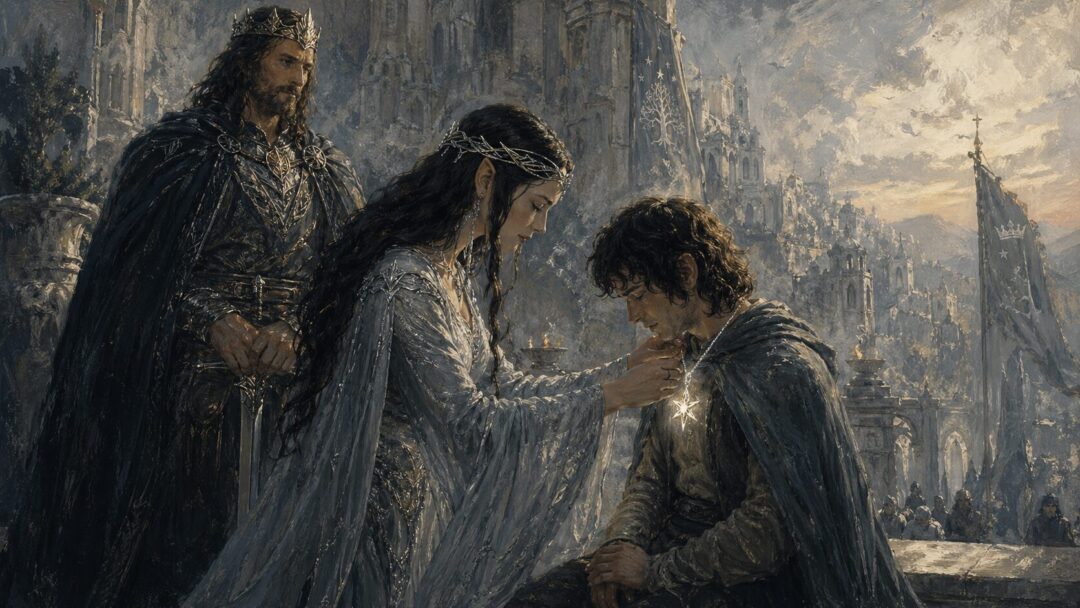
The white gem is given to Frodo by Arwen after the fall of Sauron, during the chapter “Many Partings” in The Return of the King.
By this point, Aragorn has been crowned King Elessar. Arwen has become Queen. The Shadow has passed, and many of the great figures of the age are preparing to go their separate ways.
It is in this moment of departure that Arwen turns to Frodo.
She tells him that she will not go with Elrond when he departs over the Sea. Her choice is now the choice of Lúthien: she has chosen a mortal life with Aragorn, with both its sweetness and its sorrow.
Then she says something extraordinary.
In her stead, Frodo may go when the time comes, if he desires it. If his hurts still grieve him, and if the memory of his burden remains heavy, he may pass into the West until his wounds and weariness are healed.
Only after saying this does Arwen give him the gem.
She takes from her breast a white gem, described as being like a star, hanging upon a silver chain. She sets it about Frodo’s neck and tells him that when the memory of fear and darkness troubles him, it will bring him aid.
The text does not name the gem.
It does not say it is one of the great jewels of the Elder Days. It does not connect it directly to a Silmaril, to the Elven Rings, or to any known named artifact.
That silence matters.
The gem’s power is not explained mechanically. It is not treated like a device. Its meaning comes from the person who gives it, the moment in which it is given, and the wound it is meant to answer.
It Is Not the One Ring Replaced
The most important thing about the white gem is what it is not.
It is not another Ring.
That may seem obvious, but symbolically it matters deeply.
For much of the story, Frodo carries the One Ring on a chain around his neck. It is small, beautiful, and terrible. It lies close to his body. It grows heavier as the Quest continues. It becomes not only a burden but a presence.
By the end, the Ring has worked on Frodo in ways that cannot be reduced to ordinary temptation.
It has pressed on his will.
It has isolated him.
It has become bound up with fear, possession, pity, endurance, and pain.
When the Ring is destroyed, Frodo is freed from the task of carrying it.
But he is not simply restored to who he was before.
That is one of the hardest truths in the ending of The Lord of the Rings. Evil can be defeated, and still leave scars. The world can be saved, and still the savior may not be able to live in the world he saved.
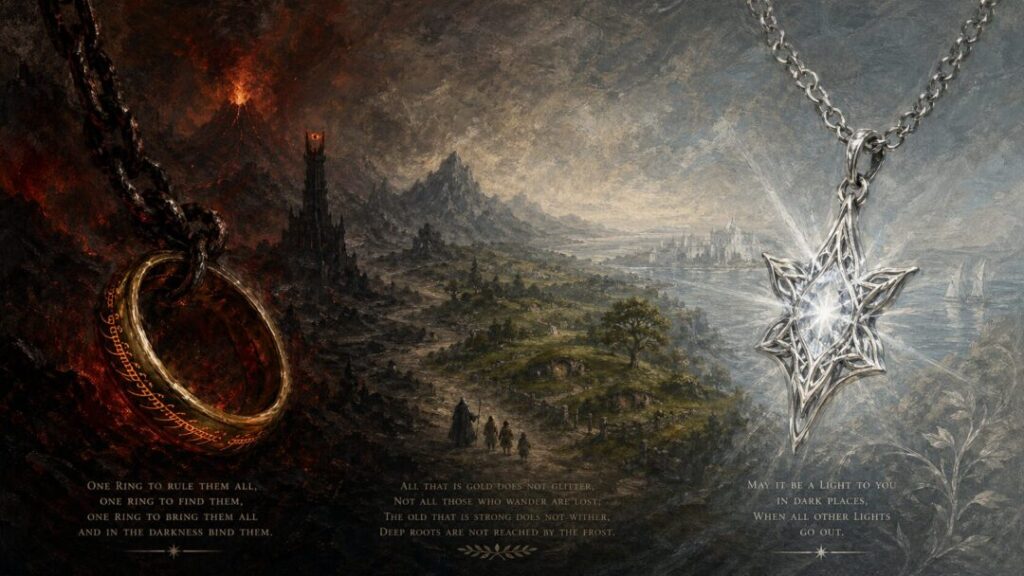
So when Frodo later wears a white gem on a chain, the contrast is unavoidable.
Where the Ring was a burden, the gem is aid.
Where the Ring drew him into darkness, the gem is like a star.
Where the Ring isolated him, the gem is given in love and memory.
It does not erase the Ring.
But it stands where the Ring once hung.
And that makes it quietly devastating.
A Gift from Evenstar and Elfstone
Arwen tells Frodo to wear the gem in memory of “Elfstone and Evenstar.”
Elfstone is Aragorn, whose royal name Elessar means Elfstone. Evenstar is Arwen herself, called Undómiel, the Evenstar of her people.
This matters because Frodo’s life has become woven into theirs.
Without Frodo’s endurance, Aragorn’s kingship would not come to fulfillment in the same way. Without the fall of Sauron, the long hope of the Dúnedain would remain under shadow. Without the success of the Quest, Aragorn and Arwen’s union would not stand at the dawn of a renewed kingdom.
But the weaving goes the other way too.
Arwen’s joy is inseparable from Frodo’s suffering.
She gains a mortal life with Aragorn in a healed kingdom. Frodo loses the ordinary life in the Shire that he tried to save.
The gem sits at the meeting point of those two destinies.
It is not payment.
It is not a reward in the simple sense.
It is not enough to undo what Frodo endured.
But it acknowledges something few others can see.
Arwen understands that Frodo’s victory has cost him more than public honor can repay.
Why Arwen Understands Frodo
Arwen is not a Ring-bearer. She does not carry the One Ring into Mordor. She does not experience Frodo’s burden directly.
But she is uniquely placed to understand the shape of sacrifice.
Her own choice is one of renunciation. By choosing Aragorn, she chooses the fate of mortality. She does not depart with Elrond over the Sea. She gives up the Elvish road that would otherwise have been open to her.
This does not make her suffering identical to Frodo’s.
The text does not say that.
But it does place their stories in quiet relation.
Arwen receives the world that Frodo helped save. Frodo, meanwhile, finds that the restored world cannot fully restore him.
That is why her gift feels so intimate. She does not simply honor him as a hero. She sees him as someone wounded.
Before the Shire fully understands it, before Sam fully grasps it, Arwen has already spoken as if Frodo may not be able to remain.
“If your hurts grieve you still…”
That line is almost prophetic.
Because Frodo’s hurts do grieve him still.
The Gem in the Shire
After Frodo returns home, the white gem appears again.
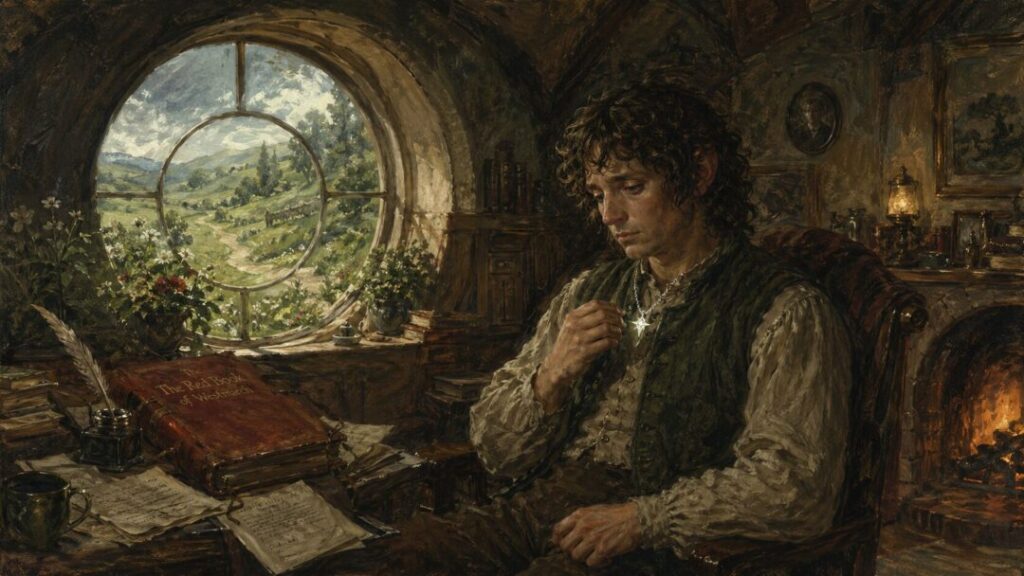
He and Sam return to ordinary clothing, but Frodo continues to wear the white jewel on its chain. The text says he often fingers it.
That detail is small, but it is not accidental.
Frodo does not place the gem away in a drawer as a keepsake from Minas Tirith. He keeps it close to his body. He touches it. It becomes part of his daily life after the Quest.
And then the darker meaning becomes clear.
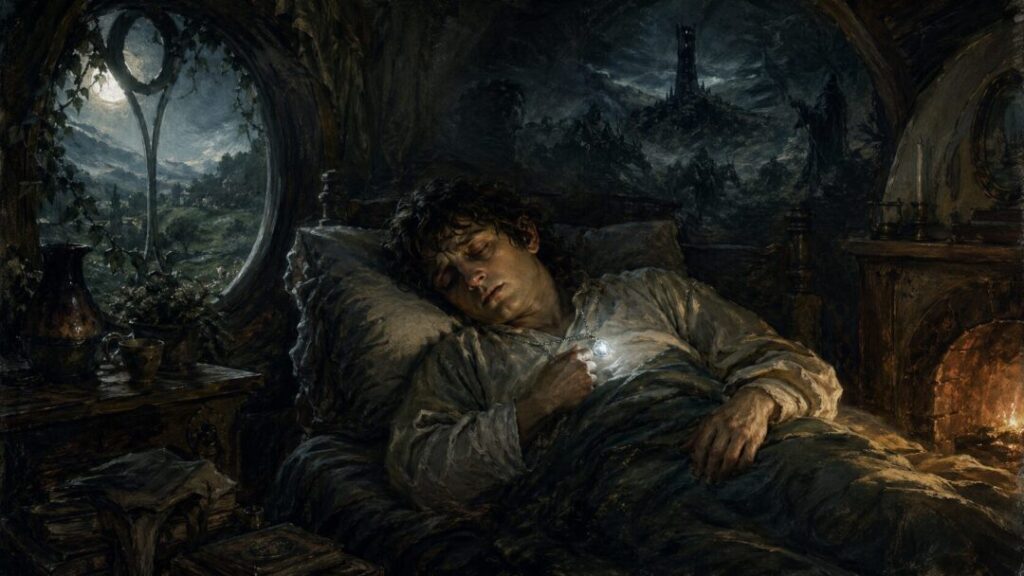
On March 13, Frodo falls ill. This date matters because it is the anniversary of Shelob’s attack and the terrible events around Cirith Ungol. Farmer Cotton finds him lying on his bed, clutching the white gem at his neck, half in a dream.
Frodo says that it is gone forever, and now all is dark and empty.
The line is one of the most unsettling in the ending.
The Ring is gone. That should be joy. But Frodo’s words suggest the wound is more complicated than simple relief. The destruction of the Ring has saved the world, but Frodo’s relationship to it has left a deep absence, a darkness where peace should be.
The white gem does not prevent the fit.
But he clutches it in the midst of it.
That is exactly what Arwen said it would be for: not to make the memory disappear, but to bring aid when fear and darkness return.
The Gem Does Not Heal Everything
It is important not to exaggerate what the white gem does.
The text never says it magically cures Frodo. It never says it removes his pain permanently. It never describes a clear visible power like the Phial of Galadriel shining against Shelob.
The gem’s aid is quieter.
It is associated with memory, comfort, and endurance. It is something Frodo can hold when the darkness returns. It is a sign that his suffering has been seen and named.
But it is not enough to keep him in Middle-earth.
That is the tragedy.
Frodo has the Shire again. He has Bag End. He has Sam. He has honor among those who know the truth. He has the Red Book and the chance to finish the story.
Yet he remains too deeply hurt.
The white gem can aid him.
It cannot make the Shire enough.
Why the West Is Part of the Same Gift
Arwen’s gift has two parts.
The first is the white gem.
The second is the possibility of passing into the West.
These should not be separated too sharply.
The gem helps Frodo endure the memory of fear and darkness while he remains in Middle-earth. The passage West offers healing when endurance is no longer enough.
This is why Arwen’s words are so important. She does not command Frodo to leave. She does not tell him that he must abandon the Shire. She says that if his hurts still grieve him, and if the memory of his burden is heavy, then he may pass into the West.
It is an offer shaped around his wound.
And when Frodo finally leaves at the Grey Havens, the earlier gift suddenly becomes clearer. Arwen had already understood the road he might need to take.
The white gem was not merely a beautiful farewell present.
It was the first sign of a mercy that would later become his departure.
Not a Prize, but a Mercy
The white gem is easy to misunderstand if we treat all gifts in Middle-earth as trophies.
Frodo is not being decorated like a victorious champion. He is not being given a jewel because he has risen into glory.
The tone is gentler than that.
Arwen gives him something for pain.
That distinction matters.
Frodo’s ending is not about reward in the ordinary heroic sense. He does not return home to enjoy uninterrupted peace. He does not become lordly. He does not become a ruler. He does not even remain in the land he saved.
His honor is real, but his healing is incomplete.
The white gem belongs to that uncomfortable truth. It says that some wounds continue after victory, and that mercy must sometimes take the form of companionship, memory, and eventual release.
In that sense, the gem is one of the most compassionate objects in the story.
It does not dominate.
It does not command.
It does not preserve power.
It comforts.
The Star Against the Dark
The description of the gem is brief, but beautiful.
It is white, like a star.
That image is not random in a story where stars often stand against darkness. Elvish memory is filled with starlight. Hope often appears not as blazing conquest, but as a small light that remains when night seems overwhelming.
The white gem belongs to that pattern.
It is not the sun.
It is not a sword of flame.
It is not a power that breaks enemies.
It is a star-like thing worn close to the heart.
That is exactly the kind of aid Frodo needs after the Quest. His battle is no longer against Orcs, Nazgûl, or the armies of Mordor. It is against memory. Against emptiness. Against wounds that return on quiet days in the Shire.
For that kind of darkness, a great weapon would be useless.
A small light is more fitting.
What the White Gem Really Means
So what was the white gem Frodo wore?
In the plainest sense, it was an unnamed white jewel on a silver chain, given to him by Arwen after the War of the Ring.
But in the deeper sense, it was a sign of recognition.
Arwen saw that Frodo’s suffering would not simply vanish because the world had been saved. She understood that his wounds might outlast the celebration. She gave him something to hold when the darkness returned, and she opened before him the possibility of healing beyond Middle-earth.
That is why the gem matters.
It is not famous because it conquers evil.
It is moving because it acknowledges what evil leaves behind.
The Ring was the burden Frodo carried for the world.
The white gem was the mercy given to the one who carried it.
And when Frodo fingers it in the Shire, or clutches it in the midst of his pain, the story quietly tells us what no song of victory can fully say:
The Quest was accomplished.
But Frodo was still wounded.
And someone had seen it.
Sources & Notes
- J.R.R. Tolkien, The Lord of the Rings, Book VI, Chapter 6, “Many Partings” — Arwen gives Frodo the unnamed white gem on a silver chain and says it may aid him when fear and darkness trouble him.
- J.R.R. Tolkien, The Lord of the Rings, Book VI, Chapter 7, “Homeward Bound” — Frodo returns in plain grey with the white jewel at his neck and is shown often fingering it.
- J.R.R. Tolkien, The Lord of the Rings, Book VI, Chapter 9, “The Grey Havens” — Frodo names his wounds from knife, sting, tooth, and burden, showing why the Shire cannot fully heal him.
- J.R.R. Tolkien, The Lord of the Rings, Book VI, Chapter 9, “The Grey Havens” — on the anniversary of Shelob’s attack Frodo is found clutching the white gem and speaking of darkness and emptiness.
- J.R.R. Tolkien, The Lord of the Rings, Appendix A, “The Tale of Aragorn and Arwen” — gives the fuller context of Arwen’s mortal choice, her union with Elessar, and the cost bound up with her gift to Frodo.