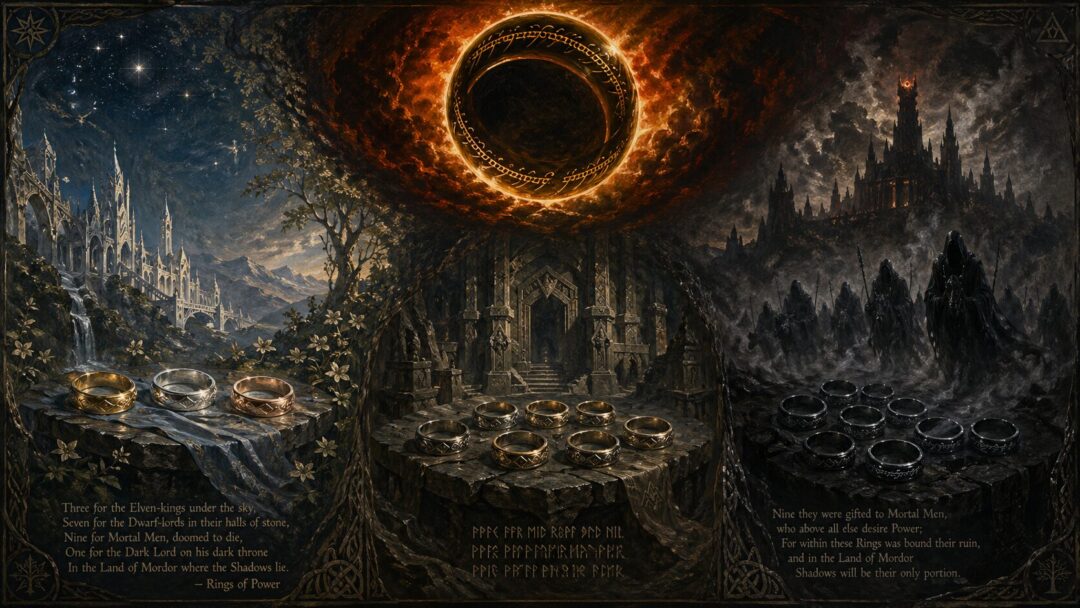
Few lines in Middle-earth are more famous than the words of the Ring.
They are short. Severe. Almost impossible to forget.
One Ring to rule.
One Ring to find.
One Ring to bring.
One Ring to bind.
Even without the full poem around them, the words feel complete. They seem to contain the whole purpose of the One Ring in a handful of phrases. There is no beauty in them. No mercy. No image of kingship as service, stewardship, or healing.
Only control.
So the answer to the question seems obvious at first.
Sauron wrote them.
After all, the One Ring was made by Sauron in the fires of Orodruin. Its inscription is in the Black Speech, the language associated with Mordor. Gandalf identifies the letters as Elvish in form, but the language itself as that of Mordor. The words are not merely decorative. They reveal the Ring’s purpose.
But then the text complicates the matter.
Because Gandalf does not present the inscription as an isolated sentence. He says it is only part of something larger: a verse long known in Elven-lore.
That one detail turns a simple answer into a much more interesting mystery.
Did Sauron write the whole Ring-verse?
Did the Elves write it?
Or did the verse preserve two different things at once: Sauron’s own words of domination, and the Elves’ later memory of what those words meant?
The most lore-accurate answer is careful rather than dramatic.
The words on the Ring itself are Sauron’s.
The full verse is remembered in Elven-lore.
But the texts do not clearly name a single author for the entire poem.
And that silence matters.
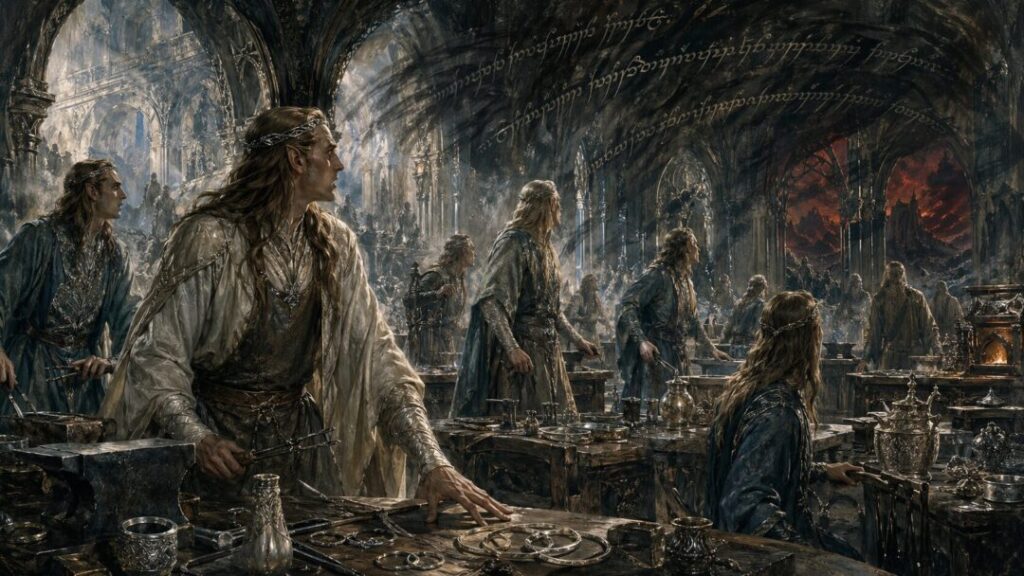
The Ring Inscription Is Not the Whole Verse
The first thing to separate is the inscription from the full Ring-verse.
The inscription on the One Ring contains only the final central lines: the lines about the One Ring ruling, finding, bringing, and binding the others. These are the words Gandalf translates for Frodo after the Ring is heated and the hidden writing appears.
The full verse is longer.
It names the Three Rings for the Elves, the Seven for the Dwarves, the Nine for Mortal Men, and the One for the Dark Lord in Mordor. The famous inscription forms only part of that larger poem.
This distinction is essential.
The Ring did not bear the whole verse. It bore the words of command. The part on the Ring is not a historical explanation of all the Rings of Power. It does not describe how many were given to Elves, Dwarves, or Men. It does not explain the wider story.
It declares purpose.
Rule. Find. Bring. Bind.
Those are not the words of a neutral observer. They are the logic of the Ring itself.
The Words on the Ring Belong to Sauron
The strongest evidence points to Sauron as the source of the inscription lines.
The One Ring was his work. He made it secretly after the Rings of Power had already been made in Eregion. His purpose was to control the other Rings and through them dominate their bearers.
The inscription expresses that purpose exactly.
It is not phrased like an Elven warning. It is not written as a lament. It does not say, “Beware the Ring.” It does not say, “The Dark Lord seeks mastery.” It speaks from the perspective of mastery itself.
The language is also important.
The words are in the Black Speech. This is not a language the Elves would have chosen for their lore. It belongs to Mordor and to Sauron’s world of domination. Gandalf is reluctant even to utter it in the Shire, and when he later speaks it at the Council of Elrond, the effect is deeply disturbing.
That does not prove that Sauron sat and “composed poetry” in the ordinary sense.
But it does strongly support the idea that the inscription lines are Sauron’s own declaration of power, bound to the Ring and to its purpose.
They are not just about the One Ring.
They are the One Ring speaking its design.
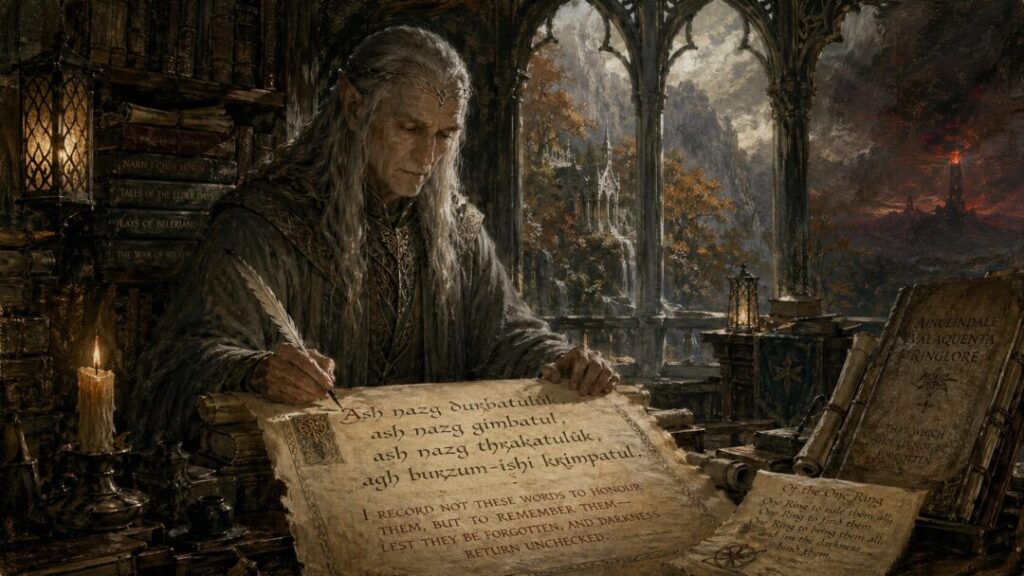
What the Smiths of Eregion Heard
The most important clue comes from the history of Eregion.
The Elven-smiths made the Rings of Power with Sauron’s hidden influence behind much of the work. The Three, however, were made by Celebrimbor alone and were never touched by Sauron. Still, they were made using the same craft and were subject to the One because the One was designed to rule the whole system of the Rings.
When Sauron forged the One Ring and put it on, the Elves became aware of him.
The texts tell us that the Smiths of Eregion heard the words and knew they had been betrayed.
That moment is crucial.
The Ring-words were not discovered centuries later as a curiosity. They were tied to the very instant the trap was revealed. The Elves realized that the power they had helped bring into the world had been turned toward enslavement.
This is why the inscription lines are so terrifying.
They are not merely a slogan.
They are the sound of betrayal becoming clear.
The Elves had made Rings with the hope of preservation, healing, and resistance to decay. Sauron’s hidden purpose was mastery. When he claimed the One, that purpose was exposed.
The words were remembered because they marked the moment beauty became a snare.
Why Is the Full Verse in Elven-Lore?
Gandalf’s phrase matters: the inscription is part of a verse long known in Elven-lore.
That does not mean the whole poem was necessarily written by Elves before the betrayal. In fact, that would be difficult to maintain.
The full verse refers to the final arrangement of the Rings: Three, Seven, Nine, and One. But that distribution belongs to the unfolding history after Sauron’s designs were revealed. The Rings were not all originally made as gifts neatly assigned to Elves, Dwarves, and Men in the way the poem later remembers them.
The Three were preserved by the Elves. The Seven and the Nine came under Sauron’s control and were given by him to Dwarves and Men. The Nine eventually enslaved mortal kings and warriors into the Nazgûl. The Seven did not enslave the Dwarves in the same way, but they inflamed greed and helped bring ruin.
So the full verse seems to look back on the completed pattern.
It is not simply the inscription copied out in longer form. It is a remembered summary of the Rings’ fate.
That is why the safest interpretation is this:
Sauron is the source of the Ring’s own words.
Elven-lore preserved those words within a fuller verse that remembered the entire disaster.
The poem, as we receive it, may therefore be less like Sauron’s complete composition and more like a historical and moral frame built around his terrible utterance.
But the text never explicitly names the author of the full verse.
So we should not pretend it does.
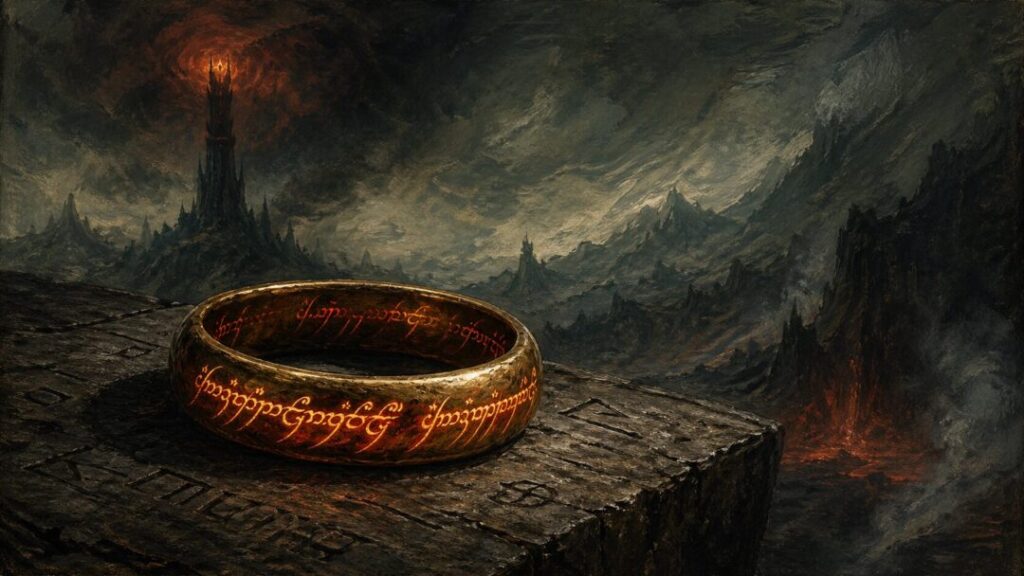
The Verse Is Not a Prophecy
It is tempting to treat the Ring-verse like a prophecy.
It sounds ancient. It sounds inevitable. It has the rhythm of doom. Many readers encounter it before they understand the whole history of the Rings, so it feels as though it is announcing the destiny of Middle-earth from above.
But within the story, the verse is better understood as memory.
It is a piece of lore. A preserved account. A compact summary of what the Rings became under Sauron’s design.
That distinction matters.
A prophecy looks forward.
The Ring-verse looks back on a betrayal already known to the Wise. It gathers the terrible pattern into a form that can be remembered: Three, Seven, Nine, One.
It is history sharpened into poetry.
That may be why it is so powerful. It does not explain everything. It does not need to. It names the structure of Sauron’s design so clearly that the reader feels the trap before fully understanding it.
The verse works because it is simple.
But what it remembers is not simple at all.
Why Would Elves Preserve Such Words?
This may be the most haunting part.
If the Black Speech lines came from Sauron, why would they be preserved in Elven-lore at all?
The answer is probably not admiration. It is memory.
The Elves had every reason to remember the moment of betrayal. The making of the Rings was one of the great tragedies of the Second Age. It was not merely a military defeat or a political mistake. It was the corruption of a beautiful craft.
The Elves desired preservation. They wished to protect what they loved from fading and change. That desire was not the same as Sauron’s lust for domination, but it became the opening through which he deceived them.
To preserve the Ring-words in lore was to preserve the warning.
This is what Sauron intended.
This is what the One was made to do.
This is what was hidden beneath the fair appearance of the Rings.
In that sense, the full Ring-verse is not just a poem about power.
It is a wound made memorable.
Why the Author Is Left Unnamed
Middle-earth often gives us names.
Kings, makers, houses, lineages, places of origin, long chains of memory—these things matter deeply in the legendarium. So the absence of a named author for the Ring-verse is striking.
But it may also be fitting.
The verse is not important because a particular poet composed it. It is important because it carries the memory of the Rings’ corruption. Its authority does not come from authorship in the modern sense. It comes from lore.
It belongs to what was remembered after Eregion’s trust was broken.
This also keeps the focus where it should be.
The inscription lines are Sauron’s will.
The full verse is the world’s memory of that will.
One is domination speaking.
The other is lore refusing to forget.
So Who Wrote It?
The most accurate answer is layered.
Sauron almost certainly stands behind the words inscribed on the One Ring. They are in the language of Mordor, they express his exact purpose, and they were connected to the moment the Elven-smiths realized his betrayal.
But the full Ring-verse is not explicitly attributed to Sauron.
It is described as known in Elven-lore. That suggests the larger poem was preserved, shaped, or transmitted among the Elves as a way of remembering the history and danger of the Rings. Whether an Elf first arranged the full verse, or whether it grew within lore over time, the texts do not say.
So the answer is not simply “Sauron wrote the poem.”
It is more unsettling than that.
Sauron gave Middle-earth the words of domination.
The Elves remembered them.
And by remembering them, they turned his boast into a warning.
Why This Changes the Ring-Verse
Once this distinction is clear, the Ring-verse feels different.
It is not just a dark little rhyme at the beginning of the story. It is the compressed history of the Rings of Power. It contains the beauty of the Three, the ruin of the Seven, the enslavement of the Nine, and the secret purpose of the One.
Its most famous lines are Sauron’s will.
But the fact that those lines survive in Elven-lore shows that evil does not get the final word simply by speaking first.
The Elves heard the words and knew they had been betrayed. They did not forget. They carried the memory forward, not to glorify the Ring, but to name its danger.
That is why the verse still feels so cold.
It is not merely about power.
It is about the moment power revealed what it had always wanted.
To rule.
To find.
To bring.
To bind.
And beneath the rhythm of the poem, that is the terror that remains.
Sources & Notes
- J.R.R. Tolkien, The Lord of the Rings, Book I, Chapter 2, “The Shadow of the Past” — Gandalf reveals the Ring-inscription, translates the Black Speech lines, and says they are part of a verse long known in Elven-lore.
- J.R.R. Tolkien, The Silmarillion, “Of the Rings of Power and the Third Age” — Sauron secretly forges the One Ring, and the Elven-smiths become aware of him and his purpose when he claims it.
- J.R.R. Tolkien, The Lord of the Rings, Book II, Chapter 2, “The Council of Elrond” — Elrond and Gandalf frame the One Ring as Sauron’s instrument for ruling the other Rings and their bearers.
- J.R.R. Tolkien, The Silmarillion, “Of the Rings of Power and the Third Age” — gives the later pattern of the Three, Seven, Nine, and One, supporting the distinction between the Ring-inscription and the fuller Ring-verse.
- J.R.R. Tolkien, The Letters of J.R.R. Tolkien, Letter 131 — describes Sauron’s will to order and dominate, useful context for reading the Ring-words as a declaration of mastery rather than a neutral poem.