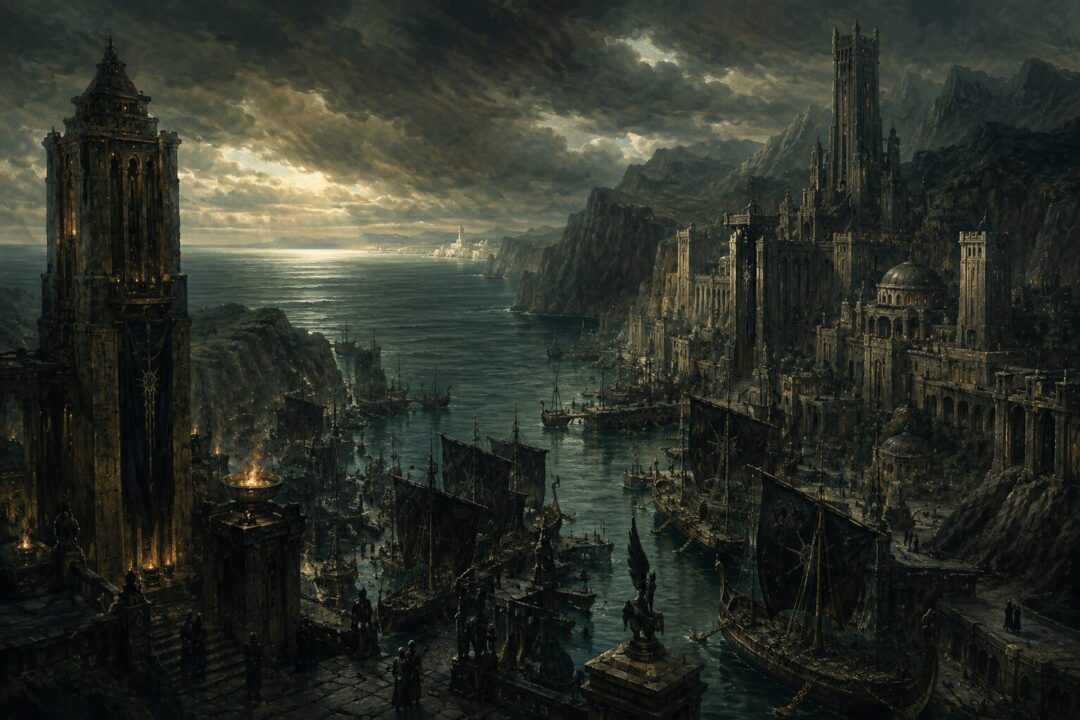
When the black-sailed ships of Umbar appear in the story of the War of the Ring, they look at first like a simple external threat: raiders from the south, sea-wolves coming to burn Gondor’s coast while Minas Tirith is already under siege. But Umbar was never only a pirate coast. Its danger was older, colder, and more intimate.
Umbar was the place where Gondor could see a distorted version of itself: Númenórean skill without humility, sea-power without mercy, kingship turned into domination, exile hardened into hatred. It was not merely a foreign harbor full of enemies. It was a rival inheritance of Númenor.
The Black Ships Were Only the Last Symptom
The Corsairs of Umbar are most visible at the end of the Third Age, when their fleet threatens Gondor’s southern lands and is later seized by Aragorn at Pelargir. In narrative terms, those ships matter because they delay or weaken the aid that might otherwise have reached Minas Tirith. Yet the black ships are only the surface of the wound.
The deeper history begins long before the War of the Ring. Umbar was a great haven far south of Gondor, associated with a cape and land-locked firth, and it had been Númenórean land “since days of old.” Reliable lore references summarize it as a southern haven long held by Black Númenóreans, later conquered by Gondor for a time.
Encyclopedia of Arda
That matters because the enemy across the water was not originally defined by being non-Gondorian or non-Númenórean. It was defined by being another branch of the same imperial past.
Two Havens, Two Moral Directions
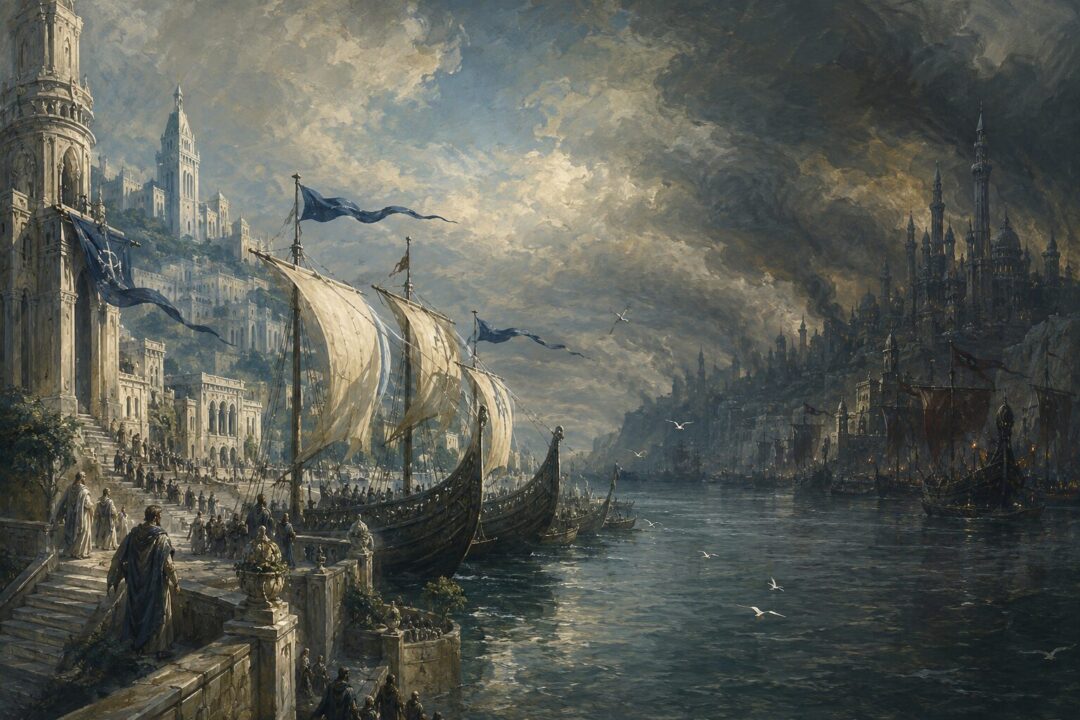
Pelargir and Umbar form one of Middle-earth’s sharpest historical contrasts.
Pelargir was built in the Second Age as a haven of the Faithful, and it later became one of the cities gathered into Gondor after the Downfall of Númenor. The same source notes that the King’s Men established havens farther south, placing Pelargir and Umbar within a wider pattern of Númenórean settlement but on opposite moral paths.
That is the first reason Umbar is a mirror. Gondor’s great port was not simply opposed to a barbarian shore. It faced another Númenórean harbor, another sea-road, another memory of the West. Both worlds knew ships, stone, lordship, and long memory. But Pelargir belonged to the Faithful tradition that survived through Elendil’s line, while Umbar became associated with the King’s Men and later the Black Númenóreans.
The contrast is not “civilization versus savagery.” It is something more tragic: the same high civilization split by pride, fear, and allegiance.
The King’s Men Without Repentance
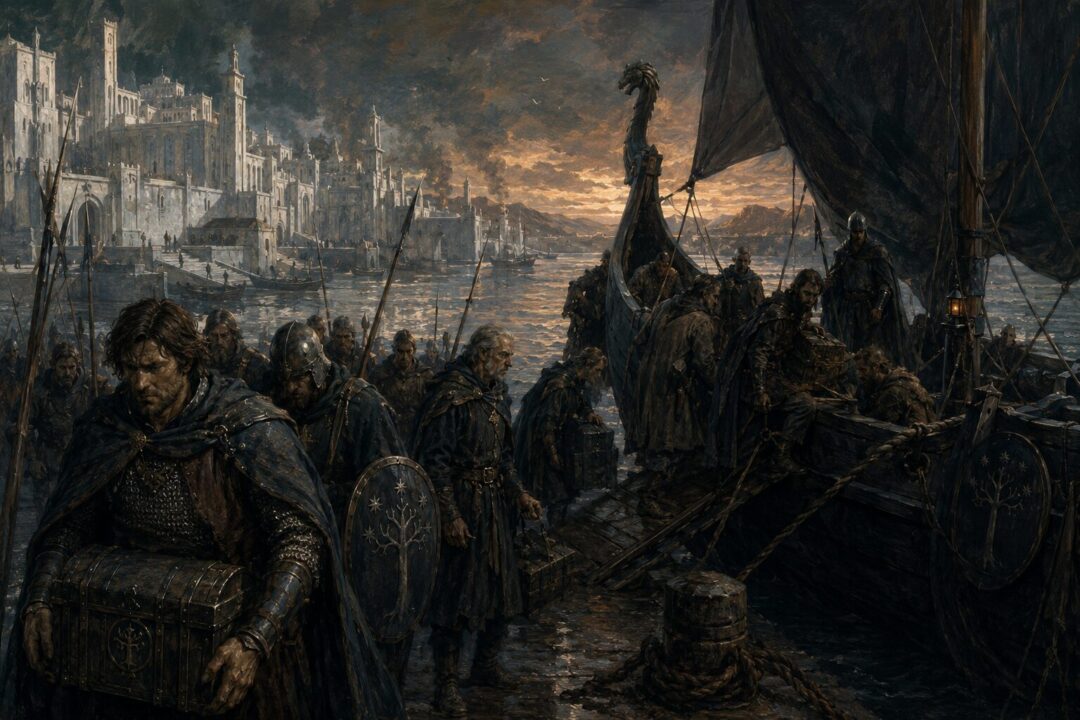
The King’s Men were those Númenóreans who opposed the Faithful and turned away from friendship with the Eldar and reverence for the limits placed on Men. In the later Second Age, many Númenóreans in Middle-earth oppressed local peoples and took tribute. Reputable lore summaries describe the King’s Men as establishing lordships and strongholds in Umbar, Harad, and other coastal places, while the Black Númenóreans emerged from that party and were associated especially with Umbar.
This is why Umbar feels like Gondor’s dark reflection. Gondor inherited Númenor’s height, but also had to live under Númenor’s warning. Its own ancestors were survivors of a drowned realm. Its towers, ships, and royal claims all came shadowed by the memory that Númenor fell not because it was weak, but because it became proud.
Umbar represents the branch that did not learn that lesson. The texts imply a continuity of hatred: after the fall of Sauron at the end of the Second Age, the race of the Black Númenóreans dwindled or merged with Men of Middle-earth, but their descendants retained control over Umbar and inherited their hatred of Gondor.
That is not ordinary piracy. That is historical resentment turned into policy.
Gondor Conquered Its Shadow, But Did Not End It
Gondor did take Umbar. During the age of the Ship-kings, Gondor’s naval power grew, and Eärnil I built a great navy to conquer Umbar. Later summaries of the Corsair wars place Eärnil’s capture of Umbar in T.A. 933, followed decades later by a counterstroke in which exiled lords led Haradrim forces against the haven and King Ciryandil was slain.
This history is important because it shows that Umbar was not a minor nuisance Gondor could swat away. It was a strategic prize, a symbolic possession, and a wound that reopened whenever Gondor weakened. Even when Gondor held it, Umbar remained a place taken at great cost.
Here the mirror grows darker. Gondor’s struggle against Umbar was not simply defensive. Gondor itself became a sea empire for a time. Its kings pushed south, ruled coastlands, and fought long wars over harbors and tribute. The texts do not make Gondor morally identical to Umbar, but they do allow a sober reading: Gondor’s greatness always stood near the same temptations that had ruined Númenor.
Umbar was the image of what Númenórean power looked like when cut loose from restraint.
Castamir Turned Umbar Into a Gondorian Wound
The second great transformation of Umbar came during and after Gondor’s Kin-strife. Castamir the Usurper was not a lord of Harad or a stranger from the south. He was a Gondorian claimant. His support was strong in the coastal regions, and he even intended to move the royal seat from Osgiliath to Pelargir, according to lore summaries based on Appendix A. When Eldacar returned and defeated him, Castamir’s family and supporters were driven from Pelargir and made their way to Umbar.
This makes the Corsairs far more disturbing than ordinary sea-robbers. Their origin, in the form that most directly tormented Gondor, came from Gondor’s own civil fracture. Tolkien does not give us a full population history of every later corsair, so it is safest not to claim that all Corsairs were pure descendants of Castamir’s rebels. But the political origin is clear enough: defeated rebels of Gondor found refuge in Umbar, and from there Umbar became a haven for Gondor’s enemies.
In that sense, Umbar did not merely attack Gondor from outside. It preserved Gondor’s internal failure and armed it with ships.
The Sea as Memory and Threat
For Gondor, the sea was never a neutral thing. It carried the memory of Númenor: glory from the West, exile after catastrophe, and the sorrow of a kingdom that could never truly return home. Pelargir, Dol Amroth, and the southern fiefs all belong to that maritime identity.
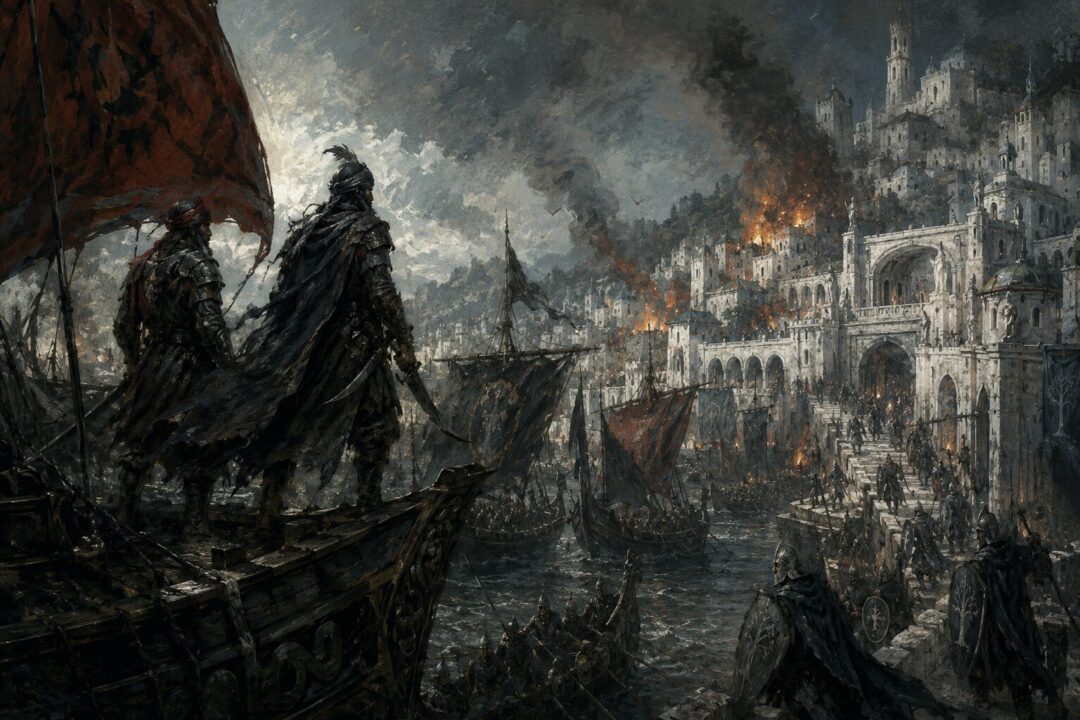
Umbar twisted the same symbolism. Its ships did not mean return, rescue, or royal legitimacy. They meant raids, vengeance, and old hatred moving up the coast. The Corsairs allied with Haradrim against Gondor, ravaged Pelargir, and in T.A. 1634 the descendants of Castamir, Angamaitë and Sangahyando, killed King Minardil there.
That attack is almost too perfectly symbolic. Pelargir, haven of the Faithful, is struck by the heirs of Gondor’s civil war coming out of Umbar, the old stronghold of the King’s Men. The sea becomes the road by which Gondor’s past returns against it.
Why Sauron Could Use Umbar So Well
Umbar’s usefulness to Sauron was not only naval. It was psychological and historical. Mordor could threaten Gondor from the east, but Umbar threatened its coast, trade, reinforcements, and memory. During the Long Winter and the troubles around T.A. 2758–2759, fleets from Umbar and Harad attacked Gondor’s coasts while Rohan faced invasion, showing how southern sea-power could isolate allies and multiply pressure.
By the War of the Ring, the same pattern remained. If the Corsairs reached the Harlond, Minas Tirith would not merely face another army. Gondor would see its own southern strength turned against the White City. The Black Fleet was a weapon, but also a message: Gondor’s borders, coasts, and old loyalties could be unmade.
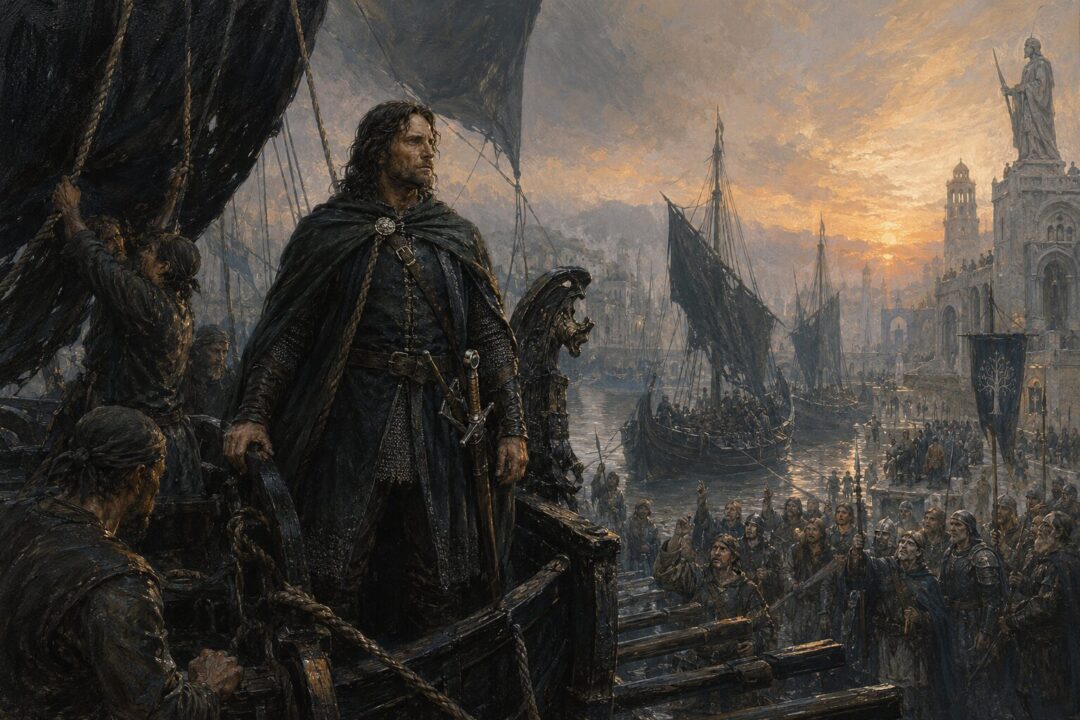
That is why Aragorn’s seizure of the ships is so powerful. At Pelargir, he does more than win a naval victory. He reverses the meaning of Umbar’s threat. The ships expected to bring terror to Minas Tirith instead bring the returning king and relief to the city.
Thorongil and Aragorn: The Same Answer Twice
Aragorn had already struck Umbar once before, under the name Thorongil, when he served Ecthelion II of Gondor. He warned that the Corsairs were a great peril to the southern fiefs, then led a surprise attack that burned many of their ships and overthrew the Captain of the Haven.
This earlier raid matters because it shows Aragorn understanding the southern threat before he openly claims the throne. He does not treat Umbar as a side issue. He sees that Gondor cannot be restored while its dark mirror rules the sea.
Then, in the War of the Ring, he answers Umbar again — not as Thorongil the hidden captain, but as the Heir of Isildur. His capture of the fleet at Pelargir turns a symbol of Gondor’s fear into a sign of Gondor’s renewal.
The Real Meaning of the Dark Mirror
Umbar was Gondor’s dark mirror because it carried the same ancient materials in corrupted form: Númenórean descent, maritime power, royal ambition, memory, endurance, and pride. It showed what the inheritance of Númenor could become when severed from repentance.
It was also a mirror because Gondor’s own failures fed it. The Kin-strife gave Umbar new life. Castamir’s rebels made the old Black Númenórean haven into a lasting refuge for Gondorian treachery. Every corsair raid after that was not just piracy. It was a reminder that a kingdom can be wounded by the part of itself it failed to heal.
So Umbar should not be reduced to “the pirate coast.” That phrase captures its surface but misses its power. Umbar was the southern shadow of Gondor’s own story: the wrong kind of Númenor surviving, the wrong kind of kingship sailing, the wrong kind of memory refusing to die.
And that is why its defeat by Aragorn feels larger than a captured fleet. The returning king does not merely stop raiders. He takes the black ships of Gondor’s dark mirror and turns them toward the White City.
Sources & Notes
- Tolkien Gateway — Umbar: overview of the southern haven's Númenórean origins, Black Númenórean control, Gondorian conquest, and later role as a Corsair base. https://tolkiengateway.net/wiki/Umbar
- Tolkien Gateway — Corsairs of Umbar: background on the seaborne raiders whose black-sailed fleet threatened Gondor during the War of the Ring. https://tolkiengateway.net/wiki/Corsairs_of_Umbar
- Tolkien Gateway — Black Númenóreans: explains the anti-Faithful Númenórean tradition associated with Umbar and its long hostility to Gondor. https://tolkiengateway.net/wiki/Black_N%C3%BAmen%C3%B3reans
- Tolkien Gateway — Pelargir: context for Pelargir as a haven of the Faithful, useful for contrasting Gondor's maritime inheritance with Umbar's darker Númenórean legacy. https://tolkiengateway.net/wiki/Pelargir
- Tolkien Gateway — King's Men: background on the Númenórean faction opposed to the Faithful, whose colonial strongholds and ideology underpin Umbar's mirror-image role. https://tolkiengateway.net/wiki/King%27s_Men
Sources document Umbar's Númenórean origins, Corsair threat, Black Númenórean associations, and the contrast with Pelargir and the Faithful tradition.