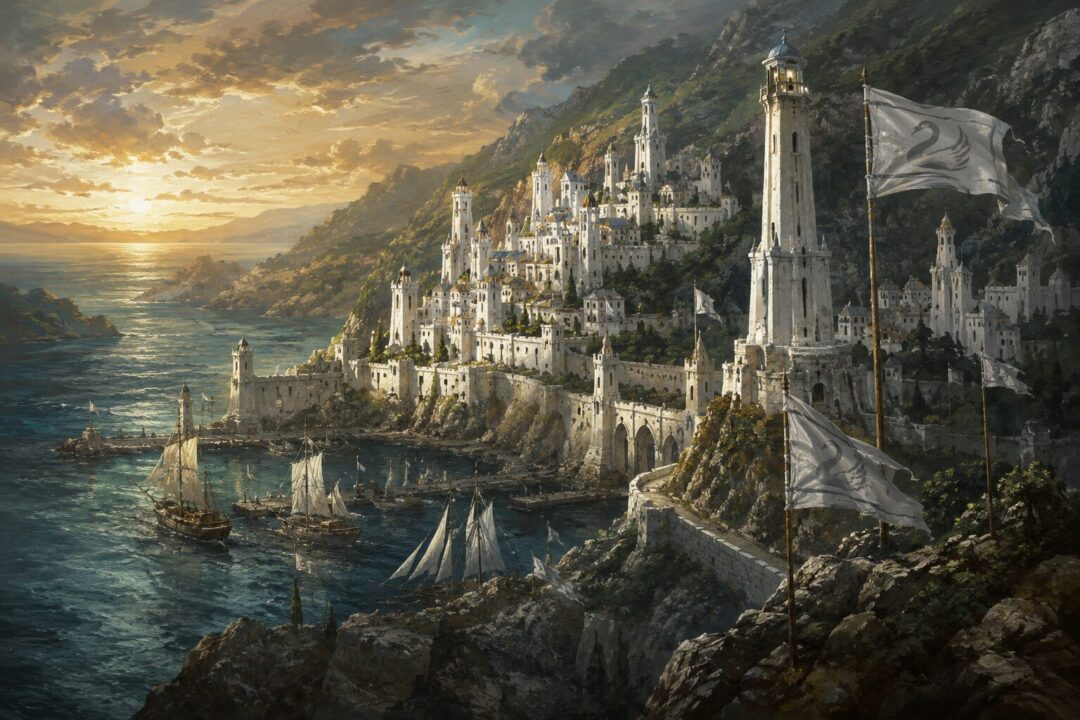
When readers first encounter Dol Amroth, it appears to be simply one of Gondor's greatest cities: a white seaport, home of Prince Imrahil and the famous Swan-knights. Yet there is something unusual about it. Unlike Minas Tirith, whose grandeur was shaped by kings and stewards, or Osgiliath, whose ruins speak of Gondor's political history, Dol Amroth seems wrapped in memories that reach beyond the kingdom itself.
That impression is not an accident. Although the principality belongs firmly to Gondor, its identity rests upon layers of history that began before Gondor existed. Elven havens, Númenórean settlers, ancient coastal traditions, and enduring legends all converge on the headland overlooking the Bay of Belfalas. The result is a place that feels less like a provincial city and more like a surviving fragment of an older world.
A Coast with Memories Before Gondor
The Kingdom of Gondor was founded after the Downfall of Númenor in the closing years of the Second Age. Dol Amroth, however, occupies land whose story reaches back further.
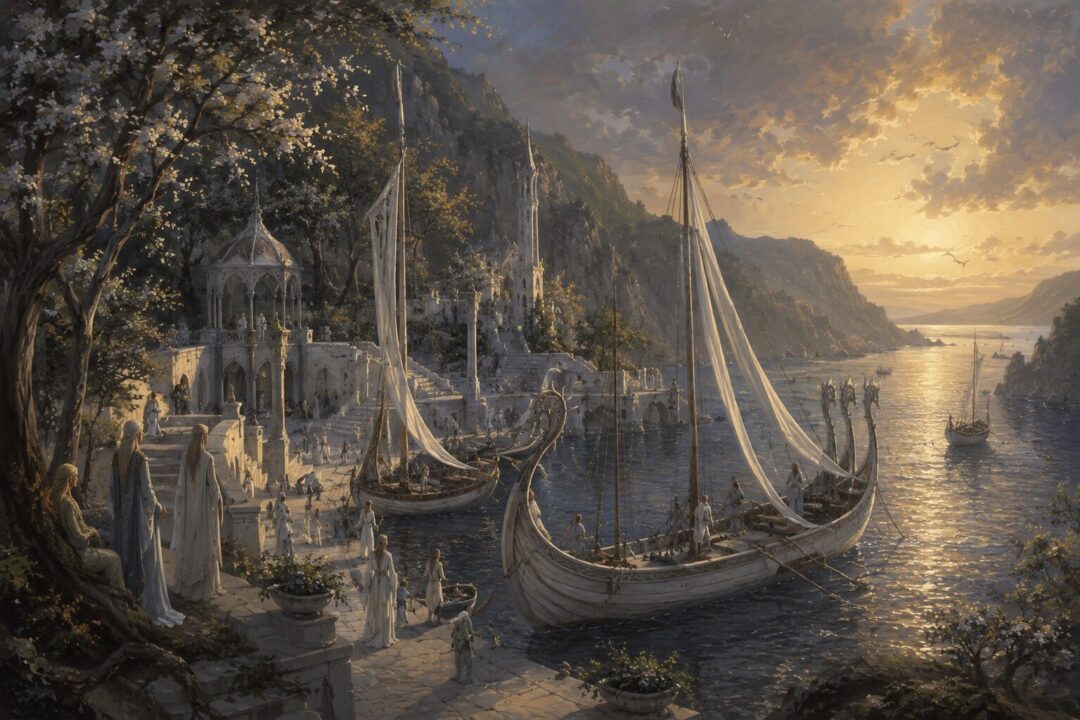
In Unfinished Tales, Tolkien presents traditions describing an Elvish haven called Edhellond near the mouth of the Morthond. Different traditions preserve somewhat different accounts of its earliest history, but all agree that Elves lived along this coast long before it became a Gondorian province. Some versions describe Sindarin refugees arriving after the ruin of Beleriand, while others connect the settlement with later Sindarin mariners or with Galadriel and Celeborn dwelling for a time in the region. The exact chronology remains uncertain, but the consistent theme is that Belfalas possessed an ancient Elvish presence before Gondor's foundation.
This matters because landscapes in Middle-earth accumulate memory. Places are rarely defined only by their current rulers. Rivers, forests, hills, and ports often preserve echoes of earlier peoples long after political borders change.
Dol Amroth stands upon precisely such a landscape.
The Faithful Did Not Begin from Nothing
The Númenóreans who settled Belfalas were not carving civilization out of wilderness.
Traditions preserved in Unfinished Tales describe a family of the Faithful settling near the Elves during the Second Age. They were related to the Lords of Andúnië and therefore kin to Elendil's house. After the Downfall, Elendil confirmed their hereditary authority over Belfalas. Rather than representing an entirely new beginning, Gondor recognized an already established local power.
That distinction is subtle but important.
Many Gondorian cities owe their importance to Gondor itself. Dol Amroth instead seems to possess an identity that Gondor inherited rather than created. Its rulers became princes within Gondor, yet their family's local roots stretch back into the late Second Age.
This gives the principality a remarkable sense of continuity.
Edhellond Never Completely Disappears
Even after the Elves gradually departed, Edhellond continued to shape the identity of the surrounding lands.
The harbor itself became associated with departure into the West. Mariners remembered it as a place where Elves had once sailed from Middle-earth. Such memories linger far longer than buildings.
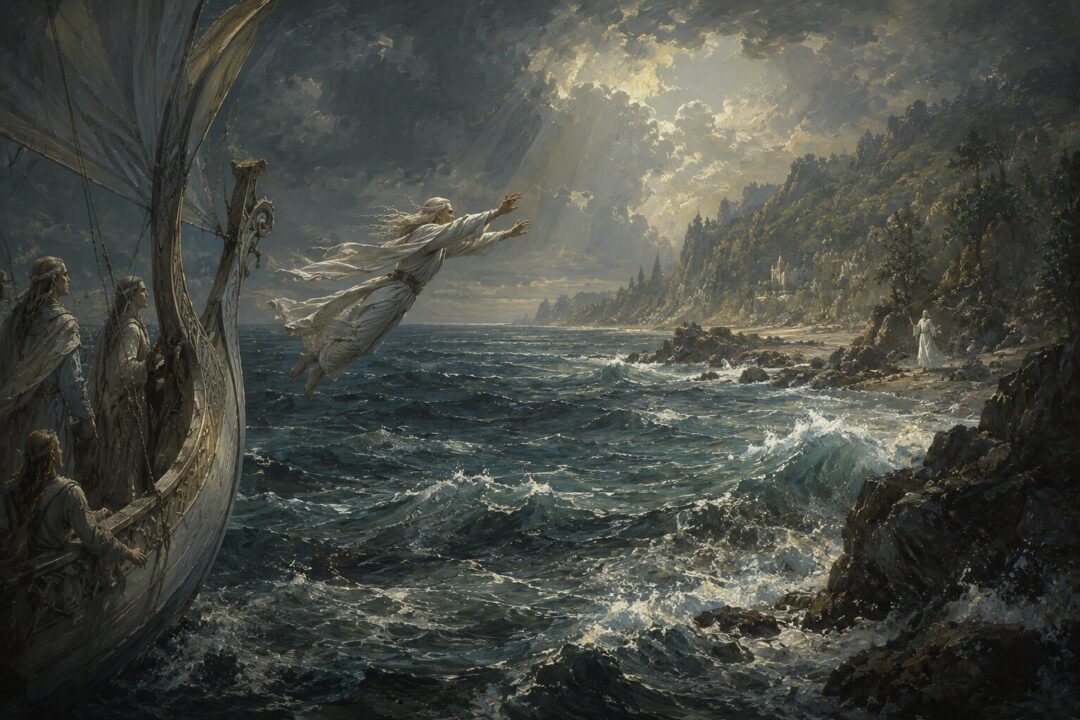
The most famous story connected with the coast concerns Amroth, lord of Lórien, and Nimrodel. According to the tradition preserved in The Lord of the Rings and expanded elsewhere, Amroth waited at Edhellond for Nimrodel before sailing into the West. When his ship was driven from shore and he believed he saw her upon the coast, he leapt into the sea and was drowned in the Bay of Belfalas.
The city later took his name.
Whether every detail of later local traditions surrounding Amroth developed exactly as remembered cannot be demonstrated, but the naming itself preserves the memory of an Elf-lord rather than any Gondorian prince.
Even the city's name therefore points away from Gondor's political history toward an older Elvish past.
The Legend of Mithrellas
No discussion of Dol Amroth's unusual character is complete without Mithrellas.
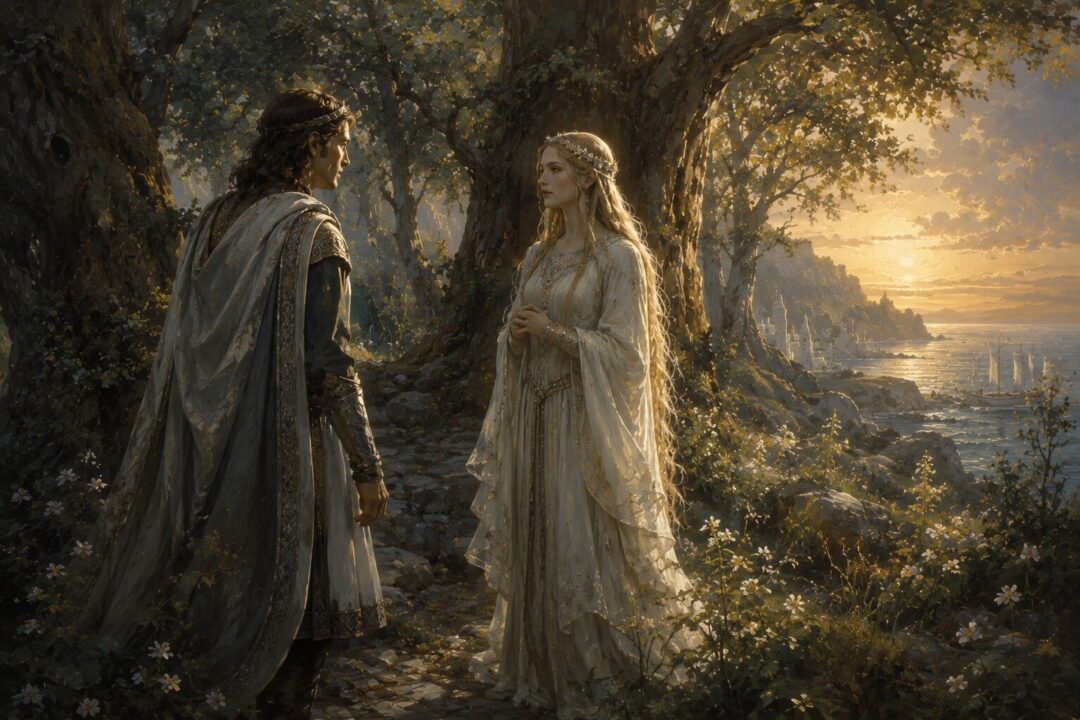
The accepted genealogy of the Princes of Dol Amroth includes an important qualification. The tradition holds that Imrazôr the Númenórean married Mithrellas, one of Nimrodel's companions, and that their son Galador became the first Prince of Dol Amroth.
The texts present this as a tradition rather than an indisputable historical fact. Tolkien never offers direct confirmation in the manner of a witnessed historical record. Yet the belief became central to the identity of the princely house itself.
Whether taken literally or viewed as an enduring family tradition, the story has profound cultural significance.
Unlike many noble families that derive prestige solely from political achievement, the House of Dol Amroth grounded part of its identity in remembered friendship—and perhaps kinship—with the Elves.
That alone makes the principality feel older than the kingdom surrounding it.
A Place Where Sindarin Never Fully Faded
One of the most striking cultural details about Dol Amroth is linguistic.
Late in the Third Age, Gondor as a whole primarily spoke Westron. Sindarin remained respected among the learned and noble, but everyday use had diminished in many regions.
Dol Amroth was different.
The people of Belfalas are specifically noted as being among the few in Gondor who still commonly spoke Sindarin. This cannot be explained merely by education. It reflects generations of cultural continuity and the long influence of nearby Elvish communities.
Language preserves memory.
Every conversation held in Sindarin quietly reinforced a connection to an older age that most of Gondor increasingly experienced only through history.
Architecture Shaped by the Sea
The sea defines Dol Amroth more deeply than it defines Minas Tirith.
Its towers, harbor, ships, and seaward defenses all reveal a civilization oriented toward the western ocean rather than inland politics.
The Seaward Tower, Tirith Aear, with its bell guiding mariners, symbolizes this outlook. The city constantly faces west toward the Great Sea—the direction associated throughout Tolkien's legendarium with memory, loss, and the Undying Lands.
Unlike the increasingly isolated Gondor of the late Third Age, Dol Amroth remains psychologically connected to the maritime traditions inherited from Númenor.
That continuity reinforces the feeling that the city belongs to an older civilization that survived political change.
The Princes Feel Like Survivors
Prince Imrahil illustrates this continuity perfectly.
He is unquestionably loyal to Gondor. During the War of the Ring he fights for Minas Tirith, commands Gondorian forces, advises the Steward, and later supports Aragorn's restoration.
Yet readers often notice that Imrahil seems distinct from the increasingly weary nobility of Minas Tirith.
He represents an aristocratic tradition that has retained confidence rather than merely preserving authority. His household remains vigorous, respected, and deeply rooted in its own history.
This difference does not arise because Dol Amroth stands apart from Gondor politically. Instead, it stems from the principality having preserved traditions that elsewhere in Gondor had faded over centuries of decline.
Gondor Grew Older While Dol Amroth Stayed Itself
This apparent contradiction lies at the heart of the city's atmosphere.
Most of Gondor experienced repeated catastrophes.
Civil war.
Plague.
Population decline.
The abandonment of provinces.
The fall of Osgiliath.
The empty throne.
By the end of the Third Age, Gondor often feels like a kingdom remembering its own greatness.
Dol Amroth also endured wars, especially against the Corsairs of Umbar, but its local identity appears remarkably stable. Its hereditary princes continued. Its maritime traditions endured. Its symbols remained recognizable. The Swan-knights still rode beneath the Silver Swan, and the city continued to look outward toward the sea.
Rather than appearing frozen in time, Dol Amroth gives the impression of uninterrupted inheritance.
A Different Kind of Ancientness
Age in Middle-earth is not measured only by years.
The oldest places often feel ancient because they preserve continuity.
Lothlórien feels old because memory survives there.
Rivendell feels old because wisdom survives there.
The Shire eventually feels old because ordinary customs survive there.
Dol Amroth belongs in this same pattern.
Its ancient quality comes not from crumbling ruins but from living traditions that connect successive generations to Elves, Númenóreans, and the western sea.
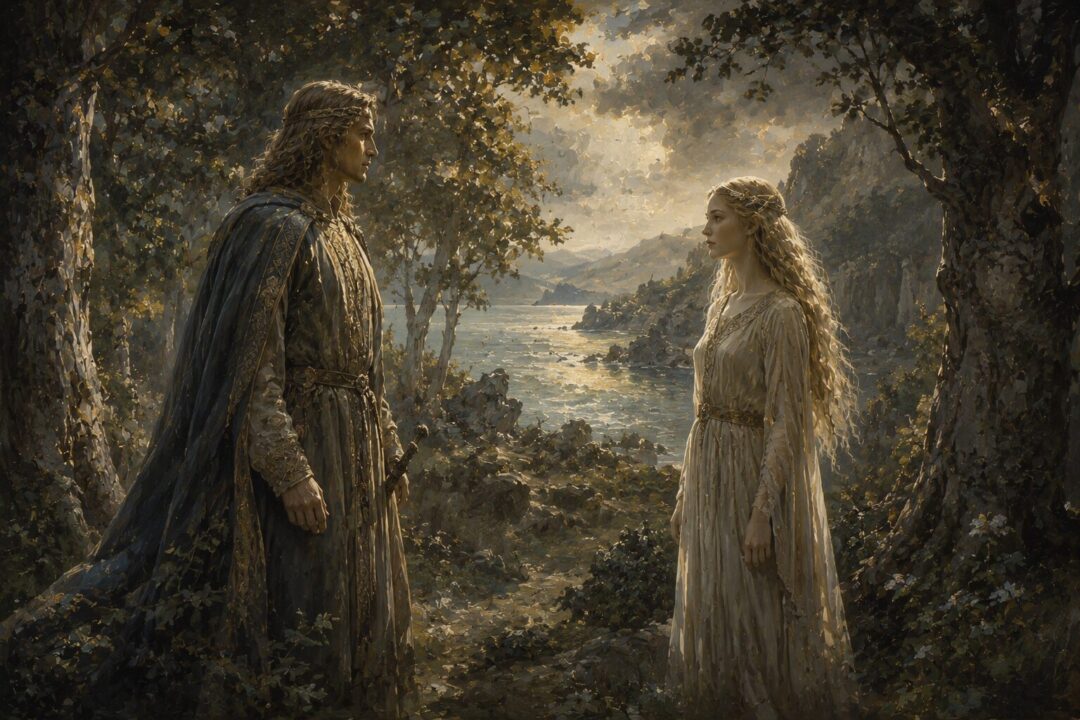
Why the City Feels Older Than Gondor
Strictly speaking, Dol Amroth as a Gondorian city did not exist before Gondor itself. Its princely house served the kingdom, not the other way around.
Yet readers instinctively perceive something older because the city inherits multiple historical layers that predate Gondor's political foundation.
The coastline remembers Edhellond.
The ruling family remembers the Faithful.
Its traditions remember Mithrellas.
Its very name remembers Amroth.
Its language remembers Sindarin.
Its gaze remains fixed upon the western sea that always symbolizes the fading Elder Days.
That combination creates one of Tolkien's most subtle achievements. Dol Amroth is not simply an old city. It is a place where successive civilizations were never completely erased, each leaving traces visible beneath the next. Gondor governs it, but Gondor did not create everything that gives it its soul.
Perhaps that is why readers so often feel that, when they reach Dol Amroth, they have stepped not merely into one of Gondor's provinces, but into one of the last living shores where the Elder Days still quietly breathe.
Sources & Notes
- Tolkien Gateway — Dol Amroth: overview of the Gondorian coastal city, its Swan-knights, Prince Imrahil, and traditions reaching back before Gondor's later political history. https://tolkiengateway.net/wiki/Dol_Amroth
- Tolkien Gateway — Edhellond: background on the Elven haven near Belfalas that underlies Dol Amroth's older coastal memory and legends of departure into the West. https://tolkiengateway.net/wiki/Edhellond
- Tolkien Gateway — Princes of Dol Amroth: summarizes the hereditary house of Dol Amroth, including Galador and the tradition of Númenórean and Elven ancestry. https://tolkiengateway.net/wiki/Princes_of_Dol_Amroth
- Tolkien Gateway — Mithrellas: explains the tradition that Mithrellas, companion of Nimrodel, married Imrazôr and became an ancestral figure of Dol Amroth's princely line. https://tolkiengateway.net/wiki/Mithrellas
- Tolkien Gateway — Amroth: background on the Elf-lord Amroth, whose legend and death in the Bay of Belfalas are tied to the city's name and older Elvish identity. https://tolkiengateway.net/wiki/Amroth
Sources document Dol Amroth's Gondorian role, the older Edhellond/Belfalas traditions, and the Elven-Númenórean ancestry attached to its princes.