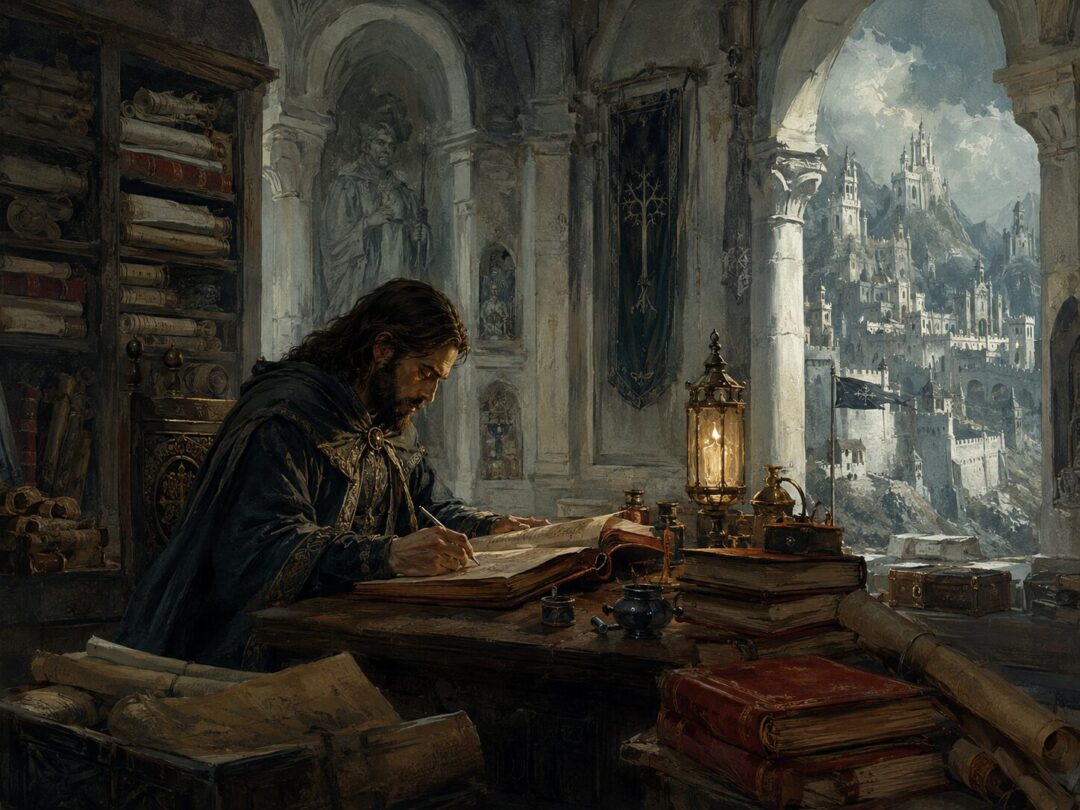
The Ring is the object everyone remembers: gold, plain, terrible, and almost impossible to destroy. But the story of the Ring reaches us through something far less dramatic: books, copies, corrections, marginal notes, and one almost invisible scribe in Minas Tirith.
His name is Findegil.
He never joins a battle. He never counsels a king. He never speaks in the narrative. He appears only in the “Note on the Shire Records,” attached to the textual history behind The Lord of the Rings. Yet his small note changes how we understand the entire story. Findegil matters because the tale we read is not presented as a clean voice falling from the sky. It is presented as a surviving tradition — written by hobbits, copied in Gondor, corrected by scholars, preserved in the Shire, and shaped by what was lost or saved.
In that hidden chain, Findegil stands near the last visible link.
The Story Is Already a Manuscript Before It Is an Adventure
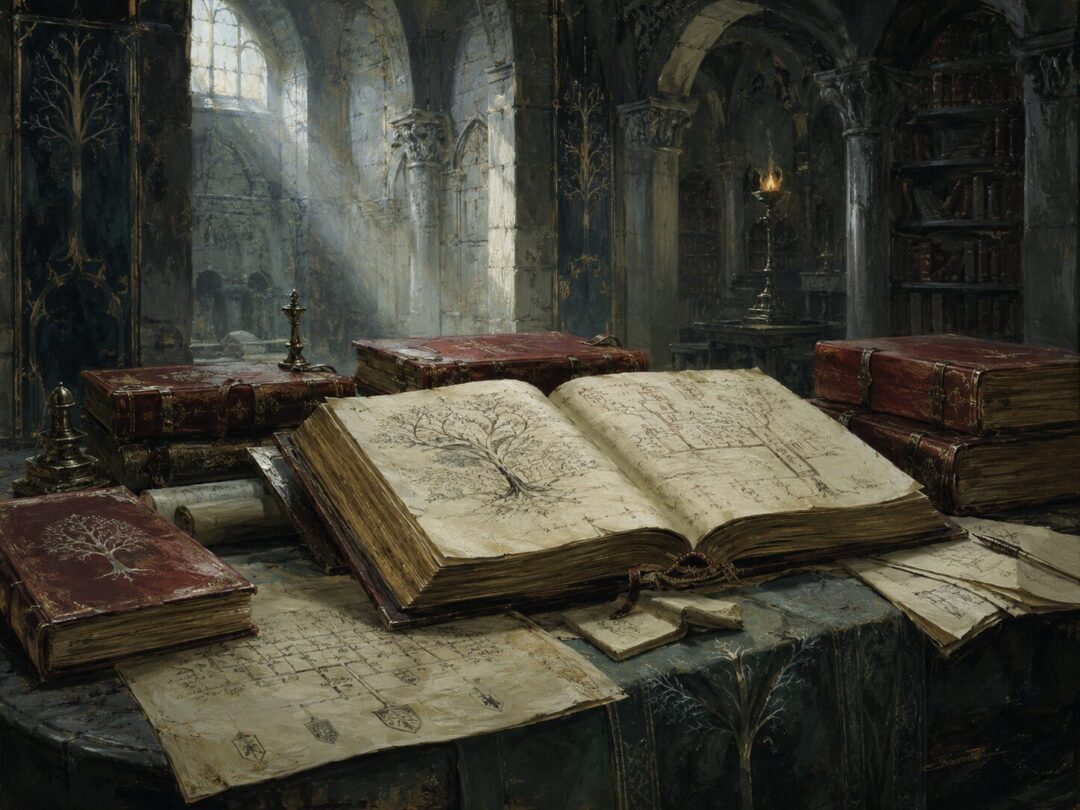
The Lord of the Rings does not simply begin with Frodo inheriting the Ring. Around the story sits a frame: the Red Book of Westmarch. Within that frame, Bilbo began with his own account, Frodo added the history of the War of the Ring, Sam preserved and continued the record, and later hands added genealogies, commentaries, and other matter concerning the hobbits of the Fellowship.
That matters because Middle-earth’s greatest story is also a story about memory. The Ring threatens not only bodies and kingdoms, but truth itself. Sauron lies, distorts, dominates, and turns other wills toward his own purposes. Against that darkness, the Red Book is an act of preservation. It remembers small people accurately.
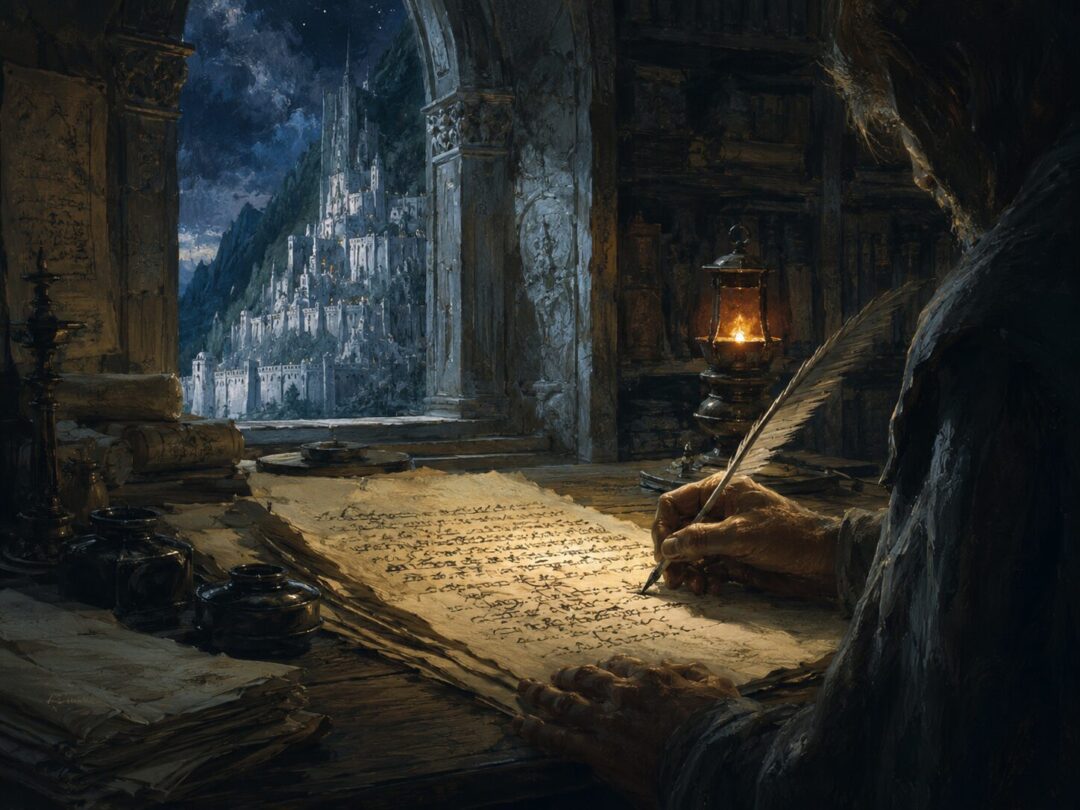
Findegil enters much later, after the great events have already passed into history. The original Red Book was not preserved, but many copies were made. The most important copy was kept at Great Smials, though it was written in Gondor and completed in Shire-reckoning 1592, equivalent to Fourth Age 172. Its scribe added the note: “Findegil, King’s Writer, finished this work in IV 172.” The Prologue further says it was an exact copy in all details of the Thain’s Book in Minas Tirith. research-repository.st-andrews.ac.uk
That one sentence places a Gondorian professional hand between the hobbit memoir and the later reader. The story survives not only because Frodo endured, but because someone long afterward copied faithfully.
The Red Book Was Not One Simple Book
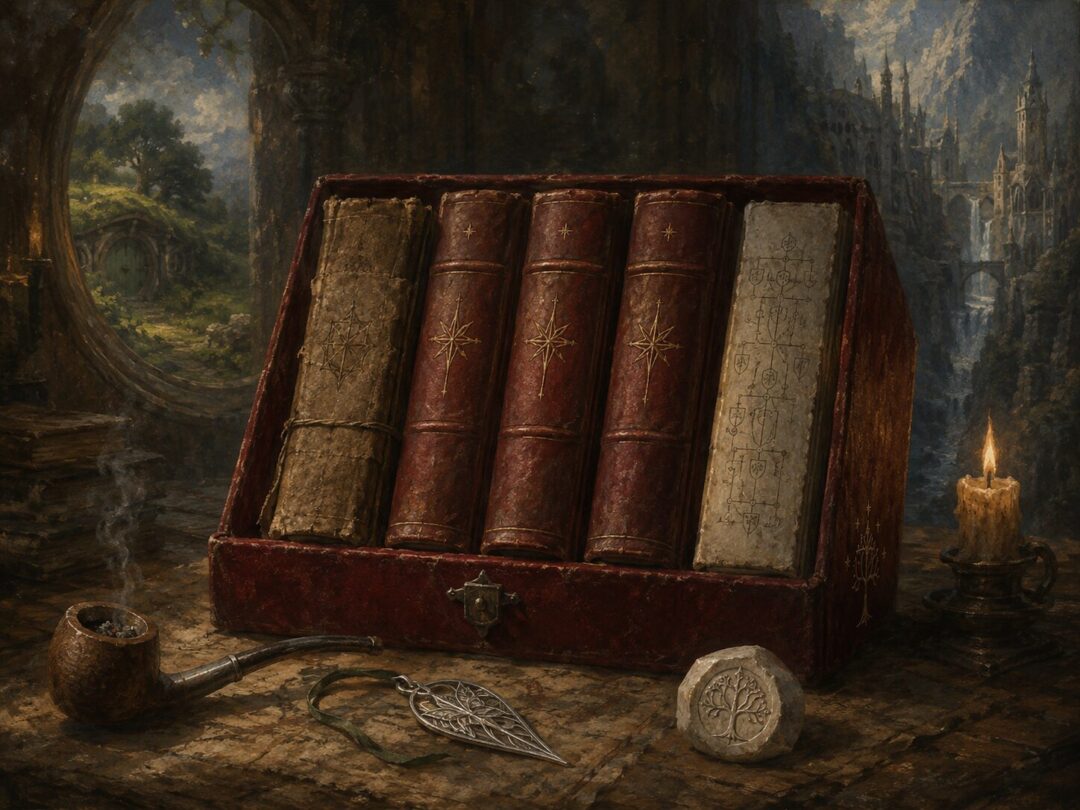
The Red Book began in hobbit hands. Bilbo’s private diary went with him to Rivendell; Frodo brought it back to the Shire along with Bilbo’s three volumes of “Translations from the Elvish.” Later, a fifth volume was added in Westmarch, containing commentaries, genealogies, and other material about the hobbit members of the Fellowship. The Prologue describes this layered record as the chief source for the history of the War of the Ring. research-repository.st-andrews.ac.uk
So even before Findegil, the “book” was already a living archive. Bilbo wrote as adventurer and translator. Frodo wrote as witness, survivor, and one who could not fully heal. Sam inherited the burden of finishing what Frodo could no longer remain in Middle-earth to keep. Later hobbit families preserved and expanded the record.
Findegil’s importance lies in the fact that he did not originate this tradition. He received it. His task was not invention but transmission. In a world where memory is fragile, that distinction is everything.
The Red Book’s history also reminds us that the version we read is downstream from loss. The original did not survive. Many copies existed, especially of the first volume, but not all were equally complete. This makes Findegil’s copy more than a duplicate. It becomes the most important surviving witness to a fuller tradition.
Why Minas Tirith Changes the Record
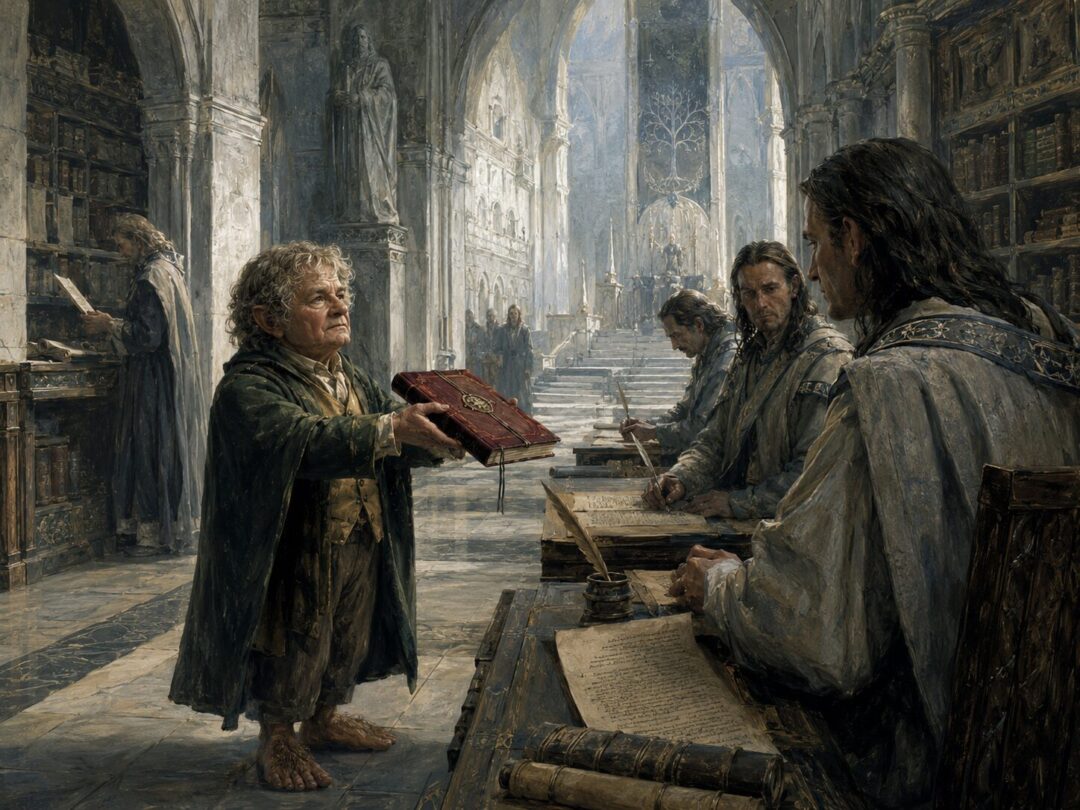
The Thain’s Book in Minas Tirith was itself a copy made at the request of King Elessar from the Red Book of the Periannath. Peregrin Took, when he retired to Gondor in Fourth Age 64, brought the book to the king. In Minas Tirith it received annotation and many corrections, especially of names, words, and quotations in the Elvish languages. It also gained an abbreviated version of parts of “The Tale of Aragorn and Arwen” that lay outside the account of the War. research-repository.st-andrews.ac.uk
This is one of the most quietly important facts in the whole frame. The hobbits had lived through the War, but they were not masters of every language, lineage, or ancient tradition touched by their story. Gondor could correct Elvish words. Gondor could supply royal and Númenórean memory. Gondor could add the love and doom of Aragorn and Arwen in a way the hobbit-centered war narrative did not fully contain.
But this does not mean Gondor replaced the hobbit voice. The power of the tradition is that it holds both together. The Shire preserves the experience of the small and overlooked. Minas Tirith supplies the long memory of kings, Elendil’s heirs, and the Elder Days. Findegil stands at the meeting point: a southern scribe copying a book of the Periannath for return to the Shire.
That is a beautiful reversal. In the War, hobbits came south and changed the fate of Gondor. In the Fourth Age, Gondor’s scribal care returns their story north.
The Exact Copy and the Moral Weight of Accuracy
Findegil’s note calls his work “an exact copy in all details.” Within the fiction of the text, that phrase is a promise. It says the scribe did not treat the book as raw material for patriotic revision. He did not turn hobbit memory into royal propaganda. He copied it.
That should not be overlooked. Gondor had every reason to center its own greatness. Aragorn had restored the kingship. Minas Tirith had endured siege. The Captains of the West had marched to the Black Gate. Yet the record still preserves Frodo’s pity, Sam’s loyalty, Merry’s terror and courage, Pippin’s growth, and the strange fact that the world was saved by those least suited to dominate it.
An exact copy is therefore not a minor clerical act. It is an ethical act. Findegil’s faithfulness helps preserve the uncomfortable shape of the story: that power did not save Middle-earth by becoming more powerful; mercy, endurance, friendship, and providence did what armies could not.
Of course, the text does not give us Findegil’s thoughts. We are not told whether he admired hobbits, whether he understood Frodo’s wound, or whether he felt awe copying Bilbo’s translations. Anything beyond his office and his note is interpretation. But the role assigned to him is still meaningful. He is remembered not for authorship, but for fidelity.
Why Bilbo’s Translations Make Findegil Essential
The chief importance of Findegil’s copy is stated plainly: it alone contained the whole of Bilbo’s “Translations from the Elvish.” These three volumes were the product of Bilbo’s years in Rivendell, where he used living and written sources available to him between Shire-reckoning 1403 and 1418. They concerned the Elder Days and were little used by Frodo, so the Prologue says no more of them there. research-repository.st-andrews.ac.uk
This is where Findegil becomes important not only to The Lord of the Rings, but to the wider sense of Middle-earth’s history. Bilbo is not merely the witty burglar of The Hobbit or the elderly giver of the Ring. In Rivendell, he becomes a translator of ancient Elvish lore. His work links the Shire to the Elder Days, hobbit curiosity to Elvish memory, and the War of the Ring to the deeper history of the Silmarils, Beleriand, Númenor, and Sauron’s earlier rise.
The texts do not require us to say that every later version of First Age material comes mechanically through Findegil. That would be too rigid. But within the Red Book tradition, Findegil’s copy is singled out because it preserved Bilbo’s complete translations when other copies did not. That makes him a guardian of depth. Without that preserved fullness, the War of the Ring would be easier to misread as a sudden crisis, rather than the last movement of an ancient tragedy.
Findegil matters because he helps keep the story old.
A Scribe at the Border of Ages
Findegil completed his work in Fourth Age 172, long after the Ring was destroyed, after the passing of many of the central figures, and after the world had begun to settle into the Dominion of Men. King Elessar had died in Fourth Age 120, so Findegil’s work belongs to a later royal generation, probably under Eldarion’s reign, though the text does not dwell on his political setting. Tolkien Gateway summarizes him conservatively as a King’s Writer of Gondor in the Fourth Age.
That timing gives his work a particular poignancy. The great age of Elves was receding. Frodo had gone over Sea. Sam, too, according to later tradition, eventually passed westward. Merry and Pippin had gone south in old age and were laid in Gondor. The living witnesses were vanishing.
This is when scribes become crucial. When memory is no longer carried by voices in the room, it must be carried by careful hands. Findegil belongs to the age after wonder, when the task is not to perform the great deeds again but to keep them from being flattened, forgotten, or misunderstood.
In that sense he is one of the quiet figures of the Fourth Age’s true labor. The Shadow has fallen, but history still has to be protected.
The Hidden Chain Behind Every Reader
Findegil’s presence also changes the reader’s relationship to the story. We are not asked merely to consume an adventure. We are invited to imagine the chain by which it reached us: Bilbo writing, Frodo revising, Sam completing, Elanor’s descendants preserving, Peregrin bringing a copy to Gondor, Gondorian scholars annotating and correcting, Barahir’s tale being added in abbreviated form, Findegil copying the enriched Thain’s Book, and the Great Smials keeping that precious version.
The result is a story that feels ancient because it behaves like ancient literature. It has sources. It has omissions. It has corrections. It has regional archives. It has uncertainty. Some dates are conjectural. Some voices are closer to events than others. Some material survives only because one copy did.
That is why Findegil matters to every version of the story we read. He is a reminder that Middle-earth is not only made of heroes and kings. It is made of keepers: archivists, translators, scribes, lore-masters, and families who refuse to let the past disappear.
The Ring is destroyed in fire. The story survives in ink.
Findegil’s hand is almost invisible, but the invisibility is the point. A faithful scribe does not stand between the reader and the truth. He becomes one reason the truth can still be read at all.
Sources & Notes
- Tolkien Gateway, “Findegil” — summarizes Findegil as the King’s Writer who finished the Gondorian copy in Fourth Age 172, directly supporting the article’s focus on his scribal role. https://tolkiengateway.net/wiki/Findegil
- Tolkien Gateway, “Red Book of Westmarch” — outlines the Red Book’s layered transmission from Bilbo, Frodo, Sam, and later Shire/Gondor copies, matching the article’s manuscript-frame claims. https://tolkiengateway.net/wiki/Red_Book_of_Westmarch
- Tolkien Gateway, “Thain’s Book” — explains the Minas Tirith copy made for King Elessar, its annotations/corrections, and the Great Smials copy made by Findegil. https://tolkiengateway.net/wiki/Thain%27s_Book
- Tolkien Gateway, “Prologue (The Lord of the Rings)” / “Note on the Shire Records” — provides context for the prologue’s account of Shire records, the Red Book tradition, and the textual-history frame behind the published story. https://tolkiengateway.net/wiki/Note_on_the_Shire_Records
Sources cover Findegil, the Red Book/Thain’s Book transmission chain, and the Prologue/Note on the Shire Records frame.