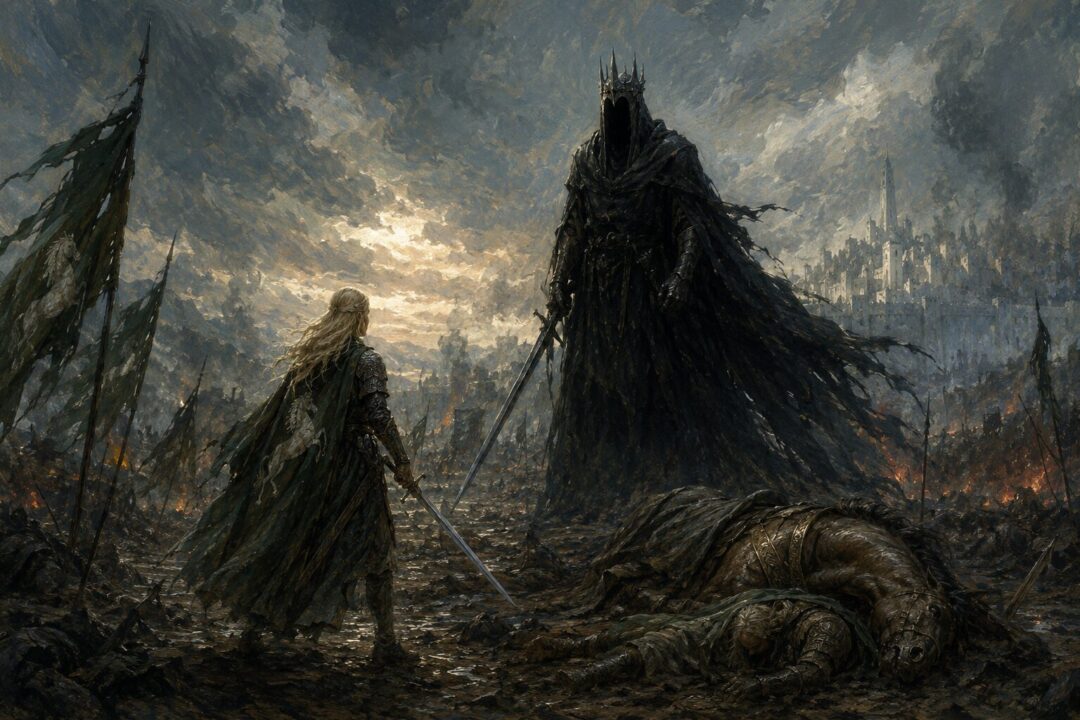
On the Pelennor Fields, the Lord of the Nazgûl stands over Théoden, King of Rohan, and believes the moment belongs to him.
The King’s horse has fallen. The Black Captain has descended from the sky. The battle is breaking open before the gates of Minas Tirith. Against him stands only a disguised rider of Rohan, seemingly too small a thing to matter in the ruin of kings.
Then he speaks one of the most famous boasts in The Lord of the Rings: no living man may hinder him.
It is easy to remember the answer as a clever reversal. Éowyn reveals herself, declares that she is no man, and strikes him down. In that simplified version, the scene becomes almost a riddle with a punchline.
But the deeper power of the moment is not that the Witch-king forgot women existed. It is that he mistook a prophecy of doom for a guarantee of safety. What he heard as invincibility was, in truth, a warning.
The Prophecy Was Never “No One Can Kill Him”
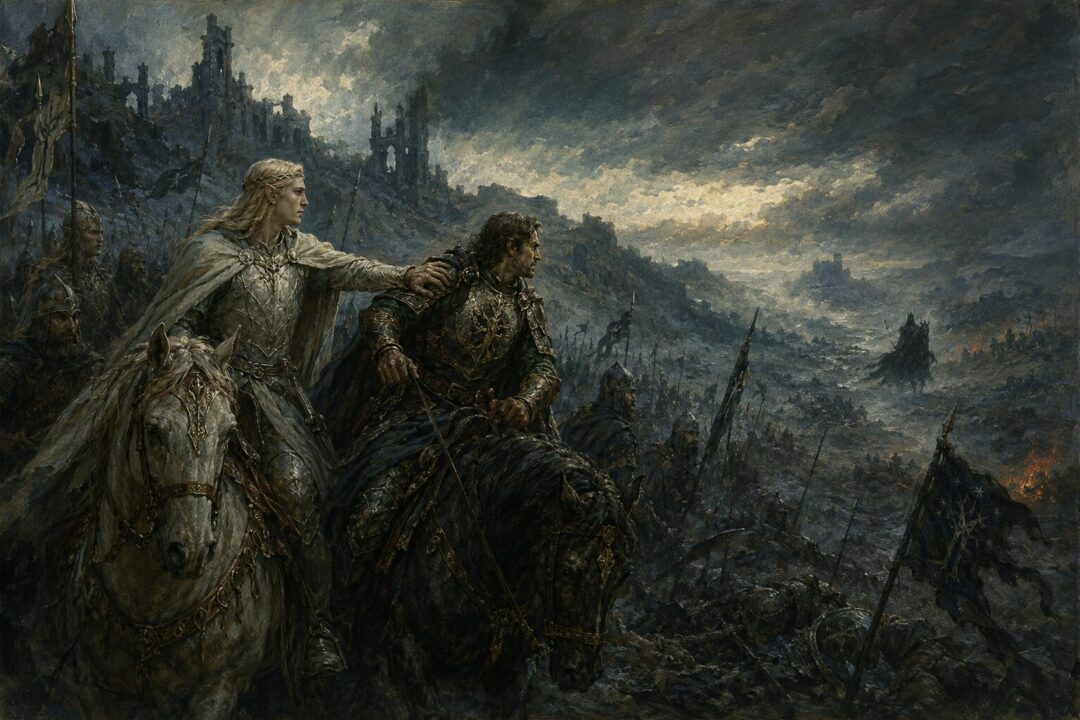
The older words about the Witch-king come long before the Battle of the Pelennor Fields. After the fall of Angmar and the Battle of Fornost, the Witch-king fled north, and Eärnur of Gondor wanted to pursue him. Glorfindel restrained him with a prophecy: the Witch-king would not return to that land, his doom was still far off, and he would not fall by the hand of man.
That wording matters.
It does not say the Witch-king cannot fall. It says that he will fall, but not by the hand of man. The prophecy is not a wall around him. It is a shadow cast forward from his ending.
The Witch-king’s later boast changes the emphasis. “No living man may hinder me” sounds like a weaponized version of the old saying. Whether he knows Glorfindel’s words directly is not fully explained in the text, so it is safest to say only that his boast echoes the old prophecy in a darker, more arrogant form. He turns a foretold doom into a battlefield threat.
That is the first irony. The prophecy’s most important word is not “man.” It is “doom.”
A Servant of Fear Misread His Own Fear
The Nazgûl are terrifying because they rule through fear. Their greatest strength is not simple physical force. It is dread, despair, the weakening of wills before the real blow lands. The Witch-king, as their lord, has mastered that kind of domination.
On the Pelennor, he does not merely threaten Éowyn with death. He threatens a fate beyond ordinary death: torment, darkness, and exposure to the Eye. His words are meant to unmake courage before the fight begins.
That is why his boast is so revealing. “No living man may hinder me” is not a joke in his mouth. It is psychological warfare. He is trying to make resistance feel not merely dangerous, but impossible.
Yet the texts repeatedly show that evil in Middle-earth often misunderstands the very things it uses. Sauron cannot imagine that anyone would try to destroy the Ring rather than wield it. Saruman cannot imagine power except as control. The Witch-king cannot imagine prophecy except as something that strengthens his own terror.
He believes the words make him larger. In fact, they mark the boundary of his power.
Éowyn Does Not Win Because of a Technicality
Éowyn’s answer is famous because it is so direct: she is no living man, but a woman. Yet the scene is much more than a technical loophole.
She is not there as a puzzle-solver. She is there because she has ridden to war under the name Dernhelm, driven by despair, pride, loyalty, and a hunger not to be left behind while others win renown or die. Her courage is real, but it is not simple. She comes to the Pelennor carrying wounds of the spirit long before the Witch-king wounds her body.
That complexity makes the confrontation sharper. Éowyn does not stand before the Witch-king because she knows Glorfindel’s prophecy and has worked out its hidden clause. The text does not present her as exploiting ancient lore. She stands there because Théoden lies fallen, because love and honor bind her to defend him, and because she refuses to move.
Her words answer the Witch-king’s arrogance, but her act is deeper than wordplay. She does what many warriors on the field would have feared to do. She comes between the Nazgûl and his prey.
In that sense, “I am no man” is not merely a statement of gender. It is a rejection of the Witch-king’s whole system of fear. He says no living man may hinder him. She says, in effect: then the thing you did not count will stand here instead.
Merry Is Not a Footnote
The most commonly flattened version of the scene treats Éowyn as the sole answer to the prophecy. But the book gives Merry a crucial role.
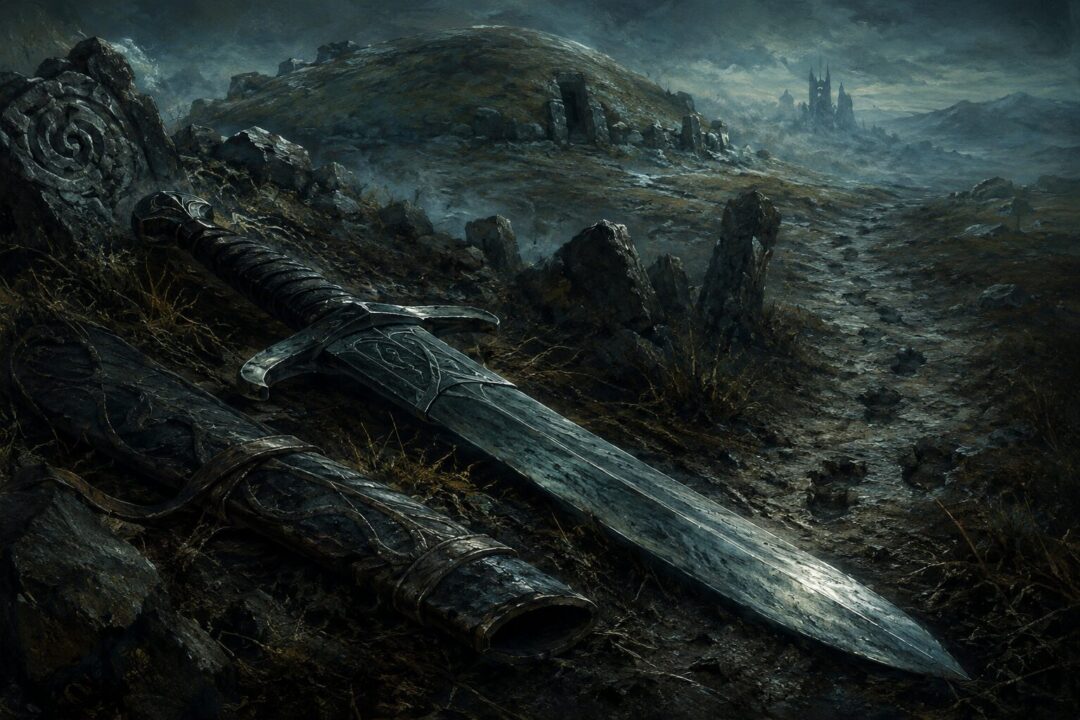
Merry strikes the Witch-king from behind with a blade taken from the barrow on the Barrow-downs. That blade was not an ordinary weapon. It came from the old wars of the North, from the world of the Dúnedain and their long struggle against Angmar. The text gives special weight to that stroke, making clear that no ordinary blade would have had the same effect in that moment.
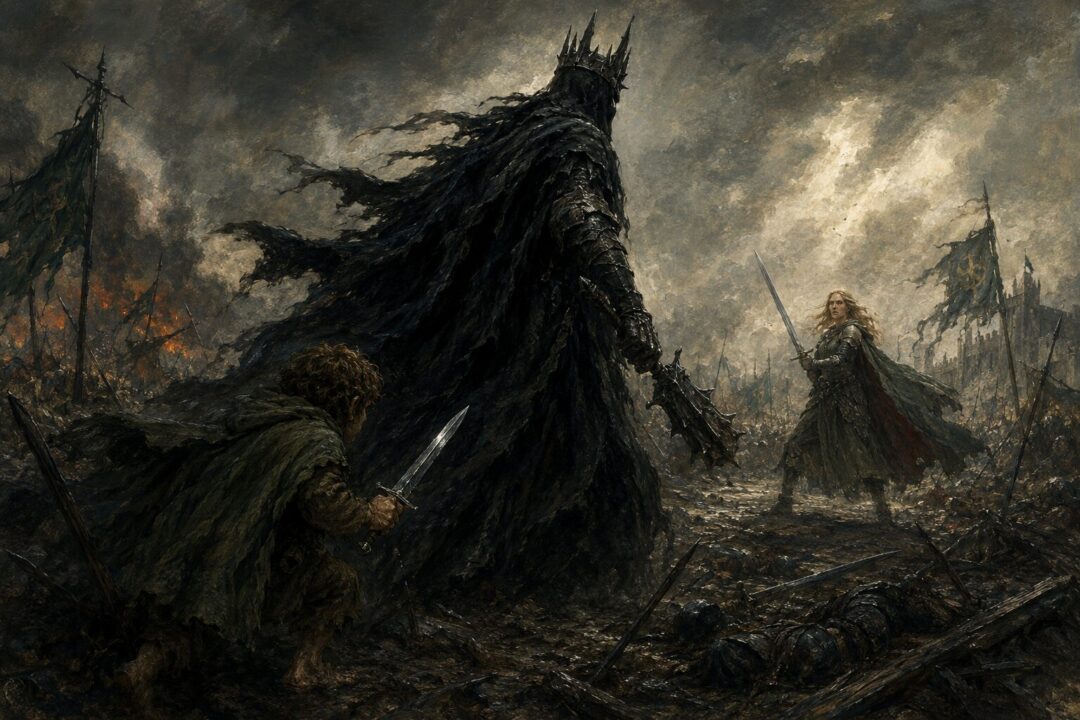
Merry’s blow wounds the Witch-king in a way that breaks the dreadful power sustaining his attack. Only then does Éowyn drive her sword into the place where his crown and mantle hide his invisible head.
This matters for the prophecy. The Witch-king is not overthrown by one clean heroic category. He falls through the convergence of people and histories he despises or overlooks: a woman of Rohan, a hobbit of the Shire, and a blade preserved from the ancient war against his own realm of Angmar.
His end is not random. It is woven from things outside his imagination.
The Old War of Angmar Returns in a Hobbit’s Hand
Merry’s sword gives the scene a long memory.
The Witch-king once ruled Angmar, the northern realm that helped destroy the divided kingdoms of Arnor. The barrow-blades carried by the hobbits are relics of that older struggle. When Merry uses one on the Pelennor, the past reaches into the present.
This is one of the scene’s most elegant hidden designs. The Witch-king’s ancient enemies do not return as a grand army of lost kings. They return as a small hobbit, terrified and half-forgotten in the shadow of a monster.
That is very Middle-earth. Great powers fall not only before equal powers, but before overlooked faithfulness, preserved memory, and small acts of courage at the right hour.
Merry is afraid. He is not presented as a fearless champion. He acts while nearly overwhelmed by horror, and his stroke costs him greatly. That makes his role more powerful, not less. The Witch-king is undone partly by someone he would never have considered worthy of his full attention.
The Witch-king’s Mistake Was Spiritual, Not Linguistic
The phrase “no man” invites a simple linguistic reading, and the story certainly uses that reversal. But the Witch-king’s deeper mistake is spiritual.
He thinks in terms of domination: who is strong, who is weak, who can be made afraid, who can be dismissed. In his mind, the world is arranged by power. Men are warriors and kings. Women are not expected to stand against him. Hobbits are beneath notice. Old northern blades are museum-dead remnants of defeated peoples.
Every part of that judgment is wrong.
Éowyn’s courage is not lesser because it comes from grief. Merry’s hand is not useless because it is small. The old blade is not powerless because its kingdom is gone. The prophecy is not empty because its meaning is hidden.
The Witch-king does not lose because he fails a grammar test. He loses because evil cannot truly understand humility, pity, loyalty, or courage that does not seek mastery.
A Warning to Men as Well as Monsters
Glorfindel’s original warning is also directed at Eärnur. After Fornost, Eärnur wants to pursue the fleeing Witch-king. Glorfindel tells him not to. The prophecy restrains a proud man from chasing a doom not appointed to him.
That is important because Eärnur later becomes connected to the Witch-king again. The Witch-king challenges him, and Eärnur eventually rides to Minas Morgul and does not return. The texts do not describe exactly what happened to him there, but Gondor loses its king, and the Stewards rule after him.
So the prophecy carries a double edge. To the Witch-king, it means: your doom exists, though you do not understand it. To proud warriors of Men, it means: this enemy is not yours to destroy by reckless pursuit.
That makes “not by the hand of man” less like a joke and more like a boundary. It tells Men that courage without wisdom can still be ruin. It tells the Witch-king that power without humility becomes blindness.
Why the Scene Still Feels So Satisfying
The death of the Witch-king works because it resolves several tensions at once.
Éowyn’s hidden anguish becomes visible courage. Merry’s smallness becomes strength. The forgotten war of the North returns through a buried blade. Théoden’s fall is answered by loyalty. The Witch-king’s terror collapses at the exact moment he thinks it is absolute.
And the prophecy is fulfilled without becoming mechanical. It does not feel like a legal loophole because the scene is emotionally and morally earned. Éowyn does not arrive as a category. Merry does not arrive as a technical assist. They arrive as people who should not, by the standards of the proud and powerful, decide the fate of a great captain of Sauron.
But they do.
That is the true force of the line. “No living man may hinder me” is frightening because the Witch-king believes it. Éowyn’s answer is thrilling because she exposes what he has missed. Merry’s blow is moving because it proves the forgotten and the small still matter.
The Witch-king was not joking. He was warning the world that no ordinary courage could stop him.
But he was also, unknowingly, announcing his own end.
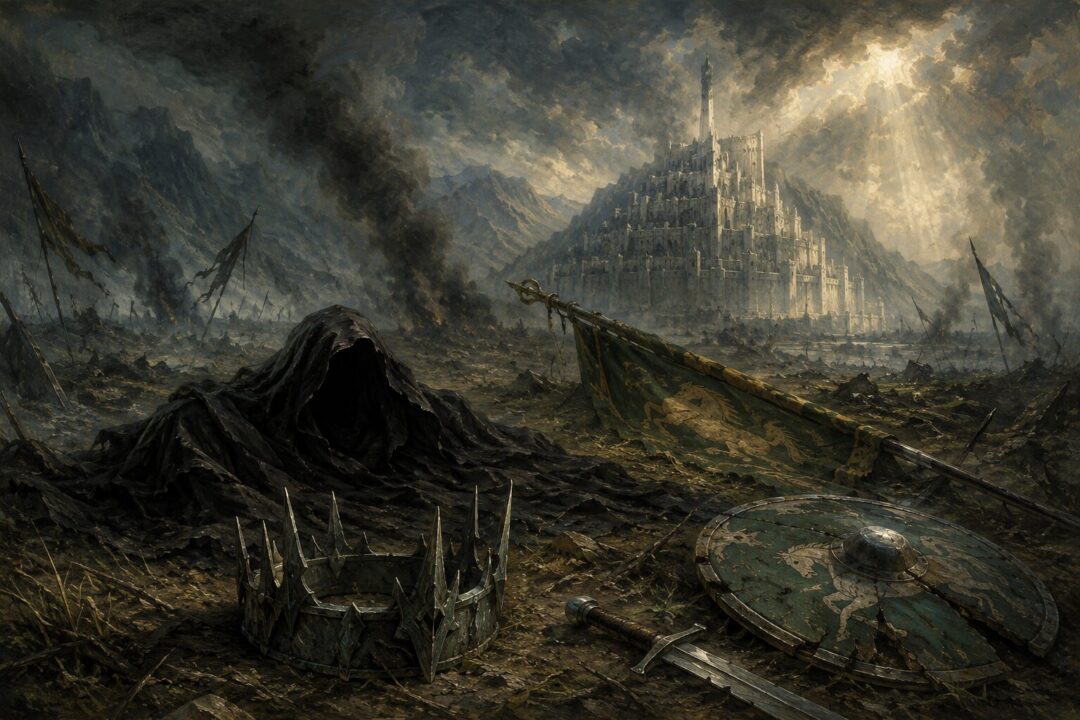
The Doom He Carried With Him
In Middle-earth, prophecy is rarely a neat trick. It is often a glimpse of doom, and doom is not the same as immunity.
The Witch-king carried his end inside the very words he used to terrify others. Every time he leaned on that boast, he revealed the shape of his blindness. He believed that “no man” meant no danger. But the prophecy had always meant that his fall would come from outside the pattern he recognized.
A woman grieving yet unbroken. A hobbit shaking yet faithful. A blade from a buried war. A king defended in his last helplessness. A battlefield where despair seemed to have won.
The Witch-king’s boast is remembered because Éowyn answers it. But it should also be remembered because it shows how evil misreads the world. It mistakes doom for privilege, fear for truth, and overlooked people for powerless ones.
“No man can kill me” was never the joke.
The joke, if there is one, is on the tyrant who heard a prophecy of his death and thought it made him safe.
Sources & Notes
- J.R.R. Tolkien, The Return of the King, Book V, Chapter 6, The Battle of the Pelennor Fields. https://tolkiengateway.net/wiki/The_Battle_of_the_Pelennor_Fields
- Tolkien Gateway overview of the Witch-king of Angmar. https://tolkiengateway.net/wiki/Witch-king_of_Angmar
- Tolkien Gateway character overview for Merry Brandybuck. https://tolkiengateway.net/wiki/Meriadoc_Brandybuck
Sources added.