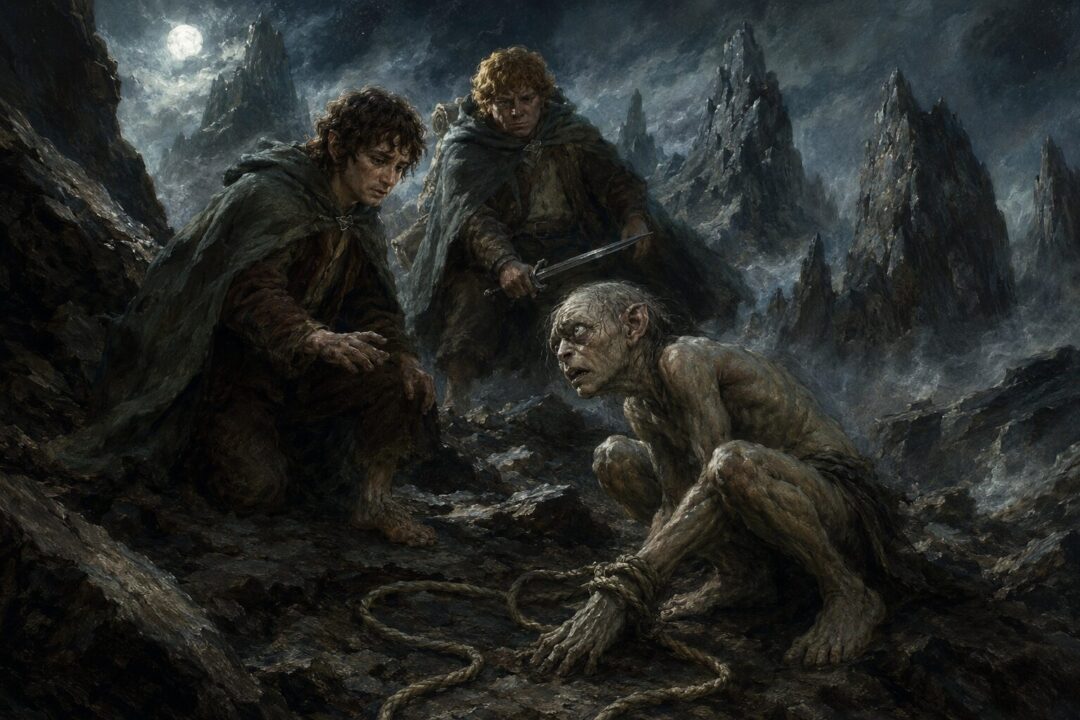
Everyone remembers Gollum’s hunger for the Ring: the whispering, the crawling, the awful tenderness of that one word — Precious. But one of the most dangerous moments in his story is not when he bites Frodo at the Crack of Doom. It happens much earlier, in the broken rocks of Emyn Muil, when Frodo has him helpless and Gollum offers a promise.
At first, it sounds like mercy winning a small victory. Frodo does not kill Gollum. Sam does not throttle him. The wretched creature is spared, and in return he swears to guide them. Yet the exact thing by which he swears — the Precious itself — turns the promise into something far darker.
Gollum does not swear by truth, by friendship, by the Shire, by pity, or by any higher power. He swears by the very object that has already hollowed him out. That is why his promise becomes a trap. It binds him to help Frodo, but it also keeps his mind circling the Ring. It makes him servant to “the master of the Precious,” while his whole ruined will longs to become that master again.
The oath is mercy, but mercy placed beside a treacherous thing.
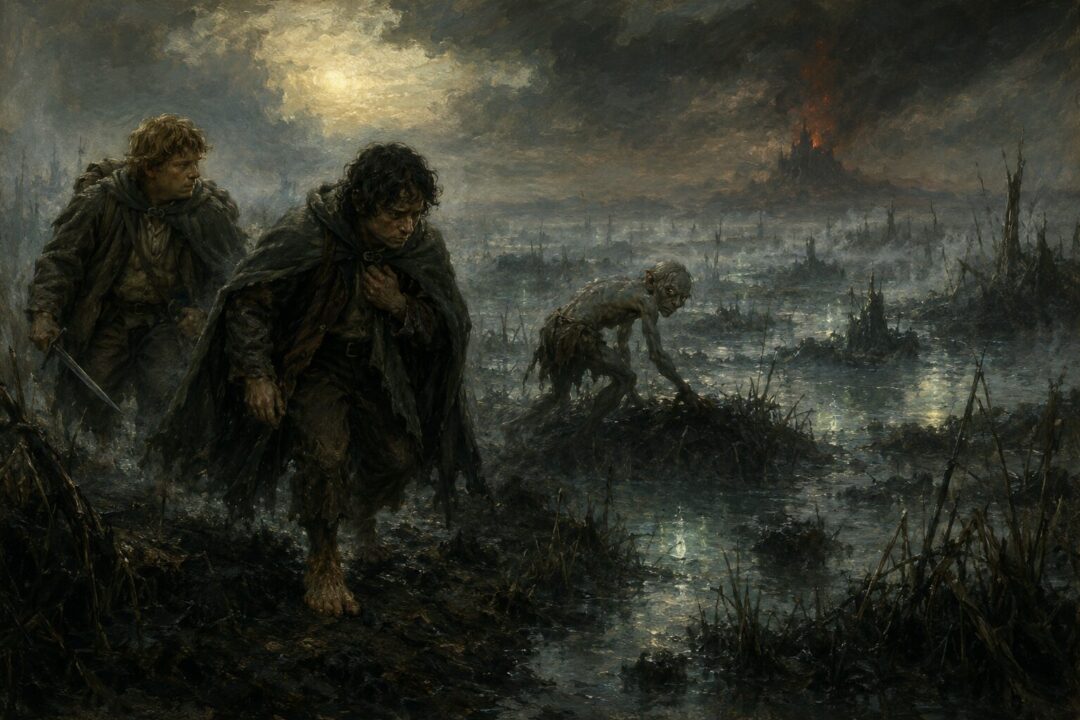
The Promise Begins With Pity
When Frodo and Sam finally catch Gollum in Emyn Muil, he is not a mysterious cave-creature anymore. He is a danger with hands and teeth. He has followed the Fellowship through Moria and beyond, then pursued Frodo and Sam after the breaking of the Fellowship. In the struggle, he bites and nearly strangles Sam before Frodo subdues him. The Elvish rope used to restrain him causes him pain, and Frodo, moved by pity, accepts Gollum’s promise to help them instead of keeping him bound or killing him.
This is the first key to the trap: Frodo’s mercy is real. The text does not present him as foolish for sparing Gollum. In fact, Gollum’s guidance becomes practically necessary. He knows ways through the Dead Marshes and toward Mordor that Frodo and Sam do not. Without him, their path would likely have ended long before Mount Doom.
But Frodo’s mercy is not naïve. He understands Gollum better than Sam thinks. Frodo knows the Ring has marked both of them, though in very different degrees. He can pity Gollum because he sees, in him, a possible image of what the Ring could make of any bearer if given enough time, loneliness, and surrender.
That pity makes the promise possible. But the Ring makes it dangerous.
Why Swearing by the Precious Is Different
Gollum’s word is already unstable because Gollum himself is divided. “Sméagol” can plead, obey, and even show flickers of attachment. “Gollum” schemes, hates, and cannot stop desiring the Ring. The name “Precious” deepens that division because it is not merely a nickname. It is the language of possession. Isildur used the word of the Ring after taking it from Sauron, Bilbo later used similar possessive language, and Gollum’s use of it shows how completely the Ring had entered his self-understanding.
So when Gollum swears by the Precious, he is not swearing by something outside himself. He is swearing by the thing that has confused self, desire, memory, and identity. The oath is made in the name of the very power that has taught him to lie to himself.
Frodo sees the danger. Later, he warns Gollum that the promise will hold him, but also that it will seek a way to twist the promise to his undoing. Frodo even points out that Gollum has already betrayed his own thought by saying, “Give it back to Sméagol.” In that moment, Frodo names the hidden contradiction: Gollum can serve the master of the Precious only while suppressing his desire to be that master himself. Goodreads
That is the trap. The oath does not cure Gollum’s desire. It cages it.
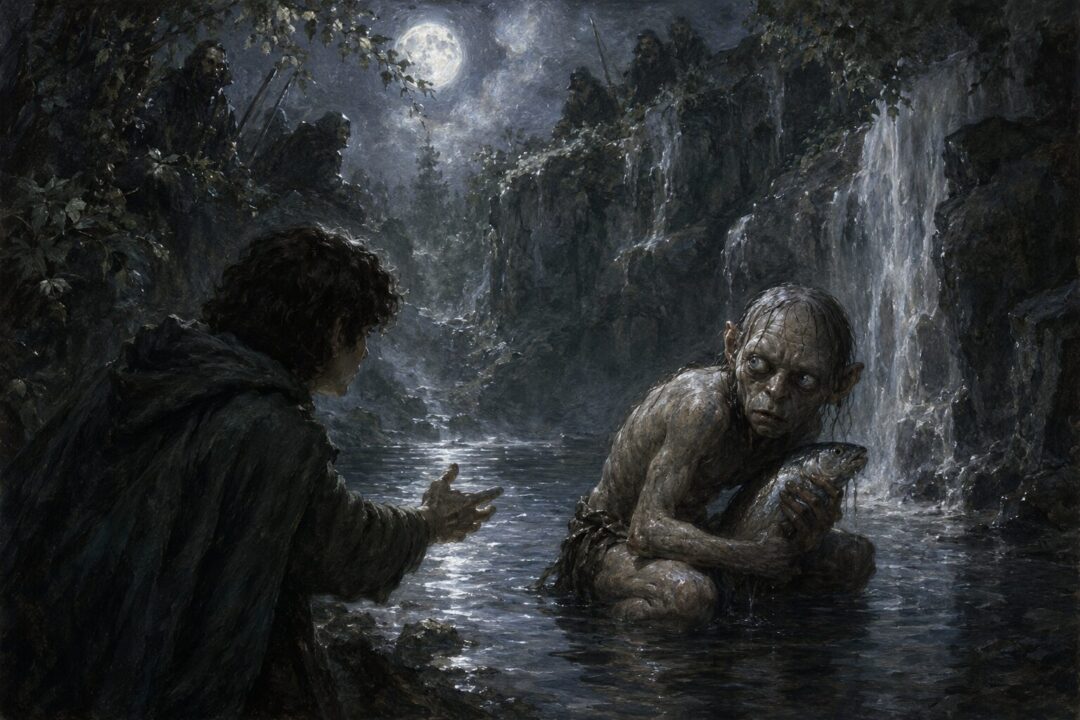
The Ring Turns Service Into Torment
For a time, Gollum does keep the promise in a limited but meaningful way. He guides Frodo and Sam through perilous country. Frodo later says that Gollum has had chances to harm them and has not done so. This matters. Gollum is not pretending every second. The texts leave room for a real, damaged struggle inside him.
But every step toward Mordor also brings the Ring closer to the fire. To Frodo, that is the goal. To Sauron, it is the one possibility he has not seriously imagined. To Gollum, it is unbearable.
This is why the promise becomes psychological torture. If Gollum serves Frodo faithfully, he helps carry the Ring toward its destruction. If he betrays Frodo, he breaks an oath sworn by the thing he most fears and loves. He is trapped between two forms of loss: losing the Ring by obedience, or losing himself by treachery.
And because the Ring is treacherous, the words themselves become slippery. Gollum wants to keep the Ring from “Him” — from Sauron. That part of the oath can almost sound loyal to Frodo. But Gollum’s deepest idea of “saving” the Precious is not destroying it. It is recovering it. His service can therefore bend, step by step, toward betrayal while still pretending to itself that it is protecting the Precious from Sauron.
That is how corruption often works in Middle-earth. It does not always make someone say, “I choose evil.” More often, it teaches a person to rename selfishness as necessity.
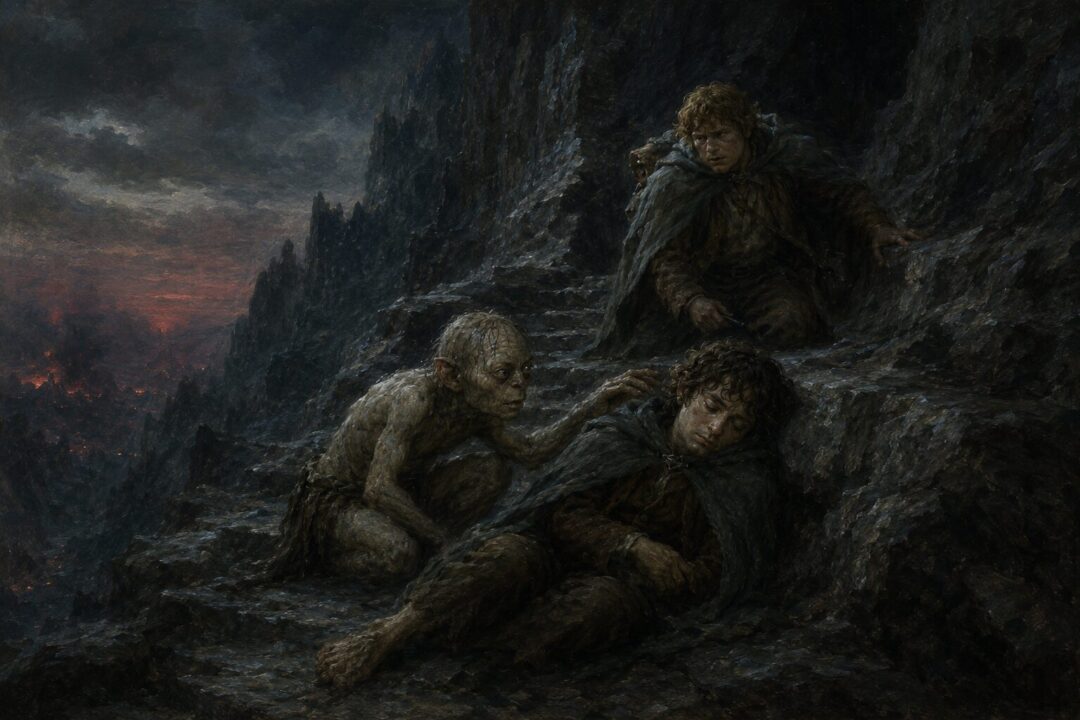
The Forbidden Pool Breaks the Fragile Thread
The promise might still have had another ending. At Henneth Annûn, Gollum is discovered in the Forbidden Pool, where Faramir’s men have the right, by their law of secrecy, to kill trespassers. Frodo intervenes and saves him, but he must also lure him out so the Rangers can capture him. Gollum experiences this as betrayal, even though Frodo is trying to preserve his life.
This scene is painful because both things are true. Frodo saves Gollum from death. Gollum feels deceived. Mercy reaches him, but it reaches him through a wound.
After this, Faramir warns Frodo that Gollum’s intended route, Cirith Ungol, is a place of great evil and that the guide cannot be trusted. The warning is justified. Gollum later leads the hobbits toward Shelob, hoping that she will destroy them and leave the Ring for him.
Yet even here the story refuses to make Gollum simple. On the stairs of Cirith Ungol, when Frodo is asleep, Gollum nearly repents. The moment is fragile, almost silent. He sees Frodo not merely as prey or master, but as something that touches the remains of Sméagol. Then Sam wakes and speaks harshly, and that possibility collapses.
A later letter describes Sam’s failure to perceive the change in Gollum as the story’s “most tragic moment,” because it blighted the possibility of repentance and helped set the Shelob betrayal in motion. That does not make Sam evil; he is exhausted, loyal, suspicious, and often right about danger. But it shows how narrow the road of mercy had become.
Frodo’s Command and the Shape of Doom
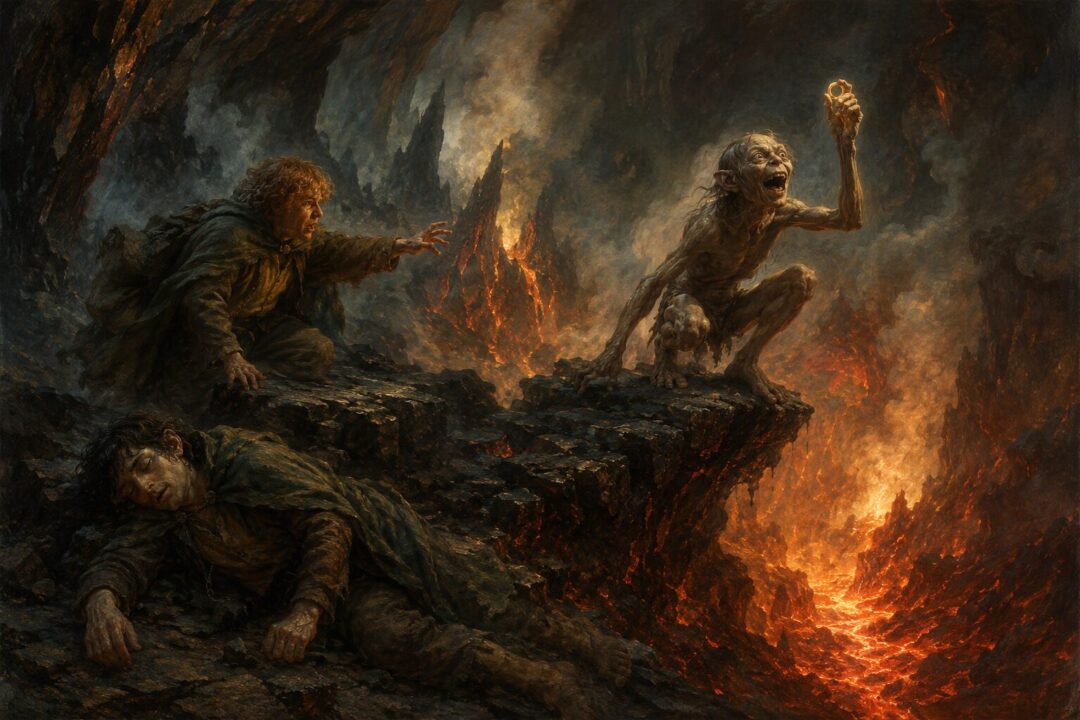
The oath’s darkest echo comes on Mount Doom. Frodo, at the edge of his endurance, warns Gollum that if he touches him again, he will be cast into the Fire of Doom. Later, inside the Sammath Naur, Frodo claims the Ring for himself. Gollum attacks, seizes the Ring by violence, and falls with it into the fire.
The text does not explain this as a simple magical contract with mechanical rules. A conservative reading should avoid saying, with certainty, that the Ring “executed” Frodo’s earlier command like a spell. But the pattern is too strong to ignore. Frodo warned that the Precious would hold Gollum and twist the promise to his undoing. Frodo warned that Gollum’s desire might betray him to a bitter end. At Mount Doom, Gollum’s desire does exactly that.
The trap closes because Gollum gets what he wants in the only place where getting it destroys him. He recovers the Precious, but only at the edge of the Crack. He keeps it from Sauron, but not by saving it. He breaks faith with Frodo, yet his betrayal completes the quest Frodo can no longer complete by will.
This is one of the great ironies of the Ring. Its corruption creates the conditions for its own destruction. Gollum’s oath does not redeem him in a clean, heroic way. It binds his hunger to the story’s final mercy and final judgment.
The Trap Was Also the Last Door
The promise by the Precious became a trap because it placed Gollum under three powers at once: Frodo’s mercy, the Ring’s treachery, and his own divided will. Frodo’s mercy gave him a chance to serve. The Ring’s treachery twisted that service. Gollum’s desire turned every chance toward possession.
And yet the trap was also the last door through which hope entered Mordor.
Frodo could not destroy the Ring voluntarily at the end. A later explanation of the quest emphasizes that Frodo had reached the limit of endurance and that the final success came through grace and through the consequences of earlier mercy, especially the sparing of Gollum.
That is why Gollum’s promise matters so much. It is not a side detail. It is the hidden knot in the last movement of the story. The oath keeps Gollum near Frodo long enough to guide him, betray him, follow him, attack him, and finally take the Ring at the one place where taking it means losing it forever.
Gollum swore by the Precious because it was the only thing he truly revered. But the Precious was never a safe witness. It was a devouring power, and in the end it devoured the oath, the oath-breaker, and itself.
The tragedy is that Sméagol’s promise might have been a path back. The terror is that, sworn by the Ring, it became a noose.
Sources & Notes
- J.R.R. Tolkien, The Two Towers, Book IV, Chapter 1, The Taming of Smeagol. https://tolkiengateway.net/wiki/The_Taming_of_Sm%C3%A9agol
- Tolkien Gateway character overview for Gollum. https://tolkiengateway.net/wiki/Gollum
- Tolkien Gateway overview of the One Ring. https://tolkiengateway.net/wiki/One_Ring
Sources added.